If I’m honest with myself, I don’t really need access to an off-grid, fault-tolerant, mesh network like Meshtastic. The weather here in New Jersey isn’t quite so dynamic that there’s any great chance the local infrastructure will be knocked offline, and while I do value my privacy as much as any other self-respecting hacker, there’s nothing in my chats that’s sensitive enough that it needs to be done off the Internet.
But damn it, do I want it. The idea that everyday citizens of all walks of life are organizing and building out their own communications network with DIY hardware and open source software is incredibly exciting to me. It’s like the best parts of a cyberpunk novel, without all the cybernetic implants, pollution, and over-reaching megacorps. Well, we’ve got those last two, but you know what I mean.

Meshtastic maps are never exhaustive, but this gives an idea of node density in Philly versus surrounding area.
Even though I found the Meshtastic concept appealing, my seemingly infinite backlog of projects kept me from getting involved until relatively recently. It wasn’t until I got my hands on the Hacker Pager that my passing interest turned into a full blown obsession. But it’s perhaps not for the reason you might think. Traveling around to different East Coast events with the device in my bag, it would happily chirp away when within range of Philadelphia or New York, but then fall silent again once I got home. While I’d get the occasional notification of a nearby node, my area had nothing like the robust and active mesh networks found in those cities.
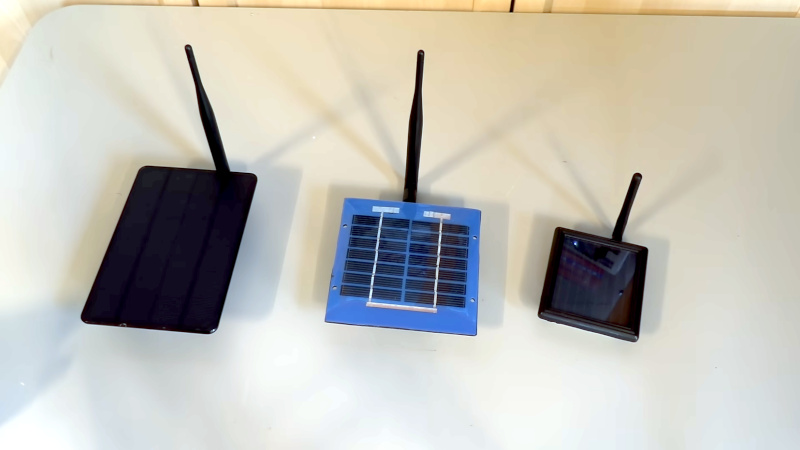
Well, they say you should be the change you want to see in the world, so I decided to do something about it. Obviously I wouldn’t be able to build up an entire network by myself, but I figured that if I started standing up some nodes, others might notice and follow suit. It was around this time that Seeed Studio introduced the SenseCAP Solar node, which looked like a good way to get started. So I bought two of them with the idea of putting one on my house and the other on my parent’s place down the shore.
The results weren’t quite what I expected, but it’s certainly been an interesting experience so far, and today I’m even more eager to build up the mesh than I was in the beginning.
Starting on Easy Mode
I didn’t make a conscious decision to start my experiment at my parent’s house. Indeed, located some 60 miles (96 km) from where I live, any progress in building out a mesh network over there wouldn’t benefit me back home. But it was the beginning of summer, they have a pool, and my daughters love to swim. As such, we spent nearly every weekend there which gave me plenty of time to tinker.
For those unfamiliar with New Jersey’s Southern Shore area, the coastline itself is dotted with vacation spots such as Wildwood, Atlantic City, and Long Beach Island. This is where the tourists go to enjoy the beaches, boardwalks, cotton candy, and expensive rental homes. But move slightly inland, and you’ll find a marshland permeated with a vast network of bays, creeks, and tributaries. For each body of water large enough to get a boat through, you’ll find a small town or even an unincorporated community that in the early 1900s would have been bustling with oyster houses and hunting shacks, but today might only be notable for having their own Wawa.

To infinity, and beyond.
My parents are in one of those towns that doesn’t have a Wawa. Its very quiet, the skies are dark, and there’s not much more than marsh and water all around. So when I ran the SenseCAP Solar up their 20 foot (6 m) flagpole, which in a former life was actually the mast from a sailing catamaran, the results were extremely impressive.
I hadn’t had the radio up for more than a few hours before my phone pinged with a message. We chatted back and forth a bit, and I found that my new mesh friend was an amateur radio operator living on Long Beach Island, and that he too had just recently started experimenting with Meshtastic. He was also, incidentally, a fan of Hackaday. (Hi, Leon!) He mentioned that his setup was no more advanced than an ESP32 dev board sitting in his window, and yet we were reliably communicating at a range of approximately 6 miles (9 km).
Encouraged, I decided to leave the radio online all night. In the morning, I was shocked to find it had picked up more than a dozen new nodes. Incredibly, it was even able to sniff out a few nodes that I recognized from Philadelphia, 50 miles (80 km) to the west. I started to wonder if it was possible that I might actually be able to reach my own home, potentially establishing a link clear across the state.
Later that day, somebody on an airplane fired off a few messages on the way out of Philadelphia International Airport. Seeing the messages was exciting enough, but through the magic of mesh networking, it allowed my node to temporarily see networks at an even greater distance. I picked up one node that was more than 100 miles (160 km) away in Aberdeen, Maryland.
I was exhilarated by these results, and eager to get back home and install the second SenseCAP Solar node installed. If these were the kind of results I was getting in the middle of nowhere, surely I’d make even more contacts in a dense urban area.
Reality Comes Crashing Home
You see, at this point I had convinced myself that the reason I wasn’t getting any results back at home was the relatively meager antenna built into the Hacker Pager. Now that I had a proper node with an antenna bigger than my pinkie finger, I was sure I’d get better results. Especially since I’d be placing the radio even higher this time — with a military surplus fiberglass mast clamped into the old TV antenna mount on my three story house, the node would be around 40 feet (12 m) above the ground.

The mast gets my node above the neighbor’s roofs, but just barely.
But when I opened the Meshtastic app the day after getting my home node installed, I was greeted with….nothing. Not a single node was detected in a 24 hour period. This seemed very odd given my experience down the shore, but I brushed it off. After all, Meshtastic nodes only occasionally announce their presence when they aren’t actively transmitting.
Undaunted, I made plans with a nearby friend to install a node at his place. His home is just 1.2 miles (1.9 km) from mine, and given the 6 mile (9 km) contact I had made down the shore, it seemed like this would be an easy first leg of our fledgling network.
Yet when we stood up a temporary node in his front yard, messages between it and my house were only occasionally making it through. Worse, the signal strength displayed in the application was abysmal. It was clear that, even at such a short range, an intermediary node would be necessary to get our homes reliably connected.
At this point, I was feeling pretty dejected. The incredible results I got when using Meshtastic in the sticks had clearly given me a false sense of what the technology was capable of in an urban environment. To make matters even worse, some further investigation found that my house was about the worst possible place to try and mount a node.
For one thing, until I bothered to look it up, I never realized my house was located in a small valley. According to online line-of-sight tools, I’m essentially at the bottom of a bowl. As if that wasn’t bad enough, I noted that the Meshtastic application was showing an inordinate number of bad packets. After consulting with those more experienced with the project, I now know this to be an indicator of a noisy RF environment. Which may also explain the exceptionally poor reception I get when trying to fly my FPV drone around the neighborhood, but that’s a story for another day.
A More Pragmatic Approach
While I was disappointed that I couldn’t replicate my seaside Meshtastic successes at home, I’m not discouraged. I’ve learned a great deal about the technology, especially its limitations. Besides, the solution is simple enough — we need more nodes, and so the campaign to get nearby friends and family interested in the project has begun. We’ve already found another person in a geographically strategic position who’s willing to host a node on their roof, and as I write this a third Seeed SenseCAP Solar sits ready for installation.
 At the same time, the performance of Meshtastic in a more rural setting has inspired me to push further in that region. I’m in the process of designing a custom node specifically tailored for the harsh marine environment, and have identified several potential locations where I can deploy them in the Spring. With just a handful of well-placed nodes, I believe it should be possible to cover literally hundreds of square miles.
I’m now fighting a battle on two fronts, but thankfully, I’m not alone. In the months since I’ve started this project, I’ve noticed a steady uptick in the number of detected nodes. Even here at home, I’ve finally started to pick up some chatter from nearby nodes. There’s no denying it, the mesh is growing everyday.
My advice to anyone looking to get into Meshtastic is simple. Whether you’re in the boonies, or stuck in the middle of a metropolis, pick up some compatible hardware, mount it as high as you can manage, and wait. It might not happen overnight, but eventually your device is going to ping with that first message — and that’s when the real obsession starts.
From Blog – Hackaday via this RSS feed