Art
620 readers
265 users here now
THE Lemmy community for visual arts. Paintings, sculptures, photography, architecture are all welcome amongst others.
Rules:
- Follow instance rules.
- When possible, mention artist and title.
- AI posts must be tagged as such.
- Original works are absolutely welcome. Oc tag would be appreciated.
- Conversations about the arts are just as welcome.
- Posts must be fine arts and not furry drawings and fan art.
founded 2 months ago
MODERATORS
1
Carefully signed by the artist with the place and date of execution, this drawing was likely made as an entry in an album amicorum, or friendship album—a collection of drawn and written tributes to an individual patron or associate. The nude woman holding the brushes, palette, mahlstick, and coat of arms of the Guild of Saint Luke is an unmistakable personification of the art of painting. The meaning of the devil breathing fire on her leg is less obvious, but it may allude to the idea that art itself can be a dangerous temptation.
Welcome to Visual Arts!
I have been posting in various art communities across Lemmy recently and I've wanted to have one on an instance that I love. From now on this is where I'll be making most of my posts and would love to see more people join in!
I'll be trying to add more and more links with my posts from now to show rbe source of information and offer you resources on where to find art. May even create a post dedicated to sources later.
Similarly the most common style of posts you'll see will include:
- Single image posts with a passage to explain them.
- Multi image posts to show themes within an artists oeuvre.
- Single image posts without explanatory text if I can't add much of value.
I'll also be cross posting a fair bit to make sure more and more people are exposed to art as that is my primary desire.
Hope you all enjoy.
Sincerely, SnokenKeekaGuard.

2
79


4


The Largest Active Hindu Temple in Southeast Asia
Many of the largest Hindu temples in history were not built in India, but in Southeast Asia.
Angkor Wat in Cambodia, for example, is the largest Hindu temple ever built. Similarly enormous Hindu temples would be erected at Pranambam in Java, and across Southern Vietnam.
Majapahit, a Hindu-Buddhist thalassocracy that reigned from 1292 to 1527, represented the height of Hindu civilization in the Malay archipelago.
Its decline, triggered by civil war and culminating in the invasion by the Sultanate of Demak, led to the rapid spread of Islam across Java.
The Temples of Besakih in Bali represent the moment that Hindu aristocrats began to move eastwards from Bali to remain under Hindu rule.
Today its the largest and most important Hindu temple in Southeast Asia thats still active
-Sam Dalrymple.


6
Janet Ternoff (American Artist, born 1985) "One and One", 2024. Oil on Canvas, 12" × 18". Private Collection.
I have a watering hole near home that look just like this.
Original post : https://bsky.app/profile/trahias.bsky.social/post/3mang4o5gvs2c

7
53
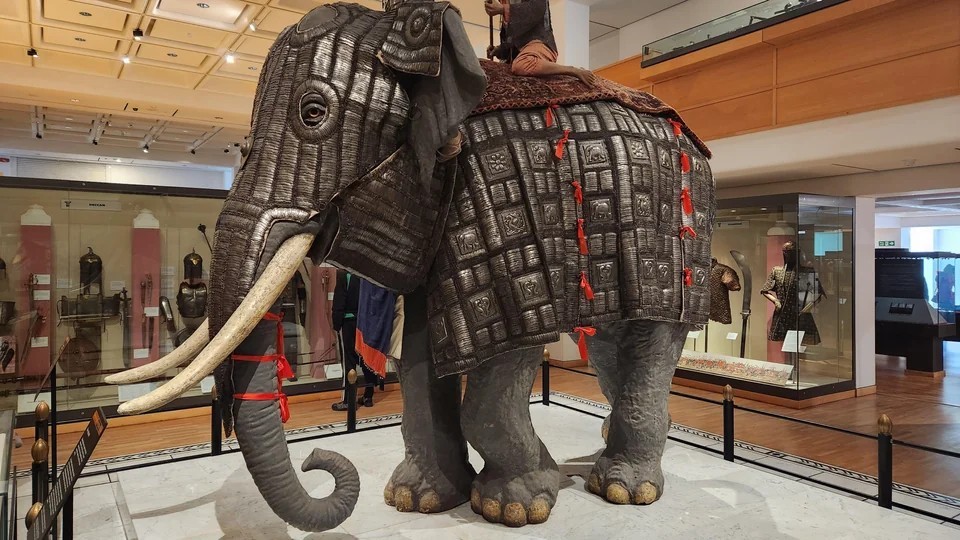
Allegedly, the only surviving war elephant armour in the world, made in India in the late 16th century, currently at Leeds Armouries.
(media.piefed.social)
cross-posted from: https://piefed.social/c/historyartifacts/p/1598705/allegedly-the-only-surviving-war-elephant-armour-in-the-world-made-in-india-in-the-late
https://royalarmouries.org/collection/object/object-1761
FUN FACT: The Toy Dolls were so moved, they recorded a loverly tribute song:


8
Long before Coca Cola advertising gave him a nice red and white hat, Father Christmas was actually a real Catholic Saint.
St Nicholas, or Nikolaos as he would have pronounced his name, was the the priest of Myra a town now in southern Turkey from 280-352AD.
The most famous story tells of him saving the daughters of a destitute nobleman in Patara from prostitution. Each night, before the nobleman is about to sell one of his daughters into prostitution, St Nick creeps up and throws a bag of gold into the house at midnight.
This happens three times, with three bags of St Nicholas’ gold being used to save three daughters from prostitution. This story sets the basis for much of the later Santa legend: “an arrival at night, bearing secret gifts to the young.”
He died on 6 December and was placed in a sarcophagus in Byzantine Lycia around 352AD. Soon after his death, a church was built in Myra in his honour.
The Basilica of St. Nicholas is one of the best preserved Early Byzantine churches in existence. The initial structure was an ancient East Roman basilica, constructed around AD 520, funded or supported by Emperor Justinian.
Myra was earlier a centre for Poseidon worship, and St Nicholas would subsequently take on many of the attributes of Poseidon, becoming a patron saint for sailors and the “deliverer of pilgrims to the Holy Land by Sea.”
His feast day, December 6th, is also speculated to have coincided with ancient pre-Christian festivals honoring Poseidon.
Bizzarely, the modern Santa myth would also adopt many aspects of the Norse cult of Odin.
-Sam Dalrymple.
A great historian with a great substack if anyone is interested.

9
21
This is the story of the Saint Thomas Cross, also known as the Mar Thoma Sleeva, one of the oldest Christian symbols found anywhere in the subcontinent.
(lemmy.dbzer0.com)
According to tradition, Thomas the Apostle arrived on the Malabar Coast in 52 AD, travelling along ancient maritime trade routes that connected India to the Persian Gulf. The communities he is believed to have founded came to be known as the Saint Thomas Christians or Nasranis.
And one of the most remarkable survivals of this early history is a granite cross discovered in 1547 at St. Thomas Mount in Chennai. Carved into hard charnockite stone, the cross bears inscriptions not in Latin or Greek, but in Pahlavi, a Middle Persian script used during the Sasanian Empire. This alone tells us something crucial. Indian Christianity was once deeply connected to the Persian Church of the East, long before European missionaries arrived.
The cross itself looks unlike what most of us associate with Christian imagery today. There is no body of Christ. Instead, the cross is empty, emphasising resurrection rather than suffering. It rises from a lotus flower, a powerful Indian symbol of purity and divinity, signalling how Christianity took root in local soil rather than replacing it. Above it descends a dove, representing the Holy Spirit, while floral arms and pearl-like buds speak of life, renewal, and the Tree of Life.
For centuries, the inscriptions puzzled scholars. It was only in the nineteenth century that they were identified as Pahlavi, linking the cross unmistakably to Persian Christian communities who travelled, traded, and settled along India’s coasts. One widely accepted reading even names the artisan or donor, a Persian Christian whose name survives only through this stone.
Local tradition also records something more mysterious. From the sixteenth to the early eighteenth century, the cross was believed to have “sweated blood” during moments of prayer and the Eucharist. Portuguese chroniclers documented these events, and the cross came to be known as the Miraculous Cross of Mylapore. Whether read as miracle or metaphor, these stories reveal the intense devotion surrounding the relic.
Sources drawn from epigraphic and archaeological studies of the Saint Thomas Crosses of South India.
- Shah Umair.


10
156
People forget how good Gustav Klimt was at painting landscapes. Especially his ability to paint water, woven with light…
(lemmy.dbzer0.com)
Do you guys like these micro posts where i post a very specific theme from an artist or movement or my macro posts where I show the limits of a movement more? Want to gauge interest.


11


You'll love this @johnnyenzyme@piefed.social

12

13

14


19
55
Oswald Spengler had a fascinating take on art, and why western art is (in his view) in terminal decline.
(lemmy.dbzer0.com)
For all cultures, the first true art form is architecture. For Western culture, the upward-reaching cathedrals of the Middle Ages were inspired by the forests of Northern Europe.
The prime symbol of Western culture is the perception of infinite space — a yearning to reach out of the darkness of the trees to the light beyond.
Architecture is the most immediate expression of a culture's "world-feeling," and all other art forms then spring out from it.
Notice how sculptures of saints were originally attached to the churches, but later stepped out of the architecture to stand on their own feet.
Likewise, fresco paintings became detached from the walls as standalone oil paintings, and even classical music came from Gregorian chant, for which the cathedral was designed to carry and amplify.
Even western drama came from religious ceremonies (Spengler talks about how western drama is confessional in nature).
Spengler says this is because all art forms (and all non-natural expressions of life) originate from religion. They may separate themselves physically from the church over time, but are still fundamentally tied to that metaphysical expression.
You cannot define individual art forms because they all blend into each other. Sculpture, painting, and music are merely words, and they are nothing without the prime urge that created them. This is why to define what art is you have to extract the cultural form, or the "inner form-language".
The artists of the present (in the Western culture) aren't really engaged in "art" at all, but merely a kind of craftsmanship. Today’s art lacks the spontaneity and necessity of the word-feeling that birthed the culture’s artistic expression, and this is a natural evolution of all civilizations:
"Of great painting or great music there can no longer be, for Western people, any question. Their architectural possibilities have been exhausted these hundred years. Only extensive possibilities are left to them."

20
This is art goddammit and I'll fight anyone who'd dare disagree.

21
https://open.substack.com/pub/friedrichfaust/p/the-artistic-demise?r=1wlet9
I wrote a bit about this myself. Give it a go if you've got 3 mins to spare.

22
58

23


The roots of Classical Greece lie in the Geometric period of about ca. 900 to 700 B.C., a time of dramatic transformation that led to the establishment of primary Greek institutions. The Greek city-state (polis) was formed, the Greek alphabet was developed, and new opportunities for trade and colonization were realized in cities founded along the coast of Asia Minor, in southern Italy, and in Sicily. With the development of the Greek city-states came the construction of large temples and sanctuaries dedicated to patron deities, which signaled the rise of state religion. Each polis identified with its own legendary hero. By the end of the eighth century B.C., the Greeks had founded a number of major Panhellenic sanctuaries dedicated to the Olympian gods.
Geometric Greece experienced a cultural revival of its historical past through epic poetry and the visual arts. The eighth century B.C. was the time of Homer, whose epic poems describe the Greek campaign against Troy (the Iliad) and the subsequent adventures of Odysseus on his return to Ithaca (the Odyssey). A newly emerging aristocracy distinguished itself with material wealth and through references to the Homeric past. Their graves were furnished with metal objects, innately precious by the scarcity of copper, tin, and gold deposits in Greece.
Evidence for the Geometric culture has come down to us in the form of epic poetry, artistic representation, and the archaeological record. From Hesiod (Erga 639–40), we assume that most eighth-century B.C. Greeks lived off the land. The epic poet describes the difficult life of the Geometric farmer. There are, however, few archaeological remains that describe everyday life during this period. Monumental kraters, originally used as grave markers, depict funerary rituals and heroic warriors. The presence of fine metalwork attests to prosperity and trade. In the earlier Geometric period, these objects, weapons, fibulae, and jewelry are found in graves—most likely relating to the status of the deceased. By the late eighth century B.C., however, the majority of metal objects are small bronze figurines—votive offerings associated with sanctuaries.
Votive offerings of bronze and terracotta, and painted scenes on monumental vessels attest to a renewed interest in figural imagery that focuses on funerary rituals and the heroic world of aristocratic warriors and their equipment. The armed warrior, the chariot, and the horse are the most familiar symbols of the Geometric period. Iconographically, Geometric images are difficult to interpret due to the lack of inscriptions and the scarcity of identifying attributes. There can be little doubt, however, that many of the principal characters and stories of Greek mythology already existed, and that they simply had not yet received explicit visual form.
Surviving material shows a mastery of the major media—turning, decorating, and firing terracotta vases; casting and cold-working bronze; engraving gems; and working gold. The only significant medium that had not yet evolved was that of monumental stone sculpture—large-scale cult images most likely were constructed of a perishable material such as wood. Instead, powerful bronze figurines and monumental clay vases manifest the clarity and order that are, perhaps, the most salient characteristics of Greek art.
The met.

24
The clarity and elegance of form in Greek Geometric art is as effective in three-dimensional sculpture as it is in vase painting. Small-scale bronzes, such as this horse, were produced in workshops throughout the Greek mainland and represent the most innovative sculptural achievements of the period.
This solid-cast bronze horse, probably made in Corinth, exemplifies Geometric art at its best. The flat parts of the neck and legs are carefully integrated with the cylindrical muzzle and body of the animal. The base, articulated with triangular patterns suggesting a rocky terrain, further contributes a sense of volume and lends definition to the space occupied by the figure. Decorated base-plates—with perforated or relief geometric patterns—are typical of such statuettes during the later part of the eighth century BCE. This feature served as a stand but might also have been used as some kind of early stamp or seal.
All over the Greek world, Geometric bronze horse statuettes as this one have been found at sanctuaries in great quantities, where they were deposited as votive offerings to the gods. Though other animals, and more rarely humans, were also represented, horses largely outnumber all other types of solid cast statuettes. Ownership of horses was a status symbol for aristocrats, who used these animals in warfare and in the competitive sphere of horse and chariot races, often held at sanctuaries.
The met.

25
11


Surmounted by a portrait statuette of a philosopher. This statuette is a reduced copy of a Hellenistic original of the III century B.C.
The met.

view more: next ›