Drop Site News

25 readers
1 users here now

Independent news on politics and war

founded 5 months ago
MODERATORS
1


Speakers at this month’s weapons conference in Tel Aviv. Source: DefenseTech-Week.com

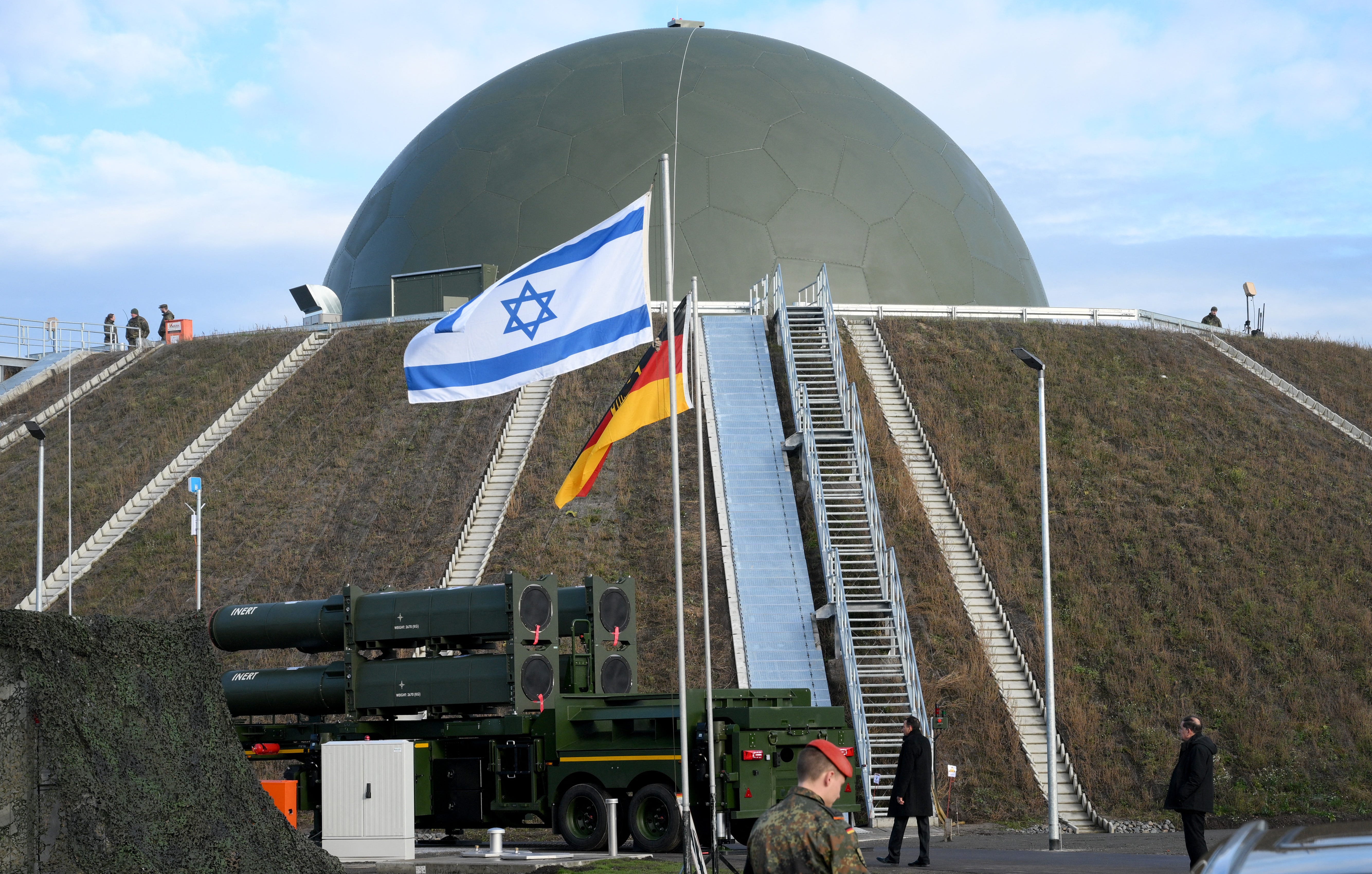
At a recent military technology conference in Tel Aviv, Israeli weapons companies made some of their most explicit remarks yet connecting the value of their products to the real-world testing of that firepower on Palestinians in Gaza. A recording of the conference remarks was obtained by Drop Site News and includes comments from the president and CEO of the Israel Aerospace Industries as well as executives at Elbit Systems, RAFAEL Advanced Defense Systems, and others. The conference was called DefenseTech Week and was held in early December. Drop Site shared the audio with independent news outlets in Brazil, Ireland, Australia, and elsewhere; those outlets will be producing their own investigations.

The Israeli weapons industry has previously come in for criticism for its willingness to boast that its products are “lab tested” on human beings under occupation, most prominently by Australian journalist Anthony Lowenstein. His book, The Palestine Laboratory, was adapted into a Drop Site podcast last year.

The newly uncovered remarks suggest that, rather than having been chastened by global condemnation for the genocide in Gaza, the nation’s weapons industry is emboldened by it. “The war that we faced in the last two years enables most of our products to become valid for the rest of the world,” boasted Boaz Levy, head of Israel Aerospace Industries (IAI), on day one of the conference. “Starting with Gaza and moving on to Iran and to Yemen, I would say that many, many products of IAI were there.”

The military itself was well represented at the gathering. Major General (Res.) Amir Baram is director general of the Israel Ministry of Defense and also gave remarks on the first day. “These are not lab projects or powerpoint concepts,” he said. “They are combat proven systems. This is what defense tech means in Israel and this has redefined Israel’s global identity. For years, Israel was known worldwide as a cyber nation. Today, we have evolved into a true defense tech nation.”

Gili Drob-Heistein, executive director of the Blavatnik Interdisciplinary Cyber Research Center, said that the two years of unleashing Israeli weapons technology on Palestinians had helped transition Israel from a “startup nation” to a global player in the defense industry. “Israel is known for being the startup nation and we all believe that defense tech has the potential to become the next big economic engine for Israel and beyond,” he said. “Israel’s technological leadership combined with smartness, boldness, and out of the box thinking continues to yield astonishing results, as we’ve seen recently on the battlefield during a war that was forced upon us on multiple different fronts simultaneously. Many of the technologies have both military and civilian applications.”

Data on global arms sales suggests the boasting at the conference reflects genuine upward trends for Israel’s weapons industry, with three Israeli arms companies increasing their combined weapons revenues by 16 per cent to $16.2 billion, according to the Stockholm International Peace Research Institute (SIPRI). “The growing backlash over Israel’s actions in Gaza seems to have had little impact on interest in Israeli weapons,” said Zubaida Karim, researcher with the SIPRI Military Expenditure and Arms Production Programme.

Elbit Systems, the Israel weapons company that reportedly signed a multi-billion deal with the United Arab Emirates, was also heavily represented at the conference. Executive Vice President Yehoshua Yehuda boasted of “combat proven technologies” that allowed people to be struck even when “the targets are less than a pixel.”

The UAE is financing and arming the Rapid Support Forces in Sudan, a militant group carrying out a campaign of mass slaughter that is on track to eclipse the genocide in Gaza if it hasn’t already.

Israeli weapons are playing an increasing role in global conflict, Levy told the audience. “Eighty percent of our activity is really for export—only 20 percent of our activity goes to the Israeli market,” he said. “I think that all of the things that we learned during this war in Israel impacts our future business capabilities. And IAI as of now has $27 billion of new orders and has something like $7 billion of sales every year.”

At the same time, the weapons makers did acknowledge that a growing boycott was a threat to their business. “I think Israel is experiencing a boycott,” said Shlomo Toaff, executive vice president of the General Manager Air & Missile Defense Systems Division of RAFAEL Advanced Defense Systems Ltd. “We’ve seen it in the Paris air show last June where we were shut down by the French.”

“This is something that we have to take into account when we’re talking about what we’re doing here in the industry,” he said.


From Drop Site News via this RSS feed

2


Drop Site is a reader-funded, independent news outlet. Without your support, we can’t operate. Please consider making a 501(c)(3) tax-deductible donation today.

Israel is currently maintaining 48 military outposts east of the yellow line. Image by Forensic Architecture.

Since the so-called ceasefire came into effect in Gaza on October 10, Israel has been consolidating its control of over 50% of Gaza and—according to new research by Forensic Architecture—physically altering the geography of the land. Through a combination of the construction of military infrastructure alongside the destruction of existing buildings, Israel appears to be laying the groundwork to establish a permanent presence in the majority of the Gaza Strip.

Israel has constructed at least 13 new military outposts inside Gaza since the ceasefire—primarily located along the yellow line, in eastern Khan Younis, and near the border with Israel, according to analysis of satellite imagery by Forensic Architecture.

“Israel is doing what it always does, and what it historically has done best: establish ‘facts on the ground,’ incrementally rather than spectacularly, and make them permanent once those with influence to force it to reverse course either lose interest, decide that the cost of confronting Israel is not worth the price, or come out in open support of Israeli violations. Israel is in no rush and prepared to play the long game,” Mouin Rabbani, co-editor of Jadaliyya and a former UN official who worked as a senior analyst on Israel-Palestine for the International Crisis Group, told Drop Site after reviewing a summary of the Forensic Architecture findings.

The analysis also shows that, between October 10 and December 2, 2025, Israel has:

Accelerated the growth and infrastructure development of 48 existing military outposts inside Gaza.

Expanded a network of roads connecting military outposts inside Gaza to the Israeli road network, bases and settlements outside of Gaza.

Continued construction that began in September 2025 of a new road in Khan Younis, re-routing the Magen Oz corridor to run within Israel’s area of control.

Engaged in the systematic demolition and destruction of Palestinian property, particularly in eastern Khan Younis, targeting areas which haven’t already been destroyed. New military outposts and roads have emerged across this area.

“Augmenting multiple Israeli statements about extending its borders with buffer zones to the north, east, and south, this is indisputably an Israeli campaign to partition the Gaza Strip and thereby promote its long-term objective of moving the Palestinian population elsewhere,” Rabbani said. “At the same time, Israeli success is not a foregone conclusion. If it was, the Palestinian population of the Gaza Strip would have been ethnically cleansed years if not decades ago.”

As part of the initial phase of the ceasefire agreement, the Israeli military partially withdrew to what became known as the “yellow line,” with over half of Gaza under continued Israeli control. The term comes from a map that was distributed in late September as part of President Donald Trump’s 20-point ceasefire plan that depicted a phased withdrawal of Israeli troops, to an initial yellow line, followed by another withdrawal, until an eventual pullback to a “buffer zone” running inside Gaza along the border with Israel.

The original withdrawal map according to President Trump’s 20-point Gaza plan.

Trump then posted a new map showing the initial withdrawal line that left Israel in control of 58% of Gaza. After the ceasefire came into effect, an Israeli military spokesperson posted yet another map with the yellow line showing Israel in control of 53% of Gaza.

Since the ceasefire, Israel has seized more land by physically placing at least 27 yellow blocks (delineating its area of control) west of the yellow line marked in Israel’s own maps.

Point 16 of Trump’s 20-point plan explicitly states, “Israel will not occupy or annex Gaza. As the [International Stabilization Force (ISF)] establishes control and stability, the Israel Defense Forces (IDF) will withdraw based on standards, milestones, and timeframes linked to demilitarization.” It goes on to say, “Practically, the IDF will progressively hand over the Gaza territory it occupies to the ISF according to an agreement they will make with the transitional authority until they are withdrawn completely from Gaza, save for a security perimeter presence.”

While the “standards, milestones, and timeframes” around Israel’s withdrawal have been highly contentious, they are nevertheless the principal subject of ongoing negotiations. However, the analysis by Forensic Architecture clearly shows that Israel is consolidating its military presence on the ground east of the yellow line in a way that suggests no intention of a further withdrawal.

These findings come as the Trump administration is reportedly planning the construction of a number of residential compounds, dubbed “Alternative Safe Communities,” in areas east of the yellow line to provide housing to tens of thousands of Palestinians, with no construction allowed on the west side, that appear to be part of a plan to entrench the partition of Gaza and allow for permanent Israeli control over more than half of the enclave.

The Full Forensic Architecture Analysis

Israel’s network of military infrastructure

Within Gaza, Israel is currently maintaining 48 military outposts east of the yellow line. The outposts are connected to a network of roads which have been created, expanded or appropriated by the Israeli military. In turn, these link to Israeli bases, roads, and settlements outside of Gaza.

New Israeli military outposts

Since the ceasefire came into effect, Forensic Architecture observed three changes to Israeli military outposts east of the ‘yellow line’:

  1. An increase in the number of outposts in locations strategic for occupation.

  2. The expansion of outposts.

  3. The development of outpost infrastructure.

Forensic Architecture documented 13 new outposts since the ceasefire. They are primarily located along the ‘yellow line’, in east Khan Younis, and near Gaza’s border.

Case study: New military outpost in Jabaliya

At a new outpost in Jabaliya, a densely populated tent area was dismantled, and Israel demolished the surrounding buildings. In their place, Israel carved a road, built berms, and constructed buildings on the outpost. The largest berms measure 75 by 65 meters.

The outpost was constructed on high ground, and is visible on 26 November in a ground-level photograph taken from the west side of the ‘yellow line’, where Palestinians have been forcibly displaced to. The two areas are separated by a strip of destruction. From this vantage point, you can see the berms making up the outpost, with lights atop them, and the vehicles likely used to construct the outpost.

Photograph taken on 26 November 2025 in Jabaliya, west of the 'yellow line', looking towards an Israeli military outpost east of the 'yellow line. Source: @mahmoud__abusalama

Israel is rerouting existing military infrastructure to fall within its area of control

In mid-July 2025, the Israeli military announced the completion of the Magen Oz corridor, a 15-kilometer military road separating the city of Khan Younis into its eastern and western parts. Since September, Israel has been constructing a new road in Khan Younis, re-routing the Magen Oz corridor to run within its area of control.

Destruction in east Khan Younis

Military expansion is occurring alongside continued destruction east of the ‘yellow line’.

The largest body of land under Israel’s control is in the south of Gaza, and includes Rafah and eastern Khan Younis, which remains densely packed with private property. Here, since the ceasefire, Israel has been destroying buildings not previously destroyed, and constructed new military outposts and roads across the area.

Nearby, demolition vehicles (A) are visible on the border.

Military outpost in Khan Younis, on the border of Gaza, connected by road to a military crossing in which demolition and military vehicles are visible. 5 November 2025. Source: Planet Labs LBC.

For more detail, including additional maps and data, visit gaza.forensic-architecture.org/database or forensic-architecture.org/location/palestine

Leave a comment

Subscribe now


From Drop Site News via this RSS feed

3


We have a commitment to ensuring that our journalism is not locked behind a paywall. But the only way we can sustain this is through the voluntary support of our community of readers. If you are a free subscriber and you support our work, please consider upgrading to a paid subscription or gifting one to a friend or family member. You can also make a 501(c)(3) tax-deductible donation to support our work.

Make an End-of-Year Gift

Abdullahi’s gravesite near his home in Badhan. Photo: Mohamed Gabobe.

MOGADISHU—On September 13, Omar Abdullahi, a high-profile clan chief in Somalia’s Sanaag province, called his wife to tell her that he was on his way home from a nearby town, and to ask her to prepare dinner for the evening. Abdullahi was on the road back to Badhan, a remote town in the northeast of the country, returning to mediate a clan dispute, one of the responsibilities he held as a local community leader.

Abdullahi never reached home. On the drive back, his car was struck by three missiles fired by a drone overhead, incinerating his vehicle and killing him instantly. Only a piece of his stomach remained in the burnt-out wreckage, according to a death certificate seen by Drop Site News.

The strike shocked residents of Badhan and members of the Warsangeli clan that he hailed from. They had largely avoided the U.S.’s two-decade shadow war against the Al Qaeda-linked group al-Shabaab, and the Islamic State. Abdullahi himself was a prominent local elder, who residents and local government officials said was widely known and respected in the region.

Three months later, Asha Abdi Mohamed, Abdullahi’s mother, told Drop Site that she lives with the trauma of his killing. “I always have flashbacks of him being burned in a car. That is why I’m scared to sleep at night,” she said. “The soil under my feet was moving when I found out it was Omar who was killed.” Mohamed said that the drones continue to fly near Badhan; adding that she quietly prays for them to fall from the sky in order to be at ease.

Drop Site depends on readers like you.

Hawa Ahmed Ali, his wife, was waiting for him when Abdullahi’s sister suddenly arrived with the news that a vehicle had been hit on the road that he was traveling. She recalled that it was raining that day, a rare occurrence in Somalia’s harsh climate. “I didn’t want to believe it because I’m aware that other cars also travel on or use the same roadways,” his widow said.

Four days after the strike, the U.S. military’s Africa Command (AFRICOM) claimed responsibility for Abdullahi’s killing. AFRICOM claimed that it had acted in concert with the Somali government in killing what it described as an al-Shabaab arms dealer, adding that “specific details about units and assets will not be released to ensure continued operations security.”

Although the region, adjacent the Gulf of Aden, is a key smuggling route for weapons entering Somalia from the Middle East, interviews with local residents in Badhan and Somali government officials contradict claims that Abdillahi was an al-Shabaab operative or weapons dealer.

Omar Abdillahi Ashur is a commander of the Daraawish force, a specially-trained regional paramilitary unit that operates under the regional government in Sanaag. He knew Abdullahi since the 1970s, and said that he had in fact been a leader in fighting Somali Islamist groups in the area. “He was a backbone to resistance against terrorism,” Ashur said.

Somalia operates a federal system granting significant independence to its six member states, reflecting both the central government’s weakness and the strong local support many states command. Somaliland, in the northwest, though unrecognized, has declared independence. Puntland, one of the most autonomous Somali states, withdrew from the federal system in 2024 over election and constitutional disputes, and operates independently.

In the absence of strong state authority, respected elders like Abdullahi also play a vital role in local governance. Abdullahi rallied support against insurgents in Puntland over the years, and helped gather supplies for their government operations.

“His clan has suffered the most casualties in the fight against terrorism in this region,” Ashur said, citing battles against Somali Islamist group al-Itihaad al-Islamiya in the 1990s, and the deadly 2017 al-Shabaab attack on a Puntland base in Af-Urur that saw dozens of Warsangeli clansmen killed.

In November, Somalia’s outspoken defense minister, Ahmed Fiqi, said he would seek answers from AFRICOM about the killing of Abdullahi. Speaking in parliament, Fiqi said that although the intelligence that Somalia’s allies use for strikes is usually sound, there was no reason to kill Abdullahi, a public figure well known to authorities. “We could have called him and asked him questions,” Fiqi said. While Somalia has authorized allies such as the U.S. and UAE to support Puntland’s forces, he added, strikes in areas under its control are the responsibility of regional authorities.

Personal identification card for tribal leader Omar Abdullahi. Photo: Mohamed Gabobe.

Even al-Shabaab—the group Abdullahi was accused of belonging to—issued a statement denying he had ever been a member, saying U.S. allegations were used to cover up civilian casualties from the air campaign in Somalia.

In December, Puntland’s Police Force Criminal Investigation Department also released an official report into Abdullahi’s killing that contradicted the U.S. military’s claim that he was an al-Shabaab operative, a justification used for the strike. The issuance of the report pointed to unease within elements of the security establishment over the killing.

The report, which was submitted to both the Attorney General and Supreme Court of Puntland, found that Abdullahi had “no criminal record” and was not “under any investigation” by Puntland security or investigative agencies—explicitly challenging the U.S. assertion that the strike had killed an al-Shabaab operative.

AFRICOM did not respond to requests for comment about the report published by Puntland’s authorities.

“We Don’t Operate That Way”

The strike that killed Abdullahi comes amid an unprecedented escalation of the U.S. drone campaign targeting ISIS in northern Somalia, where the group is concentrated, and where al-Shabaab also has a small presence. Since his return to office, President Donald Trump has delegated authority to authorize strikes to AFRICOM commanders, which has increased their pace and aggressiveness. In comments to the Council of Foreign Relations just two weeks after Abdullahi was killed, Somali President Hassan Sheikh Mohamud welcomed the move as “effective,” adding that the number of U.S. military assets in Somali airspace had also risen. (Drop Site News also recently reported on an airstrike in Jamame, a town held by al-Shabaab in south-central Somalia, that killed 11 people, including seven children.)

The U.S. conducted only one airstrike against ISIS fighters in the country during all of 2024. But to date in 2025, more than 100 have been registered across the country, the majority against ISIS—almost double the 51 airstrikes former President Joe Biden authorized during his term. The scale of these operations was underscored in May when the USS Harry S. Truman and its strike group launched what the Navy’s top admiral, James Kilby, called the “largest airstrike in the history of the world”, dropping some 125,000 pounds of munitions on targets in Somalia.

Referring to the strike that killed Abdullahi, but speaking more broadly about the unprecedented escalation of strikes in the country, a police commander in Sanaag who spoke to Drop Site accused the U.S. of “testing weapons on Somalis.”

Abdullahi himself was well known to the Puntland government. Just days before the strike, he had been part of a delegation that met with Puntland’s president, Said Deni, at Bosaso airport, where the U.S. military maintains a presence. Said Ahmed Jama, the governor of Sanaag province, confirmed to Drop Site that Abdullahi was among those leading a delegation during a meeting that lasted about four days—an engagement Abdullahi’s brother, Ali, said focused on Puntland’s impending operation against al-Shabaab in the Calmadow mountains, which is home to Abdillahi’s Warsangeli clan. Puntland, Ali said, was seeking Abdullahi’s support given his role as a key regional powerbroker.

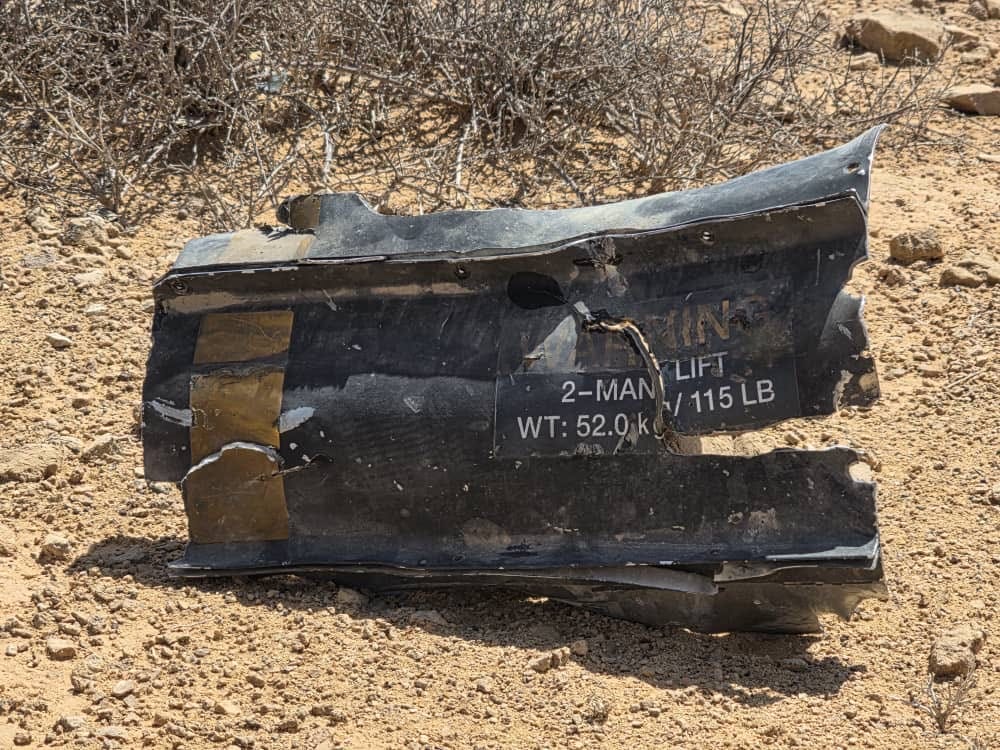
Missile fragments found at site of killing of Abdullahi. (Photo: Mohamed Gabobe)

The Puntland regional government did not respond to any questions about the strike.

Omar’s brother, Ali Abdullahi, added that if there had been allegations against him the U.S. and Somali authorities were more than capable of arresting him and putting him on trial instead of killing him while he was driving home. “The U.S. and their UAE allies all have a presence at Bosaso airport. He met President Deni six times inside the airport. He could have easily been arrested, but instead they [the Americans] decided to kill him.”

Puntland has not formally addressed the strike beyond the investigation by the security services, likely due to the sensitivity of U.S. security cooperation, though one senior official, speaking anonymously, distanced the administration from it. “We don’t operate that way,” the source told Drop Site.

“Still Searching for Answers”

Behind the escalation of the U.S. campaign against ISIS and al-Shabaab in Somalia lies a targeting process that multiple officials and analysts described as opaque and deeply flawed. Current and former Somali government officials who spoke to Drop Site said that once a target is identified, the U.S. requests permission to enter Somali airspace, and, when approved by federal authorities, drones can carry out a strike. Regional and federal Somali officials also often provide operational and other intelligence to support target acquisition, though U.S. officials have at times acted on their own intelligence as well.

One former senior Somali security source told Drop Site that, before Trump, the CIA coordinated with Somali officials and that the strikes ultimately had presidential oversight. The source said the process had more safeguards in the past, but that now the U.S. military was empowered to take the lead. “Military officials tend to be more gung-ho and mistakes are made.”

Samira Gaid, a Somali security expert with Balqiis Insights and former government security advisor, said that the standard practice was for Somali officials to receive “a call a maximum of an hour before a targeted strike” in which the defense minister would be asked to sign a letter approving the operation.

“Most of the time less,” she added, stating that the compressed timeframe made it difficult for Somali authorities to carry out their own assessments. “There is just an assumption that the U.S. knows best, that it has strong and accurate intel. But we know that that isn’t always the case.”

Adding to the impunity over civilian deaths in Somalia is a prior history of U.S. authorities downplaying civilian casualties from their operations, while rarely providing compensation for targeting mistakes. “The only time we see the U.S. admit to civilian casualties is when local elders make public outcry and when the media, and especially international media, catches on,” Gaid said.

Mursal Khaliif, a Somali MP and member of the US-Somalia Friendship Group in Parliament, was blunt in his assessment. “What is missing from the process of airstrikes, and how they’re carried out, is overall transparency and accountability,” he told Drop Site. “That needs to change.”

The problem, Gaid added, is that most strikes occur in areas controlled by al-Shabaab or other armed groups, making independent verification of their impact nearly impossible. “The onus then needs to be on the Somali government to check if these claims are correct because the strikes are usually behind the lines of al-Shabaab or areas that are inaccessible to partners.”

Governor Said Ahmed Jama told Drop Site that the strike has had lasting consequences for how U.S. operations in the region are perceived. “Everyone rose up and protested. Somalis both at home and in the diaspora condemned the American strike. We as the government officials, tribal elders are still searching for answers,” Jama said, visibly frustrated. The Warsangeli clan is demanding reparations from the U.S. following the attack.

Other security officials similarly believe that the U.S. drone strike that killed Omar Abdullahi has harmed perceptions of the U.S. among communities in the Sanaag region. “Everybody has their eyes on the skies. In the past, the war in Somalia was fought on the ground but now everyone’s attention is to the sky. It’s the new reality for many,” Darawish commander Omar Abdillahi Ashur told Drop Site News.

“These new realities can bring insecurity, lack of trust and ignite suspicion and resentment towards those involved in such activities,” he added.

Asha Abdi Mohamed, Abdullahi’s mother, said she continues to seek justice for her son. “The Americans admitted to killing him and we want answers for why they targeted our son and why they murdered him so brutally,” she said.

Her health has worsened since the strike, she said, and she struggles to sleep. “This was a peaceful region,” she added. “We never feared drones until they killed Omar.”

Leave a comment


From Drop Site News via this RSS feed

4


At least three killed in continued Israeli attacks on Gaza. A report from The Integrated Food Security Phase Classification (IPC) finds Gaza still facing starvation. UN warns impacts of Israeli restrictions on NGOs working in Palestine will be “immediate and catastrophic.” U.S. Special Envoy Steve Witkoff to meet with officials from Qatar, the United Arab Emirates, and Egypt on Friday. At least 18 people are killed in Gaza’s winter storms this week. Doctors Without Borders says restrictions on aid must be eased to save the lives of Gaza’s children. Israel’s Supreme Court denies a request to prevent the demolition of buildings in a West Bank refugee camp. Washington sanctions two International Criminal Court judges for advancing cases involving Israel. Feds report that they found the Brown gunman dead, and that he is likely responsible for the murder of an MIT professor as well. The Trump administration moves to suspend the U.S. Diversity Visa Lottery. Health and Human Services proposes rules limiting gender-affirming care for minors. Trump admin officials are planning a further crackdown on “left-wing terrorism.” Emails shed new light on Noam Chomsky’s relationship with Jeffrey Epstein. 16 people killed in RSF artillery bombardment of besieged city in Sudan’s Kordofan region. Saudi military readies for possible engagement with UAE-backed Yemeni separatists. French, U.S., and Saudis discuss disarming Hezbollah with the Lebanese Army. Egypt worries about its “red lines” in Sudan. UN report on earlier notorious RSF attack on displacement camp finds over 1,000 killed, 319 by summary execution. A Sudan expert says as many as 300,000 may have died in Darfur and that two-thirds of the country is food insecure.

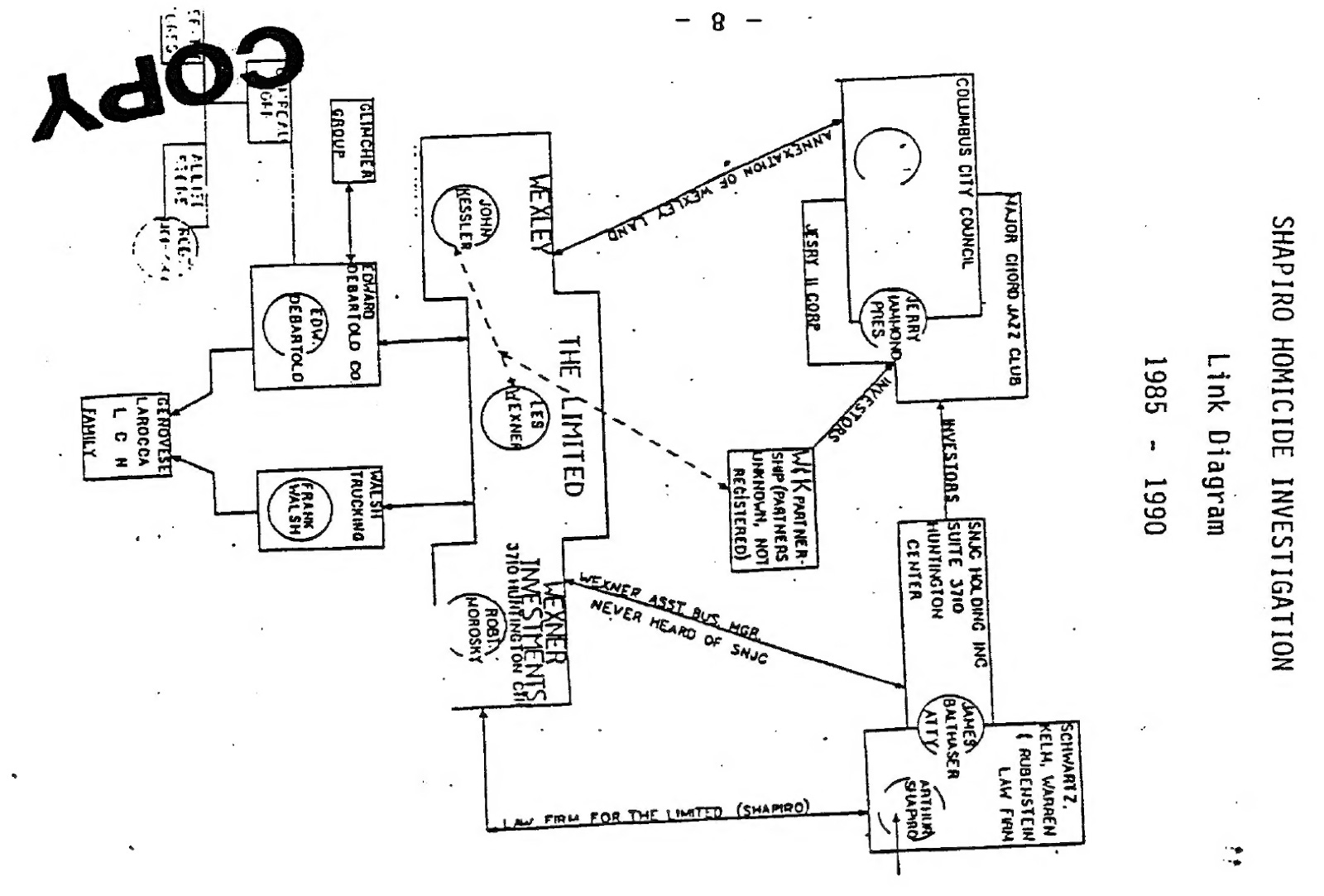
New from Drop Site: “Epstein, Israel, and the CIA: How the Iran-Contra Planes Landed at Les Wexner’s Base—Jeffrey Epstein helped Leslie Wexner repurpose the CIA’s Iran-Contra planes from arms smuggling to shipping lingerie.” Ahead of Congress’s December 19 deadline for releasing the Epstein files Friday, Drop Site released a massive investigation on Epstein, Iran-Contra, Les Wexner, and the CIA, available here.

Also new from Drop Site: “University of Michigan Regents Who Led the Charge Against Pro-Palestine Protestors Are Now Backing Prosecutor Karen McDonald’s Candidacy for State Attorney—like Dana Nessel before her, McDonald has received huge backing from Pro-Israel organizations, GOP contributors, and corporate donors.” A new report on Michigan’s state attorney election from Tom Perkins is now available here.

A petition from Drop Site, “Stand Against Governors’ Unconstitutional Attacks on Religious Freedom”: Following Texas Governor Greg Abbott’s nearly identical attack in November, Governor Ron DeSantis has become the second governor to issue an unconstitutional proclamation falsely declaring CAIR, America’s largest Muslim civil rights and advocacy organization, a “foreign terrorist organization.” Drop Site has created a petition to stand against these attacks.

ADD YOUR NAME TO THE PETITION

Programming note: This will be the last Drop Site Daily before our holiday break. We’ll be back on Monday, January 5, with regular coverage—thank you for reading, and we wish you a restful and safe holiday.

This is Drop Site Daily, our new, free daily news recap. We send it Monday through Friday.

Subscribe now

An aerial view shows protesters at Shahbagh intersection in Dhaka, as thousands rallied across Bangladesh on December 19, 2025, for a second straight day. (Photo by Abdul Goni / AFP via Getty Images).

The Genocide in Gaza

Israeli attacks across Gaza: At least three Palestinians were killed by Israeli artillery fire in eastern Khan Younis, according to Al-Aqsa TV. Israeli forces carried out air attacks, artillery shelling and heavy gunfire across the Gaza Strip on Friday, according to Al Jazeera, with artillery shelling and heavy gunfire across eastern Khan Younis, the bombing of the Shujaiya neighborhood in Gaza City and airstrikes targeting Deir al-Balah.

IPC report finds situation still severe in Gaza: Food security conditions have improved in the Gaza Strip and the spread of famine averted, but the situation remains critical with the enclave still facing starvation, the world’s leading authority on food crises, the Integrated Food Security Phase Classification (IPC), said in its latest report on Friday. Between October 16 and November 30, 2025, around 1.6 million people faced high levels of acute food insecurity (IPC Phase 3 or above), including more than half a million people in Emergency (IPC Phase 4) and over 100,000 people in Catastrophe (IPC Phase 5) who faced famine conditions. Acute malnutrition is at critical levels in Gaza Governorate and serious levels in Deir al-Balah and Khan Younis governorates. “Despite the improved situation, the population of the Gaza Strip still faces high levels of acute food insecurity and acute malnutrition,” the report said. “In the coming months, the situation is expected to remain severe.”

UN, international NGOs warn that Israeli restrictions endanger the delivery of aid: United Nations agencies and more than 200 international and local NGOs warned that Israel’s new registration regime for international aid groups could dismantle life-saving humanitarian operations in Gaza. In a statement, they claimed that the registration policy is forcing organizations out without a replacement for their services, and thus placing Palestinian lives at imminent risk. They report that dozens of groups face the prospect of deregistration by Dec. 31—jeopardizing roughly $1 billion in annual aid—and warned the impact would be “immediate and catastrophic.” As a result of the policy, one in three health facilities would be slated to close, 345 hospital beds would be lost, and all five inpatient centers treating children with severe acute malnutrition would be shut down. The statement also stressed that humanitarian access is a legal obligation under international humanitarian law, which Israel has failed to meet.

MSF says Israel needs to let in more aid to save the lives of Gaza’s children: Doctors Without Borders urged Israeli authorities to urgently allow a large-scale increase of aid into Gaza, warning that “children are losing their lives because they lack the most basic items for survival.” The organization reported the death of a four-week-old infant on Wednesday, bringing the number of children who have frozen to death to five in a period of less than ten days, according to Gaza’s Civil Defense. “Babies are arriving at the hospital cold, with near-death vital signs,” MSF said. “Even our best efforts are not enough.”

Witkoff to meet with representatives from Qatar, UAE, and Egypt on Friday: White House envoy Steve Witkoff will meet with senior officials from Qatar, Egypt, and Turkey on Friday in Miami to discuss the next phase of the Gaza deal, according to several reports. The talks mark the highest-level U.S.-based meeting among the ceasefire’s mediators since the agreement was signed in October. The meetings come amid growing frustration over Israel’s repeated ceasefire violations: Qatar’s prime minister said Israel’s actions were putting mediators in an “embarrassing position,” and Hamas says it has documented roughly 25 ceasefire violations per day.

This week’s winter storms killed a minimum of 18: Based on figures previously reported by Gaza’s Civil Defense, at least 18 people have been killed in Gaza in just over a week, including five children who froze to death. One survivor is 12-year-old Wessam Badran, who was pulled from the rubble after his family’s tent collapsed in heavy rain. Wessam survived the storms, but his entire family was killed. Sahat English spoke with him in a video available here: “I was scared,” he says, “I go to [what was] my home and start crying.”

Doctor discusses the case of a Palestinian child in urgent need of medical evacuation: “If Taim dies after surviving the bomb, it will not be an accident. It will be a choice,” said Dr. Nada Abu Alrub, who treated six-year-old Taim AlNemer, who was critically wounded in an Israeli airstrike in Gaza and is now in urgent need of medical evacuation. Abu Alrub said Taim survived the bombing but sustained catastrophic injuries requiring surgical intervention unavailable in Gaza, and noted that Israel is blocking not only his evacuation, but the evacuation of 5,000 other children among more than 16,000 patients approved for medical transfer. She called for the immediate evacuation of wounded children, saying delays are turning survivable injuries into death sentences.

Unexploded Israeli ordnance killed a child in Gaza and injured others: Three separate explosions from unexploded Israeli ordnance killed at least one child from the Al-Suri family in Nuseirat refugee camp and injured civilians elsewhere across Gaza on Thursday, sparking fires and damaging homes, according to Gaza’s Civil Defense. The agency warned that incidents involving unexploded munitions are increasing in residential areas, and it holds Israel, international organizations operating in Gaza, and the U.S. coordination mechanism responsible for failing to clear explosive remnants of war. Gaza’s Civil Defense says that repeated meetings with the International Committee of the Red Cross and UN mine-action officials have produced no results.

Erdoğan says Turkey will “fight on every front” to ensure justice for Gaza: Turkish President Recep Tayyip Erdoğan said Thursday that Turkey will continue to “fight on every front” to ensure what is happening in Gaza is not forgotten and that justice is served, saying Ankara “stands firmly with the Palestinian people, unwavering and unbowed,” and will keep “speaking the truth” about Israel’s actions, which he has repeatedly described as atrocities and genocide.

West Bank and Israel

Israel’s Supreme Court rejects petition to prevent the demolition of buildings in Nur Shams: Israel’s Supreme Court has rejected a petition by the Adalah Human Rights Center seeking to halt the demolition of 25 buildings in the Nur Shams refugee camp in the northern occupied West Bank, Al Jazeera reports. The decision clears the way for demolitions, which are set to begin this week, and will displace hundreds of Palestinians. The United Nations Relief and Works Agency said nearly half of the camp’s buildings were already damaged or destroyed before the latest demolition order and said that the demolitions are part of a broader Israeli campaign to permanently reshape and control refugee camps in the north, which is justified by claims of “military necessity.”

U.S. News

U.S. kills five more people in boat strikes: The U.S. military announced it killed five people in two strikes on two boats in the Pacific Ocean on Thursday. “A total of five male narco-terrorists were killed during these actions—three in the first vessel and two in the second vessel,” U.S. Southern Command said in an online post. The latest strikes in international waters bring the death toll from the U.S. campaign to over 100.

U.S. sanctions two ICC judges for forwarding cases against Israel: The United States has sanctioned two International Criminal Court judges for allowing war crimes cases involving Israel to proceed, accusing the court of acting “illegitimately” by asserting its jurisdiction without requesting Israel’s consent and warning it will impose “significant and tangible consequences” on anyone seeking to hold Israeli or U.S. officials legally accountable. Amnesty International, Human Rights Watch, the United Nations Commission of Inquiry, and leading Israeli human rights organizations have all said Israel’s actions in Gaza amount to a deliberate attempt to destroy a population in whole or in part, meeting the legal definition of genocide, a crime subject to prosecution by the International Criminal Court.

Supposed Brown gunman found dead, reportedly responsible for the murder of an MIT professor as well: The gunman responsible for the shooting at Brown University and the killing days later of an MIT professor was found dead of a self-inflicted gunshot wound inside a New Hampshire storage facility, authorities said Thursday, ending a five-day manhunt. Prosecutors identified the suspect as Claudio Manuel Neves Valente, a former Brown physics graduate student and Portuguese national, who they say acted alone and specifically targeted MIT professor Nuno Loureiro, with whom he had a prior academic connection, though the motive for either crime remains unknown.

Trump administration suspends the U.S. Diversity Visa Lottery Program: The Trump administration has suspended the U.S. Diversity Visa lottery program, Homeland Security Secretary Kristi Noem announced Wednesday, under the direction of President Donald Trump. The move follows disclosures that Claudio Manuel Neves Valente, the primary suspect in the Brown and MIT shootings, entered the United States through the program in 2017 before later obtaining permanent residency. The Diversity Visa program, created by Congress in the 1990s, allocates up to 55,000 visas annually. Given that it is mandated by federal law, its suspension will likely face legal challenges.

Trump administration seeks to block physicians from assisting in minors’ gender transitions: The Trump administration proposed sweeping new rules Thursday that would sharply curtail gender transition care for minors by barring providers who offer such services from participating in Medicare, Medicaid, and other federal health programs, according to reporting from the Washington Post. If finalized, the regulations would effectively eliminate most youth transition care nationwide. Medical associations condemned the move as political interference in patient-physician decision-making, while civil rights groups and Democratic state officials promised to contest the changes.

Trump admin plans further crackdown on “left-wing terrorism”: The Trump administration is launching a broad campaign to target what it calls left-wing domestic terrorism, the Washington Post reports, directing federal agencies to hand over intelligence on “Antifa” and related organizations to the FBI for potential investigations. The effort has prompted concern about the surveillance of lawful political activity, with observers warning that it could further entrench speech-suppression and increase the rolls on federal watch lists.

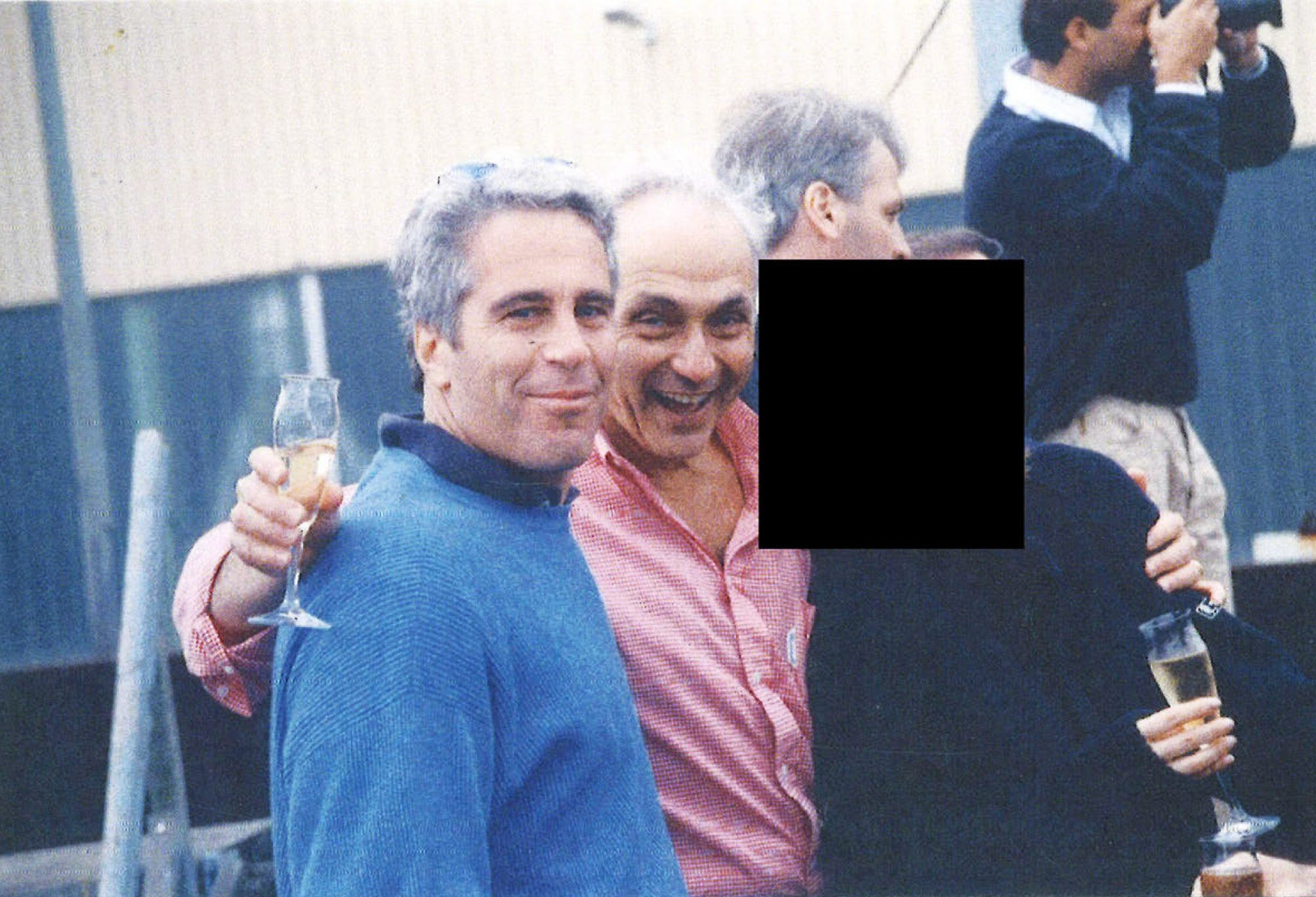
Emails detail Noam Chomsky’s relationship with Jeffrey Epstein: Emails and documents released by the U.S. House Oversight Committee in November 2025 show that Noam Chomsky, now 96, remained in contact with Jeffrey Epstein for years after Epstein’s 2008 conviction, holding meetings with Epstein and corresponding with him at least until 2017. An undated letter attributed to Chomsky describes Epstein facilitating high-level discussions and introductions—including to former Israeli prime minister Ehud Barak—and newly released photos from Epstein’s estate show Chomsky with Epstein aboard his private plane, with Chomsky characterizing the relationship as a “most valuable experience” centered on “intellectual exchanges.”

Micron migrates into the AI market: After receiving billions in taxpayer subsidies, Micron is exiting the consumer electronics market to focus exclusively on supplying AI companies and data-centers, a move critics warn will drive up prices for household electronics. By ending its “Crucial” line of DRAM and SSD products, Micron leaves the global memory market effectively consolidated into a duopoly between Samsung and SK Hynix, reducing competition as prices have already surged roughly 170% in the past year. The shift comes as Micron’s stock has jumped about 180% this year, and as the company continues to receive massive public subsidies under the CHIPS Act to support semiconductor production. Read more about this from The Lever here.

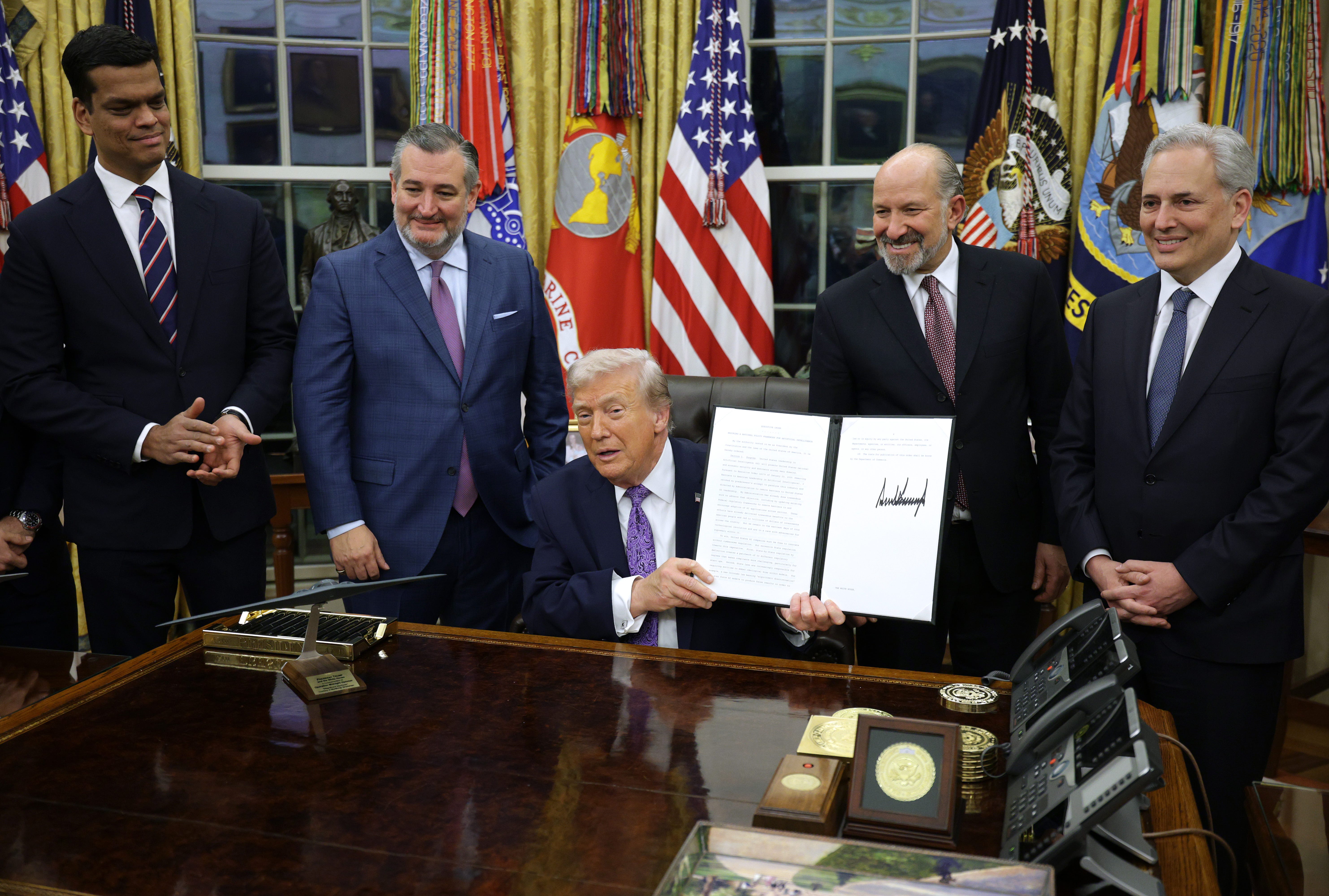
Trump signs executive order reclassifying cannabis: President Trump signed an executive order Thursday directing federal agencies to reclassify marijuana from a Schedule I classification—the most restrictive category under the Controlled Substances Act, alongside heroin and ecstasy—to a Schedule III classification, which would pave the way for the Food and Drug Administration to study its medicinal uses. “This action has been requested by American patients suffering from extreme pain, incurable diseases, aggressive cancers, seizure disorders, neurological problems and more, including numerous veterans with service-related injuries, and older Americans who live with chronic medical problems that severely degrade their quality of life,” Trump said from the Oval Office on Thursday.

International News

16 killed in Kordofan: At least 16 people have been killed in an artillery bombardment of the besieged city of Dilling in Sudan’s Kordofan region, according to the Sudan Doctors Network, a medical monitoring group. The Rapid Support Forces (RSF) and their allies in the Sudan People’s Liberation Movement–North have shelled residential areas of Dilling over the past two days, according to the group. More than 50,000 people have fled Kordofan since late October, when the RSH captured a major army base in the region, according to the International Organization for Migration.

Egypt says developments in Sudan have crossed its “red lines”: Egypt said developments in Sudan have crossed “red lines” affecting its national security, following talks in Cairo between President Abdel Fattah al-Sisi and Sudanese Army Chief Abdel Fattah al-Burhan, Sudan Tribune reports. The Egyptian presidency said those “red lines” include preserving Sudan’s territorial integrity, preventing secession, and safeguarding state institutions along Egypt’s southern border. Cairo rejected the Rapid Support Forces’ declaration of a parallel governing authority in Darfur and expressed concern with any potential unilateral actions that might threaten Nile Basin water security.

The RSF killed at least 1,013 civilians during a spring assault on a displacement camp, UN OHCHR says: The United Nations Office of the High Commissioner for Human Rights (OHCHR) reported that Sudan’s Rapid Support Forces killed at least 1,013 civilians, 318 of whom were summarily executed, during a three-day assault in April 2025 on the Zamzam displacement camp in North Darfur. The revised toll was over three times as great as earlier estimates. OHCHR also documented 66 incidents of conflict-related sexual violence involving 104 victims. The camp had been under a months-long siege, with RSF forces blocking food, water, medical aid, and humanitarian relief, which forced civilians to survive on smuggling and eating animal feed. The April attack forced more than 406,000 people from their homes, at least 56,000 of them into eastern Chad, and could constitute war crimes, according to the Office of the United Nations High Commissioner for Human Rights.

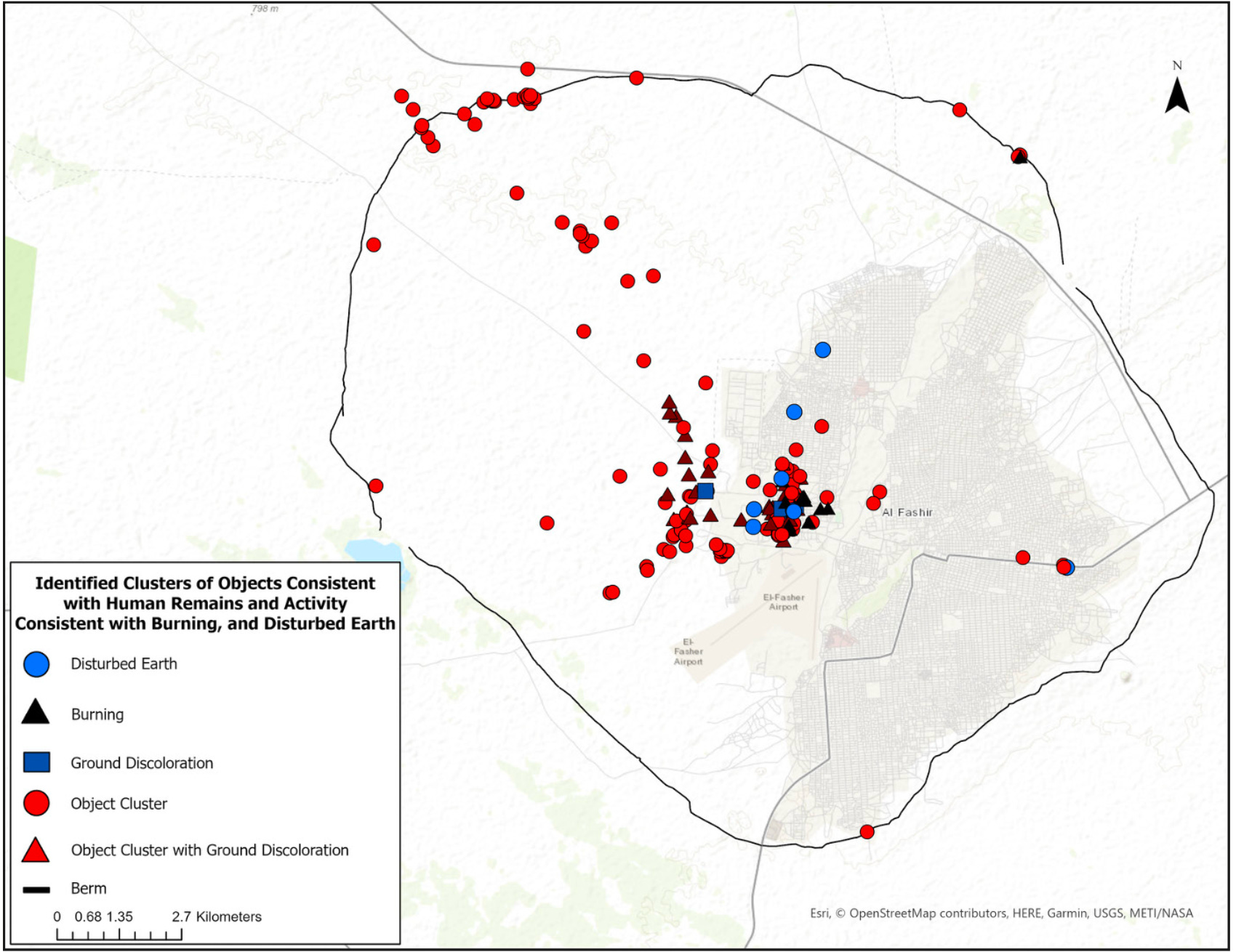
Sudan scholar says 300,000 may have died in Darfur, and two-thirds of the country faces food insecurity: Sudan expert Dr. Khaled Medani of McGill University said an estimated 300,000 people have been killed across Darfur, with two-thirds of the country—around 30 million people—now facing food insecurity as famine spreads, according to remarks he made on The Majority Report. Medani estimated that about 150,000 were killed in attacks on El-Fasher alone.

French, American, and Saudi officials discuss their plans to disarm Hezbollah with Lebanese army chief: French, U.S., and Saudi officials held talks in Paris with Lebanese Army Chief Rudolf Heikal on the topic of disarming Hezbollah, as well as to discuss a mechanism which might channel international support to the Lebanese Armed Forces (LAF), The New Arab reports. The meeting agreed to convene a February conference to boost funding and political backing for the LAF, with aid explicitly conditioned on progress toward Hezbollah’s disarmament and enforcement of the 2024 U.S.-brokered ceasefire with Israel. French officials said the LAF would be positioned as Lebanon’s sole legitimate armed force. Critics warn that tying aid to disarmament risks politicizing the LAF and deepening the country’s persistent political instability.

Israeli representative accuses Hezbollah of preparing for war, but offers no evidence for his claims: Asked by Sky News why Israel was violating its Lebanese ceasefire, Israel’s UN ambassador Danny Danon accused Hezbollah of rebuilding military infrastructure, restocking bunkers, and smuggling weapons and cash into Lebanon, but offered no evidence for these claims. The United Nations Interim Force In Lebanon, which has a substantial presence in southern Lebanon, said it has found no evidence of Hezbollah regrouping, reporting only old, abandoned weapons caches and unexploded ordnance dating to earlier conflicts.

Saudi military prepares to engage with UAE-backed Yemeni separatists: As many as 20,000 Saudi-backed forces are amassing near Yemen’s eastern border, as the UAE-backed Southern Transitional Council (STC) has made controversial territorial gains in the oil-rich region of Hadramaut, according to reporting from The Guardian. The STC, which is using its advance to push demands for a re-division of Yemen into north and south, has said it will not withdraw from its newly acquired territories, despite Saudi threats of possible airstrikes.

Protests in Bangladesh over death of activist: Protests have erupted across Bangladesh after Sharif Osman Hadi, a prominent youth leader of the country’s 2024 pro-democracy uprising who was injured in an assassination attempt, died in a hospital in Singapore. After his death was announced, thousands of people took to the streets of Dhaka and other cities. Several buildings in the capital have been set on fire. Hadi was shot in the head last week by masked assailants as he was leaving a mosque in Dhaka. He had just launched his campaign for a seat in the country’s first parliamentary elections since the ouster of Prime Minister Sheikh Hasina in the 2024 uprising. Hasina fled to India where she remains in self-imposed exile. She was sentenced to death for crimes against humanity last month. The UN’s human rights chief Volker Turk said in a statement: “I urge the authorities to conduct a prompt, impartial, thorough and transparent investigation into the attack that led to Hadi’s death, and to ensure due process and accountability for those responsible.”

Cambodia accuses Thailand of bombing Poipet: Cambodia’s defense ministry accused Thailand of bombing the casino hub of Poipet, a major land crossing between the two countries, saying Thai forces dropped two bombs on the town on Thursday, according to Al Jazeera. Thailand has not confirmed the strike, but Cambodian officials say multiple casinos have been damaged.

Thailand and Cambodia agree to ASEAN observation: Thailand and Cambodia agreed to deploy an observer team from the Association of Southeast Asian Nations (ASEAN) in an effort to de-escalate their border conflict, Malaysian Prime Minister Anwar Ibrahim said Wednesday, according to The Diplomat. Anwar said the ASEAN observers, led by Malaysia’s chief of defense force, will report ahead of a December 22 meeting of ASEAN foreign ministers, expressing cautious optimism about the effort. Thailand has reframed its renewed military campaign as targeting Cambodia-based online scamming networks, and China has begun to participate in diplomatic efforts to resolve the conflict.

Half of Haiti’s population goes hungry every day, UN estimates: About 5.7 million people—roughly half of Haiti’s population—are going hungry every day, the UN said. The country, which has seen rising violence and increasing gang control over its central urban areas, has seen huge spikes in internal displacement, which has doubled in a year (an estimated 1.4 million people are displaced, representing about 12% of the population). The UN also warned of the violence’s disproportionate impact on women and girls, with an average of 27 new cases of gender-based violence recorded per day in 2025, more than half involving sexual violence and roughly two-thirds of those cases involving gang rape.

Mexican billionaire aligns himself with Trump: Mexican billionaire Ricardo Salinas Pliego is touting his invitation to President Donald Trump’s Christmas dinner in Washington, according to Drop Site correspondent José Luis Granados Ceja. A vocal critic of Mexican President Claudia Sheinbaum, Salinas Pliego has used his media empire to attack her and former President of Mexico Andrés Manuel López Obrador, and he has openly floated a 2030 presidential run. Pliego recently met with Salvadoran President Nayib Bukele. He will attend the dinner alongside ultra-conservative opposition figure Eduardo Verástegui—once viewed as MAGA’s closest ally in Mexico, but whose attempts at electoral politics faltered.

More From Drop Site

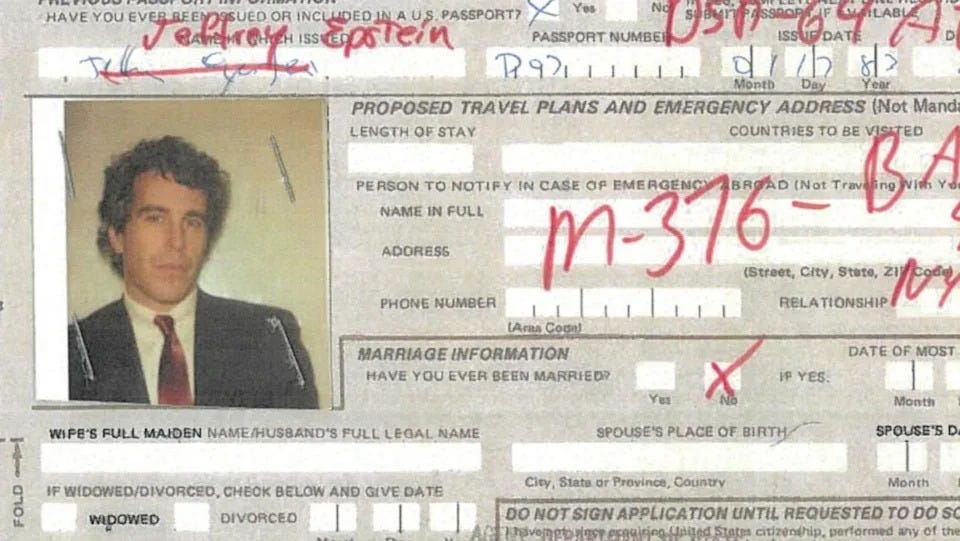
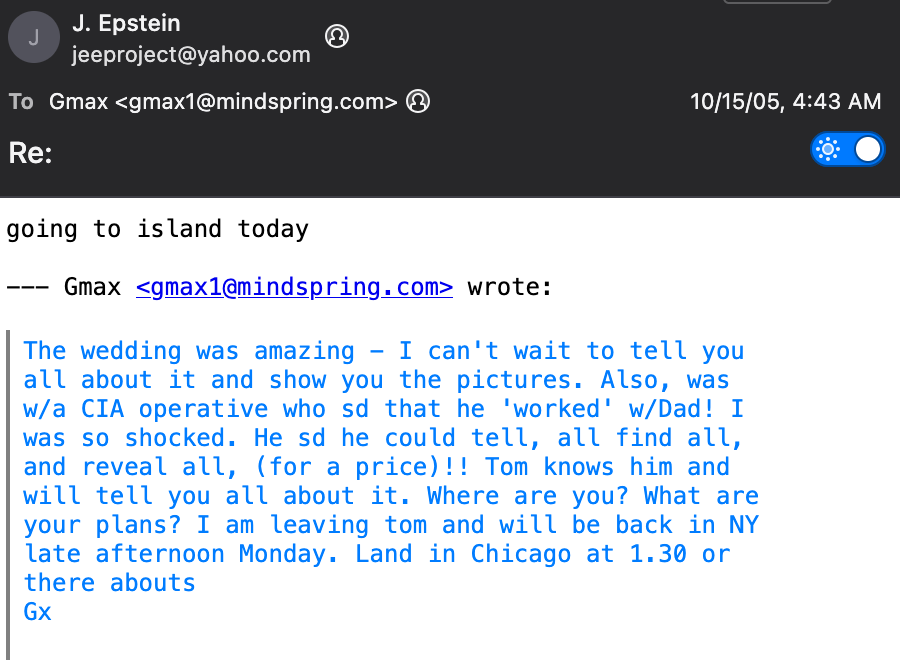
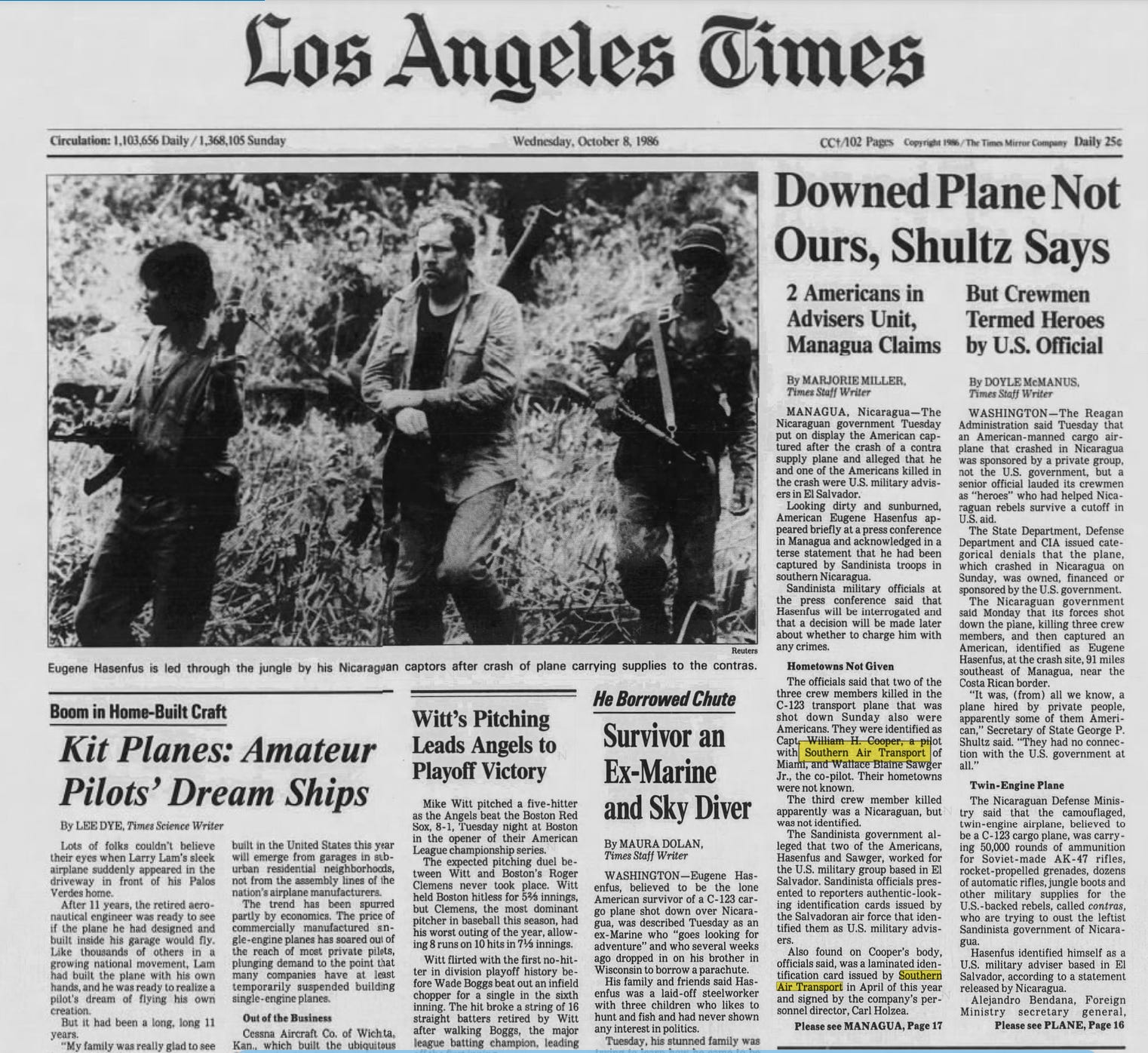
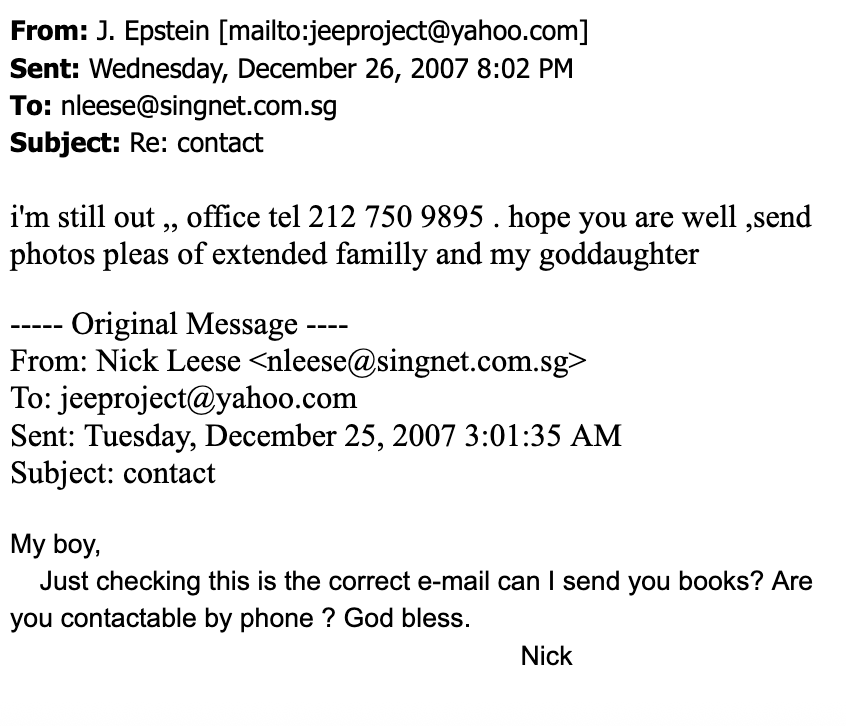
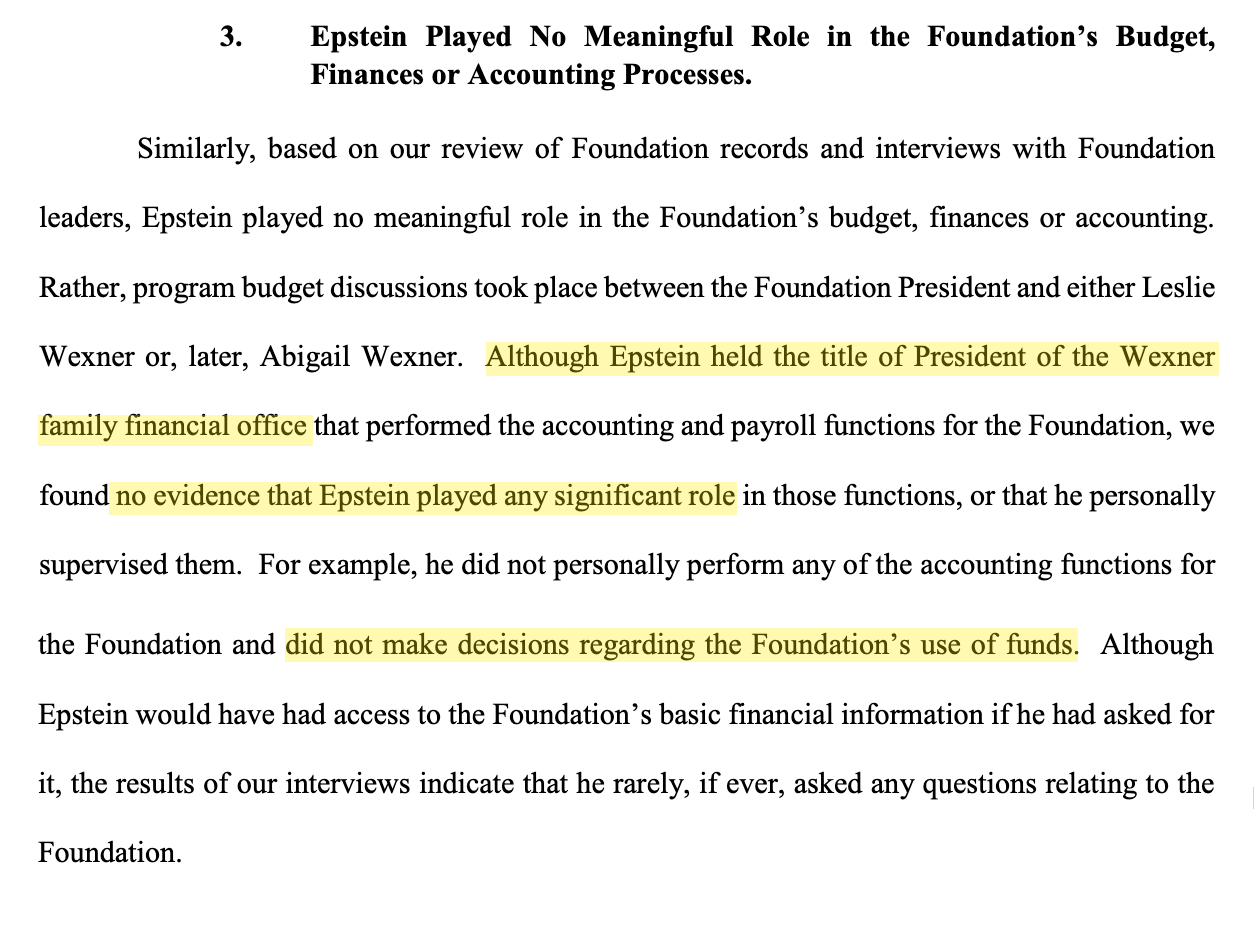
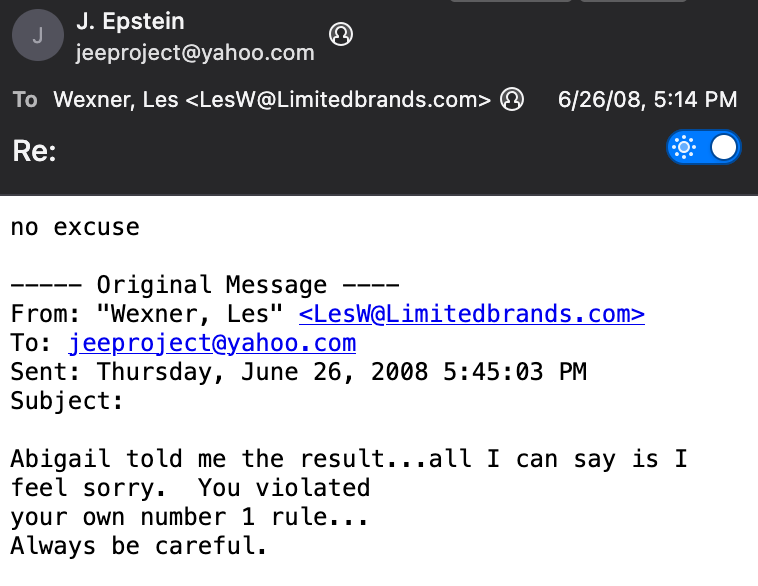
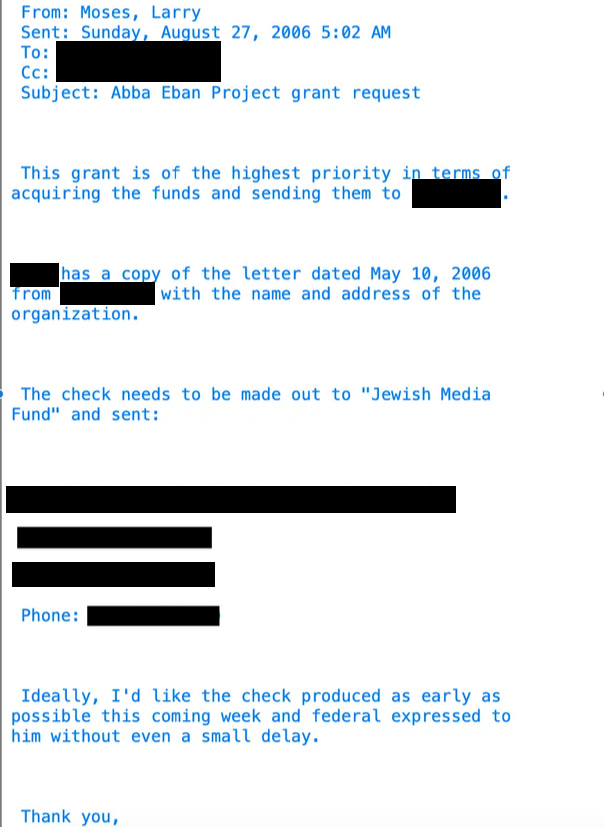
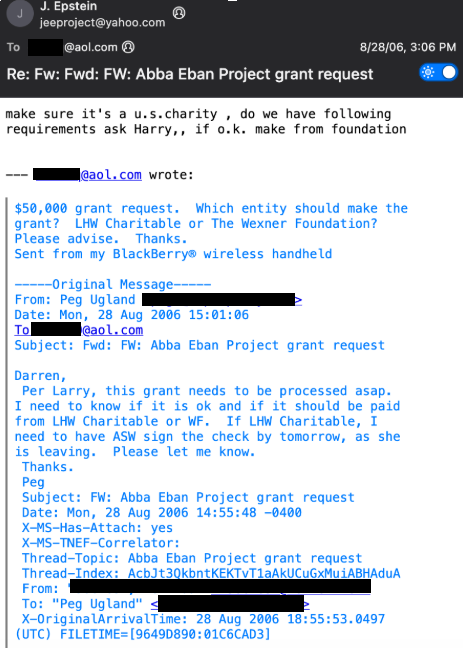
Epstein, Iran-Contra, the CIA, and Les Wexner: After the Iran-Contra scandal broke in 1986, following the downing of a CIA-front aircraft owned by Southern Air Transport in Nicaragua, Jeffrey Epstein helped relocate SAT planes to Columbus, Ohio, where they were repurposed to service the retail empire of billionaire Leslie Wexner, who later granted Epstein power of attorney over his fortune. Epstein’s takeover of the SAT aircraft was one of his many links to the Iran-Contra networks: he knew Adnan Kashoggi, Douglas Leese, and, for a period, lived with lawyer John Stanaley Pottinger, who oversaw weapons transfers to Iran on behalf of the CIA. Drop Site’s newest Epstein investigation traces these connections, following the SAT planes, uncovering suppressed Columbus police records, and revealing leaked emails from Epstein’s own Yahoo inbox. Read the latest from Ryan Grim, Murtaza Hussain, and Harrison Berger here.

Michigan’s state attorney race: The pro-Israel regents of University of Michigan (U-M) ignited controversy during the pro-Palestine campus protests by recruiting State Attorney General Dana Nessel to crackdown on the protesters. Now, members of U-M’s Board of Regents are making large donations to Oakland County Prosecutor Karen McDonald, a candidate who may replace Nessel. McDonald is running against Eli Savit, a progressive Jewish prosecutor in Ann Arbor. Read new reporting on Michigan’s state attorney election from Tom Perkins here.

Programming note: You can sign up here to get updates from us on our WhatsApp channel.

If you want to continue getting this newsletter, you don’t have to do anything. But if this is too much—we do try to be mindful of your inbox—you can unsubscribe from this newsletter while continuing to get the rest of our reporting. Just go into your account here at this link, scroll down, and toggle the button next to “Drop Site Daily” to the off setting. It looks like this:

Share

Leave a comment


From Drop Site News via this RSS feed

5


We have a commitment to ensuring that our journalism is not locked behind a paywall. But the only way we can sustain this is through the voluntary support of our community of readers. If you are a free subscriber and you support our work, please consider upgrading to a paid subscription or gifting one to a friend or family member. You can also make a 501(c)(3) tax-deductible donation to support our work.

Make a Gift

Jeffrey Epstein, from right, with Ghislaine Maxwell and Bill Clinton. Undated photo released by House Oversight Committee.

Since Jeffrey Epstein’s second arrest in 2019, the Clintons have spent considerable effort distancing themselves from the enigmatic financier, and they are currently fending off House Oversight Committee Chair James Comer, who threatened contempt proceedings after the political power couple refused to testify this week regarding their relationship to Epstein.

Epstein first came into public view after accompanying former President Bill Clinton on a 2002 tour of Africa, aboard Epstein’s infamous Boeing 727 plane, later dubbed “Lolita Express.” Abundant photos from that Africa trip—with Kevin Spacey and Chris Tucker—have just been released by the Justice Department.

Through a spokesperson, Bill Clinton has acknowledged traveling on Epstein’s jet during a humanitarian tour of Africa in 2002, but has said he knew nothing of Epstein’s crimes, never visited Epstein’s properties, and ended contact in 2005. In a Justice Department interview in July 2025, Ghislaine Maxwell downplayed Epstein’s connection to the former president, telling Deputy Attorney General Todd Blanche, “President Clinton was my friend, not Epstein’s friend.”

Yet as Hillary Clinton’s 2008 presidential campaign ramped up, it was Epstein looking to duck the Clintons. Epstein was facing increasingly dire legal consequences in South Florida, stemming from his years-long sexual exploitation of young women and girls. The glare of a presidential campaign risked unraveling what Epstein and his friend and ally Ghislaine Maxwell had so effectively constructed over the years, as they were increasingly associated with the spectacle of “Clintonworld.”

Subscribe now

President Bill Clinton in a hot tub. Undated photo released by the Department of Justice as part of the Epstein files.

Epstein and Clinton in an undated photo released by the DOJ.

In May 2007, the news media drove a scandal around the relationship between Hillary Clinton and Vinod Gupta, an Indian technology executive accused of corrupt dealings with the Clintons related to inflated consulting fees and travel on his company’s jet.

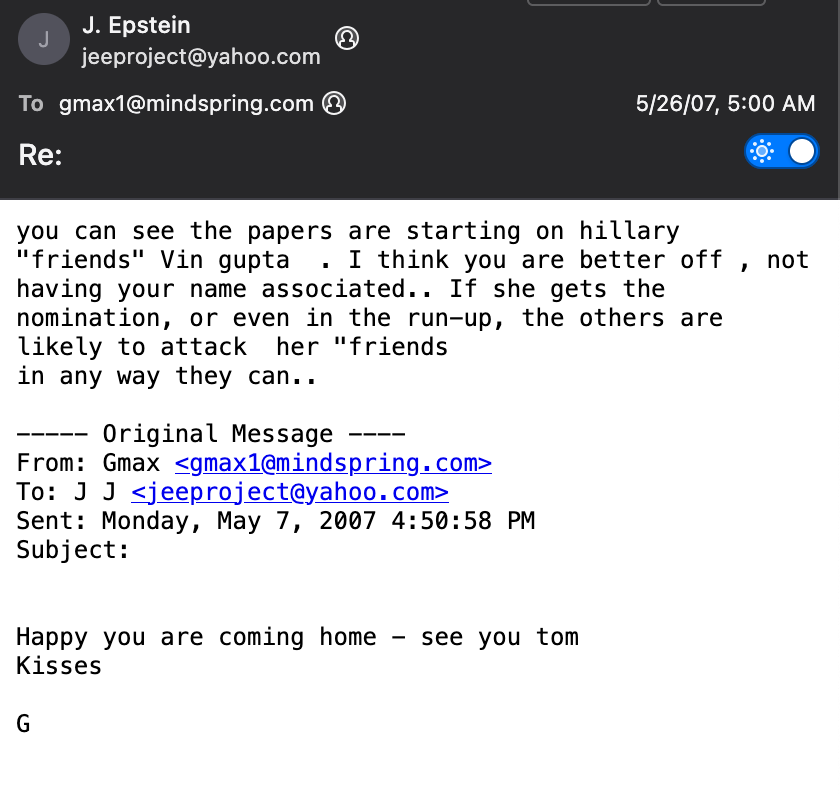
In a May 26 email, four months before signing his “sweetheart deal” to avoid federal sex trafficking charges, Epstein predicted to Maxwell that Clinton’s opponents would “attack her ‘friends’ in any way they can,” and he warned her that Clinton’s presidential run could bring unwanted attention to Maxwell. He wrote to Maxwell, “you can see the papers are starting on hillary ‘friends’ Vin gupta,” he wrote, adding, “I think you are better off, not having your name associated.”

Epstein warns Maxwell about having her name associated with Hillary Clinton, May 26, 2007.

Epstein’s lawyers claim he was part of the original group that created the Clinton Global Initiative (CGI), a cornerstone of Bill Clinton’s post-presidential life, where world leaders met to address major issues like climate change and global health.

Leaked messages from Epstein’s Yahoo! email suggest Maxwell and Epstein’s relationship with the Clintons’ world was closer than the Clintons have publicly acknowledged. The new email cache was vetted and published by Distributed Denial of Secrets, and contains many of the same forensic signatures as the dataset reported by Bloomberg earlier this year.

In messages spanning 2005 through 2007, Maxwell and Epstein coordinated directly with Clinton Foundation personnel, met with members of the Clintons’ inner circle, and gave expensive gifts to a senior Clinton aide. The email cache was vetted by Distributed Denial of Secrets, and overlaps the dataset authenticated by Bloomberg earlier this year. The Clinton Foundation did not respond to request for comment.

With Democrats out of the White House and positioning for the 2008 presidential cycle, the Clinton Foundation served as a parallel influence network that blended philanthropy and unofficial foreign policy engagement. (Hillary Clinton would lose to Barack Obama in the primary, but her global expertise would be parlayed into a position as Secretary of State).

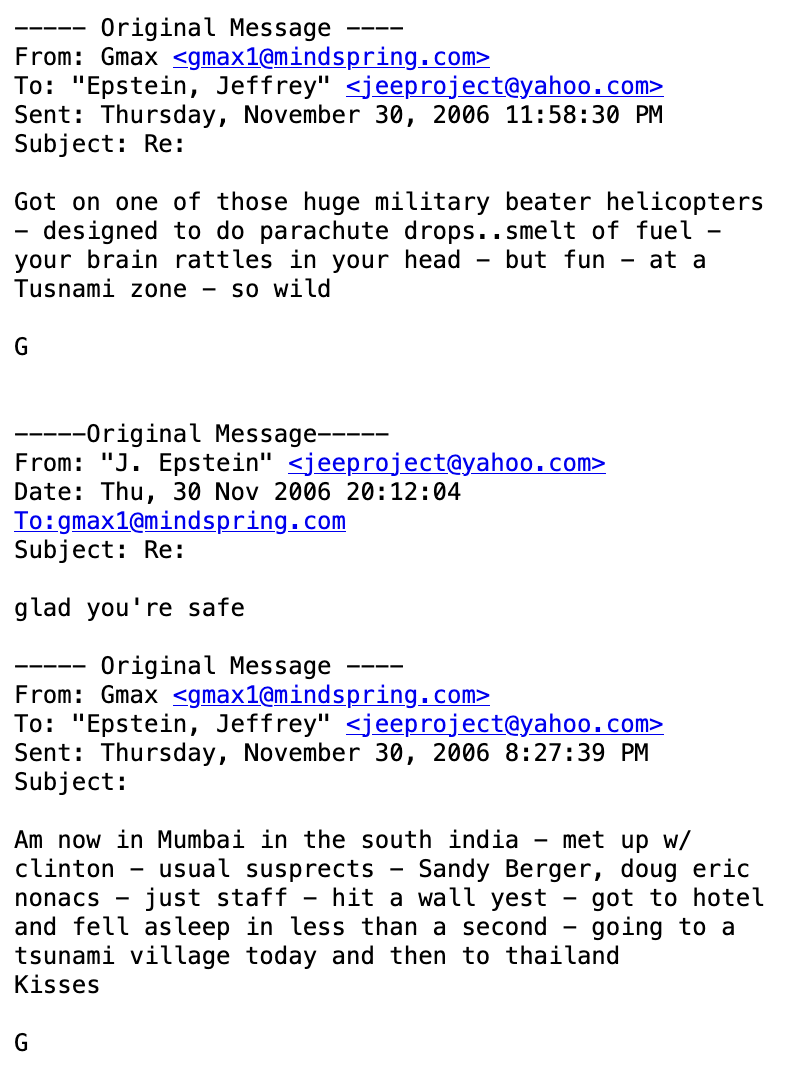
Bill Clinton traveled to Mumbai and New Delhi between November 29 and December 1, 2006, to meet with Prime Minister Manmohan Singh and attend events tied to United Nations and Clinton Foundation work. On November 30, 2006, Maxwell emailed Epstein to inform him she was in Mumbai and “met up w/ clinton” and other Clinton-linked “usual suspects,” including Sandy Berger (a senior former Clinton national security official), Doug Band (a longtime Clinton aide and a central architect of CGI), and Eric Nonacs (a foreign-policy staffer in Clinton’s office).

Maxwell emails Epstein about meeting Clinton staff in Mumbai, November 30–December 1, 2006.

Maxwell sent Epstein another message on December 1, 2006, “going to a tsunami village today,” and a few hours later, “fun - at a Tsunami zone - so wild.” That day, Bill Clinton visited Thazhanguda village in Cuddalore, Tamil Nadu, to see new homes and a school constructed in the tsunami-ravaged region.

Undated photo of Ghislaine Maxwell released by the DOJ.

Doug Band

In a 2020 interview with Vanity Fair, Doug Band, a loyal Clinton “fixer” for nearly two decades, claimed he had been trying to push Epstein “out of Clinton’s orbit” ever since their famous 2002 tour of Africa on Epstein’s plane; Band said he got “bad vibes” from Epstein and advised Clinton to end the relationship in 2002. Band also claimed to have tried to break up Ghislaine Maxwell’s friendship with Chelsea Clinton (with whom he had a frosty rivalry) by advising Bill Clinton’s office to ban Maxwell from all Clinton-related events.

The emails obtained by Drop Site show that Band, despite his proclaimed protestations, remained on good terms with both Maxwell and Epstein for at least a few years after the Africa trip. Band did not respond to a request for comment.

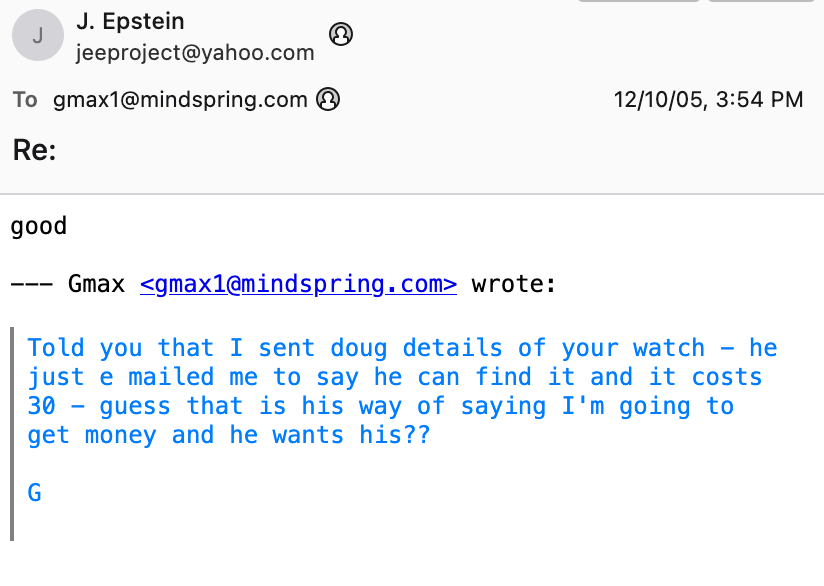
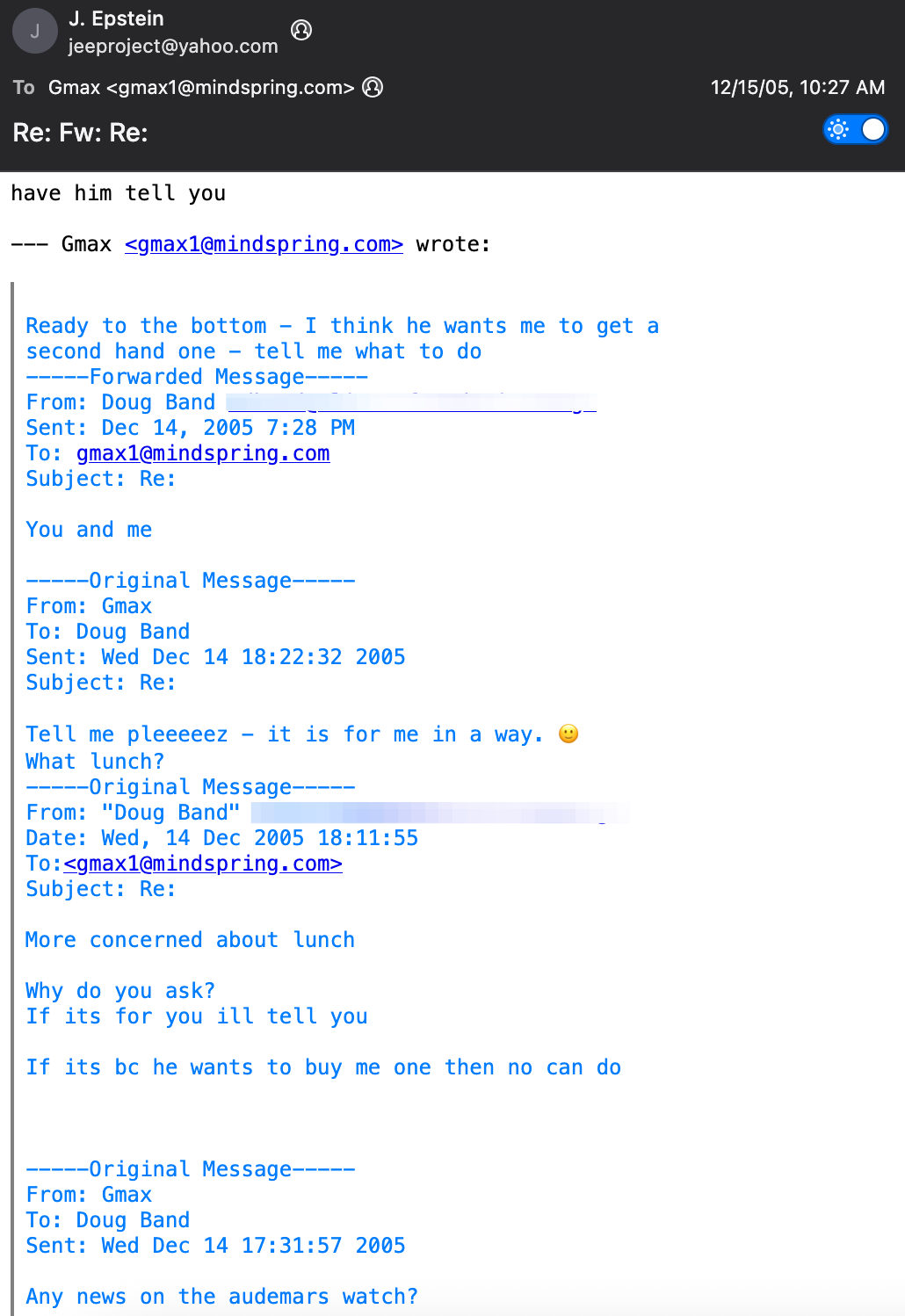
On December 10, 2005, Maxwell informed Epstein that Band was interested in Epstein’s Audemars Piguet watch, a luxury brand with five- and six-figure price tags — she wrote, “he just e mailed me to say he can find it and it costs 30 - guess that is his way of saying I’m going to get money and he wants his??” (The emails don’t offer any context about what Maxwell was being compensated for).

Maxwell informs Epstein that Band is interested in the watch, December 10, 2005.

Five days later, Maxwell followed up with Band, “Any news on the audemars watch?” Band replied, telling Maxwell he’d rather have lunch with her; he declined to accept a luxury gift from Epstein, writing, “If its bc he wants to buy me one then no can do.” Maxwell forwarded the thread to Epstein, and guessed about Band’s intentions, writing “I think he wants me to get a second hand one - tell me what to do.” Epstein pressed her to follow through: “have him tell you.”

Epstein, Maxwell, and Band discuss Audemars Piguet watch gift (December 14, 2005).

A week later, on December 21, 2005, Maxwell reported that she’d purchased the watch for Band for “35” ($35,000). Epstein messaged back, “good..make sure he gets it for xmas.” Maxwell asked Epstein, “what do you want the note to say - is it from you, from me, from us?” Epstein replied, “us.”

Maxwell reports to Epstein “wiring the money today” for Doug Band’s watch, December 21, 2005.

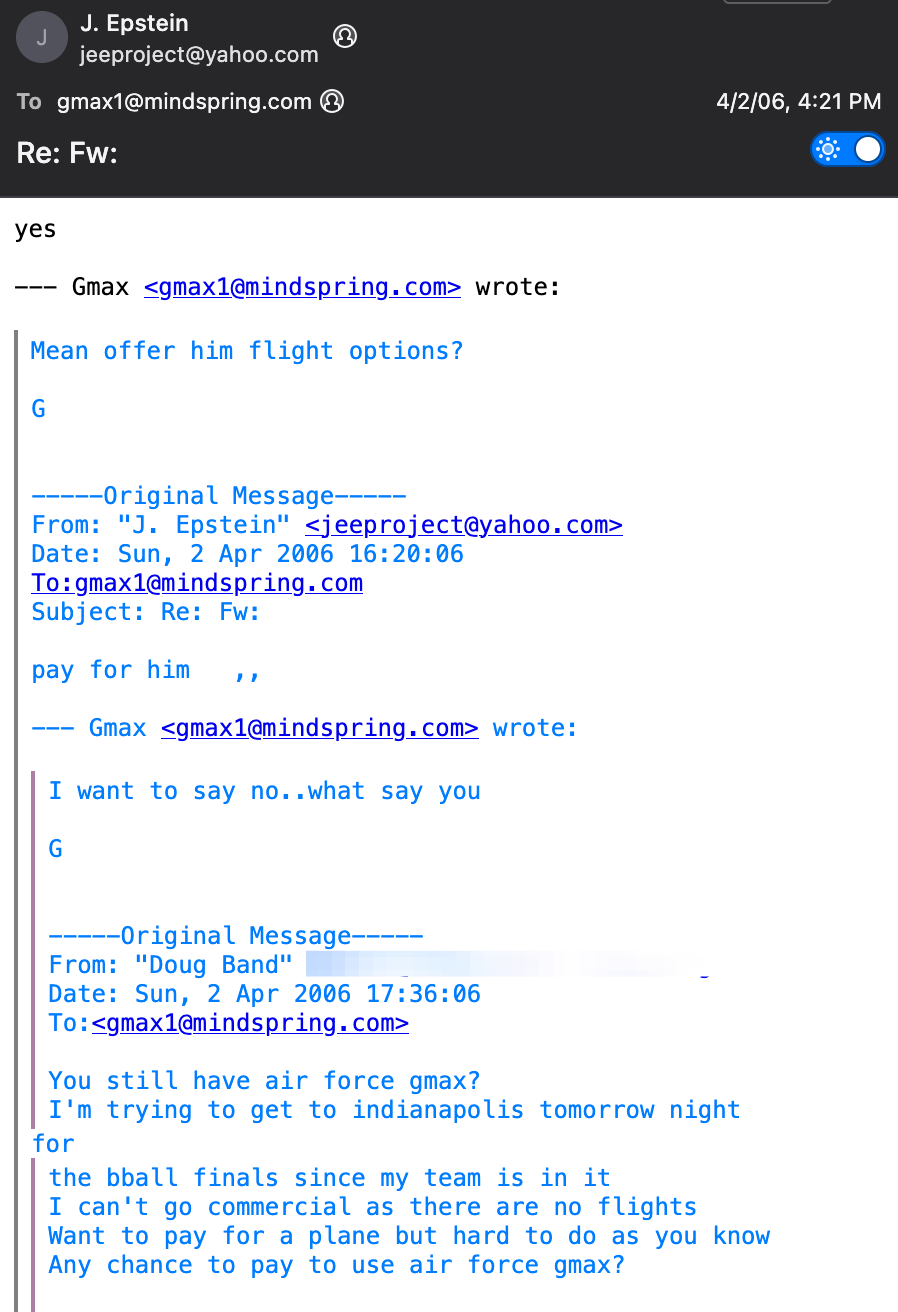
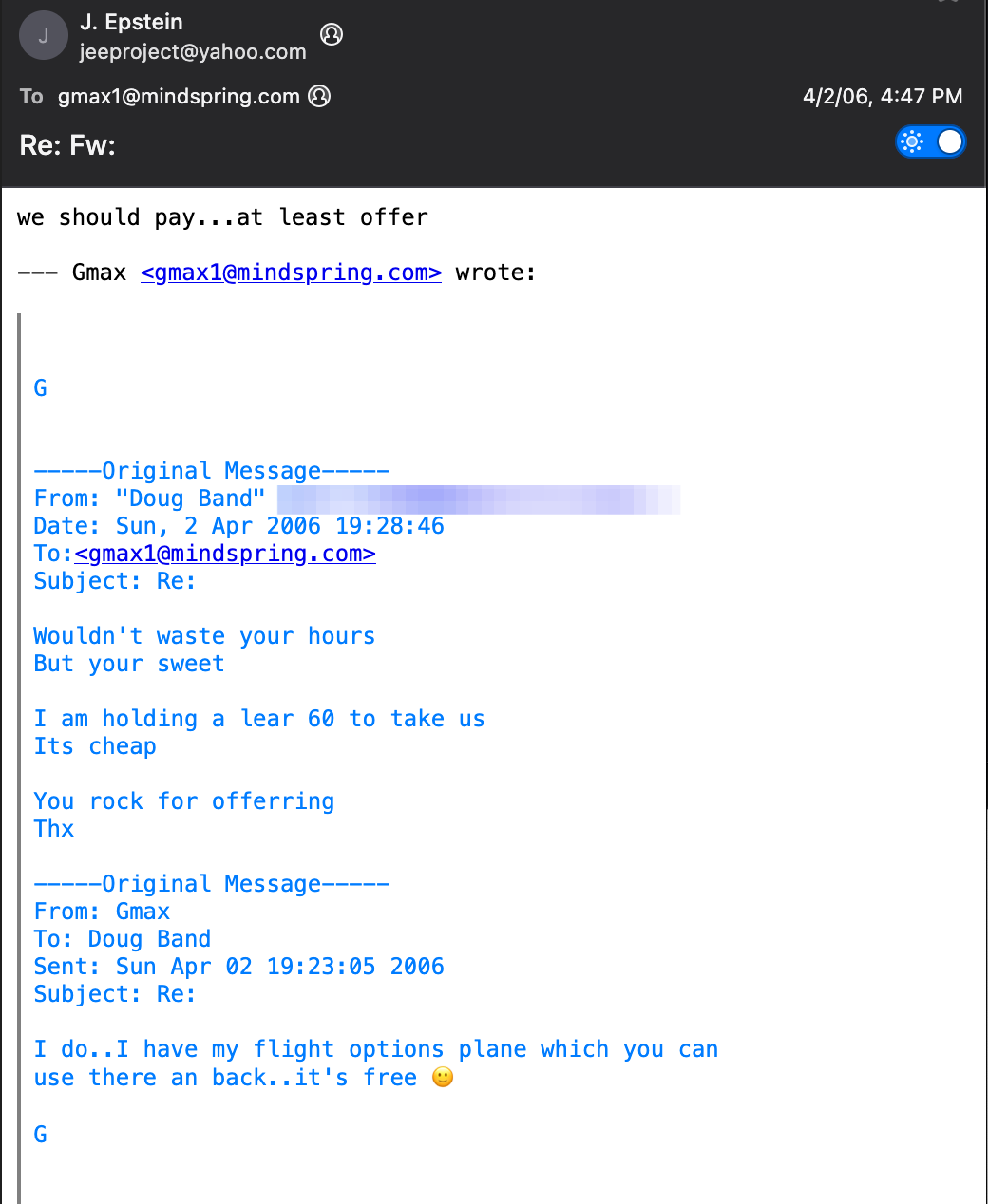
In April 2006, Band, a University of Florida graduate, asked to use Maxwell’s plane for a last-minute trip to Indianapolis to watch his team play in the NCAA men’s basketball finals. Commercial flights were unavailable. He wrote, “You still have air force gmax?” After getting Epstein’s approval, Maxwell offered a free round-trip on her “flight options plane,” a Beechjet 400 owned by “Air Ghislaine, Inc.” Band declined, saying he had already reserved a Learjet. Epstein was still eager to do a favor for Band, advising Maxwell, “we should pay...at least offer.” The Gators won.

Band did not respond to a request for comment. Maxwell has previously denied any connection to Air Ghislaine, Inc., and her lawyer told the Justice Department in July the company had “nothing to do with her.”

Band, Maxwell, and Epstein discuss Band taking Maxwell’s plane to attend a basketball game, April 2, 2006.

Epstein insists upon paying for Band’s flight, April 2, 2006.

The Clinton Foundation

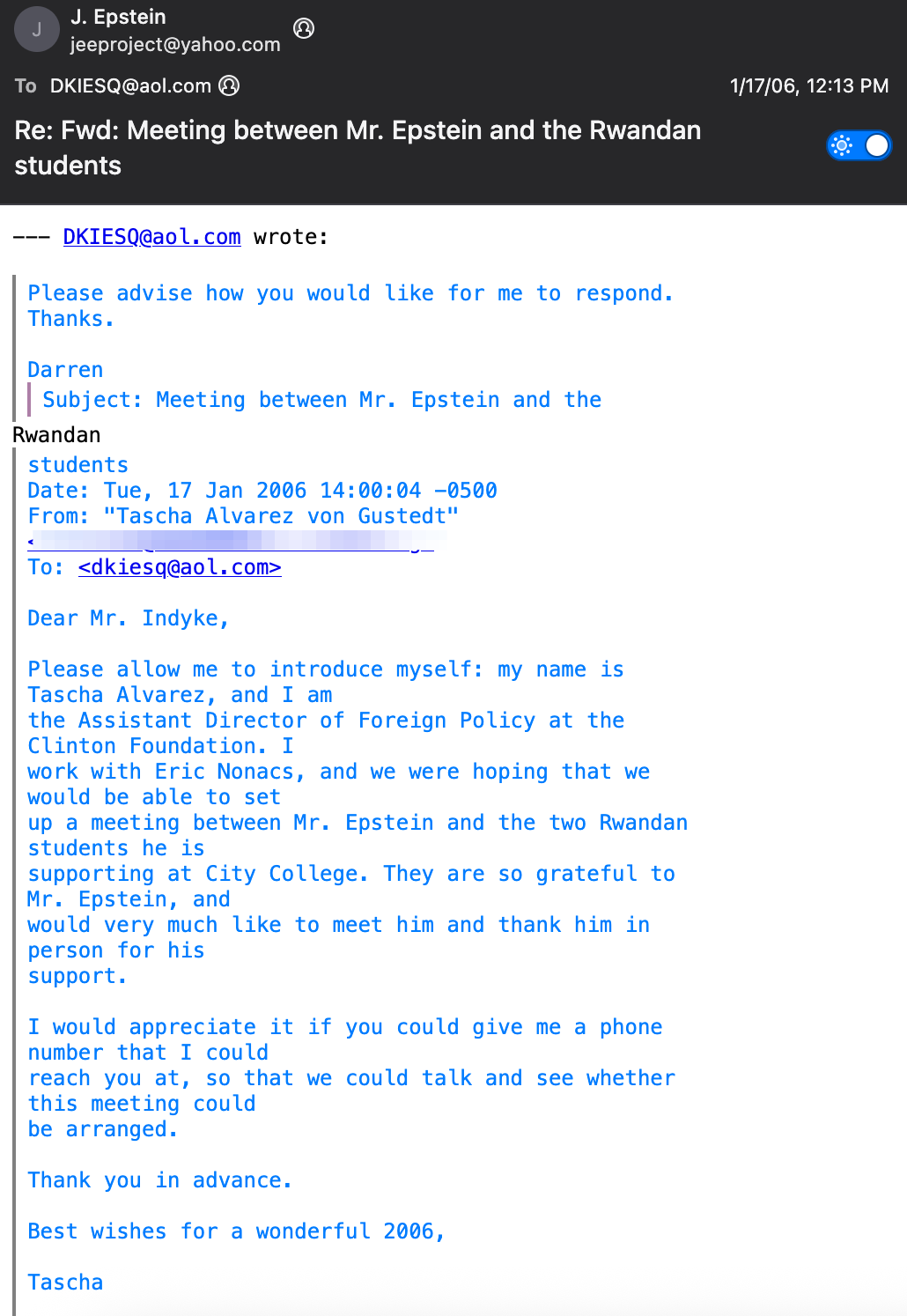
Epstein was far from frozen out of the Clinton Foundation for years after his 2002 Africa trip with Bill Clinton. In January 2006, Tascha Alvarez, Assistant Director of Foreign Policy at the Clinton Foundation, contacted Epstein’s lawyer Darren Indyke to request a meeting between Epstein and two Rwandan students he was supporting at the City College of New York. Alvarez followed up several times to schedule the meeting, but Epstein repeatedly postponed it.

Clinton Foundation staff asks Epstein to meet Rwandan students, January 17, 2006.

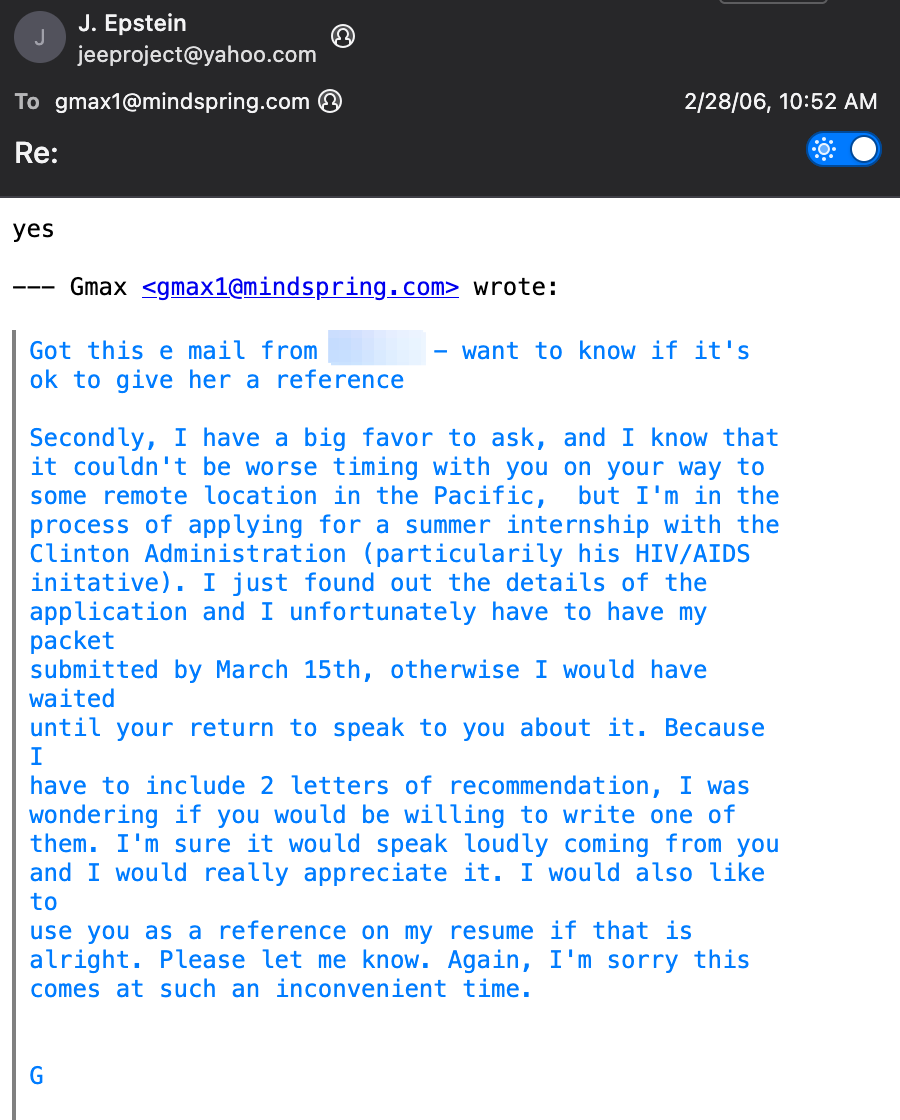
Maxwell’s name was perceived to hold some caché in Clinton’s world. In February 2006, Maxwell received a request for a reference letter for an internship with Clinton; the person who made the request wrote, “I’m sure it would speak loudly coming from you.” Maxwell asked Epstein’s permission before agreeing.

Maxwell asks Epstein for approval to write a letter of reference for somebody applying for a Clinton internship, February 28, 2006.

That year, Epstein donated $25,000 to the Clinton Foundation.

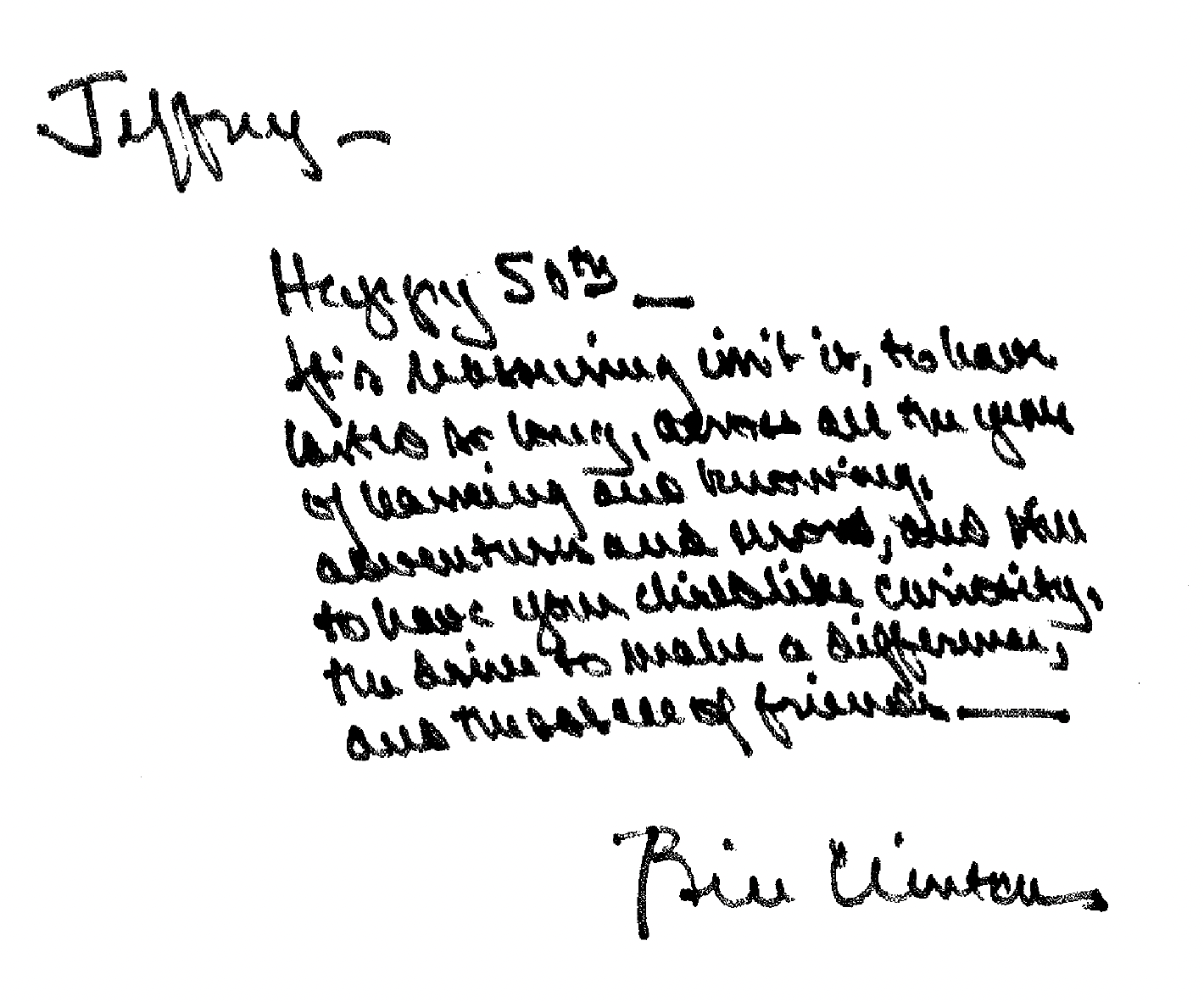
Before Epstein’s crimes became known to the public, Bill Clinton seemed to consider Epstein a good friend. In 2003, he penned a handwritten note in Epstein’s fiftieth “birthday book,” celebrating their friendship:

Jeffrey — Happy 50th — It’s reassuring isn’t it, to have lasted so long, across all the years of learning and knowing, adventures and wonder, and still to have your childlike curiosity, the drive to make a difference, and the solace of friends —

Bill Clinton

Bill Clinton handwritten note to Jeffrey Epstein in 2003, from “birthday book.”

Leave a comment

Share


From Drop Site News via this RSS feed

6


Drop Site is a reader-funded, independent news outlet. Without your support, we can’t operate. Please consider making a 501(c)(3) tax-deductible donation today.

Subscribe now

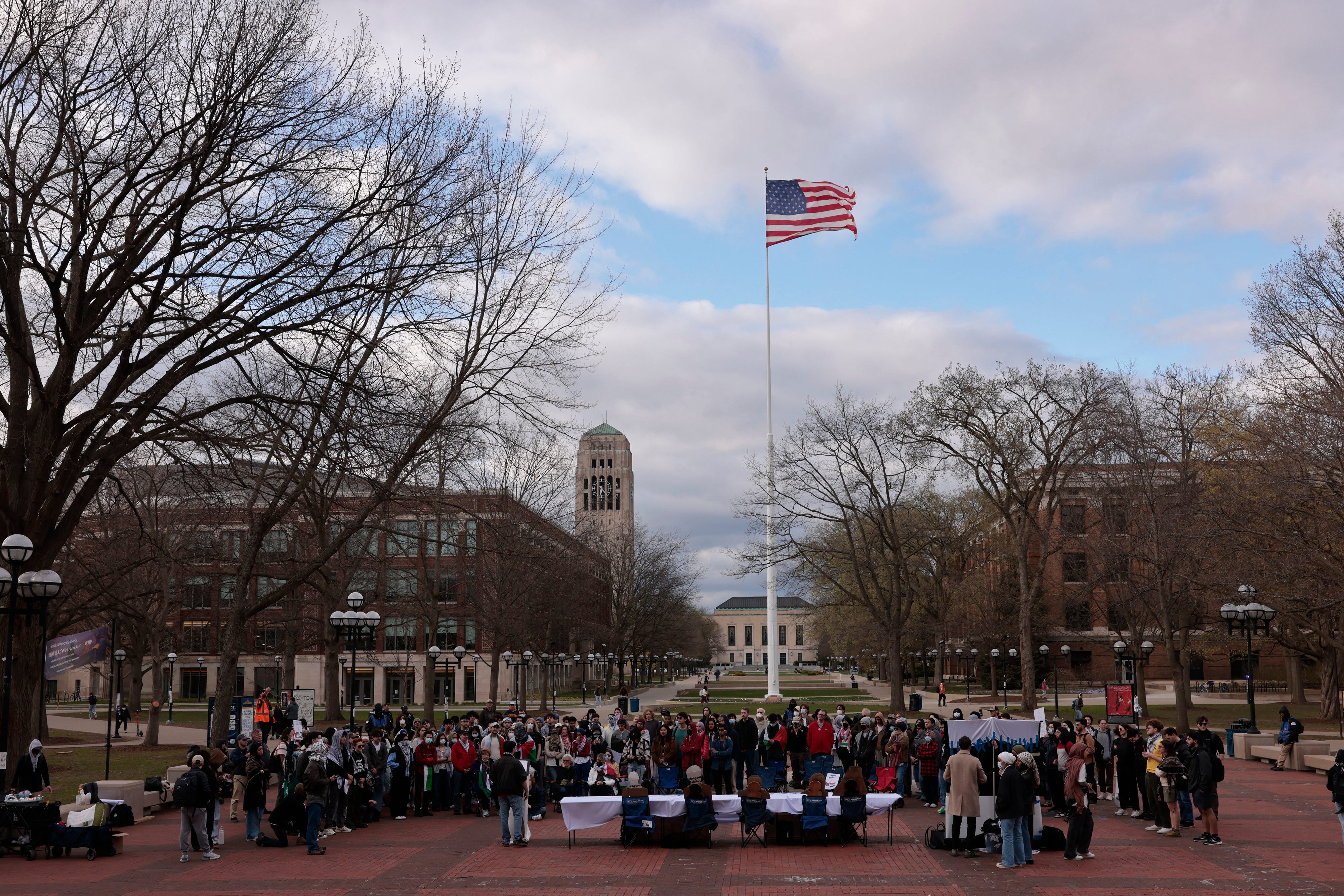
Pro-Palestinian demonstrators gather for a mock trial against the University of Michigan’s Board of Regents on the university’s campus in Ann Arbor, Michigan, on April 21, 2025. The demonstrators claim for the last 18 months, the president and the regents have proven their allegiance to Israel and their own political interests over the university community. (Photo by JEFF KOWALSKY / AFP) (Photo by JEFF KOWALSKY/AFP via Getty Images)

Article by Tom Perkins

Last year, the pro-Israel regents of University of Michigan (U-M) ignited controversy by recruiting State Attorney General Dana Nessel to crackdown on campus Gaza protesters. Now, members of U-M’s Board of Regents are making large donations to Oakland County Prosecutor Karen McDonald, a candidate who may replace Nessel.

McDonald is the prosecutor in a wealthy suburban county north of Detroit. McDonald also received the highest level of corporate donations from the state’s largest businesses and executives, and is viewed as the establishment choice to replace Nessel.

McDonald is also receiving significant backing from donors that include prolific GOP contributors and those connected to pro-Israel organizations in metro Detroit, as well as from national organizations like Friends of the Israeli Defense Forces and AIPAC. The regents and pro-Israel donors have contributed at least $200,000 to McDonald’s campaign, according to state and federal campaign donation records reviewed by Drop Site.

McDonald has reportedly raised $840,000 in donations so far—more than the other four candidates combined. An analysis of campaign finance records shows donations of at least $2,500, meaning it is likely the pro-Israel donations to her are higher.

State records show significant donations from the three U-M regents most closely tied to Nessel, who led the attack against campus protesters. Those donations include nearly $11,000 from regents Jordan Acker and Mark Bernstein, who have belonged to pro-Israel groups like the Jewish Federation, American Jewish Committee, and Hillel. Bernstein twice referred to pro-Palestinian advocates as “an antisemetic mob,” including after his home was vandalized with anti-Israel graffiti, and Acker said the protests demonstrate that “antisemitism runs rampant” on campus.

Regent Denise Illitch, part of the Little Caesar’s Pizza billionaire family, donated the maximum allowed by a single individual of nearly $8,400.

Records show a diverse range of large donations from state and national pro-Israel figures, including $37,500 from the family of Gary Torgow, a prominent Michigan bank executive, prolific campaign donor, and president of the Jewish Federation of North America.

While opinions of each person included in the campaign donation analysis aren’t known, they are affiliated with pro-Israel activists or groups in metro Detroit. Many are associated with the Jewish Federation of Detroit, for example, which has materially supported the Friend of the IDF, funded explicitly pro-Israel nonprofits, and criticized the use of the term “genocide” to describe Israel’s assault on Gaza.

Detroit Pistons executive Arn Tellem, who owns an Israeli basketball team, and his wife gave a combined $16,650. Tellem in December 2023 penned an op-ed critical of the Gaza protest movement.

James Bellinson, who gave nearly $8,400, is an AIPAC and major centrist Democrat donor. His wife gave $7,200 to US Rep. Shri Thanedar in November 2023, soon after the Detroit lawmaker announced he was splitting with the Democratic Socialists of America because it was critical of Israel, and he became a vocal proponent of Israel’s assault on Gaza.

Another $8,000 came from Nicole Eisenberg, who is affiliated with the Jewish Federation and recently co-executive produced a documentary on antisemitism in the US with Debra Messing. Artist Gretchen Davidson, who married into the billionaire Davidson family that since the 1940s has been a major Zionist movement funder, gave $1,000. Joan Epstein, who is part of the national Hadassah Women’s Zionist Organization of America, and who took part in a Friends of IDF fundraiser, contributed $2,500.

The donations appear to be an effort by the regents and donors to secure another pro-Israel ally in the state’s highest law enforcement office, and raises ethical questions about campaign donations to prosecutorial candidates.

While campaign donations are considered protected speech, prosecutorial candidates who knowingly receive donations from a complainant in a high-profile case should consider returning the donation or recusal, said Chesa Boudin, a former San Francisco district attorney who now runs the University of California at Berkeley Criminal Law and Justice Center.

“There can certainly be the appearance of impropriety… … and I would exercise my own discretion to maintain the appearance of impartiality and independence,” Boudin said.

A donation to an AG can be much more impactful than donating to a legislative candidate, Boudin added, because “there’s a much more direct connection between the outcome of the election and the issue that [the donor] is contributing for.”

In a statement, a McDonald spokesperson said she “has received support from a broad variety of Michigan residents who are looking for an attorney general who will keep our communities safe, stand up for the vulnerable, and fight to protect their rights from Donald Trump.”

“Regarding the regents, Karen has not reviewed the cases and cannot comment on the details, but believes the attorney general’s office should instead be focused on serving communities without resources,” the spokesperson said.

Landscape of the Election After Nessel

McDonald’s main opponent is Eli Savit, a progressive Jewish prosecutor in Ann Arbor. U-M’s response to protesters has been a legal controversy since late 2023, when Savit filed only minor charges against four out of 40 people arrested during a sit-in at a campus building. He also did not immediately press charges against protesters in early 2024, including those who set up an encampment. Savit declined to comment for this article.

Angered by Savit’s unwillingness to quickly crack down on the protesters, U-M’s regents executed a highly unusual move in mid-2024 in recruiting Nessel. A Guardian investigation revealed Nessel’s extensive political, financial, and personal connections to university leadership.

Six of eight regents contributed more than $33,000 combined to Nessel’s campaigns, and her office hired regent Bernstein’s law firm to handle major state cases, Bernstein co-chaired her 2018 campaign, and she has personal relationships with some regents, including Acker. Nessel also had the backing of many state pro-Israel groups. Nessel and the university have denied that she was “recruited.”

She filed charges against 11 campus protesters, but ultimately dropped the cases. A judge was preparing to hold a hearing on disqualifying the AG’s office over bias, in part because of her connections to the regents, and she would have been forced to turn over communications about why she took the cases.

In April 2025, Nessel partnered with the Trump FBI to raid homes where several student protesters lived. Nessel’s office said at the time that the raids were part of an investigation into the vandalism of homes and businesses of U-M leadership. Nessel and the Trump administration seized phones, computers and a car, but have since said nothing about the raids.

The next attorney general may takeover the investigation into those crimes, which has been a point of outrage for pro-Israel advocates in the region.

The new round of donations shows how far regents will go, said Drin Shapiro, a U-M student who is part of the TAHRIR Coalition, a student-led coalition of more than 90 pro-Palestine student organizations at the University of Michigan. Shapiro was charged by Nessel, but later had his cases dismissed.

“This proves that no matter what, the regents are going to try to have a foot in the door with whoever is able to slap charges on the protesters—if not Nessel then McDonald,” Shapiro said. He added that TAHRIR stays out of electoral politics and won’t be backing any of the candidates.

Shapiro said Nessel was forced to drop case against protesters over similar pro-Israel ties, and McDonald, if she investigated students, would be “doing the same thing.”

Shapiro added that “She would prosecuting pro-Palestine protesters and over stepping her jurisdiction just to serve pro-Israel interests, and particularly for regents Jordan Acker and Mark Bernstein.”

Subscribe now

Leave a comment


From Drop Site News via this RSS feed

7


Drop Site is a reader-funded, independent news outlet. Without your support, we can’t operate. Please consider making a 501(c)(3) tax-deductible donation today.

Subscribe now

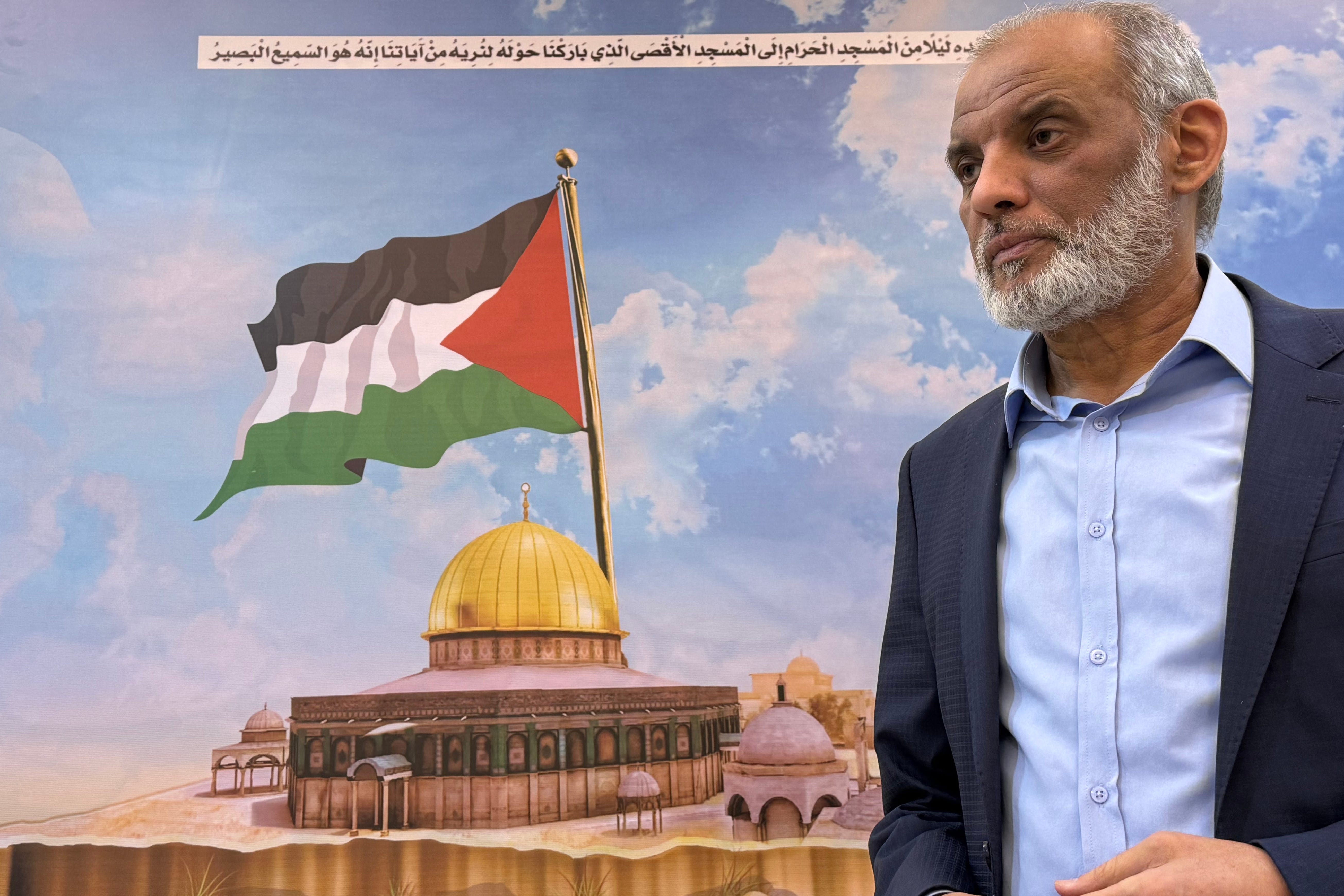
Hamas political bureau member Husam Badran in Doha, Qatar on October 11, 2025 (Photo by Rania SANJAR / AFP) (Photo by RANIA SANJAR/AFP via Getty Images).

DOHA, QATAR—Since President Donald Trump falsely proclaimed the dawn of a new era of peace and harmony in the Middle East in early October, Palestinians in Gaza have lived in an Israeli-imposed purgatory. The scorched-earth terror bombings and full-spectrum blockade on any life essentials entering Gaza have been replaced by sporadic, though daily, Israeli strikes and a trickle of food and medicine deliveries in quantities far below the terms agreed to in the October 10 “peace” deal. What is happening in Gaza is not a ceasefire, but a lower intensity, slower-paced killing operation by an Israeli regime daring Palestinians to fight back.

As the White House struggles to convince even a single nation to deploy forces in Gaza on a mission to disarm the Palestinian resistance, Hamas negotiators say there has been no formal communication from the U.S. on how it intends to proceed on any of the terms laid out in Trump’s sweeping plan. There have been no substantive discussions on how Gaza will be governed, who will be in charge of its internal security, when or how Israeli forces will withdraw, and what role Palestinians will play in determining their own destiny.

The fact remains that Hamas and other Palestinian factions did not sign an agreement beyond a ceasefire, exchange of captives, and an initial framework for the redeployment or withdrawal of Israeli forces from some parts of Gaza. Officially, there is no deal on a “second phase.” Moreover, several senior Hamas officials told Drop Site that there currently are no substantive negotiations happening with Palestinians outside of a process that appears aimed at using Palestinian Authority chief Mahmoud Abbas to give the appearance of Palestinian endorsement.

“The matter is so complex. It’s not just that we, as Palestinians, do not have a clear view of the next steps: I tell you, even the countries in charge, including America, do not have clear steps,” said Husam Badran, a senior Hamas official and a member of its political bureau, in an interview with Drop Site. Badran is a former West Bank commander of the Qassam Brigades and is currently Hamas’s head of national relations. He told Drop Site that Palestinians recognize they cannot issue demands of Trump, but can impact the reality on the ground through their refusal to surrender or to leave.

“Even though Palestinians are relatively weak compared to the occupation—sometimes we may not be able to impose what we want, but we can reject what we don’t want. As Palestinians—not just Hamas—we still have the ability to reject what we do not accept. And the world has started to realize that,” Badran said. “Certainly, we do not have the forces, military and financial capabilities, or international relations that the occupation has, but in the end, we are the people of this land; we are the people of this cause; and we are a people oppressed for more than seventy years. We live in an extremely sensitive region—not in the far West or the far East, but at the heart of the world.”

Several Palestinian negotiators who maintain contact with regional mediators from Qatar and Egypt told Drop Site that what is happening behind the scenes is largely a negotiation between the U.S. and Israel, as well as consultations with regional mediators Egypt, Qatar, and Turkey. The Palestinian side, Hamas officials said, is periodically briefed on the evolution of the U.S.-Israeli positions gleaned by the mediators, but it is not engaged in any process resembling a negotiation.

On Friday, the foreign ministers of Egypt, Qatar, and Turkey traveled to Miami, Florida, for meetings with Trump’s Special Envoy Steve Witkoff. The gathering represents the highest-level talks that have taken place since the October agreement was signed in Sharm El-Sheikh, Egypt.

“The resistance forces have fully adhered to their obligations under the agreement and remain committed to doing so, but the current situation is unsustainable,” said senior Hamas official Basem Naim on Friday. “We expect examination of how to implement what remains of the plan in a way that achieves sustainable stability, launches comprehensive reconstruction, and lays the foundation for a political path in which Palestinians govern themselves—culminating in the establishment of an independent state.” Naim called on the U.S. and regional mediators to “put an end to the ongoing Israeli rampage and to compel the occupation to abide by the requirements of the Sharm El-Sheikh agreement—foremost among them the provisions of the humanitarian track, including the entry of aid, the opening of Rafah crossing in both directions, and allowing in all needs for reconstruction and rehabilitation of infrastructure.”

Since October, Israel has adopted a posture as a victorious conqueror who now dictates the terms of surrender and occupation to a vanquished enemy—a stance fiercely rejected by Hamas. “The battle did not end with the defeat of the resistance or with the military defeat of Hamas. We paid an extremely high price, yes—martyrs and the destruction of infrastructure—but in the end, we were not defeated in this battle. You cannot compare us—excuse me for saying this—to the Japanese emperor when he was defeated in World War II,” said Badran. “We reached an agreement in Sharm El-Sheikh. It is true that [from the Palestinian perspective] the agreement is not just, but it is a political agreement attended by all the world’s leaders, foremost among them Trump.”

Despite repeated demands by Israel throughout the war against Gaza that Hamas surrender, it failed to achieve that aim through its genocidal war. Badran said that Palestinians will not suddenly capitulate their liberation struggle through a bureaucratic process masquerading as a peace agreement. “If the world—and especially the Americans, who today have the greatest influence in the world—wants to create genuine, long-term stability in this region, the only solution begins with the end of the occupation, not with anything else,” Badran said. “If you want to start by talking about disarmament and Palestinian surrender—the Palestinian will not surrender. And I tell you: even if Hamas were to disappear, others would come after it.”

On Thursday, Trump claimed he had “ended the war in Gaza, bringing for the first time in 3,000 years, peace to the Middle East.” The statement, delusional on its face, was nonetheless an encapsulation of Trump’s overarching approach to the Gaza plan—animated by a belief that his edicts alone entail equal results. Reality, though, is far more complex, and the prospects for an enduring resolution bleak.

Hamas officials have increasingly warned that Israel’s actions—and the U.S. refusal to compel Israel to abide by the terms of the ceasefire—risk destroying the deal. The head of Hamas in Gaza, Khalil Al-Hayya, said recently that Israel’s actions “threaten the agreement’s ability to hold,” and called on Trump “to compel the occupation to respect the agreement, adhere to its implementation, and refrain from exposing it to collapse.”

There are some indications that Trump realizes the Israelis want to ignite the flame that could torch his deal. The U.S. reportedly expressed its concerns that Israel conducted the strike without giving the White House prior notice and warned Israeli Prime Minister Benjamin Netanyahu against actions that would jeopardize Trump’s plan. Since the October deal went into effect, nearly 400 Palestinians have been killed in Israeli attacks, the vast majority of them civilians. Israel has also been systematically murdering the very combatants with which it signed the ceasefire deal, brazenly justifying its attacks by claiming to target Qassam fighters, including Israel’s assassination on December 13 of Raed Sa’ad, a senior commander of the Qassam Brigades. Rather than retaliate by force, the Palestinians have repeatedly appealed to mediators to intervene.

“There is no doubt that these deliberate, clear, and blatant violations pose a very serious threat to the agreement and cause it to wobble and weaken,” said Ghazi Hamad, a senior Hamas negotiator on Sunday. He warned that the pervasive Israeli violations “place the agreement in grave danger.”

The White House has already begun downsizing its plans and “pushing for an initial deployment [of an international force] that would operate only in areas controlled by Israel,” perhaps only in areas of Rafah in southern Gaza, according to the Wall Street Journal. The wild card, then, becomes whether Trump would greenlight expanded Israeli military operations in the name of disarming Hamas. That scenario would force the Palestinian resistance to decide whether to retaliate in self-defense, which Israel would seize upon to further escalate its own attacks.

Badran and other Hamas officials told Drop Site that if Trump and other world leaders do not compel Israel to cease its war of annihilation in Gaza and halt the intensifying Israeli assaults and settlement expansion in the West Bank, a third intifada could break out. Moving forward with a plan in Gaza that seeks to advance Israel’s war of conquest through non-military means under a false banner of peace will reignite the war and send a message to Palestinians that they have no choice but armed resistance.

“If the world once again says, ‘There’s been a war, we will calm things down, [slightly] improve Palestinian conditions, and then the Palestinian cause will die,’ they will be surprised by what comes next,” Badran said. “The matter is not only about what the occupation wants. If the world deals with us Palestinians as if the [Israeli] occupation decides everything, this region will never find stability. And not only in Palestine.”

The Qassam Brigades, military wing of Hamas, pray as they attend a military parade during the 30th anniversary of the foundation of Hamas in Khan Younis, Gaza, on December 5, 2017. (Photo by Ali Jadallah/Anadolu Agency/Getty Images)

“Phase Two”: Disarmament, the ISF, and the “Yellow Line”

To listen to Trump and his allies, the priority right now is to move to the “second phase” of his grand deal. U.S. officials speak as though the terms have been laid out clearly and what remains is implementation. The plan is this: A “Board of Peace” chaired by Trump and consisting of a hand-picked assortment of world leaders will take charge of Gaza’s destiny and create a massive private and public financing scheme, estimated at $70 billion, to rebuild the enclave as part of an attractive investment opportunity. To do this, they will first deploy an International Stabilization Force (ISF) to disarm the Palestinian resistance and assume control of areas currently occupied by the Israeli army. A 15-member technocratic committee of non-partisan Palestinians will be enlisted to act as a civil administration inside Gaza, though they will be entirely beholden to the dictates of Trump’s imperial board and function more as a city council than a sovereign governing authority.

Palestinians in Gaza, the deal sheet claims, will not be forcibly displaced, but little else about their fate beyond that is spelled out. There is mention of a sufficiently reformed Palestinian Authority (PA) possibly returning to Gaza, though who would determine how the PA achieves that status is not detailed. “While Gaza re-development advances and when the PA reform programme is faithfully carried out, the conditions may finally be in place for a credible pathway to Palestinian self-determination and statehood, which we recognize as the aspiration of the Palestinian people,” Trump’s plan says without offering any specifics or addressing the massive attacks and displacement operations underway in the occupied West Bank.

The most contentious issue right now centers around the planned deployment of the international force. Trump and Netanyahu have said its first mission would be the total disarmament of the Palestinian resistance and the demilitarization of the Gaza Strip. To date, Trump has failed to get any nations to volunteer for a deployment of that nature. Arab and Islamic countries, which Trump claimed for weeks would form the backbone of the ISF, say the mission must focus on creating a barrier between the Israeli occupation forces and the Palestinians of Gaza and ensuring that the terms of the ceasefire are respected. “We do not want a stabilization force in Gaza that serves to protect one party at the expense of another,” said Qatar’s Prime Minister and Foreign Minister Mohammed bin Abdulrahman Al-Thani on Wednesday. “Delays and ceasefire violations endanger the entire process and place mediators in a difficult position,” Al-Thani said after meeting with Secretary of State Marco Rubio, adding that the force’s role should be to safeguard the October agreement.

“What we hear from these [Arab and Islamic] countries—whether we speak with them directly or through mediators—is that they want the mission to be completely clear. They cannot send their forces on an unknown mission. The most important thing is that there should be no clashes between them and the Palestinians, because that would affect even the public image of these countries,” Badran said. “The sympathy for Palestinians among Arab and Islamic peoples is nearly absolute. Therefore, any ruler in any country has to consider that they are not, in effect, confronting the Palestinians. And that’s where the complexities come in.”

Al-Hayya said “the role of international forces should be limited to maintaining the ceasefire and separating the two sides along the borders of the Gaza Strip with our 1948 lands, without having any duties inside the Strip or intervening in its internal affairs.”

From the perspective of the Palestinian resistance, the fact that it is openly welcoming the deployment of a foreign force is itself a significant concession. “Historically, Hamas did not agree with the idea of an international force. This was our fundamental political stance,” said Badran. “However, given the developments that occurred during the war—and the heavy price paid by our people in the Gaza Strip—we are ultimately a pragmatic movement that discusses what serves the general interest. Therefore, we agreed, in coordination with all the factions including the Palestinian Authority and Fatah who took the same position. We have no objection to the principle of international forces—there is no objection to that. But what their role and mission will be—that is what matters.”

In the lead up to the signing of Trump’s plan, Israel made clear it opposed the deployment of a UN force in Gaza, and senior Israeli officials railed against the international body as an antisemitic enabler of Hamas. On November 17, Trump managed to secure a UN Security Council resolution that endorsed his private force without placing it under any UN command or oversight. Nonetheless, Netanyahu’s public position on the deployment of the ISF has been one of scorn, dismissing outright that it would ever undertake the disarmament of the Palestinian resistance, while claiming that Israel would eventually need to resume its war. “Our friends in America want to set up an international force to do the work,” Netanyahu said on December 7. “I said, ‘Please, are there volunteers? Go ahead.’ We know there are certain tasks this force can do, but not everything—perhaps not even the main tasks.”

Israeli officials have also declared that the so-called “yellow line,” which currently partitions Gaza in half, is the new border with Israel by which Israel’s occupation will indefinitely remain in control of eastern Gaza. “The ‘yellow line’ is a new border line, serving as a forward defensive line for our communities and a line of operational activity,” said Eyal Zamir, chief of the general staff of the Israeli army, during a visit to troops in northern Gaza on December 8. “We have operational control over extensive parts of the Gaza Strip, and we will remain on those defense lines.” The line, which was first presented in a map accompanying Trump’s plan, was officially framed as the initial Israeli redeployment position. Since the ceasefire came into effect, Israel has been constructing military infrastructure and demolishing Palestinian homes and buildings in eastern Gaza.

The U.S. has been floating a proposal to construct so-called Alternative Safe Communities to entice Palestinians to leave areas of Gaza still controlled by Hamas by offering them temporary housing, food, and medical services in areas currently under full Israeli occupation. “This is not an earthquake that happened in an area and [you need] to move people to another area,” said Badran. “The story is connected to a people, a life, a future, political ambitions, study, education, and other such things. Even if this plan succeeds—which I expect it will not—they are talking about many years ahead. Who will have patience with them?”

Dr. Mustafa Barghouti, a prominent Palestinian political leader and former presidential candidate, sees a sinister motive driving the actions in eastern Gaza. “It’s Bantustanization with another goal, which is liquidation of the Palestinian cause. The Israelis want to end Palestine and the Palestinian people. That’s exactly what Netanyahu is dreaming about,” Barghouti said in an interview with Drop Site. “The way he’s dealing even with this idea of stabilization forces, making jokes of it. And he hints that he’s the only one who will be able to conduct the job [of disarming Palestinians]. I think he never gave up the idea of total occupation of Gaza and ethnic cleansing of its population,” Barghouti added. “The same applies to the West Bank where they are using settler groups to attack Palestinians. And they’ve already uprooted 60 communities. So the challenge is huge. But one thing I am 100% sure of, there is no power in this world that will force us to leave our country. And there is no power in this world that will break our will.”

Hamas and other Palestinian factions have emphasized that Israel is using the issue of demilitarization and disarmament of the resistance as a proxy to demand a total surrender of the cause of national liberation.

“The occupation wants not only to confiscate weapons: it could pursue us even down to the knives in people’s kitchens as ‘weapons.’ It knows perfectly well that we do not have warplanes, tanks, armored personnel carriers, or naval vessels. Everyone knows that. We are not an army: we are a resistance movement whose weapons are, in the end, simple weapons. So what does the occupation want? It wants to break the idea of resistance within the Palestinian people,” Badran said. “The issue is not about weapons; it is about wanting the Palestinian to surrender and abandon his political aspirations.”

Hamas negotiators understand that the issue of disarmament is not going to disappear and that the Israeli narrative has been fully embraced in Washington and in European capitals. “We affirm that the resistance and its weapons are a legitimate right guaranteed by international law for all peoples under occupation, and that this right is linked to the establishment of the Palestinian state,” said Al-Hayya. “We are open to studying any proposals that preserve this right, while ensuring the establishment of an independent Palestinian state and the Palestinian people’s right to self-determination.”

The foreign ministers of Turkey and Egypt—two of the most important Muslim allies supporting Trump’s plan—have said that the U.S. must be realistic about the issue of disarmament and an international force. On Friday, Rubio appeared to acknowledge that Israel’s demand for total disarmament was implausible and that the issue will require an agreement with the Palestinian resistance. “You’re not going to convince anyone to invest money in Gaza, if they believe another war is going to happen in two, three years. So, I would just ask everyone to focus on what are the kind of weaponries and capabilities that Hamas would need in order to threaten or attack Israel—as a baseline for what disarmament would look like,” Rubio said. “We’re going to leave that to the technical teams to work on. It would have to be something, obviously, that they’re willing to agree to—that our partners can push and pressure them to agree to. It also has to be something that Israel agrees to. In order for that to work, both sides have to agree on it—we need the space to do it.”

In meetings with regional mediators, Hamas has proposed a range of ideas on how to address the issue on a technical level. If the concern is ensuring no attacks are launched against Israel, then Hamas believes an internationally-enforced, long-term truce is the best path. “We are open to having a comprehensive approach in order to avoid further escalations, or in order to avoid any further clashes or explosions,” Naim said in early December. He told Drop Site Friday that, in order for Hamas to offer an official stance, it needs to see an actual proposal. “We have no idea about the true goals of the plan in clear words,” Naim said.

Hamas has expressed an openness to a deal that would see the weapons of Hamas and Islamic Jihad stored or “frozen,” a configuration that would come with the endorsement of the Palestinian resistance groups themselves. Violating such an agreement, especially one endorsed by large numbers of Arab and Islamic countries, would carry grave consequences for the broader Palestinian struggle. The most significant risk to such an arrangement, Hamas officials argue, is that Israel would continue its attacks as it has in Lebanon, while insisting Palestinians have no right to self-defense.

“In the occupation’s narrative, it wants to portray weapons as the obstacle even to implementing the second phase. Why should we fall for this narrative? In the first phase, the occupation put forward a clear goal: it convinced the Americans, and perhaps others, that the main reason for the continuation of the war was the presence of [Israeli] captives held by the resistance in the Gaza Strip. And the entire world began repeating that the only problem was the captives,” said Badran. “So where did the occupation uphold its commitments in the first phase? It did not uphold them in anything at all. This shows that the captives were merely a pretext and an excuse. Now they want to push us into the second phase—which is far more dangerous and strategic—using the same method, by claiming that the problem is weapons. The problem is not weapons.”

Husam Badran, Hamas’s head of national relations and a former Qassam Brigades commander, speaks to Drop Site’s Jeremy Scahill and Jawa Ahmad in Doha, Qatar, December 11, 2025 (Photo: Jeremy Scahill).

The Future of Gaza’s Security

Hamas officials have reiterated their position that Palestinians should be in charge of governance and internal security in order to stabilize Gaza, prevent a resumption of fighting, and open a space for real negotiations on the broader agenda embedded within Trump’s plan. Hamas has formally agreed to a non-partisan technocratic committee to govern Gaza in the interim, but it has insisted that it not simply serve as an enforcer of a foreign or Israeli agenda. International forces, they emphasized, should not be engaged in law enforcement or disarmament.

Badran argued that a Palestinian police force, deployed with the full support of all Palestinian factions, including Hamas and Islamic Jihad, would have the local credibility necessary to establish order and to ensure compliance with any agreement governing weapons of the resistance. He asserted that Hamas’s offer to agree to a long-term truce with Israel, wherein the Palestinian resistance agrees to store its weapons and not deploy them in any attacks against Israel, is the only tangible path to resolving the issue.

“The committee that assumes responsibility for the Gaza Strip in all its details must also take responsibility for what is called internal security or civil peace within the Gaza Strip,” he said. “The Palestinian police currently in the Gaza Strip for roughly the past twenty years are not Hamas police. It is true that Hamas has been overseeing the overall administration, but these employees—the police force—are ultimately a civilian police force—not an army. As a result, large numbers of them are not members of Hamas, even to this day,” Badran added. “Any armed individual other than the Palestinian police who appears in the street carrying a weapon should be held accountable by this police force, and his weapon confiscated. We were very clear on this point: internal security related to the Gaza Strip is the task of this committee, which is responsible for all matters, including security.”

Badran, who was born in Nablus in the West Bank, spent a total of 14 years of his life in Israeli prisons, and he was a cellmate and close friend of Yahya Sinwar, the former leader of Hamas in Gaza who was killed by Israeli forces on October 16, 2024. Badran was arrested in 2002, and in 2004 he was sentenced to 17 years in prison on charges that he orchestrated a series of deadly attacks during the second Palestinian intifada, which began in 2000. He was released in 2011 with Sinwar and more than 1,000 other Palestinians in exchange for Israeli soldier Gilad Shalit.

During his interview with Drop Site in Doha, Badran described the motivations behind the October 7 attacks; the dire humanitarian conditions in the Gaza Strip, which worsened by the month prior to the attacks; and the suffering endured by Palestinians in the seven decades preceding the launch of Operation Al Aqsa Flood in 2023.

“I think the general Palestinian feeling was that Palestinians were forced into such a step because the world wasn’t listening to them. You remember in 2018, 2019, when the Great March of Return took place—peaceful marches. Hundreds of Palestinians were killed, and still the world did not grasp the message, and the occupation didn’t either. So maybe October 7 came to tell the whole world that Palestinians are capable of doing something that you wouldn’t expect,” Badran said. “We are not seeking improved living conditions—we are not a minority living within another state. We want our political rights. And, therefore, I tell you that October 7 is fundamentally because of this idea.”

He described how Palestinians held inside Israeli prisons regularly go on prolonged hunger strikes, in some cases to achieve a simple demand that they be given glasses to drink tea. “So someone who cannot give up small things—and who paid the price of going on a hunger strike for twenty days just to obtain that one glass cup—why do you expect him to surrender?” he added. “This is the Palestinian mentality. Failing to understand it will lead major political leaders—including Trump and his team—to a wrong understanding, and therefore to wrong decisions. The feeling that Palestinians are weak, that their capabilities are limited, that Gaza has been destroyed, and that the occupation today has achieved all its glory through attacking the Palestinians—this leads to a false conclusion: that the world can live with this situation. And I tell you: it cannot.”

Badran said that Palestinians are not simply seeking better tents in which to live or a reduction in checkpoints or a slower pace of the expansion of Israeli settlements. Nor, he said, will they accept a multi-decade bureaucratic process, like Oslo, that promises a vague resolution to questions of statehood and self determination as Israel’s war of annihilation continues unabated.

“Palestinians want something clear and direct: their right to self-determination, to govern themselves, and to establish a Palestinian state in Gaza, the West Bank, and Jerusalem, with full sovereignty—without anyone controlling us or interfering in our internal affairs. This is a natural demand for any people. It is neither unrealistic nor unreasonable,” he said. “If the world wants real stability, it must act now and provide Palestinians with a genuine solution—not a solution limited to improving [living] conditions.”

Subscribe now

Leave a comment


From Drop Site News via this RSS feed

8


This week, the New York Times awoke from its slumber to publish an extensive investigation on Jeffrey Epstein that purported to put to rest the question of how the man made his money early in his career. In it, the Times dismisses the possibility that Epstein could have worked for or adjacent to intelligence agencies. “Abundant conspiracy theories hold that Epstein worked for spy services or ran a lucrative blackmail operation, but we found a more prosaic explanation for how he built a fortune,” the paper wrote.

To the paper’s credit, their journalists have put into the record some details that took an impressive effort to track down. For instance, the paper reported about Epstein’s business associates in the early 1980s:

Epstein had been spending extravagantly, and despite his lofty compensation at Bear Stearns and his work for [Douglas] Leese, he found himself strapped, even occasionally bouncing rent checks. Back in New York, he joined forces with John Stanley Pottinger, a lawyer who had recently left a senior post in the Justice Department. Epstein, Pottinger and Pottinger’s brother rented a penthouse office in the Hotel St. Moritz on Central Park South. (The broker, Joanna Cutler, told us that Epstein initially stiffed her on the commission.)

The Times deserves credit, we suppose, for digging up that nugget from his one-time broker—but had the paper decided to look up rather than look down, they may have noticed something a bit more revelatory in their own reporting.

Stanley Pottinger, as it happens, was a notable figure in the scandal that became known as Iran-Contra, in which the CIA used Israel as a middleman to move off-the-books weapons to Iran. In the early 1980s, under the CIA’s supervision, Pottinger advised an Iranian banker on shipping embargoed arms to Iran using fraudulent paperwork and overseas “dummy companies”—in the very same period that Pottinger and Epstein worked together selling “tax-avoidance” strategies from a penthouse by Central Park. Pottinger’s system eventually gave rise to a network of covert intermediaries shipping arms around the world; the CIA’s profits became a slush fund used to illegally bankroll the insurgent Contra army, who waged a war against Nicaragua’s leftist government while simultaneously trafficking cocaine to the United States.

The other figure from Epstein’s past, Douglas Leese, meanwhile, is described by The Times as “a defense contractor with extensive connections in the arms industry and the British government.” What he did with those connections and where he trafficked those arms is left unexplored by the paper—a look at Bermuda financial records and Leese’s own lawsuit filed in the U.S. District Court for the Southern District of Miami, suggests he was working with the U.S. government and linked to a Chinese arms manufacturer. The Times also failed to note that Epstein and Leese had a mutual associate in Adnan Khashoggi, the notorious money launderer and weapons trafficker—who was also a central player in the Iran-Contra affair.

The Times did find that Epstein was “a relentless scammer” who “abused expense accounts, engineered inside deals and demonstrated a remarkable knack for separating seemingly sophisticated investors and businessmen from their money.” The contrast between what The Times found noteworthy about his relationship with his penthousemate Pottinger—he initially stiffed the broker!—and what they failed to notice is stark. In order to acquit Epstein of any connections to intelligence agencies, the paper of record instead crafted Epstein into an antisemitic caricature of historic proportions. We put this take to The Times, and were told by spokesperson Danielle Rhoades Ha, “We report on facts that we are able to confirm, not supposition.”

Of course, it could be an extraordinary coincidence that Epstein shared a penthouse with an Iran-Contra lawyer, worked for an Iran-Contra arms dealer, and then, as we report below, moved the Iran-Contra planes to Ohio for use by billionaire retail mogul Leslie Wexner. It may simply be a coincidence that Ehud Barak, one of Epstein’s closest friends, was the head of Israel’s military intelligence during the planning for Iran-Contra, and he supervised the CIA’s first delivery. But it might also be something The Times should look a bit closer at, if they’re so inclined.

Until then, Drop Site’s reporting will have to do, and we can’t do it without readers. If you haven’t yet upgraded your subscription, please consider doing so today. And remember that contributions to Drop Site–which you can make here–are fully tax deductible to the extent permitted by law.

Make a Gift

Drop Site News is collaborating with Distributed Denial of Secrets and the creators of JMail to make new emails publicly available and searchable. Epstein’s Yahoo! email cache was vetted and published by DDOS. You can find much of the inbox here. We’re adding new emails every week.

Subscribe now

Private photograph from Epstein’s birthday book, no date.

How the Iran-Contra Planes Landed at Les Wexner’s Base

Jeffrey Epstein helped Leslie Wexner repurpose the CIA’s Iran-Contra planes from arms smuggling to shipping lingerie.

When a Southern Air Transport plane was shot down over Nicaragua in October 1986, the world got a rare window into U.S. government covert activity. Southern Air Transport was founded as a small cargo airline in 1947, the same year the Office of Strategic Services evolved into the Central Intelligence Agency, as the U.S. pivoted to a Cold War posture. The agency owned the airline outright from 1960 until 1973, at which point it was sold to at which point it was sold to the same man, Stanley G. Williams, who had run the company since the Kennedy administration.

The downing of the plane, and the testimony of its lone survivor, Eugene Hasenfus, pulled a string that eventually unraveled the scandal known as Iran-Contra. Using Southern Air Transport planes, the CIA was shipping weapons to Iran, using Israel as a middleman, and deploying the profits to arm the Contras against the leftist Nicaraguan government.

None of it was legal, and Southern Air Transport was getting too hot. In need of a new mission, the company relocated its headquarters from Miami, Florida, to Columbus, Ohio. By 1995, the company had rebranded by flying imported shipments of clothing from China. But for three years in Columbus, the airline continued to be dogged by rumors it had been—or was still—involved in smuggling.

According to veteran Columbus journalist Bob Fitrakis, who provided his historical reporting on the topic to Drop Site and The American Conservative, investigators in both the Franklin County Sheriff’s Office and Ohio’s Office of Inspector General were looking into Southern Air Transport amid rising public scrutiny of the Iran-Contra affair—and sources in both offices identified Jeffrey Epstein as having a pivotal role in relocating the planes.

At the time, Epstein was a relatively obscure financier managing the money and real estate investments of Ohio-based fashion and retail mogul Leslie Wexner. Under his stewardship of the Wexner empire, the planes that previously carried arms to Iran and Nicaragua were repurposed to deliver clothes to feed Wexner’s network of retail chains, including Victoria’s Secret and Abercrombie & Fitch.

Southern Air Transport abruptly declared bankruptcy on October 1, 1998—exactly one week before the CIA Inspector General released its official findings on the Iran-Contra affair linking the airline to allegations of Contra cocaine trafficking from Nicaragua. Under pressure from the governor’s office, Ohio officials dropped their inquiries, meaning that Epstein’s role never became public.

How did Epstein end up moving the former Contra planes to Columbus? Answering that question—or at least getting close—requires a closer look at the men behind the scandal that defined the second half of the Reagan administration, and gave the public the clearest look inside the U.S. government’s clandestine global operations in a generation or more. Like a spy service Forrest Gump, Jeffrey Epstein can be found there every leg of the way.

“Finding Hidden Money”

In 1981, Jeffrey Epstein resigned from Bear Stearns amid suspicions of insider trading, and began traveling regularly to London, where he grew close with the family of Douglas Leese, a British businessman with a long career in auto and aerospace manufacturing. Epstein became Douglas Leese’s protégé and fast friends with his sons Nicholas and Julian, according to a podcast interview later given by the latter. After World War II, Douglas Leese had been managing director of his father’s company, Cam Gears, a steering-gear manufacturer that supplied Jaguar, Ford, Nissan, and other global auto brands. In 1965, the company was sold to TRW, a U.S. aerospace conglomerate known for satellites and intercontinental ballistic missiles.

CIA map of the Strait of Hormuz, 1980. Image: Library of Congress.

1979 was a revolutionary year in the Persian Gulf—Saddam Hussein became president of Iraq and swiftly executed and imprisoned his political rivals, while, across Iraq’s eastern border, the people of Iran overthrew the CIA-backed Shah. During Iran’s revolution, university students seized the U.S. embassy in Tehran and took Americans as hostages, leading the U.S. to impose harsh economic and military sanctions.

The CIA planned to fuel a war between Iran and Iraq, to ensure neither Saddam Hussein nor Ayatollah Khomeini could gain control of the Strait of Hormuz, while keeping the Soviet navy out as protector of the Gulf. But the hostage crisis had added a wrinkle to their plans. After the 1979 revolution, the U.S. was prohibited from selling weapons to Iran, as any overt weapons deals would violate an official arms embargo and undermine President Ronald Reagan’s public position that America did not bargain with terrorists.

Instead, in a strategy aimed at reducing Soviet influence with Iran, the CIA tacitly supported weapons sales from China, and Beijing began shipping armaments to both Iran and Iraq in 1980. In spring 1983, Iran signed a $1.3 billion arms deal with China. These weapons were supplied in part by Chinese manufacturing conglomerate Norinco using British Hong Kong as the transshipment point.

Douglas Leese at the time owned a Bermuda holding company, Lorad. Soon after the Iran arms deal was signed, a new Lorad entity, a shell company called Norinco Lorad, was formed in Bermuda; a Hong Kong trading company called Lorad Far East followed a few months later.

Leese’s exact role in China’s weapons sales has never been made public. But in 1995, a British MP—George Galloway, in fact—alleged Leese had clandestinely funded Middle East arms deals using a Bermuda bank. That year, the owners of British retail chain Littlewoods raised alarm bells about Leese’s arms trafficking ties, after the company received a proposal for Norinco to sell washing machines to Littlewoods and weapons to Lorad.

Two years later, in a U.S. civil complaint against the Littlewoods owners, Leese claimed his work concerned “highly-sensitive” projects “believed to be classified by the Department of Defense and other agencies of the United States government.”

Jeffrey Epstein requests a U.S. passport from the State Department before a trip to London in 1983.

Meanwhile, the CIA prepared it own covert pipeline to ship American-made weapons to Iran. In the fall of 1980, the FBI placed Cyrus Hashemi, an Iranian banker, under extensive electronic surveillance, recording tens of thousands of conversations over a five-month span. The tapes revealed that John Stanley Pottinger, Hashemi’s attorney, was helping the Iranians circumvent the arms embargo using phony invoices and overseas shell companies. The Senate Foreign Relations Committee later found that the CIA was involved in planning the arms deals and had met with Hashemi in Pottinger’s office.

Pottinger, it turns out, was working together with Epstein in New York. Pottinger had previously served as an Assistant Attorney General under President Richard Nixon—now, he joined up with another “crook,” and the two men rented a penthouse office together on Central Park South, according to the New York Times. The Times reported that Pottinger and Epstein were pitching “tax avoidance” strategies for wealthy clients, and noted that the business partnership was “short-lived.” In 1984, Pottinger was identified in a federal indictment against Hashemi for illegal arms exports, and Hashemi fled to England.

Pottinger escaped prosecution after the FBI’s incriminating tapes of his conversations mysteriously disappeared; he went on to make a fortune on real estate deals in the 1980s, and became a New York Times’ bestselling novelist. His Times obit from last year reports that his final spy thriller remains unpublished. Hashemi died in 1986 after being infected with “a rare and virulent form of leukemia” that was diagnosed only two days before he died. (His death was later alleged to be foul play.)

After Hashemi’s indictment, another player stepped in to broker access to Iran for the Americans: Saudi arms dealer Adnan Khashoggi, uncle of slain Washington Post journalist Jamal Khashoggi. In July 1985, Hashemi, Khashoggi, and Israeli Prime Minister Shimon Peres had met secretly in Hamburg, West Germany, to hatch a plot: With CIA director William Casey’s blessing, the U.S. would ship the weapons to Israel, Israel would sell its own weapons to Iran, and Washington would commit to replenishing Israel’s stockpile later.

Epstein obtained an Austrian passport with a false name and an address in Saudi Arabia at some time in the 1980s. After his arrest in 2019, U.S. authorities discovered it in a safe in his New York mansion. At a bail request hearing, Epstein’s attorneys claimed it came from a “friend,” intended to conceal his Jewish identity in case of a potential kidnapping while traveling. Seven Americans, including a CIA officer, were kidnapped in Lebanon between 1984 and 1985, and discussions emerged around an “arms-for-hostages” trade with Iran.

After Peres agreed to facilitate Khashoggi’s shipments to Iran, the logistics were handled by Israeli military intelligence. Epstein’s close friend and confidante, Ehud Barak, was the head of Israel’s military intelligence directorate (AMAN) during the planning phases, from April 1983 to September 1985—he left the position one month after the first arms shipment was completed. To this day, Barak maintains that he was introduced to Epstein by Shimon Peres at a “public event” in 2003, after he left government service. Barak has also falsely claimed that he barely knew Epstein. Whether they truly met before 2003 is unknown.

The Israeli arms pipeline depended on a fragile trust. The Israelis wanted cash up front, but the Iranians would only pay after the weapons were delivered. Acting as the “bank,” using accounts at the Bank of Credit and Commerce International (BCCI), Khashoggi advanced tens of millions of dollars in credit so that weapons could move even when the parties did not trust each other. Ghaith Pharaon, a Stanford-educated businessman close to the Saudi royal family, acquired regional banks and distressed insurance companies in the U.S., to loop BCCI into U.S. financial markets.

The CIA shielded BCCI from federal investigators, to conceal the money trail to their illicit arms deals. BCCI operated as a Cayman Islands entity structured as a charitable trust, funneling capital into employee-benefit funds and philanthropic foundations in the UK and South Asia, which in turn owned a plethora of shell companies. The shells served as parking lots for BCCI assets, and conduits for transactions that needed to be hidden from the balance sheets of the bank’s local branches around the world. In practice, BCCI founder Agha Hasan Abedi and his small circle of deputies controlled the entire flow of money with almost no outside oversight.

With each successful delivery, an American hostage was freed in Lebanon, and the intermediaries earned handsome commissions. Once arms profits had been cycled through BCCI’s network, real estate was a method of transforming suspicious cash flows into legitimate sales and rental income, while obscuring the “true” ownership behind layers of shells. BCCI was heavily involved in real estate lending and property purchases through shells and nominees and Khashoggi himself had massive real estate holdings worldwide, including hotels, ranches, mansions, and commercial properties.

Decades before Epstein became a household name, former Israeli intelligence officer Ari Ben-Menashe wrote in his 1992 memoir that Barak feared Peres or the Americans would discover the slush fund bank accounts where the arms profits were hidden, and take the money for themselves. Ben-Menashe claimed that Barak arranged for media mogul Robert Maxwell, Ghislaine Maxwell’s father, to launder the Iran weapons profits through his companies’ accounts, and hide the money in Soviet banks where they could not be touched by the Americans.

In 1991, four years after Iran-Contra, Maxwell disappeared from his 180-foot yacht, the Lady Ghislaine, while it cruised off the Canary Islands. Hours later, Spanish authorities recovered his body from the Atlantic. Maxwell’s media empire was collapsing under a mountain of debt, and he was secretly siphoning hundreds of millions of pounds sterling from his companies’ pension funds. When investigators began untangling the books after his death, they found nearly half a billion pounds missing, and possibly more.

An email obtained from Epstein’s Yahoo! inbox, dated October 15, 2005, suggests Ghislaine Maxwell was trying to purchase information about her father’s missing fortune—from a CIA operative. Maxwell emailed Epstein excitedly while visiting Bhutan for the wedding of Princess Chimi Yangzom Wangchuck. She wrote Epstein, “The wedding was amazing…Also was w/a CIA operative who sd that he ‘worked’ w/Dad! I was so shocked. He sd he could tell, all find all, and reveal all, (for a price)!!”

Emails between Ghislaine Maxwell and Epstein, October 15, 2005.

Epstein often made vague boasts about being a “financial bounty hunter” who tracked down “hidden” money. In 1987, while Robert Maxwell was allegedly “hiding” money from arms deals, Epstein bragged to a journalist about “finding” money for Adnan Khashoggi in such detail, the journalist thought Epstein “might be in the business of hiding as well of finding it.”

“Logistics Man”

After the Southern Air Transport plane carrying Hasenfus was shot down over Nicaragua on October 5, 1986, the Iran-Contra scheme began to unravel. On October 9, Hasenfus confessed in a conference before the world’s press that he was working with the CIA to ferry weapons to the Contras, secretly backing their war against Nicaragua’s leftist government. U.S. officials quickly denied Hasenfus’s confession, saying he was on a “private” mission. (Hasenfus passed away in late November of this year)

Southern Air Transport, a CIA front, was not only shipping weapons to the Contras—the planes were also carrying weapons to Israel, to fuel the brutal war between Iran and Iraq. Just weeks after Hasenfus’ press conference, SAT flew its last Iran-Contra mission, from Tel Aviv to Tehran, carrying 500 U.S.-made anti-tank missiles.

The front page of Los Angeles Times on October 8, 1986 with highlighted mentions of Southern Air Transport.

One month later, a Lebanese newspaper broke the story that the Iran arms sales were part of a secret deal in exchange for the release of Americans taken hostage in Lebanon. One of the hostages, CIA officer William F. Buckley, had been killed in captivity. U.S. officials confirmed the reports, spurring an investigation by the Justice Department. Within weeks, the U.S. Attorney General was forced to step in front of news cameras and acknowledge that profits from the Iran arms sales were secretly fueling the Contras. Soon afterwards, newspapers reported that the same SAT planes had been smuggling cocaine from Nicaragua and Colombia into the United States.

The story became a major political scandal in the U.S. In December 1986, reports emerged that Khashoggi had received tens of millions of dollars for brokering the weapons shipments. Within one month, in January 1987, Khashoggi’s U.S. holding company filed for bankruptcy; BCCI’s front man, Ghaith Pharaon, sold off his bank assets shortly thereafter. SAT, which was now flagged in DEA databases for suspected cocaine trafficking, pivoted to highly publicized famine relief missions in war-torn “hot spots” in Africa with the United Nations and the World Food Programme.

Within months, Epstein appeared to be absorbing lessons from the era’s covert financial engineering. In 1987, as the Iran-Contra operation was unraveling, he emerged as a key financial advisor to retail and fashion kingpin Leslie Wexner. Epstein became an officer of several Wexner shell companies, while later leading the same family office that ran Wexner’s philanthropic foundation—an architecture that, like BCCI’s, placed a charitable vehicle at the apex of a vast web of companies. That same year, Wexner established The New Albany Company, a massive real estate development project to build a new city in a rural area outside Columbus, Ohio.

Later in 1987, Epstein reprised a basic BCCI tactic: use a regulator-friendly narrative to gain control of a financial institution, then pillage its assets. Just as BCCI used Ghaith Pharaon as a nominee to acquire banks and insurance companies, Epstein helped Steven Hoffenberg persuade Illinois regulators to approve the purchase of two ailing insurers, by promising a $3 million capital injection from Towers Financial, Hoffenberg’s debt collection agency. The money never arrived, of course—after closing the sale, they used the insurers’ bonds as collateral to finance hostile takeovers of two struggling airline companies, Pan Am and Emery Worldwide.

Towers Financial became a slush fund that subsidized Epstein’s lavish lifestyle in New York. After it collapsed in 1993, Hoffenberg pleaded guilty to defrauding investors out of nearly half a billion dollars in what the SEC called the largest Ponzi scheme in U.S. history at the time. He was sentenced to twenty years in prison; he later described Epstein as his “co‑conspirator,” though Epstein was never charged.

The stolen money, however, vanished. In 2002, Hoffenberg alleged that Epstein hid $100 million in offshore accounts while working with prosecutors to scapegoat Hoffenberg and other Towers Financial executives. “Epstein certainly did secretly cooperate against Hoffenberg and gave at least three interviews to prosecutors,” Vicky Ward reported for Rolling Stone, adding that “had the case gone to trial, a source with knowledge says it would have likely turned out far worse for Epstein than for Hoffenberg.”

In that 2002 interview, Hoffenberg also helped to piece together part of Epstein’s past; he told Ward he believed it was, in fact, Douglas Leese who had introduced Epstein to Adnan Khashoggi. When Ward asked Epstein to respond to Hoffenberg’s claims, Epstein said he didn’t know Leese and furiously rejected any association with the Towers Financial fraud.

Epstein threatened to sue Ward if her story insinuated his culpability in the Ponzi scheme—and, when Vanity Fair attempted to revive the story in 2007, private messages in his Yahoo inbox show that Epstein drafted letters to Ward’s editor, Graydon Carter, railing against her piece and threatening again to sue for defamation. In drafts sent to himself by email, he wrote to Carter, “I am writing to you to give you the opportunity , while ti (sic) still exists to correct a wrong.” (Epstein may have been counseled against sending those emails; Carter told Drop Site he never received them.)

Epstein lied to Ward about his ties to the Leese family: he knew both of Douglas Leese’s two sons very well. The elder brother, Nicholas, wrote a bawdy letter in Epstein’s fiftieth “birthday book” containing anecdotes of escapades – including description of a sexual assault framed as hijinx gone wrong – in Hong Kong, Kuala Lumpur, and Tramp nightclub in London.

The relationship between Epstein and the Leeses remained intimate over the years. According to the emails obtained by Drop Site, Epstein was the godfather of Leese’s granddaughter, and both brothers affectionately addressed Epstein in their emails as “my boy.” In 2007, at Epstein’s request, Julian Leese sent a collection of family photos, writing, “Always thinking of you and the old days.”

Epstein asks Nick Leese to send pictures of his family, December 25 and 16, 2007.

Julian Leese briefly worked as an intern at Towers Financial after graduating from University of Salford, and he told journalist Tom Pattinson that his father had supported Towers Financial by introducing Hoffenberg to people in his circle. In his final recorded interview, Julian claimed his father sold radar equipment, not weapons, and admitted that Epstein occasionally advised his father and was present at some of his business meetings. In the same interview, he claimed Epstein and his father had a falling out around the early 80s, over Epstein’s abuse of his father’s expense account—a claim that raises more questions than it answers. (Julian passed away in 2024.)

“Corruption All Over the City and State”

While the Towers Financial ponzi scheme was taking off, Epstein had risen to the status of chief financial adviser to Wexner’s business empire, built around his clothing company The Limited, headquartered in Ohio. Epstein also became the financial engineer and trusted fixer behind Wexner’s massive real estate development project in New Albany. By 1991, The New York Times described Epstein as “president of Wexner Investment Company.” Epstein’s sudden rise to influence baffled Wexner’s old advisers, who were pushed out of Wexner’s organization one by one.

Although Epstein is sometimes described as a con artist who beguiled a naive billionaire—the New York Times called Wexner “his most significant mark”—the series of events leading up to Epstein’s takeover of Wexner’s fortune paint a very different picture.

In 1991, the Columbus Police Department was investigating the mob-style assassination of Arthur Shapiro, an attorney whose firm worked for The Limited. In March 1985, Shapiro was due to testify before a grand jury in a major tax evasion case—but the day before his testimony, he was shot twice in the head, at point-blank range, in his car outside a Columbus cemetery.

Berry Kessler, an accountant, was considered the prime suspect in Shapiro’s murder; he was later convicted for two unrelated murder-for-hire plots, and sentenced to death. Another Columbus man sharing his last name, John “Jack” Kessler, was Wexner’s partner in The New Albany Company, where Epstein became co-president.

On June 6, 1991, a Columbus police analyst submitted an internal memo that suggested Wexner’s business was connected to organized crime. The memo identified several Wexner corporate entities formed by the slain lawyer’s office, some of which appeared to be linked to Wexner’s New Albany property development. Epstein’s name later appeared as an officer of some of these same companies when they were dissolved a few years later.

In July 1991, one month after the “Shapiro murder” memo was submitted to the police department’s Intelligence Bureau commander, Wexner signed a document giving Epstein power of attorney to act on his behalf in all affairs, effectively handing Epstein personal control of his vast fortune, and the right to sign property transactions on Wexner’s behalf. The Columbus Police Chief ordered the memo destroyed. Ohio’s former Inspector General David Sturtz leaked a surviving copy of the “Shapiro murder” memo to journalist Bob Fitrakis, who published it in July 1998.

Map of Wexner corporate entities, from Columbus Police Department “SHAPIRO HOMICIDE INVESTIGATION”

Meanwhile, Miami International Airport made plans to demolish the hangar where Southern Air Transport was suspected of smuggling cocaine, a former U.S. Army depot that had been used by the CIA for more than twenty years. With Epstein acting as Wexner’s “logistics man” in Ohio, in 1996 SAT finished relocating its world headquarters to Columbus to deliver products from factories in Hong Kong and southern China directly to Wexner’s network of Limited Brands’ stores.

The Ohio Department of Development and Rickenbacker Port Authority assembled a generous incentive package to lure SAT out of Miami, according to FOIA records obtained by Fitrakis.

The Rickenbacker Air National Guard Base was already a well-established military and intelligence hub when Wexner’s company planned to turn it into a consumer logistics port. The nearby Defense Logistics Agency, 15 miles away, was in charge of the global supply chain for weapons systems. A decade earlier, CIA technicians had quietly met Louisiana smuggler Barry Seal at the same base and installed hidden cameras inside his plane’s fuselage, before sending him back to Nicaragua on a DEA sting.

The state offered a $6 million low-interest loan and a half-million dollar development grant, while the Department of Transportation agreed to pay ten million dollars for infrastructure upgrades. The port authority freed up $30 million in revenue bonds to be used by the project, and the county made the facilities 100-percent tax exempt for fifteen years.

“While I was writing investigative articles for Columbus Alive...I found myself inundated with people leaking stories about corruption all over the city and state,” Fitrakis told Drop Site and The American Conservative. Sturtz, the former inspector general who leaked the Shapiro murder file, spoke to the journalist specifically about Epstein. “After that, he verbally gave me a lot of information about Wexner and Epstein’s ties to organized crime and the intelligence community,” Fitrakis said. “That’s how I learned about Southern Air Transport.”

Fitrakis contacted former Franklin County Sheriff Earl Smith to find out what he knew about Epstein. Smith’s office, he learned, had an ongoing investigation into drug smuggling at Rickenbacker, related to the CIA’s planes. “He knew Epstein was the point person in soliciting Southern Air Transport to come to Ohio,” Fitrakis said. Sturtz was dismissed from the Inspector General position in 1994, which he told Fitrakis he believed was connected to his inquiry into Wexner and Southern Air Transport. His successor also resigned after two months on the job.

In Columbus, the airline did not shed its drug smuggling pedigree. In 1996, customs agents discovered cocaine hidden aboard a SAT plane, according to a report in a Mobile, Alabama paper. SAT’s public information officer told the newspaper the plane was delivering “fresh flowers” from a large flower exporter in Colombia. SAT asserted it was “not tied to the CIA and would like to know itself where the cocaine came from.” By the time the Alabama incident hit newswires, the plane in question had been handed over to an insurance company due to “mercury contamination.”

Southern Air Transport Lockheed L-100 Hercules Image: Wikimedia.

The Columbus experiment ended one year later, as more of SAT’s sordid smuggling history was dragged into public view. In June 1998, after the airline had already collected millions of dollars in state subsidies, SAT decided to “park and sell off” its fleet of Lockheed Hercules planes. On October 1, 1998, SAT abruptly filed for bankruptcy—exactly one week before the CIA Inspector General released its official findings on Contra cocaine trafficking allegations.

“A Photo With Some African Warlords”

When Ghislaine Maxwell was interviewed by Deputy Attorney General Todd Blanche in July, she was asked whether Epstein ever had any contact with intelligence agencies. Maxwell gave a vague response about Epstein’s business of “finding money” in Africa in the 1980s: “I think he may have suggested that there was some people who helped him,” Maxwell said. “He showed me a photograph that he had with some African warlords or something that he told me…That’s the only actual active memory I have of something nefarious -- not nefarious... but covert, I suppose would be the word.”

In parallel to Iran-Contra, from 1984 to 1986, Southern Air Transport flew hundreds of trips inside Angola, with some runs connecting the capital city Luanda to Dobbins Air Force Base in Marietta, Georgia. Angola’s northeastern diamond-mining towns, cut off by unsafe roads and railways, were largely accessible only by air. SAT obtained a lucrative contract from Angola’s state-owned mining company to carry equipment to the mining towns, and carry diamonds out. While making trips to the mines, the SAT planes were suspected of air-dropping weapons to the rebel group UNITA with South Africa’s support.

South Africa profited handsomely from the Angolan civil war. Johannesburg became a booming re-export hub for illicit Angolan diamonds, as UNITA-controlled “blood diamonds” were under UN embargo and could not be exported legally from Angola. By the late 1990s, UNITA earned billions of dollars by smuggling diamonds to Johannesburg, where they re-exported with false certificates-of-origin and shipped onward to London and Belgium. A UN report estimated that over $1 million worth of diamonds were smuggled out of Angola per day in 2001.

Angola was the mirror-image of Iran-Contra. As in Iran, Saudi money was the “bank” for Angola’s war. As in Nicaragua, the diamonds (like the drugs) were fueled by an off-the-books arms trade. An associate of Saudi ruler King Fahd testified before Congress that Saudi aid to UNITA was part of an informal deal with Washington in exchange for access to mobile radar surveillance systems. He recounted being told that tens of millions of dollars had been funneled through Morocco to train UNITA fighters, and claimed Prince Bandar had planned to sell oil to South Africa. The Saudi government has denied these claims.

In Columbus, SAT’s collapse was written off as the result of “financial troubles.” But before declaring bankruptcy in 1998, half of its fleet of Lockheed Hercules planes were sold to Transafrik, an Angolan airline based in the United Arab Emirates. SAT resumed its missions supporting diamond mining operations, as Angola’s civil war raged on. Decades later, Epstein bragged to journalists about making his fortune out of “arms, drugs, and diamonds.”

Epstein and unidentified African soldiers, from “birthday book.” Date unknown.

[Content truncated due to length...]


From Drop Site News via this RSS feed

9


Egypt, Qatar, and UAE are reportedly among countries joining President Donald Trump’s proposed “Board of Peace.” The UN says 55,000 families lost property or shelter in Gaza’s recent rainstorms. Mediators to hold talks on phase two of the Gaza ceasefire. Azerbaijan will not join Gaza’s International Stabilization Force. Gaza militia leader says his group receives support from Israel. Israel greenlights a record gas deal with Egypt, while Germany approves a record arms deal with Israel. The Trump administration sets a goal of 100–200 denaturalization cases per month. Trump defends Venezuela blockade, and claims country’s oil belongs to the U.S. The House votes to allow strip searches of migrant children. United States to sell more than $10 billion in weapons to Taiwan. Sudan’s Kordofan sees more than 1,000 newly displaced in two days. Attacks on health care facilities in Sudan have killed more than 1,600 people this year. The United States lifts more sanctions on Syria’s new government. Cambodian fighters allege Thailand is using chemical weapons. 12 killed at mining site attack in Nigeria. Ukraine says it controls 90 percent of Kupiansk. Bolivia’s new right-wing government seeks financial support from the United States.

If you haven’t already, please sign and share our petition: “Stand Against Governors’ Unconstitutional Attacks on Religious Freedom.” Texas Governor Greg Abbott and Florida Governor Ron DeSantis have both issued unconstitutional proclamations falsely declaring CAIR, America’s largest Muslim civil rights organization, a “foreign terrorist organization.” Add your name to stand up for religious freedom, reject anti-Muslim bigotry, and protect the constitutional rights of all Americans.

STAND AGAINST THESE ATTACKS: SIGN HERE

Support Drop Site’s model: From lawsuits designed to silence our reporting to government bans on our coverage, we’ve faced direct attempts to shut down our journalism over the past year. Reader support is what has allowed us to keep going and become stronger. To expand our reporting and impact in 2026, we depend on those who believe in this work to step up and support it.

As we head into the final days of 2025, a quick reminder: gifts to Drop Site News are fully tax-deductible. We operate as a fiscally sponsored 501(c)(3) nonprofit, which means any contribution made before December 31st qualifies for a 2025 tax deduction.

MAKE YOUR 2025 TAX-DEDUCTIBLE GIFT TODAY

This is Drop Site Daily, our new, free daily news recap. We send it Monday through Friday.

Subscribe now

The flags of Israel and Germany fly in front of the Arrow 3 shield system and a radar dome during an event held by the German Air Force to declare the Initial Operating Capability for the Arrow Weapon System. Germany approved an expansion of a defense agreement for Israel’s Arrow 3 missile defense system on Wednesday, raising the value of the deal from $3.6 billion to $6.7 billion (Photo by RALF HIRSCHBERGER / AFP via Getty Images).

The Genocide in Gaza

Casualty counts in the last 24 hours: Over the past 24 hours, the body of one Palestinian arrived at a hospital, while 13 Palestinians were injured, according to the Gaza Ministry of Health. The total recorded death toll since October 7, 2023 is now 70,669 killed, with 171,165 injured.

Total casualty counts since ceasefire: Since October 11, the first full day of the ceasefire, Israel has killed at least 395 Palestinians in Gaza and wounded 1,088, while 634 bodies have been recovered from under the rubble, according to the Ministry of Health.

Death toll from winter weather: A one-month-old baby, Said Said Abdeen, died from exposure to the extreme cold, according to the Gaza Ministry of Health, bringing the number of Palestinians confirmed dead as a result of winter weather and storms in Gaza to 13, according to the Ministry of Health. Other estimates put the death toll at 18, including five children who died of extreme cold.

55,000 families affected by rainstorms: Nearly 55,000 families across Gaza have been affected by recent rainstorms, losing their shelter or having their personal property damaged, said the United Nations Office for the Coordination of Humanitarian Affairs. The agency warned that a host of urgent repairs are needed as conditions continue to deteriorate, and added that aid groups are scrambling to provide winter assistance. It also noted that the storms damaged dozens of facilities specifically designed for Gaza’s children, disrupting services for around 30,000 children.

Reports that six countries agree to join Trump’s “Board of Peace”: The U.S. is telling interlocutors it has secured commitments from Egypt, Qatar, the United Arab Emirates, the United Kingdom, Italy and Germany to have their leaders sit on the “Board of Peace” that will oversee Gaza, according to the Times of Israel. The body is led by U.S. President Donald Trump and is supposed to oversee Gaza’s postwar governance and reconstruction, even after Trump leaves office. Washington is also courting Saudi Crown Prince Mohammed bin Salman and Turkish President Recep Tayyip Erdoğan. The Times of Israel noted that “willingness to sit on the Board of Peace does not mean further support from each country is guaranteed.”

ISF will not deploy in western Gaza or confront Hamas, U.S says: U.S. officials privately told participants at a recent U.S. Central Command conference in Doha that a proposed International Stabilization Force (ISF) would not directly confront Hamas, and would deploy only along the so-called “yellow line,” The Times of Israel reported. Washington pressed other countries to participate in the ISF, requesting them to send troop deployments, assist with policing and logistics, or provide funding. Diplomats party to the conference said key issues remain unresolved, particularly how the force would address Hamas’s weapons.

Azerbaijan will not join the ISF: Azerbaijan does not plan to join the proposed International Stabilization Force in Gaza and also does not intend to sign the Abraham Accords in the foreseeable future, despite its close diplomatic ties with Israel, sources told Haaretz. Azerbaijani officials were absent from a U.S.-sponsored preparatory conference in Doha and have privately cited unresolved questions about the force’s mandate. The decision appears driven by concerns in Baku that participation could jeopardize Azerbaijan’s relations with both Israel and Turkey, according to Israeli and diplomatic officials.

Qatar and U.S. to discuss phase two of the ceasefire: Qatari Prime Minister and Foreign Minister Sheikh Mohammed bin Abdulrahman Al Thani said Wednesday that Qatar and the United States are preparing to gather all mediators for a meeting next Friday to develop a framework for moving to phase two of the Gaza ceasefire, according to Al Jazeera. Speaking during a visit to Washington, Al Thani said there is an “urgent need” to advance the next phase and form a Palestinian civil administration in Gaza, and he warned that an international stabilization force mandated by a UN Security Council resolution must not “protect one party at the expense of another.” After meeting with U.S. Secretary of State Marco Rubio as part of the seventh U.S.–Qatar Strategic Dialogue, Al Thani said Qatar is concerned with repeated Israeli ceasefire violations, which risk undermining the agreement and placing mediators in an “embarrassing position,” he said.

Gaza militia leader says his group is supported by Israel: A Gaza militia leader operating against Hamas said his group is funded and backed by Israel, acknowledging direct coordination with the Israeli military in an interview with Israel’s Channel 14. The leader, Shawqi Abu Nassir, said his militia receives weapons, supplies, and “security coordination at the highest level,” with footage showing his fighters operating in Israeli-controlled areas near the so-called Yellow Line, according to a summary of the interview by The New Arab. Israel has reportedly armed several of these local factions, previously linked by Israeli officials to criminal activity and the looting of aid.

West Bank and Israel

Israel approves natural gas deal with Egypt: Israel approved a major natural gas export deal with Egypt on Wednesday, with Prime Minister Benjamin Netanyahu saying the government signed off on a roughly $35 billion agreement to supply Egyptian markets with gas from the Leviathan field, the largest such deal in Israel’s history. The gas will be delivered to Egypt over the next 15 years by U.S. energy giant Chevron. Netanyahu said the deal would strengthen Israel’s role in the region’s energy sector and that about half the revenue would flow to state coffers. The deal was first announced in August but was delayed by Israel’s energy minister amid disputes over pricing and terms. Egypt has not yet publicly confirmed the deal’s approval.

Israel receives German military support in the largest ever defense export deal: Germany has approved an expansion of a defense agreement for Israel’s Arrow 3 missile defense system, Israel’s defense ministry announced on Wednesday. The expansion brings the value of the deal from $3.6 billion to $6.7 billion, making it the largest Israeli defense export deal ever, according to the ministry.

U.S. News

Two U.S. strikes in as many days in the eastern Pacific: Four men were killed Wednesday in the latest U.S. strike on an alleged drug boat in the eastern Pacific, the U.S. Southern Command announced Wednesday, releasing an unclassified video of the attack on X. The attack in international waters was directed by U.S. Secretary of Defense Pete Hegseth as part of Operation Southern Spear, and it targeted “Designated Terrorist Organizations,” according to the post. Wednesday’s attack follows a separate incident on Monday when eight alleged “narco-terrorists” were also killed in U.S. strikes on three suspected drug vessels in the eastern Pacific.

Trump admin seeks 100-200 denaturalization cases per month: The Trump administration set an internal target of pursuing 100–200 denaturalization cases per month, a sharp escalation in efforts to strip U.S. citizenship from naturalized Americans, the New York Times reported. The policy would significantly expand a rarely used legal process typically reserved for cases involving fraud during naturalization. Earlier this year, Trump said he would like to revoke citizenship from naturalized people he claims were “naturalized maybe through Biden or somebody that didn’t know what they were doing.”

Trump comments on the blockade of Venezuela, calls Venezuelan oil stolen from the U.S.: Early Wednesday, President Donald Trump said the United States is enforcing “a blockade,” adding that “we’re not gonna let anybody going through that shouldn’t be going through,” and accused unnamed actors of having “illegally” taken U.S. energy rights and oil “not that long ago.”

House approves measure permitting strip searches of unaccompanied migrant children: On Tuesday, the House passed H.R. 4371, the so-called Kayla Hamilton Act, which would allow federal agents to conduct invasive body examinations of unaccompanied children as young as 12 without a parent or guardian present. The bill cleared the lower chamber with a vote of 225–201, and seven Democrats joined Republicans to secure its passage. Read more about this bill, and the response to it, from our friends at Migrant Insider here.

Former Biden regulator “spins through the revolving door”: The Office of the Comptroller of the Currency and other U.S. financial regulators have been sharply weakened in the first year of President Donald Trump’s second term, pivoting its focus from regulating banks to minting new ones with questionable credentials. The agency has granted bank charters to major cryptocurrency firms and has deepened the sector’s integration into traditional finance. Acting Comptroller Michael J. Hsu, who served under Biden, moved last week into venture capital, joining the firm Core Innovation Capital, whose portfolio includes crypto and fintech companies, creating what critics describe as a stark conflict of interest. Read more on this from The American Prospect here.

Harvard seeks to discipline students for releasing Summers video: Harvard officials opened a confidential disciplinary investigation into two students, Rosie P. Couture and Lola DeAscentiis, over videos they posted last month showing former Harvard President and former United States Treasury Secretary Larry Summers addressing his ties to convicted sex offender Jeffrey Epstein, according to people briefed on the matter. The inquiry is focusing on whether the students violated university rules by attending and recording a class they were not enrolled in, after the videos drew national attention and precipitated, in part, Summers’s decision to step back from teaching. Read our reporting on the relationship between Epstein, Summers, and Epstein associate Alan Dershowitz here.

International News

U.S. will sell more than $10 billion worth of weapons to Taiwan: The Trump administration announced more than $10 billion in new arms sales to Taiwan, including HIMARS launchers, ATACMS missiles, self-propelled howitzers, drones, and missiles, according to the Associated Press. The sales were framed by the State Department as supporting Taiwan’s “credible defensive capability,” while Taiwanese officials said the package would strengthen deterrence.

U.S. repeals sanctions on new Syrian government: The U.S. Senate has approved the 2026 National Defense Authorization Act, clearing it for President Donald Trump’s signature and formally repealing the Caesar Act sanctions imposed on Syria in 2019. The repeal is conditioned on regular White House certifications that Syria is combating ISIS, protecting religious and ethnic minorities, and refraining from unilateral military action against neighboring states, including Israel, and may be accompanied by further foreign investment and aid in Syria’s new government, which has largely adopted a conciliatory posture to the U.S. and its neighbor, Israel.

More than 1,000 people newly displaced in Sudan’s Kordofan in the last two days: Intense fighting is driving new mass displacement across Sudan’s Kordofan region, with more than 1,000 people newly displaced in South Kordofan over the past two days. Additional waves of refugees have fled West Kordofan toward Kosti, Al Fao in Gedaref State, and across the border into South Sudan, the UN reported. 9.3 million people remain internally displaced across Sudan’s 18 states, alongside more than 3 million returnees, with aid agencies warning that assistance is critically underfunded and food insecurity worsening, according to the International Organization for Migration.

Power plant bombed in Sudan: Major cities in Sudan, including the capital of Khartoum, have been plunged into darkness after drone strikes hit a key power plant in the east of the country, according to Al Jazeera. The facility in Atbara is controlled by the Sudanese Armed Forces (SAF) and came under attack by the Rapid Support Forces (RSF). Two emergency workers were killed in the attack.

Attacks on Sudanese health care facilities led to more than 1,600 deaths this year: The World Health Organization (WHO) reported Wednesday that attacks on health care in Sudan have killed more than 1,600 people so far this year. 65 assaults on medical facilities have been documented since January, with 276 people wounded, including a recent drone strike on a hospital in South Kordofan that killed nine and injured 17. The UN High Commissioner for Human Rights Volker Türk warned of an escalating crisis in Kordofan, citing at least 104 civilians killed in drone attacks since December 4, including an attack on a kindergarten and hospital in Kalogi that killed 89 people, among them 43 children. Türk said the killing of six UN peacekeepers could amount to war crimes. The WHO reported that more than 70 health workers and around 5,000 civilians have been forcibly detained in Nyala, South Darfur, where overcrowded conditions pose serious disease risks.

Israeli attacks across Lebanon: Israel carried out a series of airstrikes on southern and northeastern Lebanon on Thursday. The Israeli military announced the strikes, saying without evidence that it was targeting Hezbollah military infrastructure. Israel has carried out near daily airstrikes on Lebanon despite signing a ceasefire agreement over one year ago. The intense airstrikes on Thursday stretched from Mount Rihan in the south to the northeastern Hermel region that borders Syria, according to Lebanon’s state-run National News Agency.

Cambodian fighters allege that Thailand is using chemical weapons: Cambodian soldiers and police were wounded in fighting along the Thai border, and those attacked said they suffered breathing difficulties, after Thai aircraft dropped what they described as “poisonous” substances, Reuters reported. Thailand denied using chemical weapons and said the allegations were “fake news,” while Reuters said it could not independently verify the claims. Cambodian authorities have not provided further evidence or specified the substance involved.

12 killed at mining site attack in Nigeria: At least 12 people were killed and three others abducted when gunmen attacked a mining site in Atoso village in Nigeria’s Plateau state late Tuesday, Reuters reported. Locals identified the assailants as armed Fulani militias. The attack underscores the political insecurity in the country’s Middle Belt, where farmer-herder violence continues despite the government’s pledge to restore order.

Ukraine claims it controls 90 percent of Kupiansk: Ukraine controls nearly 90% of the northeastern town of Ukrainian city Kupiansk after recent counter-attacks, Commander-in-Chief Oleksandr Syrskyi said Wednesday. Russia’s defense minister disputed the claim and said Ukrainian efforts to retake the town had failed, according to Reuters. The competing statements come as Kyiv faces pressure amid U.S.-led efforts under President Donald Trump to forward ceasefire negotiations. A key rail hub in the country’s east, Kupiansk is strategically and symbolically significant.

Bolivia’s new right-wing government wants financial support from the U.S.: Bolivia’s new pro-U.S. government is seeking financial support from the Trump administration, including a potential currency swap similar to the one extended to Argentina, as it looks to stabilize an economy hit by soaring inflation, dollar shortages, and falling gas output, according to an interview with Foreign Minister Fernando Aramayo reported on by The Wall Street Journal. At the same time, the government is moving to open the country’s vast lithium reserves to foreign—especially U.S.—investment, reviewing deals signed under previous “Movement for Socialism” administrations for potential termination.

U.S. sends Air Force personnel to Ecuador: The U.S. announced a temporary deployment of Air Force personnel to Ecuador’s Manta air force base on Wednesday, as part of its regional anti-narcotics campaign, according to AFP. The U.S describes the mission as a short-term joint operation with Ecuador’s military to bolster intelligence and counter–drug trafficking capabilities. Ecuadorian voters, however, recently rejected a proposal to lift the country’s ban on permanent foreign military bases.

Britain arrests protesters who use the phrase “globalise the intifada”: Police in London arrested four people on Wednesday for “chanting of slogans involving calls for intifada” during a pro-Palestinian protest. The arrests came hours after British authorities announced a crackdown on protesters using slogans such as “globalize the intifada.” London Metropolitan Police Commissioner Mark Rowley and Greater Manchester Police Chief Constable Stephen Watson said in a joint statement that they made the decision following Australia’s Bondi Beach attack and an October 2 attack on a Manchester synagogue. “Violent acts have taken place, the context has changed—words have meaning and consequence,” the statement said. “Intifada,” which means uprising in Arabic, is used to describe two major Palestinian uprisings against Israeli settler colonialism and occupation. Wednesday’s arrests were made at a demonstration outside the Ministry of Justice in Westminster that had been called in support of eight imprisoned hunger strikers who were jailed over connections to the Palestine Action group which was proscribed in Britain earlier this year.

Greta Thunberg joined Kneecap in a charity run for Gaza: More than 200 people, including Swedish climate activist Greta Thunberg, joined Irish hip-hop group Kneecap for a 10-kilometer charity run through Dublin raising funds for Gaza, with Irish President Catherine Connolly cheering runners as they passed the presidential residence, Sky News reported. Led by Kneecap member Moglai Bap, the charity run supported the Gaza “Food and Play” project, which provides emergency aid and psychosocial support for children, as participants carried Palestinian flags and chanted in solidarity ahead of the group’s second sold-out show at Dublin’s 3Arena.

Pro-Israel propaganda after Sydney attack: Online pro-Israel content produced by creators from the United Arab Emirates (UAE) has started popping up following the Sydney attack this week, with a Middle East Eye video highlighting Emirati voices recycling many familiar Israeli talking points, reframing pro-Palestinian chants as calls for violence, and casting the Muslim Brotherhood as the primary threat to the region. One UAE-based speaker claims that chanting “globalize the intifada” is “not chanting freedom” but “bloodshed,” and accused pro-Palestinian protesters of calling for genocide.

More From Drop Site

Ryan Grim breaks down recent reporting from Sharif Abdel Kouddous and Abdel Qader Sabbah on Gaza’s mounting public health crisis. Israel blocks access to most major landfills, and nearly 1 million tons of garbage has piled up across the enclave. Read the full report here.

Programming note: You can sign up here to get updates from us on our WhatsApp channel.

If you want to continue getting this newsletter, you don’t have to do anything. But if this is too much—we do try to be mindful of your inbox—you can unsubscribe from this newsletter while continuing to get the rest of our reporting. Just go into your account here at this link, scroll down, and toggle the button next to “Drop Site Daily” to the off setting. It looks like this:

Share

Leave a comment


From Drop Site News via this RSS feed

10


Up to 17 Palestinians have died in Gaza since winter storms hit the enclave. Israel and the U.S. plan to divide up Rafah and to build a “new city.” President Donald Trump expands his “Muslim Ban,” applying travel restrictions primarily to Muslim-majority African and Asian countries. U.S. unemployment rises to its highest level in four years. Miriam Adelson discusses the legality of a third Trump term with attorney Alan Dershowitz. U.S. moves Cuban migrants to Guantánamo detention site. Hegseth says he will withhold the video of a second strike on a Venezuelan boat from September. A plurality of GOP voters oppose new military aid to Israel. Trump ends Biden-era student loan repayment program. Israeli strikes continue in Lebanon, killing two. Trump’s Venezuela campaign centers on control of its oil. Trump claims Venezuela is encircled by the ‘largest armada’ in South American history, as Venezuela plans to denounce the U.S. at the UN. Bondi Beach shooting suspect charged. Honduras’s former president Juan Orlando Hernández pushes back on coup claims amid Honduras’ election standoff. A Pakistani official says Imran Khan must remain imprisoned on national security grounds. Militants carry out coordinated bank robberies in Pakistan’s Balochistan province. UAE condemns RSF drone attack on UN base in Kadugli. Sudan’s army is targeting non-Arab farming communities. Zelenskyy says peace talks could yield a deal within days. M23 says it will withdraw from Uvira after U.S. pressure. Thailand says Cambodia must take the lead on a ceasefire.

New from Drop Site: A new report documents systematic killings in Sudan’s El Fasher. Nearly a million tons of waste have accumulated across Gaza. We discuss Sudan, the UAE, and more on our weekly livestream.

New petition from Drop Site, “Stand Against Governors’ Unconstitutional Attacks on Religious Freedom”: Following Texas Governor Greg Abbott’s nearly identical attack in November, Governor Ron DeSantis has become the second governor to issue an unconstitutional proclamation falsely declaring CAIR, America’s largest Muslim civil rights and advocacy organization, a “foreign terrorist organization.” Drop Site has created a petition to stand up for religious freedom, reject anti-Muslim bigotry, and protect constitutional rights for all.

STAND AGAINST THESE ATTACKS: SIGN HERE

This is Drop Site Daily, our new, free daily news recap. We send it Monday through Friday.

Subscribe now

Activity observed by the Yale Humanitarian Lab within greater El-Fasher, Darfur, between October 27 and November 28, 2025 (Source: Yale Humanitarian Lab).

The Genocide in Gaza

Casualty counts in the last 24 hours: Over the past 24 hours, the body of one Palestinian arrived at a hospital, while one Palestinian was injured, according to the Gaza Ministry of Health. The total recorded death toll since October 7, 2023 is now 70,668 killed, with 171,152 injured.

Total casualty counts since ceasefire: Since October 11, the first full day of the ceasefire, Israel has killed at least 394 Palestinians in Gaza and wounded 1,075, while 634 bodies have been recovered from under the rubble, according to the Ministry of Health.

Death toll from winter storm: At least 12 Palestinians have died as a result of the winter storms, according to the Gaza Ministry of Health, including 11 killed in building collapses and a two-week-old baby who died due to extreme cold. Estimates by Gaza’s Civil Defense put the death toll at 17, including four children who died of extreme cold.

Buildings collapsing and shelters flooding in Gaza: At least 17 residential buildings have completely collapsed and 90 partially collapsed across Gaza since winter storms hit the enclave this season, Civil Defense spokesperson Mahmoud Basal said in a statement. He added that some 90% of all shelters in the Gaza Strip have been completely flooded and that Civil Defense teams have received more than 5,000 calls for help.

Israel and the U.S. plan to divide Rafah into numbered zones: After extensive discussions, Israeli and U.S. officials have agreed to divide Rafah into numbered geographic zones inside what Israel calls a “new city,” according to the Hebrew outlet Walla. Coordination has been ongoing between the Israeli military, intelligence services, and U.S. officials in Kiryat Gat on a master plan for restructuring Rafah. Israeli Southern Command sources described the move as a “significant advance,” saying engineering activity is expected to start once approvals are finalized.

Hamas official warns that ceasefire is nearing collapse: Hamas says Israeli violations are pushing the Gaza ceasefire toward collapse, with senior negotiator Ghazi Hamad warning the agreement is now “hanging in the balance.” Hamad said Hamas has documented more than 813 Israeli breaches of the ceasefire—averaging about 25 per day—including killings, airstrikes, ground incursions, aid restrictions, and violations of agreed-upon buffer lines. Israel has killed around 400 Palestinians since the ceasefire began, according to the Gaza Ministry of Health, with more than 95% of them civilians.

West Bank and Israel

Israeli raids detain at least 40 across the West Bank: Israeli forces have conducted raids across the occupied West Bank and detained at least 40 Palestinians, according to the Palestinian Prisoner’s Society.

Israel moves to further undermine UNRWA: Israel’s Knesset Foreign Affairs and Defense Committee has unanimously advanced a bill to cut water and electricity to properties registered to UNRWA, moving it to second and third readings and bringing it close to becoming law, International Middle East Media Center reported. The legislation would force providers to withhold or disconnect services from any facility listed under UNRWA’s name and would allow the state to seize UNRWA properties in Jerusalem without normal legal proceedings. The move comes on the heels of an Israeli raid on UNRWA’s Jerusalem headquarters and is widely seen as part of a broader push to dismantle the agency’s presence and erase the Palestinian refugee issue from political negotiations.

2025 sees largest settlement expansion in West Bank since 2017: UN Deputy Special Coordinator Ramiz Alakbarov reported that Israel’s cabinet approved or “regularized” 19 settlements on December 11 and advanced more than 6,300 settlement housing units during the latest UN reporting period, pushing 2025 to the highest level of settlement expansion since UN tracking began in 2017.

U.S. News

Trump expands U.S. travel restrictions: President Donald Trump signed a proclamation Tuesday sharply expanding U.S. travel restrictions, reviving and widening the framework of his “Muslim Ban.” The revision upholds prohibitions on travel for nationals from 12 previously announced countries, and adds new restrictions on migrants from Burkina Faso, Mali, Niger, South Sudan, and Syria. The order also targets individuals holding Palestinian Authority–issued passports for the first time. Partial limits on travel apply to individuals from the remainder of the 39 countries addressed in the order, all of which are in the global South, and exemptions that were carved out in a previous order were narrowed, such as those for adoptees, immediate family members of U.S. citizens, and Afghan special immigrant visa holders.

U.S. levels of unemployment reach a four-year high: The U.S. economy lost 105,000 jobs in October and added just 64,000 in November, pushing unemployment to a four-year high of 4.6% and putting the labor market on track for its weakest year of job growth since the pandemic, according to the Bureau of Labor Statistics. According to the report, monthly job growth has slowed to about 55,000 through November, and the economy has shed jobs in three of the past six months.

Adelson consults Dershowitz about a third Trump term: Billionaire Trump donor Miriam Adelson said she spoke with attorney Alan Dershowitz in Israel about the legality of President Donald Trump serving a third four-year term. “We can do it… think about it. I will give you another $250 million,” Adelson said to an audience at the White House.

U.S. transfers Cuban migrants to Guantánamo Bay: The United States transferred 22 Cuban migrants to the Guantánamo Bay naval base this week, repopulating the detention site for the first time in two months, according to a new report from the New York Times. The transfer was the first since a federal judge ruled that the Trump administration lacked authority to detain migrants designated for deportation at the base.

Hegseth refuses to release video of the second strike on a Venezuelan boat: Defense Secretary Pete Hegseth said Tuesday that the Pentagon will not publicly release video of a deadly second U.S. strike on an alleged drug boat off the coast of Venezuela on September 2, despite mounting calls from lawmakers for its release. Hegseth said that the footage is “top-secret,” and that, as a result, it will be shown privately to congressional armed services committees. Democrats and legal experts have described the strike—carried out roughly 30 minutes after the first, when two survivors were clinging to the overturned boat—as a potential war crime, a charge the administration denies.

AOC is not satisfied with a classified briefing on Venezuela: Asked by Pablo Manriquez of Migrant Insider whether she was satisfied with a classified briefing on Venezuela, Representative Alexandria Ocasio-Cortez said she was not. “Oh, hell no. It was a joke,” Ocasio-Cortez said, adding that it was “not a serious intelligence briefing” but “the communication of an opinion.”

New poll finds that a plurality of Republicans oppose additional military aid to Israel: A plurality of Republicans oppose extending a $38 billion U.S. military aid agreement with Israel, with 42% saying the deal should lapse and just 35% supporting renewal, according to a new YouGov poll conducted with the IMEU Policy Project. Opposition to aid is strongest among Republicans aged 18 to 44. The survey found broad GOP support for independently investigating the killing of U.S. civilians by Israeli forces.

Trump is targeting Venezuela’s oil, NYT says: Venezuela’s vast oil reserves sit at the center of President Donald Trump’s campaign against Nicolás Maduro, the New York Times reported. U.S. military actions, tanker seizures, and sanctions have unfolded amid behind-the-scenes efforts to seize control of the world’s largest oil reserves. Venezuelan opposition leader María Corina Machado has openly pitched U.S. access to Venezuela’s energy wealth, saying, “I am talking about a $1.7 trillion opportunity.” Read the full report here.

Trump cuts Biden student loan program: Borrowers enrolled in President Joe Biden’s “SAVE” student loan repayment program face sharply higher payments after the Trump administration announced it will end the plan, forcing nearly eight million people into new repayment schemes that advocates warn will deepen financial strain and delinquency. “This is a policy choice by the Trump administration to make it worse for everybody,” said Mike Pierce of Protect Borrowers. A full report on the death of the program at The American Prospect is available here.

International News

Israel kills two in strikes on Lebanon: Israeli strikes on Lebanon killed two people on Tuesday, with one strike occurring near Beirut, according to Lebanon’s health ministry. Israel says the strikes targeted Hezbollah operatives, but did not provide further details; it has killed about 340 people since the ceasefire took effect.

Trump says Venezuela is surrounded by “largest armada” in South America’s history: President Donald Trump said Venezuela is “completely surrounded by the largest Armada ever assembled in the history of South America,” warning it will grow until Caracas returns “all of the oil, land, and other assets” he claimed were taken from the U.S. Trump said he is ordering “a total and complete blockade of all sanctioned oil tankers” entering or leaving Venezuela.

Venezuela will denounce the U.S. at the UN: The Venezuelan government said that it will denounce President Donald Trump’s blockade as illegal before the United Nations. Venezuela previously raised the issue of the U.S.’s recent campaign of extrajudicial executions at the UN, but the body took no substantive action.

Suspect charged in Bondi Beach killing: The surviving suspect in the mass shooting at Sydney’s Bondi Beach was charged Wednesday with murder, terrorism, and causing grievous bodily harm, Australian police said. Authorities said the father-and-son gunmen acted on behalf of the terrorist group Islamic State. Australian authorities have used the shooting as a justification for curbing mass demonstrations, linking the militants to the country’s peaceful pro-Palestinian protest movement. Chris Minns, the premier of New South Wales, proposed legislation that would enable police to reject an application for a protest, because it might “stretch resources.”

Former Honduran president denies plot to destabilize post-election process: Former Honduran president Juan Orlando Hernández rejected President Xiomara Castro’s claim that he is planning to return to Honduras to destabilize the post-election process, calling the allegation “completely false.” Castro had warned of a possible coup attempt, alleging Hernández—recently pardoned in the United States on drug trafficking charges—was preparing to undermine the constitutional order. The dispute between Castro and Hernández comes against a backdrop of growing criticism of the country’s election council, which has yet to produce a credible final result and continues to resist calls for a full recount.

Pakistan pressed to contribute to Gaza’s “stabilization force”: Pakistan’s army chief Field Marshal Asim Munir is facing a major political test, with Washington expected to press Islamabad to contribute troops to a U.S.-backed Gaza “stabilization force” under President Donald Trump’s plan, Reuters reported. Munir is due to visit Washington for talks with Trump as U.S.–Pakistan ties warm after years of mistrust, but analysts warn refusal could anger Trump and jeopardize U.S. investment and security aid, while deployment would risk fierce domestic backlash in a strongly pro-Palestinian country. Now wielding unprecedented power after being appointed overall defense chief and granted constitutionally protected lifetime immunity, Munir has consulted with Muslim-majority states also weighing participation, though Reuters says a Gaza deployment could trigger protests by Islamist groups and opposition supporters, potentially destabilizing Pakistan.

Pakistani government representative says Khan must remain imprisoned for “national security” reasons: Prime Minister spokesperson Mosharraf Zaidi acknowledged in a Tuesday interview with Sky News that he once criticized Imran Khan’s arrest and Pakistan’s “rigged system,” but said heightened tensions with India, Afghanistan, and Iran mean Khan now poses a “national security risk” and must remain imprisoned.

Militants rob Balochistan banks, steal 150 million rupees: Heavily armed militants looted at least three banks in Pakistan’s Balochistan province on Monday, stealing about 150 million Pakistani rupees, before clashing with security forces in Panjgur district, killing one police officer and a civilian, authorities told the AFP. Officials said the attackers were separatists from the Baloch Liberation Army, which has intensified attacks in the resource-rich, but impoverished, province, and has been designated a terrorist organization by Pakistan, the United States, and others.

New report on systematic killings in El Fasher: The Rapid Support Forces carried out systematic mass killings in El Fasher and then destroyed evidence, according to a report from Yale’s School of Public Health’s Humanitarian Research Lab published on Dec.16. Based on satellite imagery, the team assessed with high confidence that RSF forces killed civilians after seizing full control of El Fasher on Oct. 26, 2025, identifying mass body clusters, signs of burning and disturbed earth, and patterns consistent with executions, killings of fleeing civilians, and abuses at detention and military sites.

UAE condemns RSF drone attack on a UN logistics base in Kadugli: The United Arab Emirates (UAE) condemned a drone attack on a UNISFA logistics base in Kadugli, Sudan, that killed and injured members of the Bangladeshi peacekeeping contingent, an assault Sudanese military officials said was carried out by the UAE-backed Rapid Support Forces. While Abu Dhabi acknowledged the strike violated international law and United Nations Security Council Resolution 2802, it continues to deny backing the RSF, despite extensive documentation across UN reports, media and human rights group investigations, and open-source intelligence linking the militia to the UAE.

Sudan’s army targeted non-Arab farming communities, CNN reports: An investigation by CNN, in collaboration with Lighthouse Reports, documented a coordinated, ethnically targeted killing campaign by the Sudanese Armed Forces (SAF) and allied Islamist militias against non-Arab, Kanabi farming communities in the Al Jazirah state, with at least 39 villages attacked or destroyed from late 2024 into early 2025. Using verified videos, satellite imagery, and witness testimony, the investigation shows SAF forces executing civilians, dumping bodies into irrigation canals, and burying victims in mass graves—after the army retook Wad Madani. Survivors and security sources have described coordination among SAF senior officials and have alleged racial targeting that human rights experts say may amount to ethnic cleansing, war crimes, and crimes against humanity.

Zelenskyy says a peace deal may materialize within days: Ukrainian President Volodymyr Zelenskyy said proposals negotiated with U.S. officials to end its war with Russia could be finalized within days and presented to Moscow. Zelenskyy said roughly 90% of a U.S.-authored peace plan has the support of Ukraine and its European allies, and that the plan includes strong postwar security guarantees, though key disputes remain over occupied territory, which Kyiv refuses to recognize as Russian, despite signals from President Donald Trump that such concessions may be required.

Fighters kill at least 22 civilians northeast of Kinshasa: Militia fighters killed at least 22 civilians, including women and children, in the village of Nkana in the western Democratic Republic of Congo on November 23, Human Rights Watch (HRW) said Tuesday. HRW says the recent assault appears to be a retaliatory one, tied to escalating communal violence in the region. Mobondo fighters, associated with the Yaka community, went door to door killing mostly ethnic Teke residents. The conflict has killed hundreds since 2022, and mediation efforts by Congolese authorities have failed to halt the violence.

M23 says it will withdraw from Uvira after pressure from Washington: Rwanda-backed M23 rebels said they would withdraw from the eastern Congolese town of Uvira at the request of the U.S. administration, after Washington criticized the seizure as undermining mediation efforts tied to the Washington Accords, according to reporting from Reuters. The group undertook the measure, it says, to build trust in the Doha peace process, though residents have reported that M23 fighters remain in the town.

Suicide bomber attacks Nigerian military installation: A suicide bomber attacked a military position near Pulka in Nigeria’s northeastern Borno state, killing at least five soldiers, according to security and local defense sources cited by the AFP. The assault comes amid an uptick in terrorist attacks on Nigerian military bases this year, raising concerns about a resurgence of Boko Haram in the country’s north.

Thailand says Cambodia must take the lead on a ceasefire: Thailand said Cambodia must be the first to declare a ceasefire to end the latest round of fighting between the two neighbors, with a Foreign Ministry spokesperson calling Cambodia the aggressor and demanding cooperation on clearing landmines along the border. The clashes, reignited by a skirmish on December 7, have killed at least 32 people and have displaced around 800,000.

“Squeezing Water from the Rubble in Syria”: A dispatch from Yarmouk, the Palestinian refugee camp in Syria, follows the work of the Palestinian House: a grassroots initiative working to restore access to water in this community, which has been shattered by war, siege, and state abandonment. “Without water, there is no life,” says surgeon and organizer Khaldoun al-Mallah, who returned from exile to help rebuild the camp, adding that every borehole dug is “a step toward reviving our homes.” Read the full report at Jacobin here.

Imprisoned hunger strikers in the UK are risking death: Lawyers for several activists linked to the protest group Palestine Action, who are imprisoned in Britain, have warned the UK government they could die as a result of an ongoing hunger strike. In a letter to Deputy Prime Minister David Lammy, the lawyers wrote “Given the context of our clients’ rapidly deteriorating health and the increasing likelihood that they might die as a result of this strike, this is highly concerning,” according to the Guardian. The letter added the hunger strikers commitment “means that their death is increasingly more than a mere possibility. It is a likelihood, particularly if the situation remains unresolved.” Of 29 activists affiliated with Palestine Action in prison over their alleged involvement in break-ins at the UK subsidiary of the Israeli defense firm Elbit Systems and a Royal Air Force base, eight are on hunger strike across five prisons, including two who have refused food for 45 days and another who is on day 44. Five have been hospitalized.

More From Drop Site

Israel is causing a garbage crisis in Gaza: With Israel controlling Gaza’s major landfill areas, roughly 900,000 tons of solid waste have accumulated across Gaza over the past two years, severely exacerbating an acute environmental and public health crisis. “This is my tent and this is the garbage dump I’m living across from,” displaced Gaza City resident Amin Sabri told Drop Site. Read the latest from Drop Site contributor Abdel Qader Sabbah and Sharif Abdel Kouddous here.

Livestream Highlights

“We’re talking about tens of thousands—an enormous number of people have been killed,” Nathaniel Raymond of the Yale Humanitarian Research Lab told Drop Site. “We don’t see an alternative hypothesis,” Raymond said, noting that while roughly 260,000 people were in El-Fasher when it fell to the Rapid Support Forces in late October, only an estimated 40,000 to 60,000 remain in the city.

The importance of the UAE to the RSF: Asked how crucial the United Arab Emirates’s backing of the Rapid Support Forces is to Sudan’s war, Raymond said it is “decisive.” “The level of covert support from the UAE to the RSF is the single most decisive assistance operation for a paramilitary force since Operation Cyclone,” Raymond told Drop Site.

Biden vs. Trump on Sudan: Raymond also told Drop Site that there is “almost no daylight” between the Biden administration and President Donald Trump’s policy towards Sudan, arguing that both prioritized relations with the United Arab Emirates over stopping mass atrocities. The difference, Raymond said, is that Trump’s approach is unfolding amid what he described as “clear violations of the Emoluments Clause.”

Sharif Abdel Kouddous provides a brief outline of the conflict: Sharif Abdel Kouddous traces Sudan’s war from the 2019 uprising that overthrew Omar al-Bashir through the collapse of the civilian transition and to the April 2023 split between the Sudanese Armed Forces and the Rapid Support Forces in this video. He illustrates the scale of the catastrophe now unfolding, with more than 33 million people in need of aid, 19 million facing crisis levels of hunger, between 7 and 13 million displaced, and mass killings and sexual violence across Darfur spreading into the central Kordofan region.

Our full livestream can be accessed here.

Pablo Torre highlighted Drop Site News’ work on Epstein and Israel on his podcast “Pablo Torre Finds Out.” Torre read from previously unreleased Epstein emails first obtained by Drop Site, and was joined by Brace Belden and Liz Franczak of the podcast TrueAnon. Listen to the full podcast here.

Our community in action: Our Gaza Journalist Fund raised over $315,000 to support 89 of our Palestinian colleagues on the ground documenting the genocide. You helped us turn Refaat Alareer’s posthumous book “If I Must Die” into a USA Today bestseller, then funded the purchase and hand-delivery of 535 copies—one for every member of Congress. When a top BBC editor filed a lawsuit over our investigation into the BBC’s Gaza coverage, over 4,000 of you responded with more than $250,000 to defend our reporting and support our legal costs.

Programming note: You can sign up here to get updates from us on our WhatsApp channel.

If you want to continue getting this newsletter, you don’t have to do anything. But if this is too much—we do try to be mindful of your inbox—you can unsubscribe from this newsletter while continuing to get the rest of our reporting. Just go into your account here at this link, scroll down, and toggle the button next to “Drop Site Daily” to the off setting. It looks like this:

Share

Leave a comment


From Drop Site News via this RSS feed

11


Drop Site is a reader-funded, independent news outlet. Without your support, we can’t operate. Please consider making a 501(c)(3) tax-deductible donation today.

Heaps of garbage line the streets near Yarmouk stadium in Gaza City on December 10, 2025. (Screenshot of video by Abdel Qader Sabbah.)

GAZA CITY—Amin Sabri’s battered tent was among several sitting at the foot of a hillside of rotting garbage towering some 25 feet in the middle of Gaza City. Barefoot children, their clothes caked in grime, scampered nearby. Flies were everywhere, and the stench of fetid waste blanketed the air.

"This is my tent and this is the garbage dump I’m living across from,” Sabri told Drop Site. “We don’t sleep—not at night, nor during the day—because of the garbage. The smell comes at us constantly, and our children are ill. They suffer from severe headaches. We’re dealing with an infestation of germs and insects.”

Over the past two years, Gaza’s civilian infrastructure has been systematically destroyed by the Israeli military, including waste management services. Massive piles of garbage have accumulated across the enclave. Once busy markets and tree-shaded streets have turned into endless mountains of trash, severely exacerbating Gaza’s environmental and public health crisis.

Before the war, waste collection in Gaza City was coordinated through the Yarmouk waste transfer site, located near the city stadium, and would be transported to the Johr El-Deek landfill. With Johr El Deek inaccessible—lying east of the “yellow line” with occupying Israeli military forces—the Yarmouk facility has now been transformed into a massive dumping site.

The few landfill vehicles still operating in Gaza climb to the top of the Yarmouk site and dump more untreated garbage every day. Some communities resort to burning waste, sending toxic fumes into the air. Children run across the hills of rotting waste looking to scavenge what they can.

"We were displaced from the city of Beit Lahia in the northern Gaza Strip, and we came to Gaza City. We found that the displaced were crowded in every corner of the Strip. We were forced to live among garbage, in the Yarmouk garbage site of the Gaza municipality,” Sabri said. "We had thought we’d stay somewhere safe, somewhere decent. But we were forced here; there is nowhere else to go. We were forced to stay at this dump, among the garbage and waste…I am suffering because of this dump. Suffering from the germs, the rats, and dogs. Every day, I find 20 or 30 rats inside my tent, right inside of it. I don’t even have a tent fit for human life.”

Sabri said the recent winter storms and flooding in Gaza are wreaking even more havoc. "Our children have developed illnesses; they’ve endured, but this strong, revolting smell continues to blow towards us—beyond what you could imagine. When it rains, the sewage flows down onto us. When it rains, all of this comes down on us,” he said.

Amin Sabri is just one of many displaced Palestinians in Gaza that is forced to live next to a makeshift garbage dump. Gaza City. December 10,2025. (Video by Abdel Qader Sabbah.)

Even before the war, Gaza faced severe waste management issues, with only three major landfills that were already operating beyond capacity. All three of those landfills remain inaccessible, even after the “ceasefire,” lying in areas now controlled by the Israeli military. Throughout the war, dozens of temporary and overfilled dumping sites in densely populated areas have been used instead. Between October 2023 and November 2025, approximately 900,000 tons of solid waste have been generated and dumped in temporary dumping sites across Gaza, according to the UN Development Program (UNDP).

The vast majority of waste collection and transfer vehicles in Gaza, which were already in short supply before the war, have also been destroyed, with 261 before the war to just 48 now, according to UNDP. The number of waste containers went from 7,300 to 900 while the number of landfill machinery units went from 18 to zero. Despite the ceasefire agreement from two months ago, Israel has prevented new supplies from coming in: "The entry of waste collection trucks, medical waste collection, and treatment machinery and tools is still suspended, along with other critical supplies such as spare parts for waste collection points and waste containers,” UNDP said in a report this month.

The UNDP report also issued a dire warning regarding winter rains and floods that have been battering Gaza over the past couple of weeks. "As winter approaches, the situation presents new challenges. Rainfall and flooding may spread accumulated waste into surrounding communities and contaminate water sources,” the report said. “Blocked drainage systems and uncollected waste increase the risk of waterborne diseases and hinder access to shelters. Without sustained waste collection and safe disposal, public health risks are expected to escalate this season.”

Some 350,000 tons of solid waste have accumulated in Gaza City alone, according to Hosni Mhana, the spokesperson for the Gaza Municipality. "Gaza City today is suffering from a series of serious crises, chief among them the crisis of extreme quantities of accumulated garbage,” Mhana told Drop Site. "The Israeli occupation [has prevented] municipal crews from reaching the main landfill east of the city, in the Johr El-Deek area. As a result, the municipality was forced to store the waste in the city’s center, and thus, this accumulated waste has become a ticking time bomb placed centrally amidst the city’s residents.”

With Gaza’s landfills made inaccessible by the Israeli military, mountains of garbage have accumulated in the middle of Gaza City. December 10, 2025. (Video by Abdel Qader Sabbah.)

Mhana stressed the crises as a result of the solid waste accumulation. "First, as an environmental and public-health danger because of the accelerated spread of disease and consequent epidemics to the surrounding residents. Second, in terms of the extreme spread of insects, rodents, and foul smells. Today, this waste threatens the lives of residents and the displaced living around it, especially in light of the water crisis, which continues to be necessary for cleaning and disinfection.”

The Israeli military also destroyed hundreds of thousands of meters of Gaza’s sewage drainage network, along with nearly all of its sewage pumping and treatment facilities. "The Sheikh Radwan reservoir has now become a fertile environment for the spread of disease and epidemics, as a result of the accumulation of sewage water and its leakage into this reservoir, which was designated for collecting rainwater,” Mhana said.

"More than 95 percent of the total infrastructure in Gaza City has been destroyed as a result of the genocidal war waged by the Israeli occupation over the course of two full years. As a result, we are talking about an incredibly dangerous reality, a near-complete collapse of essential services,” he added. "The municipality today faces major challenges, foremost among them addressing the crisis of waste accumulation in the city’s center.”

Rayan El Amine contributed to this report. Sami Vanderlip edited the video.

Leave a comment

Subscribe now


From Drop Site News via this RSS feed

12


A major new report by Yale University’s Humanitarian Research Lab that reviewed and analyzed satellite imagery has found that the Rapid Support Forces (RSF) “engaged in widespread and systematic mass killing in El-Fasher, North Darfur upon gaining total control of the city and surrounding area on 26 October 2025.” The report found that the RSF “engaged in a systematic multi-week campaign to destroy evidence of its mass killings through burial, burning, and removal of human remains on a mass scale. This pattern of body disposal and destruction is ongoing.”

Nathaniel Raymond, the executive director of the Humanitarian Research Lab, joins Drop Site’s Ryan Grim and Sharif Abdel Kouddous to discuss the findings of the report, the critical role of the United Arab Emirates in funding and arming the RSF, and why he thinks the worst violence is yet to come.

Drop Site’s Jeremy Scahill joins the livestream to talk about his exclusive interview with Hamas leader Khaled Meshaal, what disarmament of the Palestinian resistance really means, the state of negotiations around phase 2 of the so-called “ceasefire,” and more.

Listen above or wherever you get your podcasts and subscribe to Drop Site at https://www.dropsitenews.com/subscribe.

Subscribe now

Leave a comment


From Drop Site News via this RSS feed

13


The UN is adjusting aid delivery to Gaza’s winter storm conditions. The White House admonishes Israeli Prime Minister Benjamin Netanyahu for carrying out strikes without alerting the U.S. President Donald Trump says other countries are willing to “clean out” Gaza, discusses Hamas disarmament, and responds to reports about Netanyahu. The U.S. freezes Turkey out of the Doha summit on postwar Gaza. 200 Palestinian dual citizens leave Gaza through Kerem Shalom. Marwan Barghouthi is in stable condition after receiving several beatings, according to his attorney. Former Colombian president calls for Barghouthi’s release at the UN. Israel arrests and detains two U.S. activists amid protests in the West Bank. Trump signs an executive order classifying fentanyl as a “weapon of mass destruction.” Four arrested in Southern California on allegations of planning to bomb several locations on New Year’s Eve. New York sues UPS for wage theft. Florida’s spike in executions drives U.S. numbers to its highest mark in 15 years. A UN report shows the tremendous scale of displacement in Sudan. More than $148 billion was spent on the failed U.S. effort to rebuild Afghanistan. Cambodia says Thai jets struck targets more than 70 kilometers inside its borders. French oil company TotalEnergies accused of complicity in Mozambique’s war crimes. The EU sanctions two oil traders for their connections to Russia. Trinidad and Tobago announces it will allow the U.S. to use its airports in ostensibly aiding the U.S. campaign against Venezuela.

New From Drop Site: Hamas political leader Khaled Meshaal gave a wide-ranging and exclusive interview, where he discussed US-Israel relations and the split in Trump’s MAGA base. Read here.

Tune into Drop Site’s Tuesday livestream happening now: Jeremy Scahill will break down Drop Site’s recent interviews with Hamas leaders, and Nathaniel Raymond, executive director of Yale Humanitarian Research Lab, will provide updates on the rolling humanitarian crisis in Sudan.

This is Drop Site Daily, our new, free daily news recap. We send it Monday through Friday.

Subscribe now

Palestinians struggle with flooding after heavy rain hits the Khan Yunis, Gaza on December 16, 2025. The damaged tents, already vulnerable due to harsh winter conditions, further worsened living conditions for civilians struggling to survive in cold and difficult circumstances (Photo by Abed Rahim Khatib/Anadolu via Getty Images).

The Genocide in Gaza

Casualty counts in the last 24 hours: Over the past 24 hours, the bodies of two Palestinians recovered from under the rubble arrived at hospitals, while six Palestinians have been injured, according to the Gaza Ministry of Health. The total recorded death toll since October 7, 2023 is now 70,667 killed, with 171,151 injured.

Total casualty counts since ceasefire: Since October 11, the first full day of the ceasefire, Israel has killed at least 393 Palestinians in Gaza and wounded 1,074, while 634 bodies have been recovered from under the rubble, according to the Ministry of Health.

Winter storms in Gaza continue to wound and kill: A Palestinian man was killed and several wounded after a residential building partially collapsed in Gaza City amid torrential rain, according to Gaza’s Civil Defense. Thousands of tents sheltering displaced families have been destroyed in the winter storms, with videos showing tents being flooded or blown away by strong winds. The United Nations Relief and Works Agency for Palestine Refugees said shelter materials for 1.3 million people and about 5,000 trucks of emergency supplies remain stalled outside Gaza as Israel continues to block all UNRWA-associated goods from entering.

Trump reprimands Netanyahu, Axios reported: The White House privately rebuked Israeli Prime Minister Benjamin Netanyahu after Israel carried out a strike this weekend without notifying the United States and in violation of the ceasefire, Axios reported. The strike killed five people, including a senior Hamas commander. Israel justified the attack by blaming Hamas, which it claims resumed hostilities and had begun smuggling weapons. Trump’s censure reportedly included a warning that Washington would not allow Netanyahu to damage his reputation any further. Multiple U.S. officials said frustration is growing inside the Trump administration over Israeli inflexibility on Gaza, with one official describing Netanyahu as a “global pariah” amid his strained relations with Egypt and Gulf states.

Trump says countries are willing to “clean out” Gaza, talks disarmament, and addresses Netanyahu rumors: President Donald Trump made several public comments on Gaza Monday, saying there are countries willing to enter Gaza and “clean that out” if the United States allows it. He added that Hamas has said it will disarm, saying, “we are going to find out if that is true or not.” Trump sidestepped a question about Axios’s reporting on his call with Netanyahu.

Turkey shut out from Doha summit on postwar Gaza: Turkey was excluded from a U.S. Central Command–organized summit in Doha on postwar Gaza security scheduled for Tuesday, a move diplomats widely attributed to an Israeli veto, according to Haaretz. Representatives from more than 45 countries are set to discuss a proposed international stabilization force, though diplomats have described the meeting as an interim session with no final decisions expected. Turkish and Qatari officials are pressing Washington to reverse the exclusion.

200 Palestinians leave Gaza via Kerem Shalom: Israeli authorities said more than 200 Palestinians from Gaza holding dual citizenship or valid visas left the territory on December 15 via Kerem Shalom, transiting through Jordan to third countries, after requests from foreign governments and the United Nations, according to the Coordinator of Government Activities in the Territories. The departures come as Israel promotes one-way exits from Gaza while continuing to heavily restrict the entry of most humanitarian aid and shelter materials.

Civil Defense authorities begin operations to recover bodies in Gaza City: Gaza Civil Defense said it has begun search operations to recover the bodies of Palestinians missing under the rubble of homes destroyed in Gaza City, starting at a house belonging to the Abu Ramadan family, where around 60 people had been sheltering. It has done so in coordination with the International Committee of the Red Cross and local institutions, and officials say teams are working with basic hand tools after Israeli attacks destroyed most heavy rescue equipment. Civil Defense has requested at least 20 bulldozers and 20 excavators, noting the disparity in equipment available to recover Israeli bodies versus what is denied for Palestinian recovery efforts.

West Bank and Israel

Palestinian teenager shot dead: Israeli settlers fatally shot a 16-year-old boy, Muhammad al-Badan, in the town of Tuqu on Tuesday, according to the Wafa news agency. The incident took place when large crowds gathered in Bethlehem on Tuesday morning for the funeral of another 16-year-old, Ammar Yasser Muhammad Taamra, whom the Israeli military admitted was shot dead on Monday for throwing stones.

**Marwan Barghouthi is in stable condition but remains “very thin”, his attorney says:**Marwan Barghouthi in stable condition and “strong in body and mind,” though “very thin,” according to Barghouthi’s lawyer Ben Marmarelli. Marmarelli said his client denied reports of a recent beating but described a severe assault on September 15 during a transfer by the Israel Prison Service’s Nachshon Division that left him with multiple broken ribs and ongoing pain. Barghouthi also told his lawyer the September attack was the seventh assault he has suffered since October 7, 2023, and said he is receiving insufficient food, accusing prison authorities of withholding rations they claim to provide. Marmarelli reports that he remains mentally resolute despite repeated abuse and prolonged deprivation.

Former Colombian president calls for Barghouthi’s release: Former Colombian President Juan Manuel Santos said Monday at the United Nations that Israel should release imprisoned Palestinian leader Marwan Barghouthi, arguing that doing so “would help very much the possibility of having a long-term peace in Israel and Palestine.” Speaking on behalf of The Elders (a group founded by Nelson Mandela), Santos described Barghouthi as a supporter of a two-state solution, the most popular living Palestinian leader, and a credible Palestinian representative for future peace talks.

U.S. activists are detained after protests in the West Bank: U.S. activists Irene Cho of New York and Trudi Frost of Boston are being held in Israeli custody after being arrested on Dec. 12 at the home of the Abu Hamam family in the West Bank village of al-Mughayyer. The activists were present at the site during a protest against forced displacement, according to Palestine News Network and the International Solidarity Movement. Their lawyers say authorities summarily revoked their permits, denied them timely access to counsel, and transferred them to Givon prison.

Jordan and Turkey discuss Israel’s activity in the West Bank: Jordanian Foreign Minister Ayman Safadi and Turkish Foreign Minister Hakan Fidan warned in a phone call that Israeli actions in the occupied West Bank risk a wider escalation and further erode prospects for a just peace. The diplomats urged Israel to fully comply with the Gaza ceasefire and to lift restrictions on humanitarian aid; they reaffirmed support for the United Nations Relief and Works Agency for Palestine Refugees, and they condemned Israeli attacks on Syria as violations of Syrian sovereignty.

U.S. News

Trump signs EO calling fentanyl a “weapon of mass destruction”: President Donald Trump signed an executive order on Monday, which formally classifies fentanyl as a weapon of mass destruction, though the practical effect of the move was not immediately clear. He announced the EO while honoring U.S. service members with medals “for their central role in the protection of our border.” U.S. law already criminalizes the use, attempted use, or threat of weapons of mass destruction—an offense that can carry the death penalty—and defines such weapons to include those involving a biological agent, toxin, or vector. Trump, however, cannot change U.S. law by means of executive order.

Four arrested in Southern California for New Year’s Eve plot: Federal authorities arrested four people in Southern California accused of plotting coordinated New Year’s Eve IED attacks targeting at least five locations in Los Angeles and Orange counties. The FBI alleges that the group planned to deploy backpack bombs timed to detonate simultaneously at midnight, and that the plot was uncovered after months of contact with an undercover agent and with the assistance of an informant. Officials said the suspects—Audrey Illeene Carroll, Zachary Aaron Page, Dante Gaffield, and Tina Lai—were linked to an offshoot of the Turtle Island Liberation Front, which the Federal Bureau of Investigation and the Department of Justice have described as far-left, pro-Palestinian, and anti-government. The suspects face charges including conspiracy and possession of a destructive device.

Mamdani considers Ramzi Kassem for NYC chief counsel: New York City mayor-elect Zohran Mamdani is considering civil rights lawyer and City University of New York law professor Ramzi Kassem for chief counsel, the mayor’s most senior legal advisory role, according to the New York Post. Kassem, 47, is known for representing Mahmoud Khalil and other Columbia University students targeted over pro-Palestinian campus activism, as well as immigrants and Muslims facing aggressive federal enforcement. Kassem is currently serving on Mamdani’s transition team handling legal affairs.

New York sues UPS for wage theft: New York Attorney General Letitia James sued UPS on Monday, accusing the shipping giant of systematically stealing wages from thousands of seasonal workers by forcing them to work off the clock, manipulating timekeeping systems, and denying legally required pay and overtime during the holiday rush. James said a 2023 investigation found the violations were widespread across dozens of New York facilities. UPS said it does not comment on ongoing litigation and is reviewing the allegations.

The most U.S. executions in 15 years: Florida drove the U.S. execution tally to its highest level in 15 years in 2025, with the state carrying out 19 executions—about 40 percent of the national total—the Washington Post reported.Most states in the U.S. have moved away from capital punishment, and public support for the death penalty has fallen to a five-decade low, according to a new report from the Death Penalty Information Center. Florida is one of only two states that permit death sentences by non-unanimous juries and has strong backing for capital punishment from both its legislative majority and Republican Gov. Ron DeSantis.

Pentagon sets its sights on the Western Hemisphere: Senior Pentagon officials are drafting a plan that would significantly reorganize the U.S. military’s top command structure by downgrading U.S. Central Command, U.S. European Command, and U.S. Africa Command and placing them under a new U.S. International Command, according to the Washington Post. The proposal, expected to be briefed to Hegseth in coming days, would reduce the number of combatant commands from 11 to 8 and shift strategic focus toward the Western Hemisphere.

Khan’s FTC took on Pepsi; her Trump administration successor drops the case: Documents unsealed this week show that the Federal Trade Commission (FTC) under former Chair Lina Khan had amassed detailed evidence that Pepsi violated the Robinson-Patman Act by engineering a “price gap” that favored Walmart while raising wholesale prices. Pepsi cut promotions for rival grocers and pursued a multiyear effort to punish the grocer Food Lion, according to the aborted lawsuit. Khan’s Trump-appointed successor, however, sided with Pepsi’s lobbyists and dropped the case before its charges were made public, dismissing the FTC’s accusations as baseless. Read more on this case and the changes in the FTC from our friends at the American Prospect here.

USCIS policy change dooms detainees: A December 5 update to U.S. Citizenship and Immigration Services (USCIS) policy has created a procedural dead end for detained immigrants. USCIS barred officers from collecting required biometrics in detention facilities, unless the person is already in active removal proceedings, and effectively mandated denials without a hearing. Immigration lawyers warn that the change creates a catch-22 in which detained applicants cannot attend biometrics appointments and are then automatically denied for “abandonment.” Read more on this policy change in the latest from our friends at Migrant Insider.

International News

UN Sudan Update: The United Nations said escalating violence is driving new displacement across Sudan, with the International Organization for Migration estimating that more than 1,700 people were displaced between Thursday and Saturday from towns in South Kordofan. Insecurity persists in North Kordofan, including the state capital El Obeid, the UN said Monday, though aid operations continue where access allows, including a World Health Organization-led cholera vaccination campaign in South Kordofan. The UN gave its latest estimate of displacement from El-Fasher to Tawila in North Darfur since late October: over 25,000 people have been displaced.

Burhan meets MBS, U.S. envoy Boulos in Riyadh: Sudan’s Armed Forces chief Abdel Fattah al-Burhan met Saudi Crown Prince Mohammed bin Salman in Riyadh on Monday to discuss developments in Sudan and efforts to achieve “security and stability,” according to the Saudi Press Agency. The talks come as Saudi Arabia has shifted from mediation to backing the Sudanese Armed Forces. Saudi officials are lobbying Washington to curb the United Arab Emirates’s support for the Rapid Support Forces (RSF) and have floated measures such as a terrorist designation for the RSF. U.S. Special Envoy to Africa Massad Boulos also met with al-Burhan in Saudi Arabia on Monday.

Yemen’s STC announces a new campaign: The Southern Transitional Counsel (STC), an Emirati-backed separatist group in Yemen, said Monday that its forces were advancing into Abyan province as part of an effort to expand control in the south, according to a report from the AP. The STC had seized most of Hadramout and Mahra earlier this month.

Report on U.S. spending in Afghanistan: More than $148 billion was spent on the failed U.S. effort to rebuild Afghanistan, according to the final report by the Special Inspector General for Afghanistan Reconstruction, which documented widespread waste, fraud, and long-ignored warnings of a Taliban resurgence. About 60 percent of the funds went to security, including tens of thousands of vehicles, hundreds of aircraft, hundreds of thousands of weapons and night-vision devices. An estimated $7.1 billion in equipment was left behind in 2021 and now forms the core of the Taliban’s security apparatus, the report said. Read a full summary of the report at Defense One.

M23 rebels said they have captured several hundred Burundian soldiers during their latest campaign: Rwanda-backed M23 rebels said they have captured several hundred Burundian soldiers during their latest offensive in eastern Democratic Republic of Congo, Reuters reported. The clashes come days after M23 seized the strategic town of Uvira. The group threatens to push farther south toward mineral-rich Katanga. U.S. officials, meanwhile, have tried to rein in Kigali and have issued a warning that the present campaign violates the recently signed Washington Accords.

Cambodia says Thai air force struck targets more than 70 kilometers inside its borders: Heavy fighting between Thailand and Cambodia entered a second week on Monday, according to the Associated Press. Phnom Penh said that Thai F-16 jets struck targets more than 70 kilometers inside Cambodian territory, including near camps sheltering displaced civilians in Oddar Meanchey and Siem Reap provinces. The renewed clashes over disputed border areas have killed more than two dozen people, displaced over half a million, damaged historic temple sites, and unraveled a U.S.-backed ceasefire promoted by President Donald Trump earlier this year.

French energy company accused of complicity in war crimes in Mozambique: A new criminal complaint filed in France accuses French petroleum company, TotalEnergies, of complicity in war crimes. The charges concern the deaths of 97 villagers who were allegedly detained, tortured, and executed by Mozambican soldiers at the entrance to the company’s Afungi gas project in northern Mozambique in 2021. The case was brought by the European Center for Constitutional and Human Rights, and it comes as TotalEnergies seeks to restart its paused $20 billion liquefied natural gas project, despite ongoing violence in Mozambique’s Cabo Delgado and growing scrutiny from lenders and human rights groups. Read a full account of the charges and the state of affairs in Mozambique from Sophie Neiman at World Politics Review here.

Ukrainian drone strikes Russian submarine: Ukraine’s Security Service said Monday it carried out a successful underwater drone strike on a Russian Kilo-class submarine in the port of Novorossiysk, causing “critical damage” and knocking the submarine’s Kalibr cruise missile carrier out of operation. Russia has not commented on the attack, which Ukraine claims is the first attack on a Russian submarine to use a Sea Baby drone.

EU sanctions oil traders for their connections to Russia: The European Union sanctioned oil traders Etibar Eyyub of Azerbaijan and Murtaza Lakhani of Pakistan, accusing them of playing a major role in facilitating Russian oil exports that generate critical revenue for Moscow’s war against Ukraine, according to the Wall Street Journal. The measures froze their assets, imposed travel bans on them, and restricted their business dealings, though both traders deny any wrongdoing.

Trinidad and Tobago will allow the U.S. to use its airports: The government of Trinidad and Tobago said Monday it will allow the U.S. military to use its airports for logistical activities in the coming weeks, according to the Associated Press. The move drew an angry response from Venezuela, with Venezuelan Vice President Delcy Rodríguez accusing Trinidad and Tobago of acting as a U.S. launchpad against his country and announcing the cancellation of gas deals between the countries.

More From Drop Site

“Hamas Leader Khaled Meshaal: Trump Should Heed the Growing Calls Within MAGA and Reject Israel’s Agenda”: In an exclusive interview with Drop Site’s Jeremy Scahill, Senior Hamas political leader Khaled Meshaal said that President Donald Trump should end Israel’s decades-long war and open a new era in U.S.–Palestinian relations, saying Washington has long prioritized “Israel’s interests more than the United States’s own interests.” Meshaal talked about how parts of Trump’s MAGA base now see Israel as “a burden,” urging the U.S. administration and American public to judge policy “based on America’s interests, not Israel’s.” Read the wide-ranging full interview here.

Drop Site co-founder Ryan Grim debated the power and harms of Big Tech in a live “Reason Versus” debate. Watch the full debate here.

Programming note: You can sign up here to get updates from us on our WhatsApp channel.

If you want to continue getting this newsletter, you don’t have to do anything. But if this is too much—we do try to be mindful of your inbox—you can unsubscribe from this newsletter while continuing to get the rest of our reporting. Just go into your account here at this link, scroll down, and toggle the button next to “Drop Site Daily” to the off setting. It looks like this:

Share

Leave a comment


From Drop Site News via this RSS feed

14


Drop Site is a reader-funded, independent news outlet. Without your contributions, we can’t operate. Please consider making a 501(c)(3) tax-deductible donation before the end of the year, and thank you for your support.

Make Your End-of-Year Gift
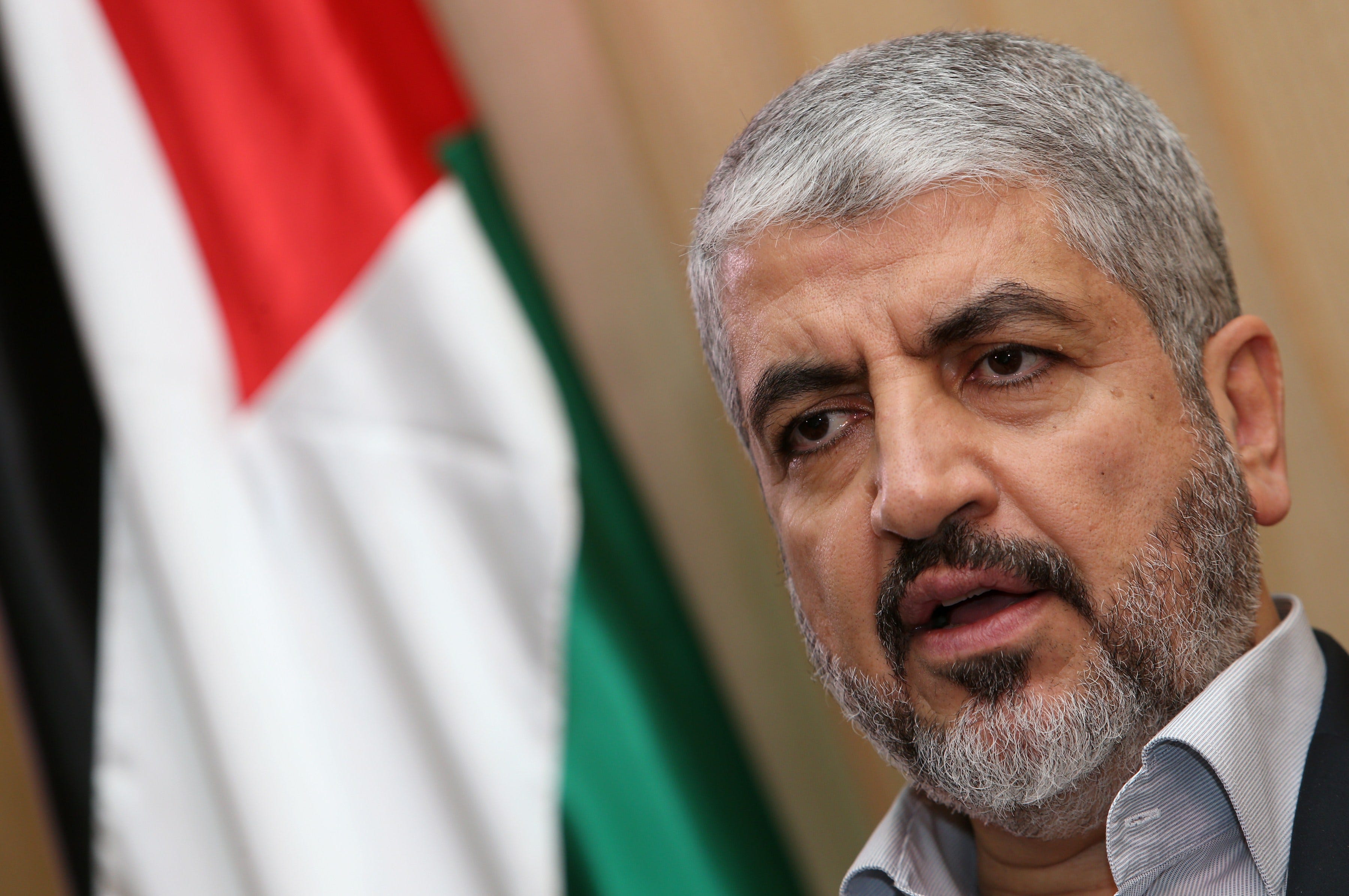
Khaled Meshaal in Doha, Qatar, on August 10, 2014. Photo: KARIM JAAFAR/AFP via Getty Images.

DOHA, QATAR—If President Donald Trump wants to achieve stability in the Middle East, he should put an end to Israeli interference in U.S. policy toward Palestine, senior Hamas leader Khaled Meshaal told Drop Site. Instead, Meshaal said, the U.S. should enter into a genuine process of direct negotiations with Hamas and other Palestinian political factions aimed at establishing friendly, bilateral relations.

“Unfortunately, one of the problems with the U.S. administration is that it prioritizes Israel’s interests more than the United States’ own interests. Even Trump’s people—MAGA—came to realize that Israel is a burden on them, restricting and harming U.S. interests. I am simply calling on the American people and the U.S. administration to judge based on America’s interests, not Israel’s,” Meshaal said. “If they look at us even for a moment in a fair and impartial way, they will see that the Palestinian people are oppressed under occupation, and they have the right to resist—unless America steps in and forces Israel to withdraw, in which case we would thank America.” He added, “When the world fails to help you, you have no choice but to resist the occupier until you force it to withdraw.”

Read Drop Site’s full, in-person interview with Meshaal below.

Meshaal, who is currently the head of Hamas outside of Palestine, was a founding member of the movement and is one of its most experienced and internationally well-known leaders. In the decade before Hamas launched in 1987, Meshaal was part of a group that created the architecture for the formation of a new Islamic political liberation movement in Palestine. That process crystallized in the formation of the Islamic Resistance Movement, commonly known by its Arabic acronym HAMAS. After the Israeli assassination of Hamas’s spiritual leader Sheikh Ahmed Yassin in 2004, Meshaal was widely recognized as the political leader of the movement and he served as head of its political bureau from 1996-2017.

He reiterated that Hamas is prepared to enter into a long-term ceasefire agreement with Israel, backed by a pledge that Hamas would store its weapons and commit to end all military operations targeting Israel. Meshaal also said that Hamas is ready to work closely with the U.S. and the international community in creating a stable security environment inside Gaza that will enable the reconstruction of the enclave, prepare the ground for democratic elections, and create the political conditions for negotiations addressing the future of a Palestinian state.

“The pragmatic American mindset, and President Trump’s genuine concern to achieve stability and prevent Gaza from remaining a continual bleeding wound that worries the world and deeply strikes the human conscience [can] create an opportunity for stability,” Meshaal said. “Hamas provides this opportunity with real guarantees and a record of commitment.”

Hamas remains a popular political actor within Palestine and has served as the only governing authority in Gaza for two decades—a fact that, Meshaal said, Trump needs to consider. While Hamas has offered to relinquish its governance of the enclave in favor of a technocratic committee of non-partisan Palestinians, Meshaal warned that attempting to impose a sweeping ban on anyone affiliated with Hamas from participating in the stabilization and rebuilding of society in Gaza would be counterproductive.

“Any attempt to establish a non-Palestinian authority inside Gaza is first unacceptable and second doomed to fail,” Meshaal said. “Any non-Palestinian authority—meaning foreign authorities or foreign forces inside Gaza—would be treated by Palestinians as an occupying authority, as an occupying power. This would automatically create a state of conflict because Palestinians would not accept it. Why would Palestinians reject Israeli occupation but accept another form of foreign occupation?”

During the sit-down interview with Drop Site in Doha last week, Meshaal argued that the current moment offers an opportunity for the U.S. and Europe to realign the Western approach to the Middle East. “The Palestinian people are not against American interests. We are opposed to those who interfere in our affairs and to those who support our enemy. But we are ready to open up to America, to Europe, and to the world,” he said. “What we will not accept is occupation, guardianship, or support for an occupier. We criticize the United States not because it is the United States—no—but because it provides Israel, our occupier, with complete support in all forms. Today, there is an opportunity for transformation, and I believe it is in the interest of the West to sponsor a fundamental change in [the approach to] Palestine, just as it eventually recognized the truth in South Africa and withdrew its support from that apartheid regime.”

Citing Trump’s embrace of Ahmed Al-Sharaa, the former Al Qaeda operative turned anti-Assad rebel leader who took power as interim president of Syria in January, Meshaal said the U.S. should pursue a similar path with Palestinian political leaders. “Why does the U.S. administration give Ahmad Al‑Sharaa this opportunity but does not give it to Hamas and the Palestinian resistance forces? It does not even give it today to [Palestinian Authority President] Mahmoud Abbas, who is not accused of terrorism,” Meshaal said. “It is in the interest of the United States and Western capitals to pursue positive engagement with Hamas and with the Palestinian people, because we are the future, and this occupation will become part of the past.”

A former physics teacher, the 69-year old Meshaal has spent his life building Hamas. In 1997, a year after Meshaal was named head of Hamas’s political bureau, the newly-elected Israeli Prime Minister Benjamin Netanyahu ordered Mossad agents to assassinate him in Amman, Jordan. Posing as Canadian tourists, the two operatives sprayed poison into his ear as he exited his car. One of Meshaal’s bodyguards, with the assistance of Jordanian police, captured the Israeli agents. King Hussein subsequently threatened to put the spies on trial and potentially execute them if Meshaal died and to end Jordan’s peace treaty with Israel. In response, Netanyahu dispatched the head of Mossad, Danny Yatom, to fly to Amman with the antidote to the poison. Hussein also secured the release of Yassin, Hamas’s spiritual leader, as part of the deal.
Sheikh Ahmed Yassin, center, the spiritual leader of Hamas, with Khaled Meshaal, right, and Mousa Abu Marzouk in Amman, Jordan, in 1997. (Photo by KHALIL MAZRAAWI/AFP via Getty Images)

Meshaal has been widely credited with being one of the architects of Hamas’s 2006 winning campaign in the Palestinian national elections. In 2012, Meshaal—who had spent his life in exile since 1967—made a triumphant visit to Palestine where he received a hero’s welcome in the streets of Gaza. Meshaal’s last act as Hamas’s political leader came on May 1, 2017 when he presided over the public unveiling of a 42-point manifesto that stated that Hamas was willing to accept a Palestinian state along the borders that existed prior to the 1967 Arab-Israeli war.

“Without compromising its rejection of the Zionist entity and without relinquishing any Palestinian rights,” it stated, “Hamas considers the establishment of a fully sovereign and independent Palestinian state, with Jerusalem as its capital along the lines of the 4th of June 1967, with the return of the refugees and the displaced to their homes from which they were expelled, to be a formula of national consensus.” The document also sharpened language defining the national liberation character of armed struggle in Palestine, denounced anti-semitism and clarified that the enemy of the Palestinian cause was a “colonial Zionist project.”

While the manifesto did not officially replace Hamas’s 1988 charter, its language on accepting what would amount to a two-state solution was seen as a significant overture to the international community. In the ensuing years, Meshaal continued to represent Hamas internationally, but the center of leadership within the movement shifted to Yahya Sinwar and Ismail Haniyeh—both of whom Israel assassinated in the summer of 2024. Over the course of the past two years of the Gaza genocide, Meshaal receded from prominence and has seldom spoken or appeared in public.

That dynamic has changed as of late. Within minutes of Israel’s attack on Hamas’s offices in Doha on September 9, Israeli media outlets and prominent social media accounts were circulating reports that Meshaal and other Palestinian leaders had been assassinated. Those rumors were false. While the strike killed the son of Hamas leader Khalil al-Hayya, and four other office staff, it did not kill any negotiators or political officials.

And now, in the aftermath of Trump’s October Gaza deal, Meshaal has reemerged as a prominent voice representing Hamas and outlining its positions on a range of issues. He has denounced Israel’s pervasive violations of the “ceasefire” agreement and its continued killing of not just Palestinian civilians, but also members of the armed resistance who are direct parties to the ceasefire. Since October 10, Israel has killed nearly 400 Palestinians and wounded more than 1,000 and continues to block the agreed upon delivery of life essentials.

“Some in the world think the first phase was excellent or fully implemented—it was not. While the war, in terms of total annihilation, has stopped, Israeli violations continue,” Meshaal said. “Therefore, our call as Palestinians, not just Hamas, is that Israel must be held accountable for all agreements of the first phase before moving quickly to the second phase. As Hamas committed to the first phase requirements, Hamas, along with all Palestinian forces, is committed to the requirements of the second phase through this serious dialogue with the mediators to reach sound approaches—not as Netanyahu wants, but as agreed upon with the mediators.”

Meshaal has also outlined Hamas’s position that while it is open to a “freezing” or storing of its defensive weapons, it will not agree to disarmament unless it is in the context of establishing a Palestinian army or security force capable of defending itself from Israeli aggression.

Last week, Netanyahu mentioned Meshaal by name in a speech, saying that Meshaal’s rejection of Palestinian disarmament would be confronted. “This mission will be completed either the easy way or the hard way,” Netanyahu said on December 9. A day later, Meshaal sat for an hourlong special interview on Al Jazeera Arabic and Hamas widely distributed his remarks across its official platforms.

Meshaal is the second most popular hypothetical candidate for president of Palestine, according to a recent poll, should the Palestinian Authority allow fair elections. Marwan Barghouti, who has ranked as the most popular potential leader for years, is currently imprisoned on multiple life terms in Israeli prison. “We hope that Marwan will be released, that he will have the opportunity to engage in national struggle and political work, and that he will be a candidate—this is his natural right,” Meshaal said. “Hamas also has the right to nominate whomever it chooses, whether Khaled Meshaal or someone else.”

Abbas, the 90-year-old head of the Palestinian Authority, disagrees. He issued a “decree law” on November 19 that would ban Hamas-affiliated candidates and other pro-resistance Palestinians from running in local elections. It would also prohibit candidates who do not officially recognize the Oslo agreements and other deals that are widely seen among Palestinians as dangerous capitulations. The law, which was pushed by Western countries but widely denounced in Palestine, is almost certain to be applied on a national level, according to a source who has seen a draft version of the proposed decree. The source added that there is language in the draft that would also prohibit any party with an armed wing from participating in elections.

“The democracy desired in Palestine, as is unfortunately practiced in some countries in the region and the world, is that elections should produce predetermined results acceptable to those holding them. If they do not, they are canceled. That is not democracy,” said Meshaal. “If you respect the will of the people, allow them to express it freely at the ballot box. Today, everyone knows—even after the destruction in Gaza following two long years of the crime of genocide committed by Israel—that the Palestinian conscience, awareness, and, I believe, the Palestinian voter, if given the opportunity, would vote for the resistance.”

Hamas’s Message to Trump: “Power is responsibility”

Drop Site News met with Meshaal in person on Thursday in Doha. The interview was conducted as the Trump administration is pushing forward with its plan to deploy an International Stabilization Force (ISF) to Gaza and, in recent days, has been intensifying its pressure on both European and Islamic nations to commit troops. Several Arab and other Muslim countries have said they will not join a mission to disarm or battle Palestinian resistance fighters.

“We should be realistic and nuanced in expecting certain things,” said Turkish Foreign Minister Hakan Fidan in an appearance on December 6 at the Doha Forum in Qatar. “Our first objective in deploying the ISF is to separate Palestinians from the Israelis.” His remarks were echoed by Egypt’s foreign minister Badr Abdelatty. “We need to deploy this force as soon as possible on the ground because one party, which is Israel, is every day violating the ceasefire and claiming that the other side is violating, so we need monitors,” Abdelatty said.

Netanyahu has dismissed the notion that an international force would be willing, or able, to implement a disarmament operation. He suggested that Israel may eventually launch its own military campaign in the name of disarming Gaza, an objective its forces failed to achieve during more than two years of scorched earth war.

Despite clear opposition from its Arab and Muslim allies, the Trump administration continues to insist the ISF will enter Gaza with a mission to disarm Hamas. “We specifically put language in there that said, ‘by all means necessary,’” U.S. Ambassador to the UN Mike Waltz told Israel’s Channel 12 on December 11, referring to the UN Security Council resolution passed on November 17. “Now, obviously that’ll be a conversation with each country. Those rules of engagement are ongoing. I’ll tell you this, President Trump has repeatedly said Hamas will disarm one way or another, the easy way or the hard way.”

Last week, U.S. officials met with their European counterparts in Tel Aviv to discuss the ISF and reportedly threatened to permit an indefinite Israeli military presence if EU nations did not offer troops. “The message was: ‘If you are not ready to go to Gaza, don’t complain that the IDF stays,’” one European diplomat told Axios.

While citing substantial objections over the Trump Gaza plan’s vague yet sweeping nature, Meshaal said that the 20-point document nonetheless contains key concepts that Hamas, in principle, would accept. Meshaal cautioned, however, that the common ground between Hamas and Trump is undermined by attempts to impose foreign rule over Gaza, deploy an international force to disarm the Palestinian resistance, rather than serve as peacekeepers, or to enact policies that would enable Israel to continue its war of annihilation under the guise of a “peace deal.”

He also reiterated that Palestinian negotiators never agreed to disarmament or any of the terms in the “second phase” of a deal, despite U.S. and Israeli claims to the contrary. The negotiators from Hamas made clear privately and publicly in October that they only had a mandate to negotiate a ceasefire and exchange of captives and that all other issues must be handled through a consensus process involving all major Palestinian political factions.

Hamas negotiators had urged the U.S. and regional mediators to approach the issue of disarmament through technical negotiation, Meshaal said, and not through edicts that seek to achieve a surrender of the Palestinian liberation cause that Israel could not win on the battlefield. During the October negotiations, he noted, Hamas leaders informed the mediators that sweeping demands for immediate disarmament would sabotage a broader agreement and undermine Trump’s stated aim of ending the war.

“We do not want to clash with anyone or confront anyone, but we will not accept being forcibly disarmed. We told them: if you want results, let us look for a realistic approach that includes guarantees,” Meshaal said. “In truth, the major question is not the likelihood of the Palestinian side’s commitment, the problem lies with the Israeli side—because by its nature it is treacherous, this is its history. Second, it is the side that possesses lethal weaponry. The issue is not how to protect the Israeli side—it is the occupier. The issue is how to protect the Palestinian people, who are nearly defenseless. The weapons of the resistance do not mean that we are armed in the conventional sense, as states are. We are a nearly defenseless people, and we have sought weapons only to the extent possible in order to protect ourselves and defend ourselves.”

In launching his sweeping plan for Gaza, Trump was able to marshal the endorsement of dozens of Arab and Islamic countries, culminating in an unprecedented UN Security Council resolution that placed a fabricated stamp of legitimacy on an agenda that many Palestinians see as doing Israel’s bidding and colonialist in nature.

When asked whether the actions of Arab and Islamic states represented a betrayal of the Palestinian cause, Meshaal struck a diplomatic tone. “While they try to play a role in supporting the Palestinian people, standing by its cause or stopping the war, they also [consider] economic interests, arms purchases and other strategic considerations,” he said. “Since the American president is, in fact, a businessman, some countries are trying to build relationships with him that either serve their interests or protect them from potential harm, because they fear Trump’s adventures and sudden moves, as we saw in the past. This situation undoubtedly weakens strong Arab and Islamic intervention to stop the war.”

Despite the justifiable anger Palestinians may harbor toward Arab and Islamic states for their lack of intervention against Israel’s genocide, Meshaal emphasized, it is the U.S. that holds the only leverage over Israel: “Yes, more is required from Arabs and Muslims, but they are not the strongest party. As you know, no one in the world is able to compel Israel—even Europeans do not do so, or cannot do so.”

“Therefore, the responsibility of the United States is a doubled responsibility, and power is responsibility,” Meshaal said. “President Trump and the American administration alone are capable of compelling Israel and Netanyahu to respect the agreements, so they bear this responsibility before we assign responsibility to any regional or international party.”

Below is the full transcript of Drop Site’s wide-ranging interview with Meshaal on December 11, 2025 in Doha, Qatar. The interview was conducted in Arabic and translated into English by Drop Site.

Subscribe now
Drop Site’s Jeremy Scahill interviews senior Hamas official Khaled Meshaal in Doha, Qatar on December 11, 2025.

Interview With Khaled Meshaal

Jeremy Scahill: Thank you for taking the time to speak with us.

Khaled Meshaal: Thank you very much. I appreciate your keenness to conduct this interview and for providing this space and platform for me and for all those who represent the Palestinian cause.

There is no doubt that the unprecedented Israeli crime is a war of genocide, a repetition of what the Jews were subjected to many decades ago. They are now committing this Holocaust and this war of genocide against the Palestinian people and against a small area of only 365 square kilometers—using the most severe and horrific tools of destruction and killing. We are pleased to address Western public opinion through your platform so that people hear from us, not about us, and so that the true nature of this conflict is understood, about which the world has been misled for many decades. So thank you.

Jeremy Scahill: Prime Minister Benjamin Netanyahu mentioned you by name the other day in regards to the demands for the disarmament of the Palestinian resistance. Trump’s National Security adviser, Mike Waltz, said recently that Hamas can disarm the easy way or the hard way. Can you explain in detail the position right now of the Palestinian resistance on the issue of disarmament, freezing weapons, and a long term truce, or hudna? Explain the position, right now, in the face of these demands from Netanyahu and Trump’s administration.

Khaled Meshaal: Of course, Netanyahu mentioned my name as if in a context of surprise, or incitement—he is inciting. Does Netanyahu really expect the Palestinian people to simply go and give up their weapons? Netanyahu’s own history, and that of his predecessors among Israeli leaders, is full of massacres. There is no trust among the Palestinian people toward the Israelis and the occupation. Israel’s history is one of massacres, treachery, and the violation of all agreements.

Even Yasser Arafat, who signed the Oslo Accords with them, was killed by poison. Mahmoud Abbas, who dealt with them with great openness in continuing Oslo and the peace process, is now left in the headquarters in Ramallah with no real role. In fact, Netanyahu, [Bezalel] Smotrich, and [Itamar] Ben-Gvir are now disassembling the Palestinian Authority and withholding its clearance funds. Not to mention the massacres Israel has committed throughout its history in Palestine, Lebanon, and Egypt, and even in relatively recent Palestinian history—when the Palestinian resistance left Beirut, [Ariel] Sharon carried out the Sabra and Shatila massacres.

Therefore, within Palestinian culture, both historically and in the present, there is no trust in the Israeli. This is a criminal, treacherous enemy, and therefore it is only natural for the Palestinian to hold on to his weapon. This is not an extra weapon or something marginal for Palestinians—it is directly tied to our existence under occupation. Any people living in an independent state rely on the state and its army—the state is theirs, the army is theirs, and it protects them. And in any society, a citizen engages with their state through political means. But when you are under occupation, resistance is natural. Who has not resisted?

Let me tell you a story. In 2007, President [Jimmy] Carter visited me. I respected him because he conducted himself with high moral standards. He wrote books supportive of the Palestinian cause. I valued him, and he gifted me some of his signed books. I remained in contact with him. I was saddened when he passed away. This man, with his deep humanity, asked me about my parents—who were living in Damascus at the time in 2007. He asked, “Do you mind if I meet them?” I said no, so he met with them. My father, spontaneously, said to him: “Mr. Carter, listen—I fought the British Mandate. I fought the British.” President Carter replied, with a beautiful spontaneity: “And we fought the British too.”

Meaning that even the Americans fought the colonizer or forms of colonialism and guardianship over the United States. I am not speaking [only] about Vietnam, South Africa, the peoples of the world, or Cuba—I am speaking even about Western societies. You know that from the BBC in London, the British authorities allowed [Charles] de Gaulle to ignite the spark of popular resistance by the French people against the Nazis—against Hitler’s forces. So this is [part of] culture—it is something natural. Accordingly, what Palestinians do in resistance is natural, and their holding on to their weapons is natural. It is essential that this background be clear to everyone.
Former U.S. President Jimmy Carter, right, embraces Meshaal upon their arrival in Damascus for a meeting on October 19, 2010. Photo: AFP PHOTO/LOUAI BESHARA via Getty Images.

When Trump’s plan emerged, followed by the Security Council resolution, and dialogue began between us and the Egyptian, Qatari, and Turkish mediators, the central matter became, how do we deal with what was stated in the plan and in the Security Council resolution? Our position was clear: Do not resort to an approach of disarmament. This would lead to clashing, violence, and confrontation from the side seeking to impose it on us. We do not want to clash with anyone or confront anyone, but we will not accept being forcibly disarmed. We told them, if you want results, let us look for a realistic approach that includes guarantees. We outlined several such guarantees. The first guarantee is that these weapons—Hamas and the resistance forces would preserve and not use, display or parade them. [The weapons] would be set aside by their own decision and with full seriousness, especially given that Hamas has a record of commitment and high credibility.

Second, what has been referred to as international stabilization forces: we accept them on the borders as separation forces between the Palestinian side and the Israeli side, not as forces deployed inside Gaza, as was intended for them and as Netanyahu wants—for them to clash with Palestinians and disarm them. Third, we proposed a hudna, and this is evidence of Hamas’s seriousness and the seriousness of the Palestinian resistance. A truce of five years, seven years, ten years—whatever is agreed upon. And a hudna means commitment. All the periods of calm, as we call them, during the wars of the past twenty years—all those limited hudnas—Hamas adhered to them, and it was Israel that violated them. So, a hudna.

We do not want to clash with anyone or confront anyone, but we will not accept being forcibly disarmed. We told them, if you want results, let us look for a realistic approach that includes guarantees.

Fourth, we said that the three mediators, along with other Arab and Islamic countries that have good relations with Hamas, Islamic Jihad, and the resistance forces, can guarantee the Palestinian side to both the Israeli and the American sides—that Hamas and the resistance are committed. In truth, the major question is not the likelihood of the Palestinian side’s commitment, the problem lies with the Israeli side—because by its nature it is treacherous, this is its history. Second, it is the side that possesses lethal weaponry. The issue is not how to protect the Israeli side—it is the occupier. The issue is how to protect the Palestinian people, who are nearly defenseless. The weapons of the resistance do not mean that we are armed in the conventional sense, as states are. We are a nearly defenseless people, and we have sought weapons only to the extent possible in order to protect ourselves and defend ourselves.

I believe these are the correct approaches. I believe—as I stated in my [Al Jazeera] interview—that the pragmatic American mindset, and President Trump’s genuine concern to achieve stability and prevent Gaza from remaining a continual bleeding wound that worries the world and deeply strikes the human conscience—Western capitals, above all others, have become exasperated and fed up with what Israel is doing—create an opportunity for stability. Hamas provides this opportunity with real guarantees and a record of commitment. This is the approach—any other [approach] is impractical. It is enough for me to say it is impractical—not just unacceptable from our side.

Jeremy Scahill: I watched your recent interview with Al Jazeera Arabic and you mentioned the experience of Paul Bremer, who George W. Bush installed as the “viceroy” in Iraq during the 2003 invasion. And when the Americans implemented de-Ba’athification—where they criminalized the Ba’ath party of Saddam Hussein—they eliminated huge numbers of not only the professional military, but also civil society, government bureaucrats, and technocrats. They broke civil society because of de-Ba’athification. It seems to me that the Americans may eventually realize that Hamas is not only a resistance movement, but was a government and built civil infrastructure and civilian security forces. If they recreate a de-Ba’athification policy with Hamas and they try to remove anyone affiliated with Hamas, what would the consequences be on a security level? Because the idea is they’re going to send in a Palestinian police force—trained by the Egyptians, maybe. But the reality is that Hamas has been the security internally in Gaza for two decades. What would the consequences be if the Americans tried to adopt a de-Ba’athification approach to Hamas in Gaza?

Khaled Meshaal: From what I’ve been following in American statements, after the 2003 Iraq invasion, there have been some American reassessments about what they did in Iraq—that one of the mistakes was not just dismantling the regime. They realized that by dismantling the Iraqi state and its institutions, including the Iraqi army, they created chaos. This allowed groups like ISIS and forces the U.S. feared to emerge and it provided a pretext for prolonging the war in Iraq and the region. Therefore, I believe the American administration under President Trump should not repeat the same mistake—this is a relatively recent experience. If America seeks stability in the region, it must not make things worse or add fuel to the fire, which would further cause instability.

Furthermore, Hamas is not just a military organization or armed group—it is a resistance movement with a military dimension, but it is also a civil society movement. It is deeply rooted in the Palestinian people and is part of the fabric of Palestinian society. Its members are present across all aspects of Palestinian life. For two decades, Hamas has governed society efficiently, learning from past mistakes and gaining experience, and there was stability. The people of Gaza know that before Hamas ruled Gaza, there was lawlessness—a certain degree of chaos from rogue groups. Hamas managed this situation with high efficiency. Therefore, Hamas has a successful track record in maintaining security in the country and providing public safety. It has a successful experience in governing society, the government and providing for people’s needs, despite an unjust siege that lasted throughout this period.

Consequently, any attempt—and here I’m speaking about the principle, not just the method—to establish a non-Palestinian authority inside Gaza is first unacceptable and second doomed to fail. That’s why I said the Bremer experience is not acceptable. Looking back at Palestinian history a hundred years ago, after World War I in the early 1920s, there was the British Mandate. Practically, this Mandate was colonial, and Palestinian revolts in the 1920s, 1930s, and 1940s fought against it. The Mandate was unjust: it seized rights it did not possess, and it served as cover for the Zionist gangs that infiltrated Palestine and established Israel in 1948. Therefore, from a practical perspective, the Mandate experience and legacy is extremely negative, and in principle, is unacceptable. In principle, a mandate and guardianship are unacceptable.

As for the consequences you asked about, if such a scenario were to occur, they would certainly be serious. This would not be a confrontation with Hamas alone; it would be a confrontation with [Palestinian] society. I have said that any non-Palestinian authority—meaning foreign authorities or foreign forces inside Gaza—would be treated by Palestinians as an occupying authority, as an occupying power. This would automatically create a state of conflict because Palestinians would not accept it. Why would Palestinians reject Israeli occupation but accept another form of foreign occupation? That is unacceptable.

That is why I said that the Palestinian people are the ones who govern themselves, who make their own decisions, and who manage [their affairs]. Then Hamas took a step meant to shorten the path: it stepped away from administration—actually relinquished governance, not just in slogans—and left it to mediators such as Egypt, Qatar, and Turkey, in a Palestinian dialogue with various factions, to agree on forming a technocratic administration. This is what we have done for more than a year. What delayed this [process] is that the [Palestinian] Authority in Ramallah was not enthusiastic about it, even though we said that the reference authority of this administration would be the authority of Ramallah so that the Palestinian system between Gaza and the West Bank could be unified. Unfortunately, it stalled. Three weeks ago, this idea was finalized: 40 respectable Palestinian figures, all independent technocrats, were proposed, and eight were selected. The original plan was for this step to be implemented quickly and efficiently, but there was a delay because everyone was waiting to see what Israel would do in the second phase and whether the United States would force Israel to enter that second phase. President Trump’s recent statements indicate that the process would begin early next year, but Israel is the one causing the delay.

For your information and for the information of American viewers and followers, the first phase has not met its requirements. Israel has violated the requirements or conditions of the first phase: in relief, shelter, the entry of tents and caravans, food and medical aid, hospital rehabilitation, and opening the Rafah crossing in both directions—as stipulated in the Trump plan and the Security Council resolution. Yet Israel only mentions the remaining Israeli bodies—only one left. Hamas and the Palestinian resistance committed to everything, while Israel violated many [obligations]. This is in addition to killings under various pretexts. Even the issue of Hamas fighters in Rafah was a solvable problem, and the U.S. offered an initiative, but it was thwarted by Netanyahu. We also heard how Trump criticized Netanyahu, saying, “Why did you make this an ongoing crisis?”

Furthermore, the “yellow line,” which initially allowed Israel to control about 53% of Gaza—[Israel] is moving this line—has now shifted closer to 60% of the Gaza Strip. So some in the world think the first phase was excellent or fully implemented—it was not. While the war, in terms of total annihilation, has stopped, Israeli violations continue. Therefore, our call as Palestinians, not just Hamas, is that Israel must be held accountable for all agreements of the first phase before moving quickly to the second phase. As Hamas committed to the first phase requirements, Hamas, along with all Palestinian forces, is committed to the requirements of the second phase through this serious dialogue with the mediators to reach sound approaches—not as Netanyahu wants, but as agreed upon with the mediators. And I believe that the American side, as I said, in its pursuit of stability and its concern for results more than the ways Israel is trying to incite the U.S.—the American administration and the international community will understand the approaches that we can develop together with the mediators.

Jeremy Scahill: How, though, are you going to navigate the role of Mahmoud Abbas and the Palestinian Authority? He’s 90 years old. The last time he was elected was 2005. The Palestinian Authority was established in 1994 with a five year mandate. The Americans also punished Abbas—they banned him from attending the United Nations general assembly in New York. But also they want to use him for a sort of legitimacy stamp to say, “Ah, see, Palestinians agree with this.” Recently Abbas pushed a decree law about elections—the local elections—that would mean Hamas can’t run in the election. Even Dr. Mustafa Barghouti, a Palestinian political leader and former candidate for president who does not control any armed faction, could not run in the election. But other resistance leaders have told me that working with the PA right now in Gaza is the least bad option because at least it’s Palestinian. But, given the history, this may not really strike a lot of Palestinians as a convincing answer. What is your position on how to navigate the way the Americans want to use the PA and the broader struggle by Hamas and other movements to preserve the Palestinian cause for an independent state?

Khaled Meshaal: First, democracy is a right of the Palestinian people. Elections and building the Palestinian political system on democratic foundations are a right of the Palestinian people, not a favor from anyone in the world—not a gift we wait for from anyone. On the other hand, the slogans raised by the United States and Western capitals about democratizing the region, or their support for a democratic system—they do practice it in their own countries, no doubt about that—they must respect the choice of peoples to exercise this democratic right. The Palestinian people have a culture and a history of political engagement. Just as they excelled in the struggle, they excel in politics. They have formed parties since the days of the British Mandate. They have culture, free press, education, and universities. The Palestinian people are vibrant, educated, and well-versed in civilization. Palestine itself is the land of civilization and of the Prophets—it has a long history. It also has a history of peaceful coexistence among its different components and religious communities. Therefore, the Palestinian people do not need anyone to teach them the culture of democracy. They simply need others not to interfere with or violate this right of democracy.

The democracy desired in Palestine, as is unfortunately practiced in some countries in the region and the world, is that elections should produce predetermined results acceptable to those holding them. If they do not, they are canceled. That is not democracy.

Now, there was the Palestinian Authority, as you mentioned, [established] in 1994. In 2006, elections were held, and Hamas participated for the first time. Hamas won the elections and formed a government in 2006 and extended offers to all Palestinian partners. However, the Authority in Ramallah pressured these factions not to participate. Consequently, Hamas was forced to form the government alone with some independent figures. This was not their choice but imposed on them because Ramallah incited the participating factions. Until clashes occurred and some members of the Palestinian security apparatus at that time attempted a coup against the legitimate government led by Mr. Ismail Haniyeh—Brother Abu Al-Ubid was the Prime Minister at the time, who later became a martyr, as you know, more than a year ago. Then the Mecca Agreement of February 2007 was reached, leading to a national unity government in which Fatah and all the factions participated.

By June 2007, as a result of an attempt by remnants of the security apparatus to overthrow this government, clashes occurred, and stability was imposed in Gaza under the leadership of Hamas. Some claimed that Hamas had ousted the others, which is not true. I visited an Arab leader at the time, and he asked me, “Brother Abu al-Waleed, how is it that you fought Fatah and the others in 2007?” I replied, “We did not fight anyone. We were not opposing or fighting the authority—we were the authority. When someone rebels against the law and the authority, what should we do? Suppose, Mr. President, someone from a party in your own country came and fought you—what would you do? Retaliate? Stop them? Or just watch and smile?” The president smiled. So, Hamas did not stage a coup against anyone because it was the authority. Ismail Haniyeh [of Hamas] was the Prime Minister of the national unity government, and [Fatah politician] Azzam al-Ahmad was his deputy.

So, Hamas is committed to democracy, committed to the law, and committed to making the democratic experiment succeed. Since that time, the situation has changed. What is the main reason for this? Many Western powers—and unfortunately, some regional powers in the area—were not satisfied with the results of the 2006 elections and did not give Hamas and the Palestinian society the opportunity to make this experiment succeed. As a result, a coup was attempted against it through security and military conspiracies. Vanity Fair at the time published a detailed report about this—it is a Western magazine, as you know. Gaza was also subjected to an economic blockade. The democratic experiment was therefore fought against economically and targeted security-wise through attempts to overthrow it. The security coup did not succeed, but there is no doubt that the blockade harmed the experiment and made life in Gaza abnormal. So, this democratic experiment was perhaps targeted for failure from the very beginning, but the will of our people enabled Hamas to continue.

[Content truncated due to length...]


From Drop Site News via this RSS feed
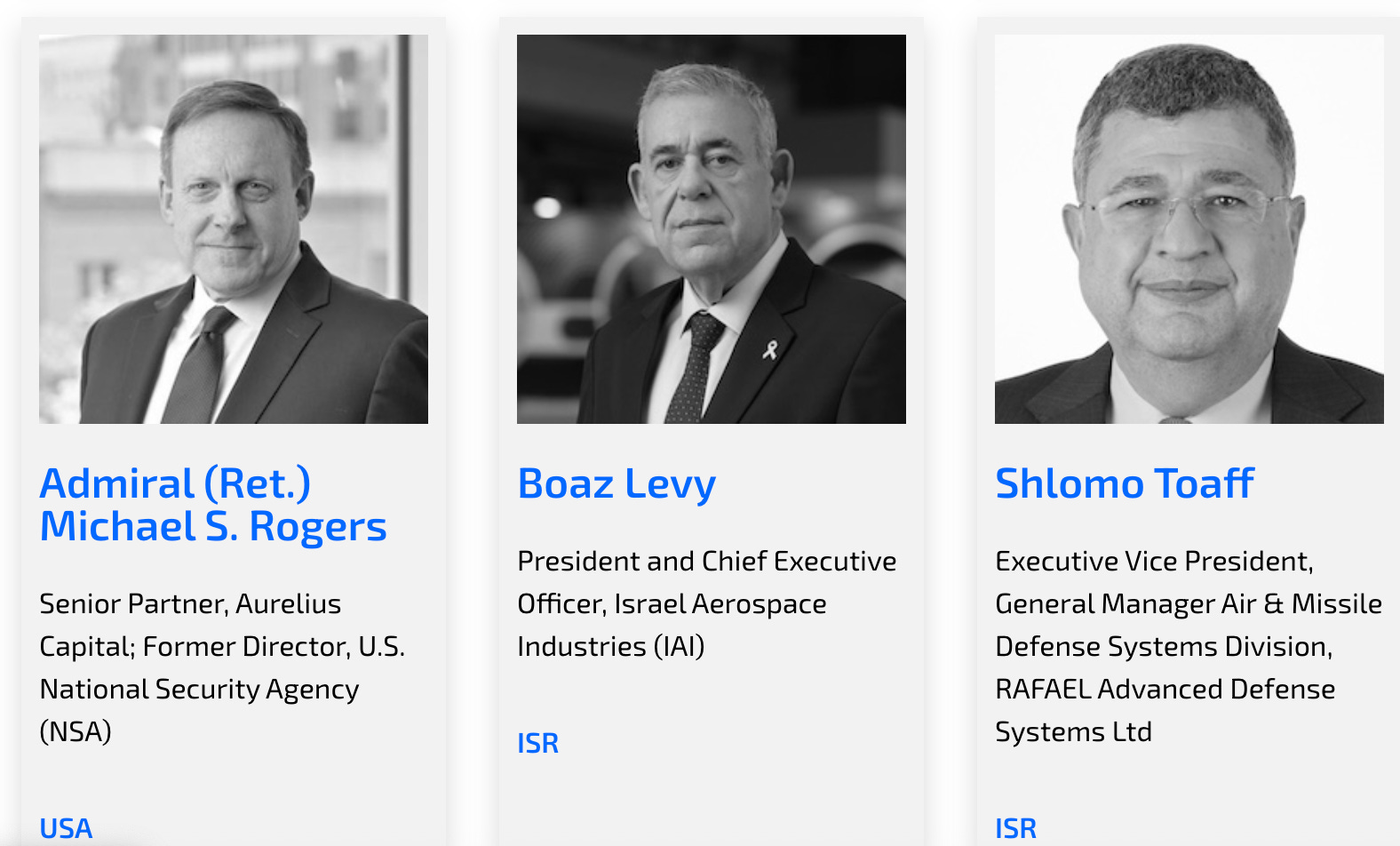
15


Israel carries out more strikes near Gaza City. Israeli navy seizes at least four Palestinian fishermen off the coast of Khan Younis. Israel employs drones to smuggle narcotics into Gaza, Al Jazeera reports. The Rapid Support Forces (RSF) reportedly kidnapped thousands of fleeing civilians in El-Fasher and attempted to extract ransoms from them. Six Bangladeshi peacekeepers were killed by a drone in Sudan’s border region. RSF shelling of a military hospital kills 9, wounds 17. The RSF committed sexual violence in Kordofan, a Sudanese rights group documents. A mass shooting kills at least 15 at Australia’s Bondi Beach. Israeli forces killed two Palestinians in the occupied West Bank on Sunday. A 26-year-old Palestinian detainee dies in Israeli custody. Two people are killed and nine wounded in a shooting at Brown University. U.S. administration figures are vying to control the billions in revenue that might accompany dominion over Gaza’s aid distribution. A federal appeals court rules in favor of the Trump administration’s attempt to stop federal funding for Planned Parenthood. Far-right candidate Jose Antonio Kast wins Chile’s presidential election. An ISIS attack kills three U.S. military personnel in Syria.

From Drop Site: A new roundup of African news from Drop Site correspondent Godfrey Olukuya. A report on U.S. strikes in Somalia. DHS arrests an Afghan National on dubious charges of support for ISIS-K.

This is Drop Site Daily, our new, free daily news recap. We send it Monday through Friday.

Subscribe now

Jose Antonio Kast is elected president of the Republic of Chile for the period 2026 to 2030. Kast won the runoff election with approximately 58.2% of the vote, defeating his rival, the Communist Party’s Jeannette Jara, who secured about 41.8%. This victory makes him the 38th President of Chile. Kast is set to be sworn into office on March 11, 2026 (Photo by Cristobal Basaure Araya/SOPA Images/LightRocket via Getty Images).

Subscribe now

The Genocide in Gaza

Casualty counts in the last 24 hours: Over the past 24 hours, the bodies of two Palestinians arrived at hospitals, while six Palestinians have been injured, according to the Gaza Ministry of Health. The total recorded death toll since October 7, 2023 is now 70,665 killed, with 171,145 injured.

Total casualty counts since ceasefire: Since October 11, the first full day of the ceasefire, Israel has killed at least 393 Palestinians in Gaza and wounded 1,068, while 632 bodies have been recovered from under the rubble, according to the Ministry of Health.

Israel strikes near Gaza City; Hamas announces the death of a major Qassam commander: Israeli warplanes carried out at least two airstrikes on areas east of Gaza City on Sunday, Al Araby reported. Al Jazeera Arabic reported that an Israeli airstrike hit a vehicle west of Gaza City on Saturday, killing five people and wounding more than 25 others. Hamas announced that senior Al-Qassam Brigades commander Raed Saad, known as Abu Mu’ath, was killed in the Israeli drone strike. Hamas said Saad died alongside three other Al-Qassam members: Riyad al-Luban, Abd al-Haqq Zakout, and Yahya al-Qayali.

Israel kidnaps more fishermen off the coast of Khan Younis: Israeli naval forces detained at least four Palestinian fishermen off the coast of Khan Younis on Sunday, December 14, after attacking fishing boats in two separate incidents, according to Zakaria Bakr of the Gaza Fishermen’s Committee. Bakr said Israeli warships detonated one boat and arrested the fishermen. Israel continues to devastate Gaza’s fishing sector, and has detained at least 24 fishermen at sea since the October ceasefire.

Israel is using drones to smuggle narcotics into Gaza: Israel is using drones and humanitarian aid routes to smuggle narcotics into Gaza, with drugs allegedly found hidden in flour bags and aid trucks, according to Al Jazeera Mubasher. Palestinian leaders say the tactic is intended to fracture society while Israel continues to block food and medical supplies.

Gaza Health Ministry rejects claims of stockpiling aid: Gaza Health Ministry Director-General Dr. Munir al-Bursh rejected claims that Palestinian authorities stockpiled and dumped infant formula. Al-Bursh said UN reports showed most of the Gaza’s milk shipments were delayed by Israel until the milk approached expiration, and then these shipments were looted by Israeli-backed gangs. These allegations, he claims, rely on distorted evidence from an August incident and deflect attention from Israel’s aid restrictions and mass looting under siege conditions.

UNRWA is still operating in Gaza despite Israeli attacks: UNRWA said it continues to operate across Gaza and provide lifesaving aid, despite Israeli efforts to shut it down, telling The Washington Post that the organization remains the primary humanitarian aid provider in the enclave. The agency said its staff delivers roughly 40% of primary healthcare, supplies water and sanitation to hundreds of thousands, and provides mental health support to more than 700,000 displaced people, while also assisting the effort to reopen Gaza’s schools.

West Bank and Israel

IDF kills two Palestinians on Sunday: Israeli forces killed two Palestinians in the occupied West Bank on Sunday, December 14—23-year-old Muhammad al-Sharouf north of Hebron and 16-year-old Muhammad Abahra near Jenin—while wounding a child in Jalazun refugee camp. Israeli authorities are withholding the bodies of those killed, according to the Palestinian Ministry of Health and local media. Israeli forces and settlers carried out raids, closures, demolitions, and detentions in cities from Hebron to Nablus, and oversaw 25 buildings razed in the Nur Shams refugee camp.

26-year-old Palestinian detainee dies in Israeli custody: Another Palestinian detainee has died in Israeli custody, the Palestinian Prisoner Society said. Sakhr Ahmad Khalil Zghoul, a 26-year-old from Husan near Bethlehem, died in Ofer Prison after more than six months of administrative detention without charge or trial, with no cause of death disclosed. His brother is also presently being held without trial. At least 98 Palestinians have died in Israeli custody since October 7, 2023.

U.S. News

Shooting at Brown University: Two people were killed and nine were wounded on Saturday in a mass shooting at Brown University in Providence, Rhode Island. Authorities continue to search for the gunman. Rhode Island Attorney General Peter Neronha said a man previously named as a person of interest—24-year-old Benjamin Erickson—was released Sunday after investigators concluded the evidence no longer supports his involvement.

U.S. administration figures are vying for control of Gaza aid: Trump administration insiders and politically connected U.S. contractors are maneuvering to control future humanitarian aid and reconstruction logistics in Gaza—an effort the UN estimates could cost up to $70 billion—according to a new investigation by The Guardian. The report says the White House launched a Gaza task force, led by U.S. Presidential Aide Jared Kushner, that is consulting contractors and advancing profit-driven models. The proposals include a “master contractor” system that could generate up to $1.7 billion a year, drawing warnings from aid experts that humanitarian needs are being subordinated to commercial interests.

Updates on the Rumeysa Ozturk case: A federal judge in Boston ordered the Trump administration to restore the student status of Rumeysa Ozturk, a Tufts University Ph.D. student who was detained by ICE, allowing her to work and continue her research. Ozturk was arrested in Somerville in March after writing an op-ed in the Tufts student newspaper about the war in Gaza and held in immigration detention for 45 days.

Appeals court rules in favor of the Trump administration’s attempt to cut federal funding to Planned Parenthood: A federal appeals court allowed the Trump administration to continue withholding Medicaid reimbursements from Planned Parenthood under a signed in July, overturning a lower court ruling that had blocked it. The judges said Congress has broad authority over federal spending, a decision Planned Parenthood warned could push its health centers to “the financial brink” and jeopardize care for more than a million patients.

NBA expands UAE partnership despite its support for the RSF: The NBA has expanded its partnership with the United Arab Emirates (UAE) through this year’s launch of the Emirates NBA Cup and additional commercial ties, The Guardian reported. From preseason games to airline sponsorships to plans for an NBA academy and future UAE-sponsored European league, the NBA has deepened its relationship with Abu Dhabi in an unprecedented way this season. All of this comes as Sudan has endured nearly three years of mass killing, rape, and ethnic cleansing by the Rapid Support Foces (RSF), which is backed and armed by the UAE.

Africa (via Drop Site’s new Africa correspondent Godfrey Olukuya)

Burundi closes its border with the DRC: Burundi closed its border with the Democratic Republic of Congo (DRC). The border closing comes after Rwanda-backed M23 rebels captured the eastern Congolese city of Uvira, following more than a week of fighting, with Congolese forces withdrawing a day earlier, according to security sources. Burundian authorities said the move is aimed at preventing incursions in a country that hosts thousands of displaced Congolese.

Kenya sends more officers to Haiti: Kenya said it deployed an additional 230 police officers to Haiti—the fifth contingent sent to support the internationally backed security mission—with the officers arriving in Port-au-Prince on Monday. Kenyan officials said the deployment follows an expanded mandate approved in October and will bolster joint operations with the Haitian National Police to secure routes, protect civilians, and restore humanitarian access amid the country’s ongoing violence.

Ghana deports three Israelis: Ghana deported three Israeli nationals on Wednesday in what its foreign ministry described as a reciprocal response to the mistreatment and deportation of Ghanaian travelers at Israel’s Ben Gurion Airport. Seven Ghanaians—including four members of a parliamentary delegation attending a cybersecurity conference—were detained without cause, with three deported, and while Ghanaian officials called Israel’s actions “provocative and unacceptable.”

Flash floods in Morocco: At least 37 people have been killed in flash floods in Morocco’s coastal province of Safi, which was hit by a sudden bout of torrential rain on Sunday. At least 70 homes and businesses in the historic city were flooded.

Summary update on the rolling humanitarian crisis in Sudan: Up to 400,000 people have been killed since the civil war broke out in April 2023, including an estimated 60,000 in El-Fasher in the Darfur region, in just three weeks after its fall in late October 2025., according to the Yale Humanitarian Research Lab. About 21 million people in Sudan face acute hunger, with roughly 375,000 at famine levels, with some 13 million people displaced., according to the Integrated Food Security Phase Classification.

Nine people killed by RSF shelling of a military hospital: Nine people were killed and 17 wounded, including medical staff, after the Rapid Support Forces shelled a military hospital in Dilling and nearby civilian areas in South Kordofan on Sunday, according to Al Jazeera. The attack deliberately targeted a medical facility in violation of international humanitarian law, the Sudan Doctors Network said.

The RSF accused of mass sexual violence in Bara: A Sudanese rights group documented the rape of at least 12 women by Rapid Support Forces (RSF) fighters in the town of Bara, North Kordofan, following the group’s takeover in late October, Sudan Tribune reported. The Gender Equality Network said the assaults took place during the RSF’s takeover of the town, as part of a wider wave of retaliatory violence that included killings, looting, and forced displacement. Hospitals reported a rise in sexual violence cases and higher rates of miscarriage among Sudanese women during the RSF’s recent offensives.

U.S. defense firm partners with Emirati weapons conglomerate: U.S. defense firm Anduril has announced a joint venture with a state-run Emirati weapons conglomerate whose arms have been repeatedly linked to atrocities in Sudan, including the RSF’s genocidal campaign in Darfur, The Intercept reported. The partnership will focus on autonomous weapons systems, including Anduril’s “Omen” drone, with the UAE set to purchase the first batch.

International News

A mass shooting at Australia’s Bondi Beach: At least 15 people were killed and dozens wounded when a father and son opened fire on a Hanukkah celebration at Sydney’s Bondi Beach on Sunday, in what Australian authorities described as a targeted terrorist attack against Jewish Australians. Police said the older suspect was killed during the attack, while the younger was critically wounded. Two improvised explosive devices linked to the suspects were found and disabled nearby. Officials said around 40 people remained hospitalized as leaders across Australia condemned the attack.

Ahmed El Ahmad, a 43-year-old Muslim and father of two intervened to disarm one of the shooters, even though he knew a second shooter was present and could fire on him. Ahmad was shot twice and is now recovering from his injuries. A GoFundMe has been created to express gratitude for his heroism.

Prime Minister Benjamin Netanyahu accused Australian Prime Minister Anthony Albanese of fueling antisemitism by supporting recognition of a Palestinian state, calling the position a “cancer” and a form of “appeasement.” Netanyahu said recognition would “reward Hamas terrorism,” and he cast the attacks as a war on “the West.” The Israeli prime minister vowed Israel would “hunt” its enemies.

Australian journalist, writer, and Drop Site contributor Anthony Loewenstein reflects on the mass shooting at a Hanukkah event on Sydney’s Bondi Beach that killed 16 people.

Far-right candidate wins Chile’s presidential election: Last Saturday, Chile held its presidential runoff between far-right candidate José Antonio Kast and left-wing candidate Jeannette Jara, with early official results from the Servicio Electoral de Chile showing Kast leading 59.83% to 40.17% with 25.37% of voting tables counted. Chile’s state broadcaster TVN called the race for Kast, and Drop Site contributor Jose Granados Ceja said the early margin and Kast’s lead across all regions determined a decisive victory.

ISIS attack kills three U.S. personnel in Syria: Two U.S. Army soldiers and an American military interpreter were killed, and three other U.S. troops were wounded, in what the Pentagon said was an ambush by a lone ISIS gunman near the Syrian city of Palmyra on Saturday. This is the deadliest attack on U.S. forces in Syria since at least 2019.

Six Bangladeshi peacekeepers killed: Six Bangladeshi peacekeepers with the United Nations Interim Security Force for Abyei were killed, and at least eight others were wounded when a UN base in the disputed Abyei region between Sudan and South Sudan was struck on Friday, reportedly by a drone, according to UN officials. The Sudanese military blamed the Rapid Support Forces for the attack, which UN Secretary-General António Guterres said could constitute a war crime, though responsibility has not been independently verified, Al Jazeera reported.

Trump envoys hold talks with Zelensky: President Donald Trump’s top envoys held five hours of talks with Ukrainian President Volodymyr Zelensky in Berlin on Sunday, as Washington pressed Kyiv to finalize a peace deal with Russia by the end of the year. The talks remain deadlocked over U.S. demands that Ukraine withdraw from parts of eastern Donbas, with unresolved questions about security guarantees if Russia violates any peace agreement. The talks are set to continue Monday with European leaders.

Clashes in Tunisia: Clashes erupted for a second night in the central Tunisian city of Kairouan after a man died following a police chase, Reuters reported. The wave of protests and national unrest arrives ahead of the January anniversary of the 2011 revolution. President Kais Saied faces mounting criticism from rights groups over repression since he began rule by decree in 2021, with authorities pledging an investigation amid fears that violent demonstrations could expand nationwide.

Airstrikes in Lebanon: Israel said it killed three Hezbollah members, including a senior figure in Jwayya, in airstrikes on southern Lebanon on Sunday, according to reporting from the New Arab. Lebanon’s health ministry also reported three people killed across multiple towns. Israel has continued strikes during the ceasefire and maintains positions on five southern hilltops. A ceasefire monitoring meeting in Lebanon is expected on December 19.

Russia retaliates for funds seizure: Russia’s Central Bank has filed a lawsuit seeking $229 billion in damages from Euroclear, Europe’s largest securities depository following an EU decision to freeze Russian sovereign reserves. A spokesperson stated that the Russian Central Bank will later decide how to enforce any ruling, including potentially targeting Euroclear assets held outside Russia.

More From Drop Site

“U.S. Airstrikes, Somali Troops Killed at Least Seven Children in a November Offensive”: U.S. airstrikes backing Somali government ground forces, including a U.S.-trained militia, killed at least 11 civilians—seven of them children, including a seven-month-old infant—during a November 15 assault on an Al-Shabaab stronghold near Jamaame in Somalia’s Lower Jubba region, according to witnesses and community leaders who spoke to Drop Site. AFRICOM confirmed it carried out strikes to support Somali troops but declined to comment on civilian deaths, as locals said that residential areas were bombed despite the absence of al-Shabaab fighters. Read the latest from Drop Site contributor Amanda Sperber on the conflict in Somalia’s Jubaland here.

“ICE Arrests Former Afghan Intelligence Ally on Terrorism Accusations”: On December 3, the U.S. Department of Homeland Security announced the arrest of Afghan national Jan Shah Safi as an alleged supporter of the Islamic State–Khorasan Province (ISK), despite offering no public evidence and overlooking his past role as a senior official in Afghanistan’s CIA-trained National Directorate of Security, where multiple Afghan and U.S. officials say his work was conducted with U.S. knowledge and backing.“We sacrificed for them, and now we are the ones being treated as threats,” a former Afghan interior ministry official told Drop Site News discussing the case. Read more on the treatment of Afghan immigrants by the U.S. from Drop Site contributor Emran Feroz here.

Drop Site’s reporting on Jeffrey Epstein was featured on teleSUR, in a video available here.

Drop Site’s Ryan Grim points out that TikTok’s new ownership is censoring our Epstein reporting, which is based exclusively on publicly available documents, calling it misinformation.

Programming note: You can sign up here to get updates from us on our WhatsApp channel.

If you want to continue getting this newsletter, you don’t have to do anything. But if this is too much—we do try to be mindful of your inbox—you can unsubscribe from this newsletter while continuing to get the rest of our reporting. Just go into your account here at this link, scroll down, and toggle the button next to “Drop Site Daily” to the off setting. It looks like this:

Share

Leave a comment


From Drop Site News via this RSS feed
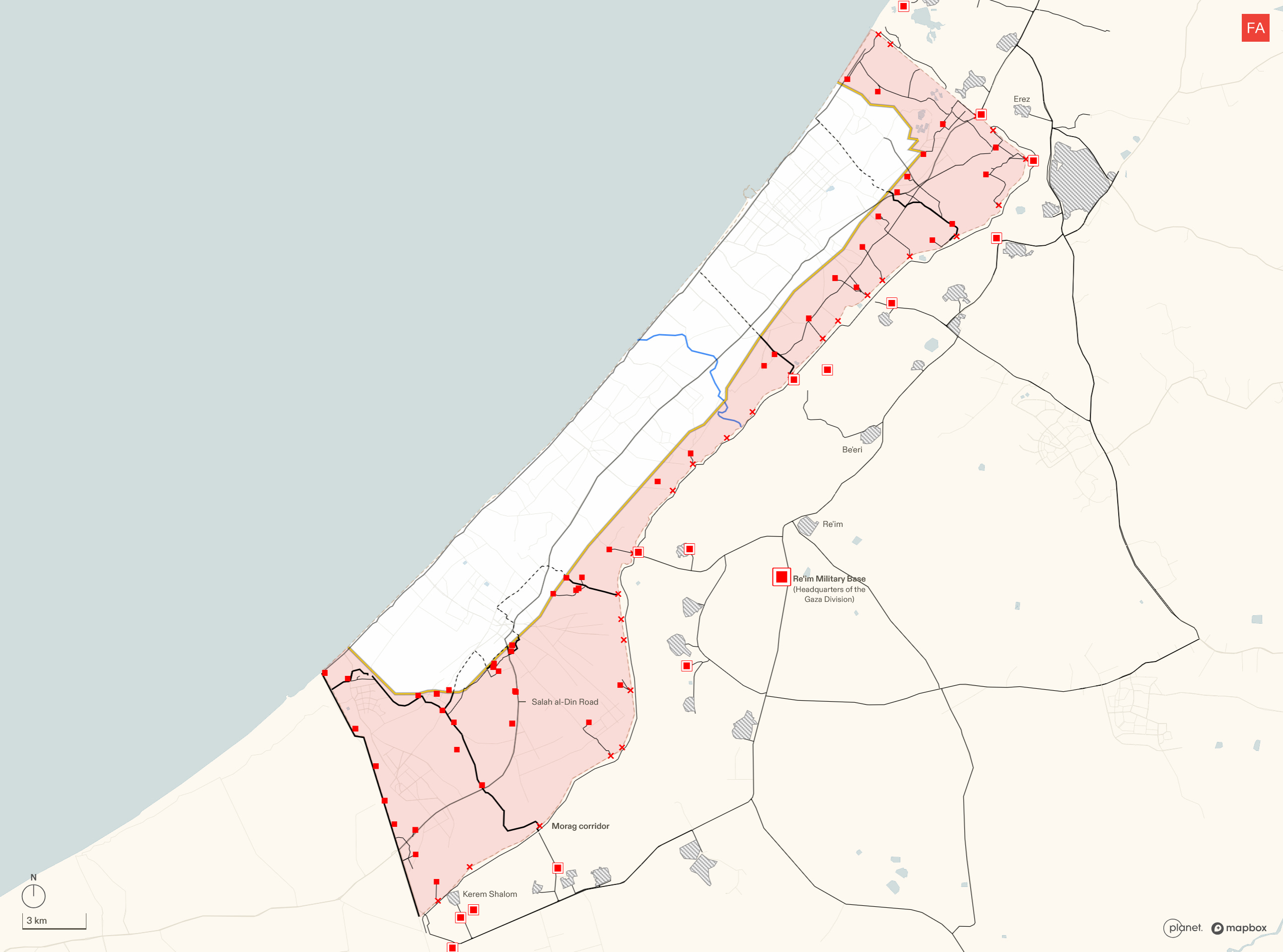
16


Image

Afghan national Jan Shah Safi sitting by a river (Photo courtesy of X).

On December 3, a press release from the U.S. Department of Homeland Security trumpeted the arrest of what they called an “illegal alien terrorist” on allegations of providing support to the Afghanistan-based terrorist group, the Islamic State–Khorasan Province (ISKP), as well as weapons to another militia fighting in Afghanistan. The statement announcing the arrest of the man, an Afghan national named Jan Shah Safi, provided little context about his background. The arrest was conducted by agents of both ICE and DHS, but the statement didn’t furnish evidence to substantiate the allegations against him—treating the arrest itself as proof of Safi’s ties to terrorism.

The reality of Safi’s background is far more complex, and the allegations against him potentially implicate the U.S. government itself: Washington is now accusing him of “supporting extremism” for work Safi did while under the patronage of the CIA in Afghanistan.

Prior to its collapse, Safi was a senior official of the National Directorate of Security (NDS), the primary intelligence agency of the former U.S.-backed Afghan government. The NDS was created and trained by the CIA in the early 2000s, following the U.S. invasion of the country. Safi’s role in the NDS placed him within a complex network of intelligence operations, tribal affiliations, and covert relationships that shaped the war’s final decade.

The Afghan government sought to find various means to try and defeat the insurgency. This effort included cultivating ties with other extremist groups that had splintered off from the Taliban. Officials in the former government said that this work was well known to the CIA, which tightly managed control over the NDS over the course of the war.

“All of these men did what they did for the Americans,” one former Afghan interior ministry official told Drop Site News. “We sacrificed for them, and now we are the ones being treated as threats.”

The former official used to work closely with NDS in the Afghan-Pakistan border area, where Safi also operated, and he denied the charge that Safi was a terrorist, calling him “an Afghan patriot working under extremely difficult circumstances.” He, like others, now fears that Afghans who worked with U.S. agencies are facing collective punishment in the wake of the Washington shooting involving Rahmanullah Lakanwal, himself a former member of a CIA-backed Zero Unit.

The conduct of security agencies like the NDS was widely blamed for destroying the credibility of the U.S.-backed government among ordinary Afghans. Critics and human rights organizations blamed the NDS and other agencies for gross human rights violations such as torture, extralegal killings and political assassinations.

Many high-level NDS recruits drew their personnel from Afghanistan’s former Communist regime, which was backed by the Soviets in the 1980s, while others came from former “mujahideen” groups, such as the Northern Alliance led by the late Ahmad Shah Massoud—a renowned Afghan commander who was killed by Al-Qaeda terrorists two days prior September 11.

Safi’s family came from the latter camp. His father, Hajji Jandad Khan Safi, was a close ally of Massoud, and fought against the Taliban in the 1990s. After the 2001 invasion, the family’s old rivalry with the Taliban made them natural allies for the U.S.-backed government.

As the former Afghan government grew increasingly desperate in its fight against the Taliban, intelligence agencies were accused of building their own strategic ties with extremists also opposed to the Taliban, including ISKP. Safi’s personal background made him an ideal candidate for such work: his family comes from Kunar province, a region known for its Salafi networks, and he shares a tribal affiliation with many members of the group. NDS officials like Safi closely liaised with their CIA counterparts as they sought to find ways to fragment and destroy the Taliban movement.

“NDS was generally regarded by the U.S. as a success story. It was a valued CIA partner and among its tasks were various covert actions aimed at weakening, dividing, or co-opting groups engaged in fighting against the Afghan government and U.S. troops,” Barnett Rubin, a senior Afghanistan expert who used to work with the UN and the U.S. government told Drop Site. According to Rubin “the CIA would have authorized an NDS operation using an Afghan operative from Kunar, especially a member of the Safi tribe, to contact the Salafis, also mostly Safis from Kunar, in an attempt to use them against the Taliban.”

During the latter years of the Afghan Republic, ISKP’s presence expanded as the Taliban gained territory. ISKP’s rise proved useful for some actors inside the Afghan state: weakening the Taliban, prolonging foreign engagement, and maintaining the war economy that had enriched numerous officials, intermediaries, and contractors tied to both Kabul and Washington. In this environment, individuals with tribal access and intelligence value—like Safi—became essential.

Multiple Afghan sources interviewed by Drop Site said that Safi acted as an intermediary between NDS operatives and ISKP-linked networks in Kunar. As a high-ranking NDS agent in the region, Safi received payments from the U.S., which later evacuated many senior NDS personnel, including Safi. A local source from Kunar province told Drop Site that Safi and his family were “typical war profiteers who had a lot of money and armed men.”

A number of former Afghan government officials describe Safi as a conventional intelligence agent working under difficult conditions. They insist he was secular, non-ideological, and even involved in counter-ISKP operations. His family echoes this view, arguing that he and his relatives were long-standing opponents of extremism.

“Everything that is being said is a blatant lie. My brother is not a terrorist, and our family, especially our late father, has a history of fighting against extremist groups such as the Taliban,” said Zia ul-Haq Safi, Jan Shah’s brother, who still lives in Afghanistan.

Safi’s cousin, former Afghan MP Javed Safi, claims that Jan Shah fought ISKP in Nangarhar in 2019, and he was wounded in those operations. “It doesn’t make sense to say my cousin was working with ISKP militants in Kunar, when he was fighting the same militants in Nangarhar,” he said.

Shah Mahmoud Miakhel, a former governor of Nangarhar province under then-President Ashraf Ghani, publicly supported this version of Safi’s activity in a statement posted on X. “Allegations alone do not make anyone guilty. As the former governor of Nangarhar, I witnessed firsthand that when ISIS-K strongholds were dismantled in 2019, Mr. Jan Shah Safi—then-Deputy Director of NDS—played a crucial frontline role in Achin District,” Miakhel wrote.

Sami Sadat, the former Deputy Chief of the Republican Afghan Army, also said Safi had led counterterrorism operations against al-Qaeda and ISIS-K in Afghanistan, arguing that the DHS should immediately release him and issue an apology. Sadat wrote on X that Safi had been one of Afghanistan’s most effective intelligence officers in Kunar. “Describing Safi as a terrorist amounted to a betrayal of wartime allies”, he said.

“Something Bigger is Happening”

Not everyone shared the view that NDS officials like Safi and the ISKP were enemies who merely shared a tactical opposition to the Taliban. The secretive nature of the operations carried out in Kunar by the Afghan government—and their U.S. allies in the later stages of the war—have led to widespread suspicions about the close ties between NDS officers with the extremist group.

Sources from the region familiar with Safi, the NDS, and the anti-ISKP operations that took place in Kunar reject the claim made by Safi’s family and former Afghan government officials that he fought ISKP, claiming instead that he and other senior NDS officials directly supported the group and aided its operations against the Taliban. “In at least two to three operations, ISKP profited from NDS activities,” one source in Kunar province said. “They were not real enemies but working together.”

The sources also said that high-ranking officials tied to Safi and the NDS often presented a misleading picture to the government of then-President Ghani in Kabul, pretending to fight a group that they had really treated as an asset. “On one such occasion, they took a horse with them and presented it as a trophy, since one known ISKP leader was riding a horse. But it wasn’t his actual horse. They just wanted to deceive and appear successful while on the ground realities were much different”, one person recalled.

Several residents in Nangarhar province interviewed by Drop Site also claimed that elements of the Afghan government indirectly supported ISKP during clashes with the Taliban in that region. In 2017, when the U.S. deployed a MOAB (Mother of All Bombs) ordnance in Achin district in an attack aimed at ISKP, locals claimed that the militants had received forewarning about the attack by local NDS officials and evacuated beforehand, while the bombing largely killed civilians. U.S. forces sealed off the site afterward, preventing independent verification.

These murky details from the war reflect a problem with efforts to vet charges against individuals like Safi, or to disentangle them from the broader U.S. role in the war. In the years before the Republic collapsed, Afghanistan’s security landscape was marked by overlapping agendas, informal networks, and ad-hoc partnerships. Intelligence work routinely required contact with armed groups. Documentation was sparse, operations were compartmentalized, and lines between infiltration and collaboration were often ambiguous. Within that context, the role of individuals like Safi remains difficult to categorize definitively.

Afghans who sided with the U.S. now worry that they will be scapegoated amid a broader Trump administration crackdown on immigrants, as well as increased scrutiny following the shooting by Lakanwal. In recent weeks, Afghans have reportedly been targeted by increased ICE raids and other scrutiny across the country.

An Afghan security source close to Safi and his family presented a grim outlook, warning that “something bigger is happening behind the curtains, and it will hit many Afghans again.” He added that once this process unfolds, “Afghans will never again trust the United States in any way.”

Meanwhile, Safi’s family continues to seek legal representation in the United States. According to Javed Safi, more than 20 law firms have declined to take the case. For a man who once served in a U.S.-backed intelligence agency, the lack of available counsel underscores a profound shift in how former Afghan allies are now perceived.

The competing narratives surrounding Jan Shah Safi—counterterrorism agent, coerced intermediary, or covert collaborator—remain unresolved. What his case reveals, however, is clearer: the U.S. is now confronting the unintended consequences of alliances it once relied on, and Afghans who operated in those shadows may be left carrying responsibilities that were never theirs alone.

*Afghan journalist Fazelminallah Qazizai contributed to this reporting


From Drop Site News via this RSS feed
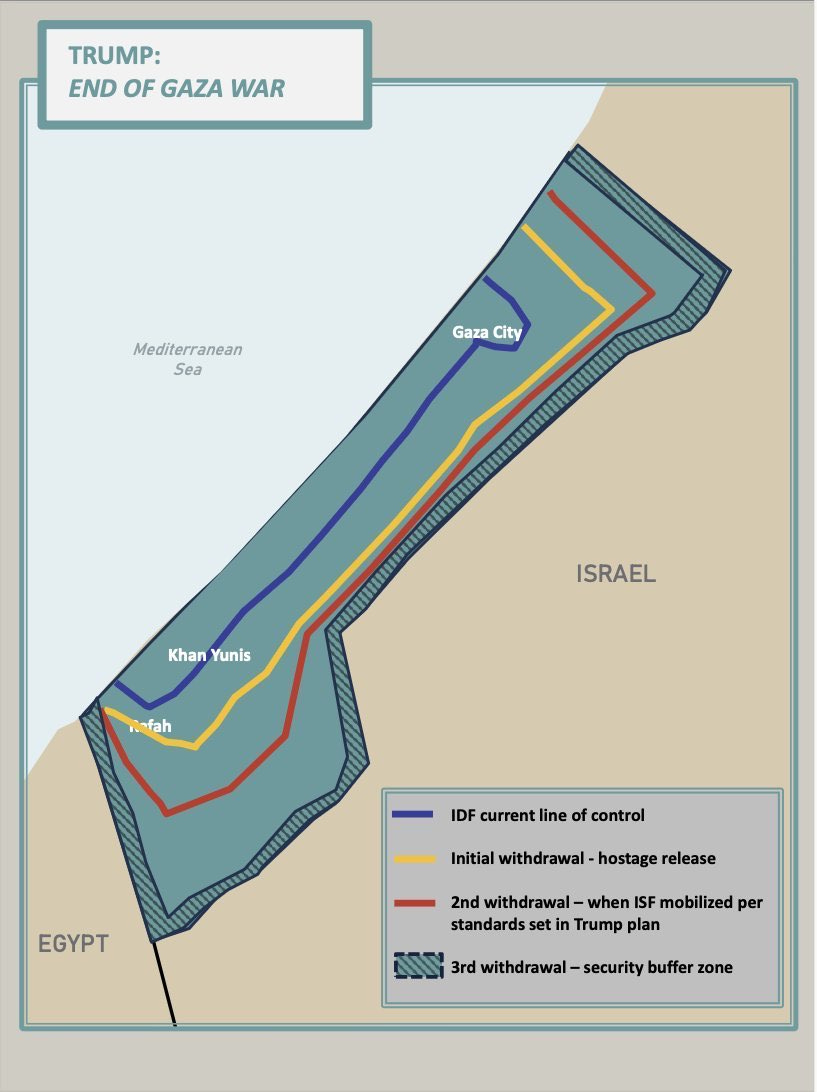
17


U.S. airstrikes and Somali government ground troops, including a militia trained by the U.S., killed at least 11 civilians, including seven children—one as young as seven months—during an operation on an al-Shabaab stronghold in southern Somalia last month.

Drop Site News spoke to four witnesses of the attack from Jaaame, a major town in the Lower Jubba region, that has been under control of al-Shabaab—an al-Qaeda-affiliated militant group—for decades. On November 15, the witnesses said, after hours of aircraft circling overhead, shelling and bombing started, leaving body parts strewn on the ground and caught in trees.

The United States Africa Command (AFRICOM) released a statement confirming that it conducted strikes in the area to support Somali troops. AFRICOM did not respond to requests for comment about the operation it supported killing civilians; neither did the government of Jubbaland.

Subscribe now

“The baby was motionless and I was trying to save my wife,” Mohammed Hassan Abdulle said. Nurto Mohamed Hassan, his seven-month-old daughter, died instantly after two pieces of shrapnell hit her head and thigh. Nurto had been wrapped on her mother’s back when the two were hit. Abdulle tried to get his bleeding wife, Farhiya Hassan Omar, help at the local clinic but “the shelling was like rain.” Finally, they managed to hitch a ride in a small Suzuki to get to a hospital in Jilib, alShabaab’s de facto capital, about 40 miles north.

Abdulle held her during the five-hour drive over dunes and flooded roads. Her torso and shoulders were badly injured. At one point, their car broke down. Abdulle was in the middle of donating blood at the hospital when a doctor informed him that Farhiya had died. He says he does not know who carried out the attacks but that he saw mortar shelling from the west, across from the Jubba River, as well as about six bombs from the sky. He said a drone was still hovering overhead as he conducted the interview with Drop Site, about three weeks later. “All the time it is in the sky,” he said.

A combination of forces, including Somali government and regional troops, as well as the U.S.-trained Danab counterterrorism unit with its own Jubbaland regional force, carried out the mid-November attacks backed by U.S. airstrikes, in an effort to bring Jubbaland under its control.

Soldiers of the Somalia National Army (SNA) in the village of Awdheegle, one of several towns recently retaken from Al-Shabaab on November 11, 2025. Awdheegle is in the lower Shabelle region—a different part of the country than Jubbaland—and has changed hands multiple times. Photo by TONY KARUMBA/AFP via Getty Images.

Videos and photos of the aftermath of the mid-November assault have been circulating across social media and regional outlets. Upwards of 50 people were killed, according to media reports, with varying estimates on the numbers of civilians killed. Two community leaders who no longer live in the region separately gathered the names and ages of at least 11 civilians killed and six wounded and shared their lists with Drop Site.

Four of them were siblings, ranging from four years old to ten, who were killed alongside their mother. Their grandfather, Mohamed Abo Sheikh Ali Muudey, said Jamaame is nearly empty of residents, but al-Shabaab is still in control. Muudey was in town during the assault and said he saw the planes come from the “Kismayo-side,” the regional capital where AFRICOM planes and troops are stationed at the airport, and where Danab commandos are trained.

On top of a decades-long civil war, Somalia is in the midst of a years-long political dispute between federal member states. Jubbaland recently formally left the federal structure and announced itself as an independent government. “Due to ongoing political fragmentation in Somalia, regional governments are trying to demonstrate they are a good counterterrorism partner to the U.S. in order to receive direct support. As part of this, you have ongoing operations by Puntland, Jubbaland and the federal government which are not always coordinated,” Omar Mahmood, the senior analyst for Somalia and the Horn of Africa at the International Crisis Group, told Drop Site News.

The attacks were part of a wider offensive on key al-Shabaab bases in the district, about 10 miles away from Jamaame town, on the other side of the river that divides the area that started earlier this year. Significant al-Shabaab bases and strategic footholds surrounding the town have fallen since the offensive was launched, according to local media. This is likely the first time in over a decade that forces besides al-Shabaab have controlled areas in the Jamaame district.

The impacted civilians in Jamaame are from the Biamaal clan, a group that is not well represented in Jubbaland’s government and is indigenous to the area. A leader from the clan, known as Ugaas, who lives in Mogadishu spoke to Drop Site News. “We were there before al-Shabaab and we want to remain there after al-Shabaab,” Ugaas Ahmed Ugaas Said Ali said. “We don’t know why we are being targeted unless someone wants to grab our land and take our resources.”

“It was a very shocking day,” Maria Abdi Haji Guled, a mother of eight, said. “So many people died. Children were running around. Everything was a mess.”

Guled was in the kitchen feeding five of her children breakfast after their morning session at school when the carnage began. Her husband was on their farm, outside of town. She stressed that al-Shabaab was not present when the shelling and bombing unleashed mayhem on the ground. She had observed a plane in the sky, and never seen one like that before, but “we did not expect it to bomb us,” she said. There had never been fighting around Jamaame, according to her. Guled also witnessed baby Nurto and her mother get hit, and the seven-month old die on the spot; they lived nearby.

It took Guled multiple days to take two of her wounded children to get medical care in Mogadishu, the national capital. Her youngest child, a seven-year-old, has shrapnel in two places in his back and waist. He was unable to walk for over two weeks. He is able to move now, but Guled cannot afford the $1,000 charge to have the metal removed from his body.

“It is well known what happened in Jamaame. There was a massacre and bombardment of residential areas,” Ugaas Ali said.

In late November, AFRICOM told FOX News that it had conducted 100 strikes on Somalia this year. The media outlet Stars and Stripes observed “strikes are occurring at a faster clip than the Pentagon’s campaign against suspected drug traffickers in the Caribbean Sea.”

“We are dying for nothing,” Mariam Omar Nur Buruji, another resident of Jamaame said. Buruji was not in Jamaame during the attack but on her family farm in an area called Bugeey, less than an hour’s walk from town. From there she could see burning houses and bombardment. Today, Buruji is staying in a village called Hongore with her three grandchildren. Their mother was killed in the offensive. Her son, their father, is back on the farm. She told Drop Site News that can still hear the aircraft, but cannot see them. The children are scared.

Leave a comment

Share


From Drop Site News via this RSS feed
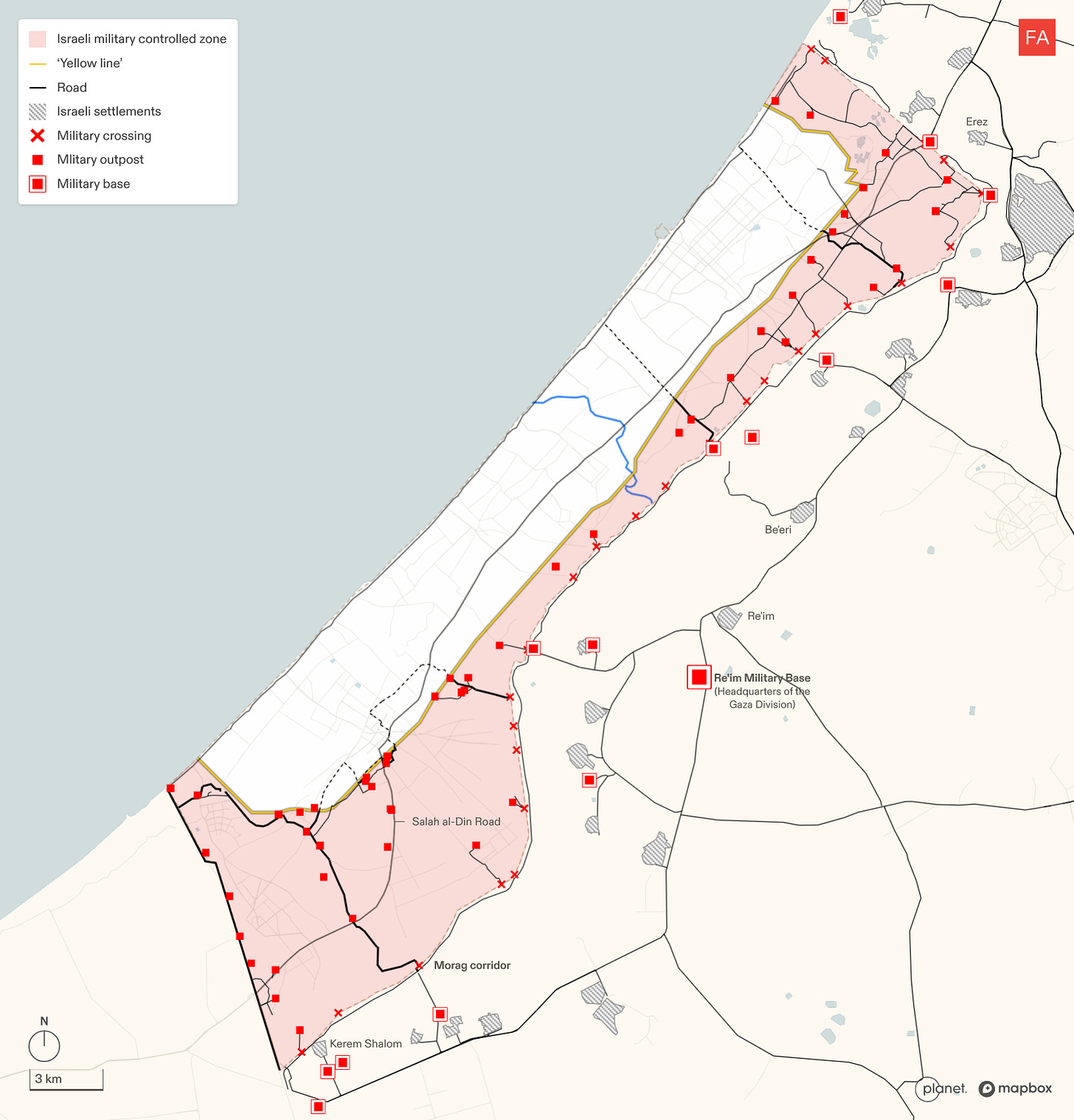
18


Drop Site News is a reader-funded, independent news outlet. Without your support, we can’t operate. Please consider making a 501(c)(3) tax-deductible donation today.

Subscribe now

Pediatric patients who were evacuated from Gaza are transferred to an ambulance upon their arrival at the King Hussein Medical City after crossing the border with Israel on June 11, 2025 in Amman, Jordan. (Photo by Salah Malkawi/Getty Images)

* The reporter for this story requested anonymity citing security concerns

A group of Palestinian children evacuated from Gaza to Jordan for medical treatment with family members or caregivers were reportedly returned to Gaza earlier this month by Jordanian authorities without prior warning and had their belongings, including money and jewelry, confiscated by Israeli soldiers, according to multiple sources.

The Palestinian children were evacuated from Gaza as part of an initiative first announced by Jordanian King Abdullah II during a meeting with U.S. President Donald Trump at the White House in February. Dubbed the “Jordan Medical Corridor initiative,” Jordan pledged to treat a total of 2,000 child patients from Gaza in successive stages. The patients would receive medical care at private or public hospitals and return to Gaza once treatment was completed. Since March, hundreds of Palestinian children have received treatment in successive batches and have been returned to Gaza.

The Jordanian Armed Forces issued a statement last week announcing that the latest group of 140 child medical evacuees and their family members were returned to Gaza. But reports indicate the group was poorly treated by Jordanian authorities and robbed by Israeli soldiers. A mother of five, who was brought to Jordan on July 15 with her sick four-year-old daughter and another teenage daughter, said Jordanian authorities showed up without warning at their hotel on December 3 and told them they were leaving immediately to Gaza. She spoke to Drop Site News on condition of anonymity citing security concerns.

“We never expected it. It all happened in a second. We were informed that we would be taken back to Gaza, and we had to leave the hotels at once. My daughter had surgery on her eye scheduled on the same day,” she told Drop Site. “I pleaded for them to let her do it. After many pleas, I was allowed a few extra hours to do the surgery before departing Jordan.” She added that although her daughter was fitted for a prosthetic eye, she still needed more time in Jordan for additional treatment.

She said they were not allowed to bring anything with them on the journey. “We couldn’t buy or take anything with us from our belongings—the toys, medicines, and other stuff. All that I could leave with was our documents, my phone, and 400 Jordanian dinars,” she said, adding that after they eventually crossed the Karam Abu Salem crossing into Gaza, Israeli troops took her four-year-old daughter’s winter jacket. “It was taken by the officers, and she kept trembling from the cold until we reached Gaza City and reunited with my husband and other children. It was a nightmarish experience,” she said, choking up as she recounted the experience. “I was lucky, but many families had their money, jewelry, and other things confiscated by the Israeli military on the Israeli side of Karam Abu-Salem.”

An activist in Amman who knew some of the families told Drop Site that Jordanian police arrived with five buses to three hotels housing Palestinian medical evacuees—Al-Fanar, Al-Andalus, and Sophia—on December 3 without prior notice and that the families were devastated by the news. “We’re not sure whether or not all the families had completed their treatment,” added the activist added, who also spoke to Drop Site on condition of anonymity, citing security concerns.

The West Bank Friends Collective, a volunteer group that assists Palestinian evacuees in Amman, also said in a statement that “Jordanian authorities arrived unannounced at their hotel in the early hours of Wednesday morning, bringing five buses and transporting the group directly to the border. Israeli authorities then took over the crossing process. Families reported that the journey was prolonged, with some not reaching Gaza until Thursday evening.” The statement added: “Multiple families also reported that, at the border, money, phones, jewelry, clothing, and children’s toys were confiscated, leaving them with almost no personal belongings.”

At least 18,500 Palestinians, including over 4,000 children, in Gaza require medical evacuation, according to the World Health Organization, though doctors say the actual figure is likely much higher. Over the past two years, the Israeli military has systematically targeted Gaza’s health care system, with not a single hospital left fully functional and only 18 out of Gaza’s 36 hospitals partially operational.

The mother said that although her daughter was able to get the surgery she needed in Jordan, their situation in Gaza is dire. Her family is displaced and living in Gaza City in a battered tent with hardly any supplies and no medicines available for her daughter. “I am happy to see my family again, but these circumstances are impossible to bear. I hope things get better and medicines can be found in Gaza for my daughter,” she said. “I can’t see this happening any time soon, so I am calling on the international community and the World Health Organization to find me and the thousands of other families a way for my daughter and their children to continue their treatment until all of them are completely alright. Then, we will all go back to Gaza.”

Leave a comment

Subscribe now


From Drop Site News via this RSS feed
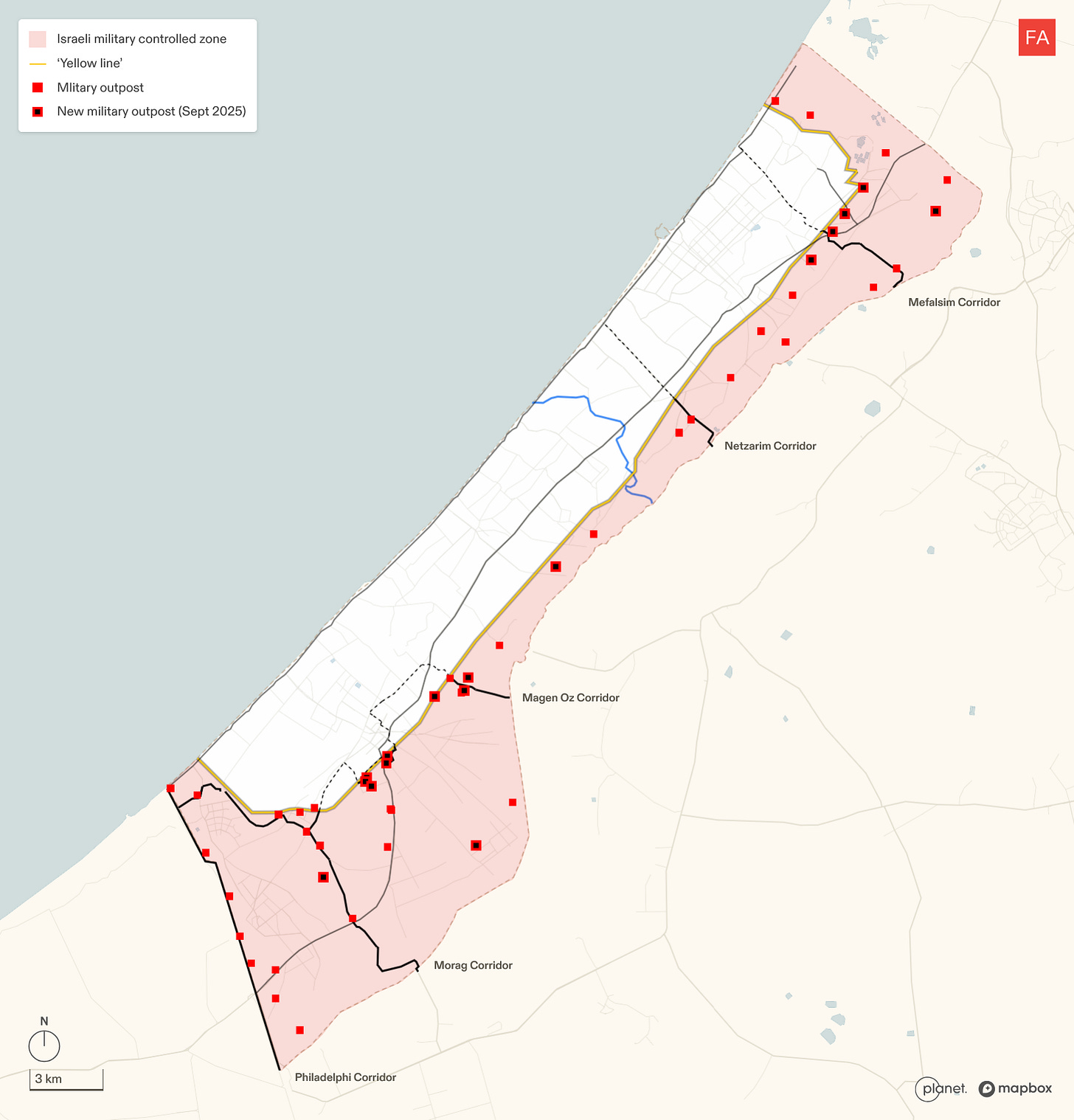
19


At least 12 Palestinians killed as torrential rains, high winds, and flash floods batter Gaza. 13 homes have collapsed and more than 27,000 tents have been destroyed. Israeli artillery strikes kill one and wound seven in the Jabilya refugee camp. A new report from Mada Masr finds a network of businessmen reaped $1 billion “coordinating” the entry of goods into Gaza. Israel denies cancer treatment to a five-year-old Palestinian. Israel’s Minister of National Security Itamar Ben-Gvir again threatens to demolish al-Qassam’s grave. President Donald Trump signs executive order blocking state laws on AI. Released Palestinian-American prisoner Mohammed Zaher Ibrahim returns to the U.S.; a new report claims Jared Kushner intervened to free the American teen, though Ibrahim’s family was unaware of any such intervention. Judge orders the release of Kilmar Abrego Garcia. Department of Homeland Security Secretary Kristi Noem is confronted with a veteran she deported. The House of Representatives votes down Trump’s union-busting executive order. Ambassador to Israel Mike Huckabee dismisses the connection between Israel and Epstein. President Trump’s redistricting plan is rejected by Indiana Republicans. House Republicans are nearing a deal to extend Obamacare subsidies. Trump considers revoking the visas of two of Elon Musk’s critics, including Imran Ahmed—a key opponent of UK politician Jeremy Corbyn and a figure who targeted opposition media in the UK. 33 killed in an airstrike in Myanmar. The South Sudanese army moves toward the Heglig oil field, with the approval of both Sudanese factions. The civilian death toll in South Kivu exceeds 400. Bulgaria’s government falls.

From Drop Site: A university in Gaza City begins a limited reopening. An evaluation of the 12-day war by Hind Hassan, from an Iranian perspective. Hassan will join Breaking Points later Friday to discuss her reporting.

This is Drop Site Daily, our new, free daily news recap. We send it Monday through Friday.

Subscribe now

U.S. President Donald Trump displays a signed executive order as (2nd L-R) U.S. Sen. Ted Cruz (R-TX), Commerce Secretary Howard Lutnick and White House artificial intelligence (AI) and crypto czar David Sacks look on in the Oval Office of the White House on December 11, 2025 in Washington, DC. The executive order curbs states’ ability to regulate artificial intelligence, something for which the tech industry has been lobbying (Photo by Alex Wong/Getty Images).

The Genocide in Gaza

Winter storms batter Gaza, wreaking havoc: At least 12 Palestinians have been killed or have gone missing in Gaza over the past 24 hours as torrential rains, high winds, and flooding batter the enclave, according to the Government Media Office. At least 13 homes have collapsed, and more than 27,000 tents sheltering the displaced have been swept away by flash floods, either submerged by water or torn apart by strong winds. Civil Defense teams are struggling to respond to hundreds of distress calls. The office said more than 1.5 million displaced Palestinians in Gaza are at risk. The UN’s International Organization for Migration (IOM) said in a statement that basic tool kits, sandbags, and water pumps have not been allowed into Gaza due to “long-standing access restrictions” by Israel. “These materials are critical for repairing and reinforcing shelters against continued rainfall and mitigating floods in sites,” the IOM said in a statement. Drop Site contributor Abdel Qader Sabbah captured footage from storm-battered Gaza, which is available here, and aid coordinator Eyad Amawi gave Drop Site an audio report of the devastation on the ground, which is available here.

Israeli artillery strike kills one, wounds seven: Gaza’s Civil Defense said its teams deployed to Jabaliya camp on Thursday afternoon, evacuating seven people wounded in an Israeli artillery strike while recovering the body of one woman who was killed.

Grandfather relays the story of his grandson, who was shot by Israelis and then run over by a tank: A grandfather in northern Gaza said Israeli soldiers shot his 16-year-old grandson Wednesday, and then drove a tank over the child “four or five times,” crushing him in the street. He said the family has not known a moment of calm, with quadcopter drones overhead “every day and every night,” as reported by Sahat English.

U.S. general likely to lead the “International Stabilization Force”: The Trump administration is moving to appoint a U.S. two-star general to command the International Stabilization Force in Gaza, even as the White House insists there will be “no U.S. boots on the ground,” Axios reported. The leading candidate is Major General Jasper Jeffers, who serves as special operations commander at U.S. Central Command and previously oversaw the U.S. effort to monitor the Lebanese ceasefire, though the White House says no final decision has been made.

Amnesty International releases a new report about sexual violence on October 7: Amnesty International published a 173-page report on abuses by Hamas and other Palestinian armed groups, including sexual violence. Amnesty said it documented evidence that sexual assault and other forms of sexual violence were committed during the October 7, 2023 attacks and against captives held in Gaza. Amnesty said it was unable, except for one case, to interview people who reported surviving or witnessing sexual violence, and could not draw conclusions about the scope or scale of the violations. The organization said it did not collect enough evidence to definitively conclude that rape occurred, citing limited access, while noting one man’s account of being raped at the Nova site and a therapist’s claim of treating three rape survivors. Amnesty also said it could not reliably determine the identity or group affiliation of those who committed the reported acts, and found no evidence that Hamas or other Palestinian armed groups ordered sexual violence.

Investigative report into aid profiteering: During Ramadan 2024, Palestinian businessmen based in Egypt met Sinai magnate Ibrahim al-Argany to complain that a “goods coordination” system created a monopoly that drove up prices in Gaza, according to a new investigation from Mada Masr. The economic coordination system ran through Rafah in partnership with al-Argany’s Sons of Sinai company and a small group of Palestinian permit holders. A database compiled by the Gaza Governorate Chamber of Commerce found that coordination fees tied to this system exceeded $1 billion over two years. The model evolved into wider profiteering on the aid going into Gaza. The full report from Mada Masr can be read here.

New documentary on British military participation in the Gaza genocide: Declassified UK released a documentary examining how British spy flights were used to support Israel’s war on Gaza from the Royal Air Force (RAF) base, Akrotiri, in Cyprus. Up to 116 previously undisclosed surveillance missions were conducted after aircraft disabled their trackers. The documentary alleges that Britain’s RAF streamed high-resolution video of Gaza to Israel in real time, and notes that the Ministry of Defence still refuses to release footage from a flight over Gaza that preceded a drone strike that killed three British aid workers. Watch the full film here.

West Bank and Israel

Netanyahu to visit Egypt to secure gas deal: Israeli Prime Minister Benjamin Netanyahu is planning to travel to Cairo to meet Egyptian President Abdel-Fattah el-Sisi and sign a $35 billion deal to supply natural gas to Egypt, according to The Times of Israel. Under the deal, which was signed in August, Israel would export roughly 130 billion cubic meters of gas from the Leviathan gas field to Egypt over the next 15 years. In November, Israel’s Energy and Infrastructure Minister Eli Cohen announced the deal would not proceed “before ensuring that Israel’s security interests are protected and that a fair and competitive price is guaranteed for Israeli citizens.” Israeli officials have been working in recent days with senior U.S. diplomats on the planned trip. Read more about the gas deal in this piece by Mada Masr, which Drop Site reprinted.

Israel refuses to allow a five-year-old Palestinian to enter the country for cancer treatment: Israeli authorities are denying permission to enter Israel from the occupied West Bank to a five-year-old Palestinian boy with aggressive cancer who requires urgent treatment. The authorities say his registered address is in Gaza, despite his family saying he has lived in Ramallah since 2022, according to court filings seen by Haaretz. Lawyers say the child urgently needs a bone marrow transplant, which is unavailable in the West Bank or Gaza, and rights groups warn the refusal violates Israel’s obligations under international and Israeli law.

Ben-Gvir again threatens to demolish the grave of Sheikh Izz-al-Din al-Qassam: Israeli National Security Minister Itamar Ben-Gvir renewed threats to demolish the tomb of Sheikh Izz al-Din al-Qassam, a historic anti-colonial resistance leader buried in a cemetery near Haifa, Ma’an News reports. In a Telegram video, Ben-Gvir said the grave “must be blown up” as Israeli police removed a tent erected by the Islamic Waqf, some signage, and solar equipment under a demolition order.

Britain threatened to leave the ICC over Netanyahu’s warrant, Khan says: International Criminal Court prosecutor Karim Khan said Britain threatened to cut funding and withdraw from the Rome Statute if the court pursued an arrest warrant for Israeli Prime Minister Benjamin Netanyahu, according to The Guardian. In a filing defending his decision, Khan said British and U.S. officials pressed the court to drop the warrants as “disproportionate” and warned of “disastrous consequences.” Khan also argued that later sexual misconduct allegations against him were weaponized to undermine the warrants, which he said were prepared well in advance of the accusations and well-grounded legally. Read Drop Site’s own reporting on allegations against Khan here.

Kushner reportedly intervened to free Palestinian American teen Mohammed Zaher Ibrahim: President Donald Trump’s top aide and son-in-law Jared Kushner secured the release of 16-year-old Palestinian-American Mohammed Ibrahim from Israeli detention, U.S. officials told The Times of Israel. Ibrahim, a Florida resident arrested in February while visiting family in the West Bank, was held for more than nine months in administrative detention without charge. According to Drop Site contributor Jasper Nathaniel, Kushner’s role in the affair is “news to the family.” Nathaniel also released a video of Ibrahim returning to the U.S., and is available here.

U.S. News

Judge orders the release of Kilmar Abrego Garcia: A federal judge ordered ICE to immediately release Kilmar Abrego Garcia, whose wrongful deportation to a notorious Salvadoran prison made him a symbol of President Donald Trump’s immigration crackdown. Judge Paula Xinis ruled the government had no legal basis to detain him after his return to the U.S., adding that officials “misled the tribunal” in attempting to deport him to multiple countries. The Department of Homeland Security says it will appeal the decision.

Executive order to block regulations on artificial intelligence: President Trump signed an executive order on Thursday that blocks states from enacting any laws regulating or limiting artificial intelligence. The order also creates a federal “AI Litigation Task Force” that will have the “sole responsibility” of challenging state AI laws. The order also demands a review of existing state laws that could “require AI models to alter their truthful outputs.” A similar ban on laws regulating AI failed earlier this year when the Senate voted 99-1 to remove the measure from Trump’s “One Big Beautiful Bill Act.”

New U.S. sanctions on Venezuela: The Trump administration imposed new sanctions on Venezuela on Thursday, targeting three nephews of Venezuelan President Nicolás Maduro and six ships transporting the nation’s oil. The Treasury Department announced the sanctions targeted Maduro’s “’narco-nephews’ and businessmen, shipping companies, and vessels supporting his illegitimate regime in Venezuela.”

Noem faces facts about a deported veteran: Congressman Seth Magaziner (D-RI) confronted DHS Secretary Kristi Noem when she falsely claimed that her department had not deported any U.S. military veterans in a hearing on the Hill on Thursday. Magaziner presented the case of Sae Joon Park, a United States Army combat veteran shot twice during America’s invasion of Panama, who was deported to Korea earlier this year. The full exchange can be watched here.

Huckabee dismisses connection between Israel and Epstein: Mike Huckabee, the U.S. ambassador to Israel, said people should “push back” against claims that Israel was behind Jeffrey Epstein, likening them to “crazy things” said about someone’s family. Drop Site’s reporting on this well-evidenced connection can be found here.

House votes down Trump’s anti-union executive order: The U.S. House voted 231–195 to overturn President Donald Trump’s executive order stripping collective bargaining rights from workers at more than two dozen federal agencies, with 20 Republicans joining Democrats to rebuke what labor leaders called the largest act of union-busting in U.S. history. The measure is unlikely to advance in the Senate, where Republicans largely oppose it, and supporters would need at least 13 GOP votes to overcome a filibuster.

Floods in Washington state force evacuations of more than 100,000 people: Historic river flooding submerged farms, towns, and infrastructure across western Washington, forcing evacuation orders for more than 100,000 people, as rivers like the Snohomish and Skagit approached record crests. Officials warned residents to evacuate immediately, cautioning that levees remain at risk and that additional storms could worsen flooding on already saturated ground.

Indiana rejects Trump’s redistricting plan: Indiana Republicans dealt President Donald Trump a setback by rejecting a redistricting plan he had pushed to shore up GOP control of the House. 21 Republican state senators joined Democrats to vote it down in one of the reddest states in the country. The defeat stymies Trump’s broader efforts to create safer Republican districts ahead of the midterms and suggests limits to his influence within his own party.

Lander criticized for investing city funds in Israeli weapons manufacturer: New York City Comptroller Brad Lander, who announced his run for Congress in New York’s 10th District earlier this week, is facing scrutiny over New York City pension investments in Elbit Systems, Israel’s largest weapons manufacturer. Pension funds increased their Elbit holdings during Lander’s tenure, even as Israel’s genocide in Gaza escalated, The New York Daily News reported. Lander refused to divest from Israeli arms firms, though he had previously backed similar divestment efforts from Russian assets after that country’s 2022 invasion of Ukraine.

Harvard professor removed from post because of her center’s work on Palestine: Harvard is removing Mary T. Bassett as director of the FXB Center for Health and Human Rights amid sustained political pressure over the center’s work on Israel and Palestine, the Harvard Crimson reported. The move follows scrutiny of FXB’s Palestine Program and a now-suspended partnership with Birzeit University, after which the Trump administration demanded an external audit and froze federal funding. The move comes as part of a broader pattern of Harvard sidelining academics who work on, or with, Middle Eastern institutions and issues.

Trump considers revoking the visas of Musk critics: The Trump administration is considering revoking the visas of former European Union Commissioner Thierry Breton and head of the Center for Countering Digital Hate Imran Ahmed—both critics of Twitter owner Elon Musk—according to documents seen by Zeteo. A draft State Department memo frames the move as a response to alleged “censorship” of Americans, and to a European Union fine against Twitter, as the administration simultaneously tightens visa screening and includes online speech in its vetting process. Read Prem Thakker’s latest for Zeteo here.

Trump to loosen federal restrictions on marijuana: President Donald Trump is expected to push for reducing federal oversight of marijuana and its derivatives by rescheduling the drug to the same level as some common prescription painkillers, according to sources who spoke with the Washington Post. President Trump reportedly placed a phone call between marijuana industry executives and House Speaker Mike Johnson in order to encourage relaxing federal restrictions.

International News

33 killed in airstrike in Myanmar: At least 33 people, including patients and health workers, were killed and around 70 wounded, after Myanmar’s military bombed a major hospital in the Mrauk U township in western Rakhine, according to a rebel group, aid workers, and witnesses. The military government has recently intensified air attacks in the country’s now nearly five-year-old civil war. UN Rights Chief Volker Turk condemned the strike as a potential war crime.

Fighting between Cambodia and Thailand continues into its fourth day: Two dozen people are estimated to have been killed, after four days of fighting between the neighboring countries, with hundreds of thousands of people displaced on both sides of the border, according to the Associated Press. The Thai Army reported that rockets hit a residential area in the country’s northeast in Thursday’s fighting, while saying that it struck an alleged military crane near the Preah Vehear Temple, which has become a focal point of the conflict. In its most recent report, Cambodia’s government said 11 of its civilians were killed, and 74 wounded.

South Sudanese army moves towards the Heglig oil field: South Sudan’s military deployed to the Heglig oilfield, with the blessing of a rare tripartite arrangement between South Sudan’s military, the Rapid Support Forces, and the Sudanese Armed Forces. Sudan’s warring parties agreed to neutralize the site and protect critical energy infrastructure, Al Jazeera reported. South Sudan’s army said the agreement requires both Sudanese forces to pull back and keep the field out of combat as fighting intensifies in the Kordofan region. Control of Heglig—which was seized earlier this week by the RSF and processes up to 130,000 barrels of oil per day—has major economic and strategic stakes for both countries.

Civilian death toll in recent hostilities in South Kivu exceeds 400: More than 400 civilians have been killed as the Rwanda-backed M23 forces intensified their offensive in South Kivu in eastern Democratic Republic of the Congo, according to Al Jazeera. M23’s recent efforts have sought to consolidate control of the town of Uvira, a strategically important city in the region, and has displaced about 200,000 people. The militia’s advances continue despite a U.S.-mediated peace agreement between Congo and Rwanda.

Russia claims additional territorial seizures in Ukraine: Commanders told President Vladimir Putin at a Thursday conclave that Russian forces took full control of the eastern Ukrainian town of Siversk, Reuters reported. The commanders described the advance as a step toward capturing Sloviansk in the Donetsk region. Ukraine’s military rejected the claim, saying its forces still control Siversk and are repelling Russian infiltration attempts, while continuing to hold parts of the nearby city of Pokrovsk.

Bulgaria’s government falls: Bulgaria’s government resigned Thursday after weeks of mass protests over economic policies and entrenched corruption, with Prime Minister Rosen Zhelyazkov announcing his cabinet’s decision minutes before a scheduled no-confidence vote. President Rumen Radev will seek a new governing coalition or appoint an interim government ahead of fresh elections. This major overhaul comes just weeks before Bulgaria is set to join the eurozone on January 1.

U.S. State Department official refuses to name the UAE when pressed on Sudan: At a House Foreign Affairs hearing on crimes against humanity in Sudan, California Congresswoman Sara Jacobs pressed the State Department over evidence that the United Arab Emirates (UAE) is backing the Rapid Support Forces (RSF), but the senior official refused to name the UAE and instead referred only to “external actors.” Jacobs and Sen. Chris Van Hollen are looking to advance legislation to block U.S. arms sales until the UAE ends support for the RSF.

More From Drop Site

“Gaza’s Schools Reopen in Defiance of Continued Israeli Attacks on Everyday Life”: Students at Gaza City’s Islamic University have begun a limited return to in-person classes for the first time in more than two years, studying inside partially restored buildings on a campus where most structures were destroyed in Israeli attacks. University officials and students told Drop Site that resuming face-to-face learning is an act of defiance amid the widespread devastation of Gaza’s education system, ongoing siege conditions, and severe shortages of electricity, internet, and school supplies. The latest from Abdel Qader Sabbah and Sharif Abdel Kouddous is available here.

“The Aftermath of the 12-Day War Between Israel and Iran”: At Tehran’s Behesht-e Zahra cemetery, families mourn those killed in Israel’s 12-day assault on Iran in June, which Iranian authorities say killed at least 1,064 people, including dozens of children. In a report from Al Jazeera’s Fault Lines, relatives and officials described widespread civilian deaths in a war that Israel claims was necessary to stop Iran’s nuclear program—an account disputed by the International Atomic Energy Agency and U.S. intelligence, which said they found no evidence Iran was building a nuclear weapon. The full report, adapted from an Al Jazeera documentary, is available here.

Jeremy Scahill on Middle East Eye: Drop Site’s Jeremy Scahill joined Middle East Eye on the latest episode of their podcast, Unapologetic, to discuss Israel’s campaign to disarm opposition to Israel’s colonialism, as Israel bombs them and carries out a genocide in Gaza. Watch the full episode here.

Programming note: You can sign up here to get updates from us on our WhatsApp channel.

If you want to continue getting this newsletter, you don’t have to do anything. But if this is too much—we do try to be mindful of your inbox—you can unsubscribe from this newsletter while continuing to get the rest of our reporting. Just go into your account here at this link, scroll down, and toggle the button next to “Drop Site Daily” to the off setting. It looks like this:

Share

Leave a comment


From Drop Site News via this RSS feed
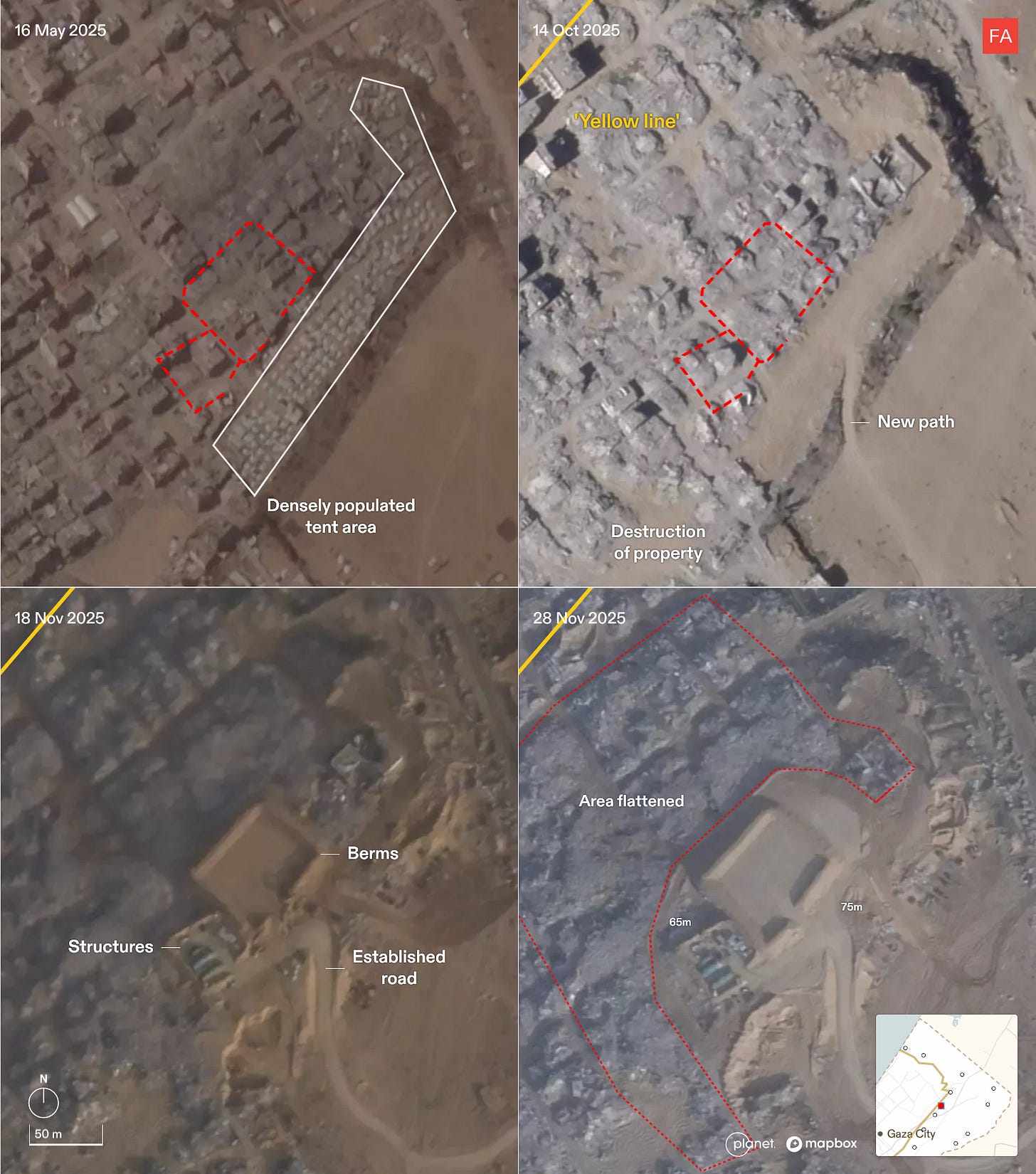
20


Drop Site is a reader-funded, independent news outlet. Without your support, we can’t operate. Please consider making a 501(c)(3) tax-deductible donation today.

Subscribe now

Students attend in-person classes at Islamic University in Gaza City on December 1, 2025. (Screenshot of video by Abdel Qader Sabbah.)

GAZA CITY—On December 1, Mohammed Hossam Ashour stood inside one of the two remaining buildings of Islamic University in Gaza City. A 19-year-old information technology major, he was attending in-person lectures for the first time in two years after the university resumed classes in late-November.

“We are happy to be beginning our return to something of a normal life, even if in a small way, to be returning to in-person learning after having been absent for more than two years because of the war the Israeli occupation waged against us,” Ashour told Drop Site News. “Despite the challenges, and despite the fact that more than 90 percent of the buildings at the Islamic University have been destroyed, the university still repaired and restored the buildings that could be used for teaching and made them available for the students so they could attend their lectures and come regularly to Islamic University.”

Like every other university in Gaza, Islamic University was targeted by the Israeli military during its genocidal assault. Once one of the largest universities in Gaza, with about 17,000 students before the war—60 percent of them women—nearly every building on the campus is now a bombed-out, hollow shell. Many of the roofs are pancaked in and the auditoriums have been gutted and burned. Hundreds of displaced families have set up tents in the rubble-filled courtyard and sought shelter in lecture halls and classrooms.

Much of Islamic University in Gaza City was destroyed in Israeli attacks. December 1, 2025. (Video by Abdel Qader Sabbah.)

Since October 2023, 745,000 students in Gaza have been out of school, including 88,000 in college and beyond. According to the Gaza’s Government Media Office, some 165 schools, universities, and other educational institutions were completely destroyed by Israeli bombardment over the past two years, while another 392 sustained partial damage. Thousands of students, teachers, and staff were killed in the Israeli assault. There is scant electricity and internet. The systematic elimination of the Palestinian educational system in Gaza prompted UN experts last year to accuse Israel of “scholasticide.”

Despite the scale of the attacks, efforts to sustain education in Gaza have continued. Thousands of university students graduated over the past two years through remote learning. And since the so-called “ceasefire,” on October 10, administrators have worked to resume in-person classes.

“We’ve lost many things, and most of the resources we need are still difficult to secure. In IT, you need internet access, you need to have a laptop, and you need to have the necessary mental fortitude,” Ashour said. “The university buildings, though it’s true we repaired some of them, there are still technologies, laboratories, different spaces that we don’t have because of the war, the occupation, and the siege we are living through.

“But here we send a message of defiance and steadfastness in the face of the occupation: that through education, God willing, and through persistence, seriousness, and hard work, we will reach our goals and put an end to the policy of enforced ignorance that the occupation has practiced, and continues to practice, against us,” he continued. “They deprived us of education for more than two years.”

Drop Site News is reader-supported. Consider becoming a free or paid subscriber.

Despite Israel’s brutal occupation, Palestinians in Gaza and the West Bank had one of the highest literacy rates in the world, reaching over 97 percent in 2020, with high rates of enrollment in secondary and higher education. Officials say the efforts to continue education in Gaza in the midst of a genocide and to resume in-person classes at places like Islamic University is a testament to that legacy.

“The university has been able to resume in-person education, gradually and partially, and despite the destruction that befell it,” Professor Bassam al-Saqqa, vice president of academic affairs at Islamic University, told Drop Site.

“More than the buildings, the academic infrastructure of the university was completely destroyed, including the internet infrastructure, which was among the strongest and most renowned in all of Palestine. The university’s laboratories as well, the computer and science labs, for the College of Science, the College of Medicine, and the College of Engineering.

“The Islamic University had the largest number of computers in all of Palestine, as well as highly advanced laboratories. We are speaking now about these resources not to romanticize what has been lost, but to tell our people that, God willing, we will restore these resources and these laboratories to what they once were. We draw our strength from our people and from our students’ passion for learning, for in-person learning. Frankly, we were surprised by our students’ enthusiasm and their widespread attendance, their presence in the university at the earliest hours, seated at their desks and ready to receive knowledge directly from their instructors. We hope this will be the beginning of a complete return to life.”

University students attend in-person classes at Islamic University in Gaza City. December 1, 2025. (Video by Abdel Qader Sabbah.)

Efforts to restore education to Gaza’s school-age children are similarly underway. More than 97 percent of elementary schools in Gaza have been damaged or destroyed. Most of them had been converted into shelters for the displaced when they were bombed.

“Most of the 658,000 school age children have had limited access to face to face learning for over two academic years,” UNICEF said in a statement last month. Since the ceasefire, Israel has also continued to ban or heavily restrict school supplies from getting into Gaza. “So far it has been impossible to get in educational supplies. Teachers are writing on tent walls. UNICEF has stationery, back packs for children and resources for teachers waiting at the borders, but it is not considered as lifesaving humanitarian aid so we have not been given permission to enter the materials into Gaza yet.” The UN Palestinian refugee agency, UNRWA—which ran the majority of the schools in Gaza—echoed the same recently, saying its work has been severely hindered by Israeli import restrictions that prevent even pens and notebooks from entering the enclave.

Palestinian officials and UN agencies have worked to set up hundreds of temporary schools in an effort to continue classes. “The genocide destroyed 90 percent of the institutions of the Ministry of Education, including the headquarters of the Ministry itself,” the Director of Education in Western Gaza, Dr. Jawad al-Sheikh Khalil, told Drop Site. “Now, the educational community, as it always does, is rising again in partnership with international and local organizations, and is opening local schools to receive the students…. In coordination with the corresponding authorities, parts of the courtyards are now being cleared so that students can be received in educational tents. We have no furniture. The students sit on the ground as they learn. The situation is extremely difficult for the teachers, the students, and all the educational staff.”

Some 390 temporary classrooms have been set up with over 5,000 teachers serving nearly 221,000 students—about 567 children per learning space. Even so, only a little over one-third of Gaza’s school-age children are enrolled for the 2025–2026 school year. Now, with cold winter rains ravaging much of Gaza, dozens of temporary classrooms have been affected by flash floods, with more expected to shut down.

Since the ceasefire, Israel has maintained its siege and continued its attacks, killing Palestinians on a daily basis, prompting Amnesty International to declare that “despite a reduction in scale of attacks, and some limited improvements, there has been no meaningful change in the conditions Israel is inflicting on Palestinians in Gaza and no evidence to indicate that Israel’s intent has changed.”

“Israeli authorities are still committing genocide against Palestinians in the occupied Gaza Strip, by continuing to deliberately inflict conditions of life calculated to bring about their physical destruction.”

Nevertheless, when Islamic University resumed in person classes, hundreds of students immediately enrolled. “I’ve finally enrolled at the College of Sharia and Law, after two years of being deprived of study for the tawijhi (high school matriculation) exam and of in-person learning, and after all the struggle we endured, today, I’ve begun my classes in-person,” Misk al-Daour, 18, told Drop Site as she stood inside a partially restored Islamic University campus building.

“This is one of the most beautiful days I’ve lived through the war, but the hardship still persists,” she said. “But we, as Palestinian people, will continue and will persevere in this work, for the sake of God and for the sake of education.”

Rayan El Amine contributed to this report. Sami Vanderlip edited the video.

Leave a comment

Subscribe now


From Drop Site News via this RSS feed
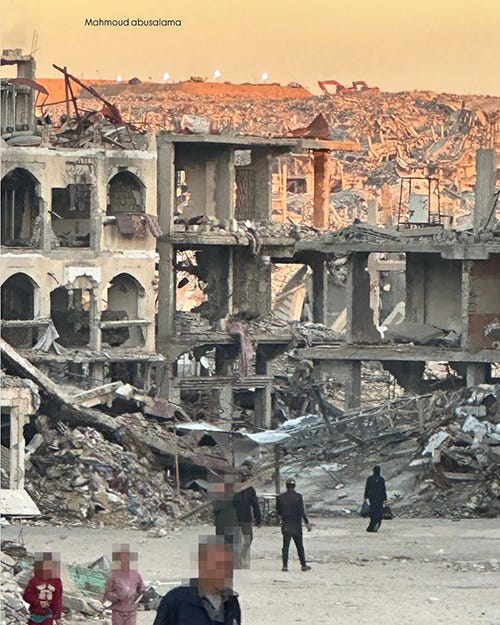
21


Drop Site is a reader-funded, independent news outlet. Without your support, we can’t operate. Please consider making a 501(c)(3) tax-deductible donation today.

Subscribe now

Image still from the documentary, “Target Tehran,” produced by Al Jazeera Fault Lines (Source: “Target Tehran”).

This article is adapted from the documentary, “Target Tehran,” produced by Al Jazeera Fault Lines. Watch the full documentary here.

TEHRAN, IRAN—At Behesht-e Zahra cemetery in southern Tehran, families gather every Thursday to mourn their dead. Among the thousands buried, there are royalty, politicians, dissidents, and soldiers, but a new section has been set aside for those killed in Israel’s 12-day military assault on Iran in June.

On June 13, 2025, Israel launched “Operation Rising Lion,” which targeted nuclear facilities, military sites, and residential neighborhoods. The assault was backed by U.S. strikes targeting Iran’s nuclear sites on June 22. At least 1,064 Iranians were killed and thousands more injured, according to Iranian government figures. Iran retaliated with missiles and drones, killing 32 people in Israel, according to Israeli authorities.

When our team with Al Jazeera English’s documentary program, Fault Lines, visited the cemetery in Tehran in October, the area was overflowing with bereaved visitors. Young girls sang songs of martyrdom beside women collapsed over burial plots. The sound of mothers wailing for their lost children, willing them to come back, filled the air with a grief that felt intrusive to witness.

One of the graves belonged to 12-year-old Amirali, who lies next to his father, Reza Amini. It has been months since they were killed in the first hours of the war, but for his grandfather, Sayed Hossein Mir Hashemi, the pain remains fresh and overwhelming.

Flowers and rose petals covered the ornate marble gravestone. Sayed knelt slowly, touching Amirali’s name with one hand, while holding his prayer beads in the other. “I have lost two of my best people,” he said. “My son-in-law is gone. His son is gone.”

Amirali’s mother, Zahraa, and his 8-year-old brother, Amirreza, survived the strike.

“Now my daughter is left with a small child. Without a home. Who’s going to take care of her? They killed her for no reason. What kind of future is waiting for this child without a father?” Sayed asked.

Photographs of victims, including children, hang above the graves at the cemetery. Gesturing toward them, he said, “Look at all these young people. Why were they killed? Most of them are civilians. Did they make bombs? Did they have guns? Did they become enemies with Israel? Did they become enemies with America?”

Breaking down, Sayed said, “I ask God for martyrdom and to go to him soon. I miss him so much that I want to die.”

The Israeli attacks in June came after the International Atomic Energy Agency (IAEA) released a report accusing Iran of enriching uranium to near weapons grade levels, and one day before the IAEA declared that Iran was not complying with its nuclear safeguards obligations.

In 2015, the IAEA issued a report detailing an alleged project to build nuclear weapons, but it stated, “The Agency has no credible indications of activities in Iran relevant to the development of a nuclear explosive device after 2009,” a year when U.S.-led negotiations began and eventually culminated in Iran’s “nuclear deal” in 2015. Formally known as the Joint Comprehensive Plan of Action, the deal set strict limits on Iran’s nuclear program. The U.S. withdrew from that deal in 2018 under President Trump. Iran has since denied authorizing any plan to develop nuclear explosives.

The Israeli government, nevertheless, claimed the June war was necessary to prevent Iran from acquiring nuclear weapons, declaring that Iran was weeks-to-months away from producing a nuclear bomb. As the bombardment began, Israeli Prime Minister Benjamin Netanyahu said in a speech that “Iran has taken steps it has never taken before—steps to weaponise this enriched uranium. If not stopped, Iran could produce a nuclear weapon in a very short time.”

In an interview with Al Jazeera on June 19, IAEA Director-General Rafael Grossi said that, while the agency had warned about the level of Iran’s uranium enrichment, it had found no evidence that Iran was building a nuclear bomb. “We said very clearly in that report that preceded the dramatic events and the attack that we did not find in Iran elements that indicate there is an active and systematic plan to develop nuclear weapons,” Grossi said.

This echoed previous assessments by U.S. Director of National Intelligence Tulsi Gabbard, who stated in March that the intelligence community “continues to assess that Iran is not building a nuclear weapon, and Supreme Leader Khamenei has not authorized a nuclear weapons programme, which he suspended in 2003. The IC [intelligence community] continues to monitor closely if Iran decides to reauthorise its nuclear weapons program.”

Iran has consistently maintained that its nuclear program is peaceful and has been engaged in indirect negotiations with the current U.S. administration, hoping to strike a deal that would allow limited uranium enrichment in return for easing U.S. sanctions. Steve Witkoff, the special envoy to U.S. President Donald Trump, appeared to flip-flop on the official position: at times suggesting enrichment could be part of a deal, then insisting that only the complete dismantling of Iran’s nuclear program would suffice.

Israel struck Tehran amidst these negotiations, with the U.S. joining the attack on June 22—ten days after Israel first struck. The U.S. bombed multiple nuclear facilities, including the notorious Fordow plant, using some of the largest bombs in the world.

By the time a ceasefire was reached on June 24, negotiations on Iran’s uranium enrichment had collapsed.

Attacks on the Charman Complex, Sarv Professors Complex, and Evin Prison

Iran rarely allows international journalists to report from inside Iran. When Fault Lines visited Tehran—the city that bore the brunt of Israel’s assault—the team gained access to sites across the capital where civilians, including children like Amirali, were killed. Fault Lines obtained the names of 33 children killed in the war—most of them in their homes on June 13, the first night of the assault.

Amirali and his father were asleep in their apartment in the Chamran Complex, a 14-story residential building linked to Iran’s Ministry of Defense, when they were killed in the first moments of the war. “It was their rest time. At 2:00 AM, no one could attack their enemy. But these bastards came at 2:00 AM. and killed people’s children,” Sayed said. Officials told Fault Lines that 46 people were killed in the attack against the Chamran Complex, including 24 children.

Sayed’s son, Amirezza, called him in the early hours, and told him about the attack. He rushed to the scene but found rubble where his daughter’s home once stood. At first, he believed the family of four had been killed, but by 4:00 AM, his daughter contacted him from the hospital, where she was receiving treatment along with her surviving son.

It was not until late in the afternoon that emergency workers were able to retrieve Amirali and Reza’s bodies. “When they were removing the rubble, I saw that my daughter’s furniture had been found. When their mattress came out, Amirali’s hands came out and his face was found under the rubble. But his father’s body had been torn apart. We identified him with DNA two or three days later,” Sayed said. He added that his son-in-law was an electrical engineer: “He was not a military man. He did not have a gun. He was not a nuclear scientist. He was not a missile operator. He was an ordinary man.”

Amiralli loved Taekwondo and competed in tournaments. Recalling his last conversation with his grandson, Sayed said, “I went to see Amirali for the last time. I kissed him and gave him a hug. He told me that he had a national competition tomorrow. I promised him that I would go to see him tomorrow morning and that we would go to the gym together to watch his competition. Unfortunately, Amirali flew away.”

Local media reported that the target of the strike was scientist Mansoor Asghari, who worked on Iran’s nuclear program. He was killed along with his wife, daughter, and three-year-old granddaughter. Hours after the attack, the Israeli military confirmed it had targeted and killed Asghari, but it made no mention of the residential facility or the children killed alongside him.

In addition to the Chamran complex, one of the first locations Israel struck was a 16-story residential building in Tehran called The Sarv Professors Complex. Once again, the target was a scientist. This time it was Dr. Mohamed Mehdi Tehranchi, who was a nuclear expert, professor, and president of Islamic Azad University of Tehran. He was killed alongside his wife as they slept in their apartment on the 6th floor. 14 other people were killed in the building.

Israel had accused Tehranchi of working on developing nuclear explosives for Iran as part of an alleged clandestine scientific project from 1989 to 2003. Tehranchi was also sanctioned by the U.S. over the same allegations.

His son, Mohamed Reza, strongly denied allegations against Tehranchi. “My father was a scientist working on peaceful nuclear energy,” he said. “There is no evidence these scientists were currently involved in any [(weapons]) project or activity. Israel hasn’t even provided any proof. Israel’s strikes were based on old accusations, ones that were already answered,” he added.

Civilians, including scientists, can’t be targeted under international law, unless they are directly participating in hostilities. Israel killed at least 14 scientists during the war, claiming they were key to developing nuclear weapons.

On the 11th day of the assault, Israel struck Tehran’s Evin Prison during its bustling visiting hours. According to Iranian officials, 80 civilians were killed, making it the war’s deadliest attack. Human Rights Watch called it an “apparent war crime” while Amnesty International said it constituted “a serious violation of international law and must be criminally investigated.”

Foreign Affairs Minister of Israel Gideon Sa’ar posted videos of the strike online, and the military attempted to justify it by calling Evin Prison “a symbol of oppression” for the Iranian people. Israeli officials also claimed “The prison compound was the site of intelligence operations against the State of Israel.” An Israel military spokesperson declared that “The strike was carried out in a precise manner to mitigate harm to civilians imprisoned within the prison to the greatest extent possible.”

Airwars, a research organization that verifies casualties in conflict zones, confirmed the names of 53 civilians killed in the strike, including prison staff, social workers, medical personnel, prisoner visitors, and children.

Fault Lines gained rare access to an administrative building of one of the bombed sites of the prison. Accountant Maryam Vahedpena had worked in the building, and had planned to flee the bombing in Tehran with her family. She went into work to process payroll and make sure her colleagues received their salaries the day the site was bombed.

Her brother Mehdi rushed to the prison as soon as he heard about the attack. “I saw one or two women; they were on fire, burning and moaning. Before I got to my sister, I put one of them out. When I got there, I saw that my sister was alive. Her teeth were knocked out. We brought her down, and she was talking to me. She said she was cold. She was holding my hand and said, ‘Stay with me.’”

Maryam died in the hospital four days later. “I didn’t think for a minute that she was going to leave us. If I’d known I wouldn’t see her again, I would have talked to her so much more.”

Iran Responds to Washington’s Threats

In Washington, most Republicans backed President Trump’s decision to strike Iran. When Fault Lines approached Republican Sen. Ted Cruz of Texas to ask about the civilian cost, he evaded the question, saying “Eliminating Iran’s nuclear weapons capability was absolutely worth it. And it keeps America much safer.” When pushed on the civilian cost, Cruz replied: “When the Ayatollah chants, ‘Death to America,’ I believe him, and we’re going to do everything we can to prevent that.”

Trita Parsi, the executive vice president of the Quincy Institute, said “To use that as a pretext for war, I think tells you how thin and hollow the case is for war…The Israelis have three objectives with their attack on Iran. Only one was successful. They wanted to finally get the United States into direct military confrontation with Iran.”

Parsi elaborated by saying, “The two other objectives, however, were failures. One was to decapitate the regime. The third objective is the most important one: They wanted to turn Iran into the next Syria or Lebanon—countries that Israel can bomb at will with impunity without American support. Because Iran was one of the few countries that actually could challenge Israel. Their strategy is the same as they used in Gaza and Lebanon, which is mowing the grass every couple of months or so: you just bomb the country again to make sure that it cannot rise against you.”

In October, Fault Lines caught up with Republican Sen. Thom Tillis of North Carolina, who has long supported sanctions on Iran, following a Senate committee hearing. He was forthright about the motivations for supporting conflict with Iran, “The Iranian people need to be freed from the mullahs. In the same way there is no place for Hamas in Gaza, there is no place for the mullahs in Iran. It’s about regime change.”

U.S. President Trump has also threatened Iran’s leadership, posting on Truth Social that if the current government is unable to “Make Iran Great Again,” then “why wouldn’t there be a regime change?”

Asked about the remark in an exclusive interview with Fault Lines, Iran’s Foreign Minister Abbas Araghchi, said “Whether Iran becomes a great and magnificent position or not is for us, and for the Iranian people, to determine. No other country can decide whether a country is in a great position or not and, therefore, whether its regime should remain or not. I really advise the United States to respect the Iranian people and the system that the Iranian people have chosen for themselves.”

Many Iranians we interviewed expressed fear of another Israeli strike—a threat Iran’s leadership takes seriously. Aragchi told us “We also hear frequently that the Israeli regime might again launch an attack. Psychological warfare is part of real warfare, and it appears they are currently focusing on psychological warfare, trying to create fear and unrest inside the country. That itself is part of a broader war they wish to wage against Iran. That said, this does not mean we are ignoring the possibility of war. We are fully prepared; our armed forces and our people are ready to defend the country under any circumstances. That does not mean we seek war. We certainly prefer to resolve matters through diplomacy.”

Araghchi told Fault Lines that Iran did not trust the U.S. as an honest negotiating partner, but that would not prevent them from pushing diplomatic channels. He added: “You may destroy buildings or damage equipment, but technology cannot be eliminated by bombing or military attack. Knowledge cannot be taken out of minds by bombs. Even if some scientists are assassinated, others remain to continue the technology. Above all, the will of a nation cannot be extinguished by bombardment.”

Subscribe now

Leave a comment


From Drop Site News via this RSS feed
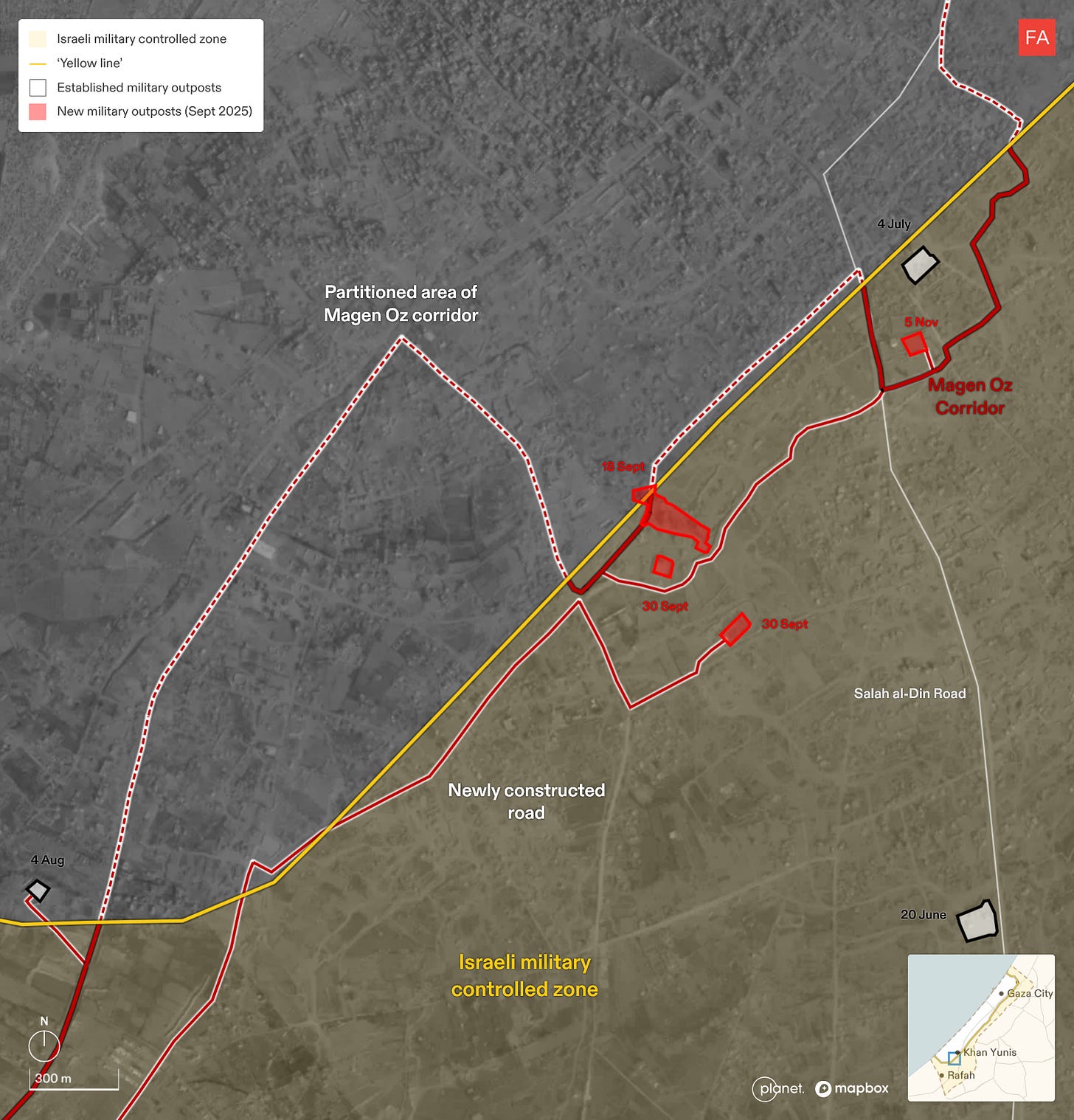
22


Three Palestinians are killed by Israel west of the Yellow Line. A nine-month-old dies of exposure in Khan Younis. Aid groups report that they are unable to reach Gaza with supplies necessary to withstand the effects of its winter storms. Israel approves construction of an additional 764 houses in illegal West Bank settlements. The U.S. seizes a Venezuelan oil tanker. The U.S. is considering designating UNRWA a “foreign terrorist organisation.” The Pentagon spent $2 billion on anti-immigrant operations. House approves the $901 billion National Defense Authorization Act. A U.S. citizen was assaulted and kidnapped by ICE in Minnesota. President Donald Trump threatens more sanctions on the International Criminal Court. Bolivia’s former President Luis Arce is arrested. Violence is surging in Sudan. Israeli soldiers fire at a UN convoy in Lebanese territory. Unidentified gunmen kill three soldiers in southeastern Iran. Burkina Faso releases its captive Nigerian soldiers. Fighting between Cambodia and Thailand enters its third day. Southern separatists threaten to attack Yemen’s capital. Drop Site releases a new report that shows how the Israeli state supports its settler militias as they terrorise Palestinians in the West Bank.

This is Drop Site Daily, our new, free daily news recap. We send it Monday through Friday.

Subscribe now

Venezuelan President Nicolás Maduro (center) greets supporters at a rally in Caracas on December 10, 2015, while the U.S. government asserted that it had seized a tanker off Venezuela’s coast (Photo by Jesus Vargas/picture alliance via Getty Images).

The Genocide in Gaza

Casualty counts in the last 24 hours: Over the past 24 hours, the bodies of four Palestinians arrived at hospitals, while 10 Palestinians have been injured, according to the Gaza Ministry of Health. The total recorded death toll since October 7, 2023 is now 70,373 killed, with 171,079 injured.

Total casualty counts since ceasefire: Since October 11, the first full day of the ceasefire, Israel has killed at least 383 Palestinians in Gaza and wounded 1002, while 627 bodies have been recovered from under the rubble, according to the Ministry of Health.

Two Palestinians killed by Israeli forces west of the “Yellow Line”: Two Palestinians, including a child, were killed by Israeli fire west of the Yellow Line in Jabaliya on Wednesday. The director of Al-Shifa Hospital said doctors on Wednesday received the body of a 17-year-old boy who had been run over and crushed to death by an Israeli tank in the Jabaliya refugee camp, according to the Associated Press. Another child was rushed to the hospital with a gunshot wound to the head, according to journalist Momin Abu Owda. The Israeli army acknowledged the incident, but claimed its troops had “eliminated” two alleged “terrorists” who had crossed the Yellow Line and posed an “immediate threat.”

Palestinian man killed by the IDF west of Khan Younis: Israeli forces shot and killed a Palestinian man in the coastal Mawasi area west of Khan Younis, according to Al Jazeera. Troops opened fire on people gathered at the al-‘Alam traffic circle, killing one and injuring several others. The site is well outside the Yellow Line marking Israeli control.

Winter storm kills an infant in Gaza: A baby girl died of the extreme cold in a flooded tent in Khan Younis overnight as storm Byron continues to ravage Gaza. The family of the nine-month-old was displaced and living in a tent. The mother told Al Jazeera “It was raining, fiercely cold, and I had very little to keep her warm. I fed her and put her to sleep. I wrapped her up the best I could, but it wasn’t enough,” she said. “It kept raining, and the cold was getting worse. I was panicking all night, as the cold kept creeping in. Then, suddenly, I found my little baby motionless, dead.”

Israel continues to restrict aid into Gaza: US Ambassador to the United Nations Mike Waltz visited the Karam Abu Salem/Kerem Shalom crossing in Rafah on Wednesday and claimed that over 600 trucks a day were entering Gaza since the so-called ceasefire went into effect. However, the Israeli military’s own figures of the number of aid trucks entering Gaza fall short of that amount, according to a new analysis by the Associated Press (AP). Under the deal, Israel agreed to allow 600 trucks of aid a day into Gaza. COGAT, the Israeli military wing in charge of coordinating aid entry, provided figures to AP that show an average of only 459 trucks a day since October 12, when the flow of aid restarted. The Israeli military’s figures themselves are highly disputed. Gaza’s Government Media Office said no more than 234 trucks per day have entered Gaza on average since the ceasefire. The office said Waltz’s claim was a “blatant attempt to exonerate the occupation from the crime of the blockade and starving the civilian population.”

Distress signals climb amid winter storm: Gaza’s Civil Defense said it has received “more than 2,500 distress signals” from Palestinians whose tents and shelters have been damaged since the heavy winter rains began. Rescue teams found entire displacement camps flooded in the areas of Khan Younis, Deir el-Balah, Nuseirat, and Gaza City.

International aid groups are unable to deliver supplies to a storm-ravaged Gaza: Israel insists there are “no supply restrictions” and that a “broad winter response” is underway, yet the Norwegian Refugee Council says international aid groups remain blocked from bringing relief and nearly 4,000 pallets of shelter materials have been rejected, leaving only a “trickle” of supplies available for the storm-battered residents of the Strip.

UN updates on Gaza: In its Wednesday briefing, the UN says about 65 former shelter classrooms in Gaza have been cleared for use, even as Israel prevents education materials from entering the stripe, while 260,000 people have received food parcels this month across 60 distribution points, including a newly opened site in Beit Lahiya. Veterinary kits entered for the first time since August, and OCHA reported continuing “security incidents,” including bullets striking UNRWA’s Maghazi Health Center near the yellow line with no injuries reported.

Unidentified bodies from Al-Shifa Hospital are buried: Fifteen unidentified Palestinians whose bodies were recovered yesterday from the courtyard of al-Shifa Hospital in western Gaza City were buried yesterday. Dr. Omar Shaban in northern Gaza shared photos of the burial with Drop Site, available here.

Hamas leader once again rejects the viability of disarmament: Hamas Political Chief Khaled Meshaal told Al Jazeera on Wednesday that the group would work to prevent future attacks on Israel, but he warned that full disarmament would be like “removing the soul” of the movement. He also rejected any non-Palestinian governing authority in Gaza and urged increased aid flows as a precondition for Phase Two. A summary of his interview with Al Jazeera can be read here.

Airwars reconstructs GHF sites and shows how they were turned into “militarized death traps”: A new visual investigation from Airwars reconstructs two Gaza Humanitarian Foundation aid sites, demonstrating how the U.S.- and Israel-backed operation effectively turned food distribution into a “militarized death trap.” Drawing on extensive footage and interviews with Palestinian aid seekers and former GHF contractors, it illustrates how, during five months in 2025, more than 1,000 people were killed trying to reach sites whose very design made “deaths and injuries inevitable.”

Trump delays “Board of Peace” rollout: President Donald Trump delayed announcing Gaza’s proposed “Board of Peace,” after a weekend in which foreign ministers warned that the fragile truce could collapse within weeks. Earlier, U.S. officials signalled interest in a Phase Two transition occurring by December, and now Trump says the board will be named “early next year.” No country has yet committed to the planned International Stabilization Force—another of the ceasefire’s more controversial provisions.

West Bank and Israel

Israel approves nearly 800 more houses in three settlements: Israel approved the construction of 764 houses in three Jewish settlements in the occupied West Bank on Wednesday. Israeli Finance Minister Bezalel Smotrich, who is a settler himself, said that the Higher Planning Council approved the units in the Hashmonaim, Beitar Illit, and Givat Ze’ev settlements. The settlements are illegal under international law. In a statement, Smotrich said a total of 51,370 housing units have been approved in the West Bank since he assumed his post in late 2022.

Israeli soldiers fire at a UNIFIL convoy: Israeli soldiers in a Merkava tank fired several ten-round bursts above and near a UN convoy patrolling the Blue Line in Lebanese territory on Wednesday, according to the United Nations Interim Force in Lebanon (UNIFIL). No casualties were reported in the incident. The UN noted that the IDF had advance notice of the patrol’s timing and location, and it said that firing on, or near, peacekeepers violates Security Council Resolution 1701, while calling upon Israel to halt its aggressive actions.

U.S. News

U.S. seizes a Venezuelan oil tanker: The U.S. seized a Venezuelan oil tanker off the coast of Venezuela, President Donald Trump said Wednesday, touting the “very large” vessel’s capture as part of a broader pressure campaign against Venezuelan President Nicolás Maduro. U.S. officials said the tanker—accused of helping move oil for Hezbollah and Iran’s IRGC-QF—was headed to Cuba, and was in international waters at the time of its seizure. Venezuela denounced the move as “international piracy” in a statement. “In these circumstances, the true reasons for the prolonged aggression against Venezuela have finally been revealed,” the Venezuelan government’s statement said. “It is not migration. It is not drug trafficking. It is not democracy. It is not human rights. It has always been about our natural wealth, our oil, our energy, the resources that belong exclusively to the Venezuelan people.” Nobel Peace Prize winner and opponent of Maduro, María Corina Machado, said she supports the US seizure of the tanker, calling it a “very necessary step” to confront Maduro’s “criminal” regime. She made the comments in Oslo where she traveled to receive the Nobel Peace Prize.

House passes massive defense policy bill: The U.S. House of Representatives passed the National Defense Authorization Act (NDAA) on Wednesday, authorizing a record $901 billion in annual military spending. The vote was 312-112 in favor of the bill and has been sent for consideration by the U.S. Senate, which is expected to pass it next week.

The Fed cuts interest rates for the third time this year: The Federal Reserve cut interest rates by a quarter point Wednesday, lowering borrowing costs for the third time this year. The Federal Open Market Committee voted to cut its benchmark rate by a quarter percentage point to between 3.5 and 3.75 percent.

Trump administration considers slapping “terrorism” sanctions on UNRWA: Trump administration officials held advanced internal discussions about imposing terrorism-related sanctions on UNRWA, the UN agency that provides essential services to millions of Palestinian refugees, a deliberation that prompted major legal and humanitarian concerns within the State Department, Reuters reported. The Trump administration reportedly considered options that include targeting specific officials or even labelling the entire agency a foreign terrorist organisation—an unprecedented step that critics warn would further cripple Gaza’s already vulnerable aid infrastructure.

The Pentagon is spending $2 billion on anti-immigration operations, report says: A new report by Democratic lawmakers says the Pentagon diverted at least $2 billion from core missions this year to support President Donald Trump’s immigration crackdown. As a result of this, projects ranging from building pilot training facilities to the repairs of schools and barracks have been paused or canceled. In the report, lawmakers warn that the shift is degrading military readiness and using troops on missions for which they “have neither signed up, nor been trained.”

Republicans block Senator Van Hollen’s bid to restrict U.S. military action in Venezuela: Senate Republicans blocked Sen. Chris Van Hollen’s effort to forward a bill that would bar the Pentagon from using taxpayer funds for U.S. hostilities in Venezuela without explicit congressional approval. Van Hollen, backed by Sens. Tim Kaine and Jeff Merkley, argued on the floor that the measure is essential to prevent unilateral wars.

U.S. citizen assaulted by ICE agents in Minnesota: A U.S. citizen named Mobashir says ICE agents tackled him, put him in a chokehold, and ignored his repeated pleas to check his digital passport before abducting him and driving him seven miles away before releasing him. His account of his treatment is available here.

Trump threatens new sanctions against the ICC: President Donald Trump is now threatening new sanctions against the International Criminal Court (ICC), unless it guarantees that neither he nor other U.S. officials can ever be prosecuted. Such a change would require the unlikely backing from two-thirds of ICC member states and comes after ICC judges issued arrest warrants for Israeli Prime Minister Benjamin Netanyahu and former Defense Chief Yoav Gallant for war crimes and crimes against humanity in Gaza.

Congress held a hearing on “Judea and Samaria” without inviting a single Palestinian to testify: Congress held a Wednesday hearing on “Judea and Samaria”—the Israeli name for the occupied West Bank—without inviting a single Palestinian witness. The panel instead featured representatives from the Heritage Foundation, the Zionist Organization of America, and the Center for Strategic and International Studies. Activists with Code Pink attended the hearing and confronted lawmakers. Watch here.

International News

Left-wing former Bolivian president arrested: Bolivia’s former President Luis Arce was arrested in La Paz on Wednesday. Authorities say the case concerns alleged irregularities and a $700 million embezzlement scheme tied to an Indigenous rural-development program. The arrest came just a month after Arce left office and has raised fears the new government is targeting political rivals. Newly-elected President Rodrigo Paz has already launched multiple “truth commissions” scrutinising Arce’s party, Movimiento al Socialismo (MAS), and its affiliated institutions. Arce’s former Minister María Nela Prada called the operation a “kidnapping.”

Violence is surging in Sudan, the UN says: The UN warned yesterday that violence is sharply escalating across Darfur and Kordofan, with drone strikes killing and injuring civilians in Kutum, Kabkabiya, and Nyala. New RSF advances—including the seizure of the Heglig oil field—have triggered fresh waves of displacement, the UN says, and the International Organization for Migration (IOM) says 185 people fled Kadugli on Wednesday alone. The IOM also reports that newly displaced families from El Fasher continue arriving in Tawila, and that they relayed stories of robbery, looting and gunfire along their route.

19,000 are being held in RSF detention sites, according to the SDN: A new Sudan Doctors Network report says more than 19,000 people are being held by the Rapid Support Forces (RSF) across Darfur, including thousands of police, army personnel, civilians, and 73 medical workers. Detention site conditions have fueled a deadly cholera outbreak. The group urges the UN to pressure the RSF to release civilians, halt arbitrary arrests, publish detainee lists, and allow family members access to those detained.

Gunmen kill three soldiers in southeastern Iran: Gunmen ambushed and killed three members of Iran’s Revolutionary Guard while they were patrolling near the city of Lar in Sistan and Baluchistan, close to the Pakistan border, the Associated Press reported. The attackers, whom the Revolutionary Guard labeled “terrorists,” remain at large, and no group has claimed responsibility for the attack. The underdeveloped province bordering Afghanistan and Pakistan has long been the site of sporadic, deadly clashes involving militant groups, armed drug smugglers, and Iranian security forces.

Burkina Faso releases its captive Nigerian soldiers: Authorities in Burkina Faso released 11 Nigerian military personnel after their “unauthorized” emergency landing yesterday, according to The Guardian. Nigeria says the diversion was a standard safety procedure due to a technical issue, and the incident has drawn heightened scrutiny as the Economic Community of West African States and the breakaway Alliance of Sahel States trade accusations amid mounting regional instability.

Ukraine drones disable a Russian “shadow fleet” tanker: Ukraine struck a sanctioned Russian “shadow fleet” tanker in its Black Sea economic zone using sea drones, the third Ukrainian strike using sea drones in two weeks, Reuters reported. The Dashan tanker was hit by explosions at its stern while sailing with disabled transponders. Kyiv says these “shadow fleet” vessels help Moscow evade sanctions and fund its war, and attacks like these have caused war insurance costs on ships in the region to spike.

Ukraine responds to the Trump peace plan: Ukraine delivered its point-by-point response to President Donald Trump’s 20-point peace plan on Wednesday, Axios reported, proposing amendments after consultations with European allies. President Trump, who discussed the plan with E3 leaders the same day, said the sides may be “closer than ever,” with further U.S.–Ukrainian military talks scheduled for Thursday.

Cambodia-Thailand fighting enters its third day: Renewed border fighting between Thailand and Cambodia has intensified, with over 400,000 people evacuated in Thailand and more than 127,000 displaced in Cambodia, according to the Associated Press. The countries have traded airstrikes, rockets, and artillery, and over a dozen people have been killed in the renewed conflict. President Donald Trump, who oversaw a truce in the summer, claims he can restore the truce and indicated plans to contact both governments for meditation; leaders in Bangkok and Phnom Penh, however, have vowed to continue combat.

STC threatens Sana’a: Aidarous al-Zubaidi, separatist leader of the United Arab Emirates-backed Southern Transitional Council (STC) in Yemen, said his forces’ next objective should be Sana’a, according to the New York Times. After seizing parts of Hadramout and al-Mahra in an offensive earlier this week, the STC is openly pursuing its breakaway ambitions and building a parallel state structure. On Tuesday, a Saudi delegation met with tribal leaders in Seiyun—the southern Yemeni city recently seized by STC forces—and urged the separatists to withdraw.

UN: Afghanistan faces a “severe humanitarian crisis”: The UN warned Wednesday that Afghanistan is facing a “severe humanitarian crisis.” The country’s women and girls remain barred from nearly all public life, and UN officials tell the Security Council that mass returns from Iran and Pakistan, vanishing press freedoms, and the Taliban ban on female UN staff are straining civil society in the country. Emergency Relief Coordinator Tom Fletcher urged member states to work to ensure women aid workers can operate and to adequately fund the UN’s Afghanistan efforts.

Spanish PM meets with President Mahmoud Abbas and reaffirms his support for a two-state solution: Spanish Prime Minister Pedro Sánchez urged Europe to “raise its voice” and not let the “tragic situation of Palestinians” fade from view as he met President of the Palestinian Authority Mahmoud Abbas in Madrid. He reaffirmed that a two-state solution is “the only possible path,” insisting the ceasefire “must be real, not merely formal,” and added that Spain “will not look away” as attacks and casualties continue to rise.

More From Drop Site

How Israel Organizes and Arms Settler Militias to Terrorize Palestinians in the West Bank: A new report from contributor David Schutz reveals the organizational structures of Israeli settler militias operating in the occupied West Bank. While settler violence against Palestinians often appears sporadic, it is in fact an official government system that is armed and funded by the state and that has an organized structure that is fully operating as intended. Read the piece in full here.

Programming note: You can sign up here to get updates from us on our WhatsApp channel.

If you want to continue getting this newsletter, you don’t have to do anything. But if this is too much—we do try to be mindful of your inbox—you can unsubscribe from this newsletter while continuing to get the rest of our reporting. Just go into your account here at this link, scroll down, and toggle the button next to “Drop Site Daily” to the off setting. It looks like this:

Subscribe now

Share


From Drop Site News via this RSS feed
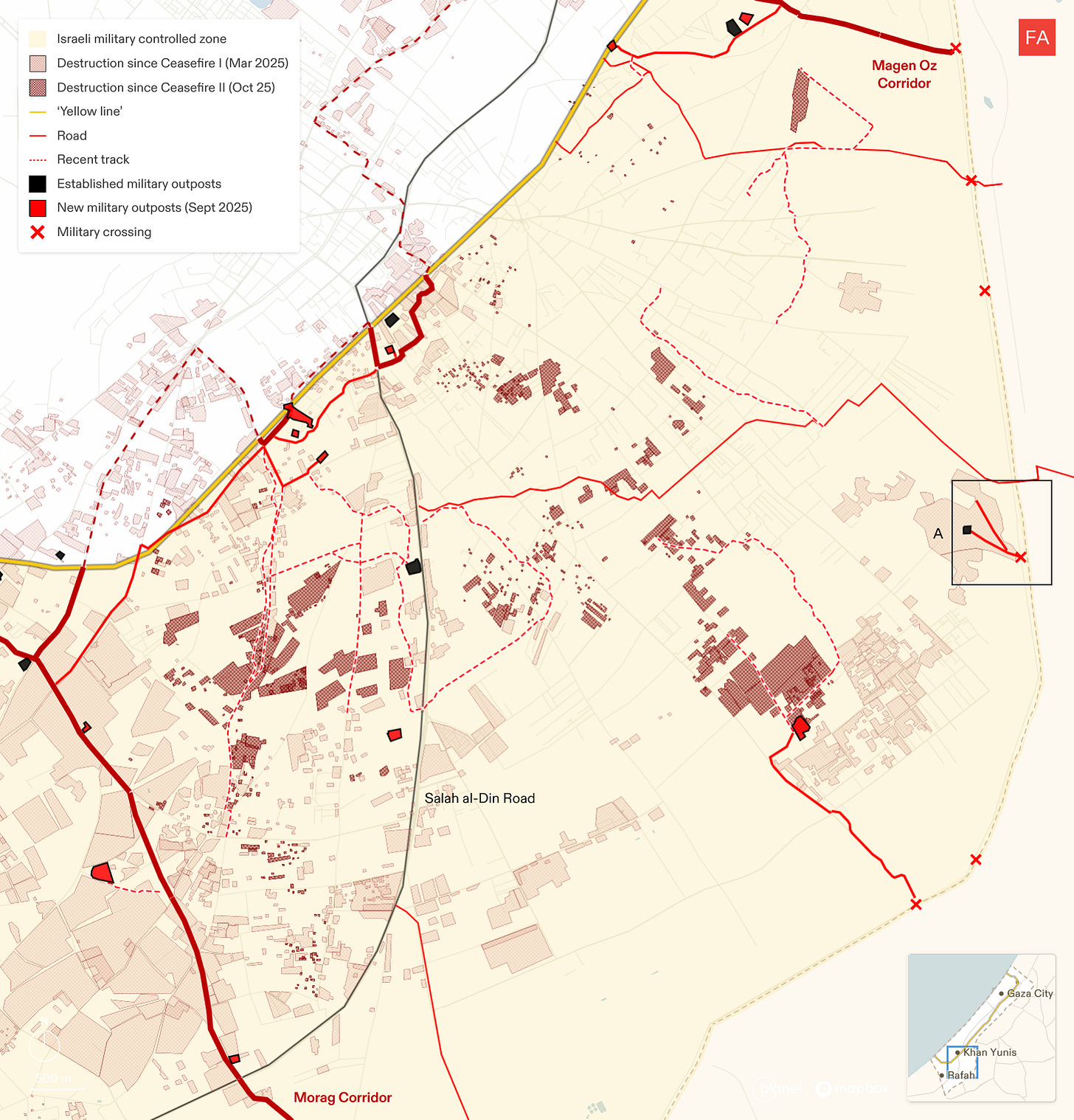
23


Winter storms are expected to hit Gaza today. Child malnutrition in Gaza remains at crisis levels. Only a third of Gaza’s children are enrolled in school. Israel remains the foremost state perpetrator of journalist killings in 2025 for the third consecutive year. More than 100 Palestinians are detained Wednesday in a sweeping raid on the West Bank. Bolivia restores full diplomatic ties with Israel. President Donald Trump says Russia is “obviously” winning in a wide-ranging interview with Politico. The U.S. military installs Google’s AI technology. A Senate report finds that immigration officials have detained and brutalized at least 22 American citizens. The U.S. sanctions a “transactional network” funding the RSF in Sudan, but fails to mention the UAE. UNICEF estimates 10 million have been displaced in Sudan. Nigerian soldiers are detained in Burkina Faso. The M23 pushes toward the city of Uvira in eastern Congo. Dozens are killed after intra-gang fighting in Haiti, six are killed in an attack on a security installation in northwest Pakistan, and the death toll rises in border clashes between Thailand and Cambodia. A new Drop Site report uncovers that Jeffrey Epstein, contrary to previous claims, was de facto chief financial officer of Leslie Wexner’s pro-Israel philanthropic foundation.

This is Drop Site Daily, our new, free daily news recap. We send it Monday through Friday.

Subscribe now

Displaced Palestinians try to drain water that has flooded their tents due to heavy rain and prevent damage to their belongings in Austrian Quarter of Khan Yunis, Gaza on November 16, 2025. A major winter storm is forecasted to hit Gaza Wednesday, placing 850,000 people at imminent flood risk (Photo by Abed Rahim Khatib/Anadolu via Getty Images).

The Genocide in Gaza

Casualty counts in the last 24 hours: Over the past 24 hours, the bodies of three Palestinians, including one recovered from the rubble, arrived at hospitals, while five Palestinians have been injured, according to the Gaza Ministry of Health. The total recorded death toll since October 7, 2023 is now 70,369 killed, with 171,069 injured.

Total casualty counts since ceasefire: Since October 11, the first full day of the ceasefire, Israel has killed at least 379 Palestinians in Gaza and wounded 992, while 627 bodies have been recovered from under the rubble, according to the Ministry of Health.

Child malnutrition remains at crisis levels, UNICEF says: Despite a ceasefire announced two months ago, child malnutrition in Gaza remains at crisis levels. UNICEF reported that 9,300 children were hospitalized for severe acute malnutrition in October, alongside 8,300 malnourished pregnant and breastfeeding women. UNICEF spokesperson Tess Ingram warns that the effects will last for years, and a surge in low-birth-weight babies is expected in the coming months.

Winter storms to hit Gaza as early as today: Three days of winter storms are expected to hit Gaza today with flash floods, high winds, and hail, according to the Palestinian Meteorological Department. The mayor of Gaza City told Al Jazeera that several roads have already been cut off and tent shelters flooded, with some completely submerged. Wind speeds of 31 miles per hour accompanied by a drop in temperature and intense rain is expected. According to the UN, more than 760 displacement sites, housing 850,000 people, face imminent flood risk. The group Save the Children has called on Israel to allow tents, winter clothes, and blankets to enter Gaza to help protect families from the storm. Meanwhile, Israeli Channel 14 host Shimon Riklin sparked outrage after celebrating the storm on air: The weather forecaster said the storm would “drown Gaza,” and Riklin replied that he was “happy” to hear it.

Only a third of Gaza’s children are enrolled in school: UN agencies say 390 temporary classrooms are serving nearly 221,000 students in Gaza this year—about 567 children per learning space. Only a little over one-third of Gaza’s school-aged population is enrolled for the 2025–2026 school year, highlighting the severe loss of educational access in the enclave after two years of U.S.–Israeli destruction.

West Bank and Israel

Over 100 Palestinians detained in the West Bank: More than 100 Palestinians were detained on Wednesday in a wave of Israeli military raids across the occupied West Bank, according to the Palestinian Prisoners’ Media Office. The hardest-hit areas included Nablus, where some 30 Palestinians were detained and questioned before some were released. Many of those detained had been formerly incarcerated.

A young Palestinian man dies in Israeli custody: Twenty-one-year-old Abdul Rahman al-Sabateen was arrested by Israeli soldiers in late June, and he has been confirmed to have died in Israeli custody last night, according to the Palestinian Authority (PA). The young man from the town of Husan, near Bethlehem in the occupied West Bank, died at Shaare Zedek Medical Center in Jerusalem, the PA said in a statement, adding that the prisoner had shown no signs of physical or health problems when his family saw him during a court session on November 25.

Israel kills more journalists than any state in the world, for the third consecutive year: Reporters Without Borders says Israel killed more journalists in 2025 than any other country for the third consecutive year, with Israeli forces responsible for the deaths of 29 Palestinian reporters—accounting for more than 40 percent of 67 journalists killed worldwide. The report also highlighted Ukraine, Sudan, and Mexico as states that have posed considerable dangers to journalists.

A new B’Tselem report refutes the IDF’s account of June killings: A new investigation by B’Tselem and Index Investigations refutes the Israeli army’s claim that two brothers killed in Nablus in June were “terrorists,” finding instead that soldiers shot them “without justification and without them posing a threat.” The full investigation is available here.

Bolivia has formally restored full diplomatic ties with Israel: The Israeli Foreign Minister Gideon Sa’ar posted photos on social media on Tuesday of a signing ceremony alongside his Bolivian counterpart. Bolivia had severed formal ties with Israel in October 2023, soon after Israel launched its genocidal assault on Gaza. Bolivia is one of the principal countries involved with the Hague Group, an alliance of nations formed in early 2025 to coordinate legal and diplomatic actions against alleged grave violations of international law by Israel in Palestine.

U.S. News

Trump says Russia is “obviously” winning in Ukraine and offers other foreign and domestic policy comments: President Donald Trump offered no reassurance to European leaders worried he may abandon Ukraine at a pivotal moment in peace negotiations, instead saying Russia is “obviously” in a stronger position, while criticizing Europe’s role in the war, promoting his own unreviewed draft peace plan, and urging Ukraine to hold new elections. In a wide-ranging interview with Politico, Trump attacked European migration policies and vowed to keep endorsing leaders like Hungarian Prime Minister Viktor Orbán in their elections. He, meanwhile, threatened broader military action in Latin America, and insisted the U.S. economy is “A-plus-plus-plus-plus-plus.”

U.S. military to begin using Google’s AI tech: The U.S. War Department announced today that it is deploying Google Cloud’s “Gemini for Government” as the first AI system on its new “GenAI(dot)mil” platform, making the tool available across Pentagon desktops and military installations worldwide as part of the government’s “AI-first” push. The rollout follows President Donald Trump’s July directive to secure U.S. AI dominance, with Secretary of War Pete Hegseth declaring the military “all in on artificial intelligence as a fighting force.” More on this from Drop Site contributor Jessica Burbank here.

U.S. proposes scrutinizing foreign tourists’ social media profiles: U.S. Customs and Border Protection (CBP) has proposed requiring visitors from 42 visa-waiver countries—including Britain, France, Germany, and South Korea—to submit up to five years of social media history along with extensive personal data as part of their travel authorization, the New York Times reported. Travel industry groups and civil liberties advocates warn that the plan marks a major expansion of surveillance, while slowing approvals and chilling free speech, as CBP says it will take public comments for 60 days before moving forward.

Trump says the Times should “cease” publication: President Donald Trump accused The New York Times of publishing “fake” stories to undermine him, calling the paper an “enemy of the people,” and suggesting it should cease publication. He claimed the Times repeatedly misreported his election results and “was forced to apologize” on much of what they wrote—reprising a fabricated apology he occasionally invoked during his 2024 campaign.

New York AG refuses to release records about Betar: New York’s attorney general has refused to release records on Betar USA—an ultra-far-right Zionist group notorious for targeting pro-Palestine students—citing an active law enforcement investigation that the state says could be compromised by disclosure. Ali Abunimah of The Electronic Intifada reports that Betar USA appears to operate with almost no regulatory oversight, may be functioning as an unregistered agent of the Israeli government, and has been linked to hate-crime plots, student arrests, extremist rhetoric, and possible violations of New York charity law. Read more reporting on Betar and EI’s stymied efforts to investigate it here, and Drop Site’s article on Betar here.

Senate report says immigration agents detained and brutalized at least 22 U.S. citizens: A Senate investigation found that federal immigration agents unlawfully detained and abused at least 22 U.S. citizens between June and November 2025, contradicting DHS Secretary Kristi Noem’s claim that “no American citizens have been arrested or detained.” The 200-page report details what investigators call a pattern of constitutional violations by ICE and CBP—including excessive force, denial of medical care, fabricated charges, and the targeting of children—and warns that these cases likely represent only a fraction of the citizens harmed. Read more coverage of this report from Migrant Insider here.

Jasmine Crockett’s campaign backed by Republicans: Rep. Jasmine Crockett was encouraged to run for Senate by an astroturfed campaign from the Republican Party, according to a new report by NOTUS. Watch Ryan Grim’s commentary on Crockett as a new kind of corporate Democrat” here.

International News

U.S. sanctions a “transactional network” funding the war in Sudan, but does not sanction the UAE: The U.S. State Department announced sanctions against eight individuals and entities involved in what it calls a “transnational network—composed primarily of Colombian nationals and companies—that recruits former Colombian military personnel to fight for the Sudanese paramilitary Rapid Support Forces (RSF) and trains fighters, including children.” Among the individuals sanctioned is a retired Colombian military officer based in the United Arab Emirates (UAE). However, the sanctions do not name or target the UAE, despite being the RSF’s principal backer.

10 million have been displaced in Sudan, UNICEF estimates: UNICEF says 10 million people have been displaced in Sudan—half of them children—making it the largest child displacement crisis in the world. Many in Darfur and Kordofan are facing near-total cutoffs of food, water, and medical care, while newly exhausted and dehydrated children arrive at refugee camps daily. Visiting Sudan, UNICEF Executive Director Catherine Russell warned that women and girls, many of whom have experienced widespread sexual violence, are bearing the brunt of this devastation, and she urged the international community to act to protect those displaced.

Nigerian soldiers detained by Burkina Faso: Burkina Faso is holding 11 Nigerian military personnel after a Nigerian C-130 made an unapproved emergency landing in the town of Bobo Dioulasso, according to a report from The Guardian. Leader of The Alliance of Sahel States (AES), Assimi Goïta, denounced the incident as an “unfriendly act” and warned that future violations of the bloc’s airspace would be “neutralized.” The dispute comes less than a day after Nigeria joined an intervention to help the government of Benin foil a coup attempt, and as part of a broader breakdown between the Economic Community of West African States and the breakaway AES union.

M23 push towards Uvira in eastern Congo: M23 rebels pushed into the outskirts of Uvira in eastern Congo on Tuesday, as part of a new offensive contributing to more than 200,000 people being displaced in recent days, the Associated Press reported. The advance comes despite last week’s U.S.-mediated agreement between Congo and Rwanda, which is widely understood to be sponsoring the M23 rebels. Fighting has intensified across South Kivu, with officials warning of possible massacres, Congolese soldiers reportedly fleeing, and shells landing in neighboring Burundi.

Lithuania declares a state of emergency: Lithuania declared an “emergency situation” on Tuesday after meteorological balloons launched from Belarus repeatedly forced airport closures. Lithuanian Prime Minister Inga Ruginienė’s announcement comes amid growing tension between Lithuania and Belarus over the balloons, which have previously been used to smuggle cigarettes but are now suspected to be operated by Belarusian security services, and Lithuanian officials have called the balloons a Russia-backed “hybrid attack.” The move allows the Lithuanian military to join border patrols as the country’s prosecutors and intelligence services investigate, underscoring wider European fears that Russia and its allies are escalating hybrid warfare tactics along NATO’s eastern frontier.

Dozens killed after intra-gang fighting in Haiti: Dozens of people, including at least 10 children, have been killed after fierce clashes within Haiti’s Viv Ansanm gang coalition, as a top Bel-Air figure was beheaded and powerful leader Kempès Sanon was wounded, according to reporting from the Associated Press. Human rights monitors say at least 49 people have been killed, burned, or mutilated since Monday, while hunger has surged and instability has deepened in the country ahead of next year’s planned elections.

Six killed and three injured in an attack in Pakistan’s Kurram district: Militants stormed a security checkpoint in Pakistan’s Kurram district near the Afghan border, killing six soldiers and three police, Reuters reported. This is the latest escalation as Islamabad and Kabul struggle to preserve a fragile truce after deadly border clashes in October. Pakistan blames the surge in attacks on militants operating from Afghan soil—a charge Kabul denies.

Death toll rises in Thailand-Cambodia clashes: Thailand and Cambodia are trading blame for reigniting hostilities along their disputed border, with Cambodia reporting nine civilians killed and 20 injured since Monday, and Thailand said four soldiers have been killed and 68 wounded, according to Al Jazeera. The clashes triggered the evacuation of hundreds of thousands of people, and both governments vow to press on with military operations, despite an earlier ceasefire mediated by the U.S. and its present attempts to quell the conflict.

Shells hit Damascus airport: Syria’s Mezzah military airport in Damascus was struck by three shells of unknown origin on Tuesday, according to Reuters. Syrian state media reported no casualties or damage and later announced the discovery of four missile launchers without claiming who was responsible.

More From Drop Site

Epstein used his billionaire associate’s foundation to support pro-Israel groups: Newly leaked emails show Jeffrey Epstein sat atop a financial apparatus designed to advance Israeli interests in the U.S., wielding power of attorney over Les Wexner’s fortune and effectively running the Wexner Foundation, which has funneled hundreds of millions of dollars to Israel-linked causes for decades. This correspondence contradicts the Wexner Foundation’s claims that Epstein had “no meaningful role,” instead revealing him to be de facto chief financial officer who directed major tax decisions, credit lines, fund transfers, and oversaw politically sensitive grants. Read the latest from Murtaza Hussain and Ryan Grim here.

Livestream Highlights

“Increasing military spending has not been stopped”: Ryan Grim spoke with Just Foreign Policy’s Erik Sperling about the roughly $900 billion, thousand-page National Defense Authorization Act (NDAA), which Ryan Grim notes is treated in Congress as “must-pass” legislation—allowing lawmakers to slip in policies that would struggle to pass on their own as the bill is hurried to a year-end vote with little public scrutiny. Sperling says the NDAA could help Washington preserve its military footholds in Korea and Europe.

We are asking to be treated like any human around the world”: Gaza journalist Asem Alnabih joined the livestream to discuss the catastrophic conditions in Gaza City, which he says is being made deliberately unlivable by Israel’s bombardment and aid restrictions. Gaza City’s infrastructure has collapsed after the genocidal campaign of the past two years, while families have been pushed into tents “built to last a few weeks, not two years,” and are now facing down a third winter under such conditions, Alnabih reported. He added that strikes continue, despite the announcement of a ceasefire, and he stressed that the hundreds of thousands of people who remain in Gaza City “will not allow Israel to take our city.”

The full livestream can be accessed here.

Amani al-Khatahtbeh, a prominent U.S. activist and political commentator, cited our reporting on Meta’s suppression of pro-Palestinian content in her debate with Israeli social media influencer Hen Mazzig on Al Arabiya English. A clip from that debate discussing our reporting can be watched here.

Programming note: You can sign up here to get updates from us on our WhatsApp channel.

If you want to continue getting this newsletter, you don’t have to do anything. But if this is too much—we do try to be mindful of your inbox—you can unsubscribe from this newsletter while continuing to get the rest of our reporting. Just go into your account here at this link, scroll down, and toggle the button next to “Drop Site Daily” to the off setting. It looks like this:

Share

Leave a comment


From Drop Site News via this RSS feed
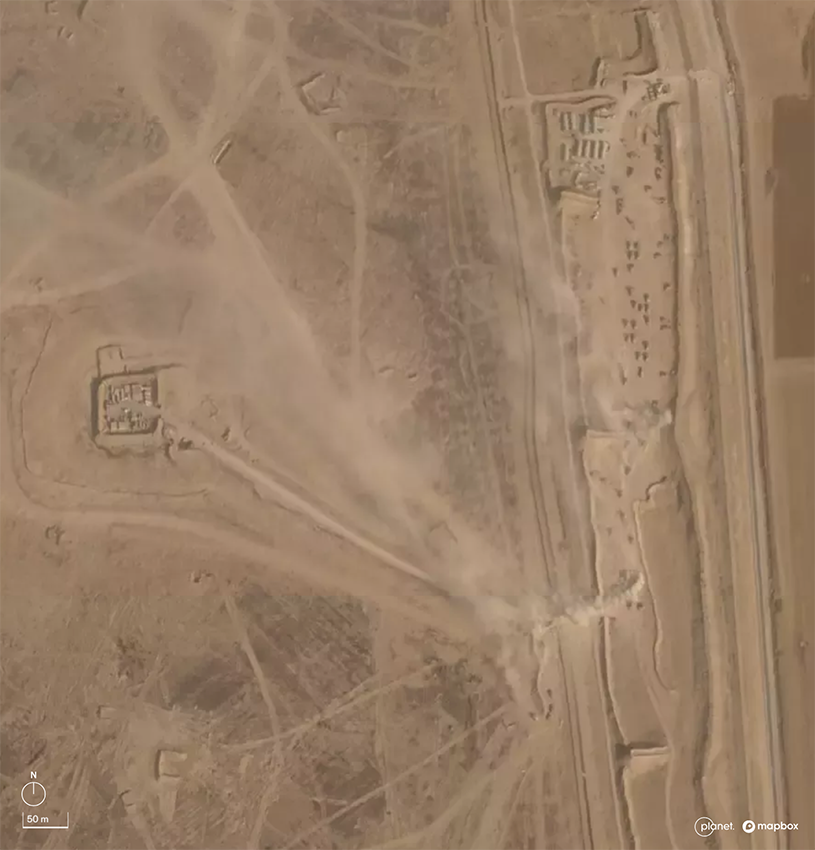
24


Drop Site is a reader-funded, independent news outlet. Without your support, we can’t operate. Please consider making a 501(c)(3) tax-deductible donation today.

Subscribe now

Three armed Israeli settlers use their phones in Tarqumiyah, northwest of Hebron, in the occupied West Bank, on November 28, 2025. (Photo by Mosab Shawer / Middle East Images / AFP via Getty Images)

Story by David Schutz

IBSIQ, WEST BANK—On July 20, around ten masked men raided the Palestinian hamlet of Ibsiq in the northern Jordan Valley in the occupied West Bank. They arrived in a two car convoy, dressed in Israeli military-issue fatigues, and carried assault rifles fitted with green laser pointers.

While their vehicles blocked the road, they stormed into a cluster of homes. At gunpoint, they forced a Palestinian family to their knees and warned them they had 48 hours to evacuate Area C and go to Area B—referring to technical designations of control in the West Bank under the Oslo Accords. Area C is under full Israeli control and Area B is technically under Palestinian civil administration but shares security control with Israel. The masked men said they would “return and burn the community down,” if the family did not evacuate to Area B.

I had been staying with an elderly Palestinian couple for five days in Ibsiq to document settler violence amid rising threats against the community. As the men approached, I asked one of them who he was. They looked like soldiers, but the vehicles in which they arrived had yellow civilian license plates. These masked assailants were members of the hagmar— settler reservist militias formally attached to the Israeli army and tasked with “security” in West Bank settlements.

The men dragged me behind a fence where four of them beat me until I required hospitalization. They stole the phone of an International Solidarity Mission activist who tried to record the attack.

My host, Abu Safi, who was 84, had little choice but to leave his home after that raid by the hagmar. The family packed up their belongings accumulated over decades in the house and moved to a nearby location in Area B. Abu Safi died of a heart attack soon afterwards.

The raid on Ibsiq, whose Palestinian residents have since all fled the depopulated hamlet, offers a glimpse into an essential part of how Israel rules the West Bank.

In parallel with Israel’s genocidal assault on Gaza that began in October 2023, Israeli violence from settlers and soldiers in the West Bank escalated to record levels. About 3,000 settler-related attacks causing Palestinian casualties or property damage were recorded between October 2023 and mid-2025, with more than 1,000 of them in the first 8 months of 2025, and 264 incidents in October 2025 alone—the highest monthly total since the UN began monitoring in 2006.

Over the past two years, settlers have increasingly been “going into houses, holding people at gunpoint, and giving them 24 hours to leave, and many have…It happened in Khirbet al-Maktal, Umm Salam, Razeem, and elsewhere,” said a field researcher with Israeli human rights group B’Tselem. He spoke to Drop Site on condition of anonymity out of security concerns. “We file complaints, but many times the authorities tell us the perpetrators were acting outside their capacity as soldiers, so we’re referred to the police,” he added. “Then the police say it’s a military matter. We end up in a situation where no one investigates.”

An Integrated Web of Civilians and Soldiers

Settler violence against Palestinians often appears sporadic, but it is an official government system with an organized structure operating as intended.

Since 1967, Israel has ruled occupied Palestinian territories through dual structures—military occupation and civilian settlements—each reinforcing the other while mutually devolving responsibility.

At the heart of this arrangement lies a legal device: regional settlement councils, chartered under the 1964 Municipalities Ordinance as standard Israeli municipalities, yet which operate in occupied Palestinian territory. Israeli jurisdiction rests on military orders and the West Bank Emergency Regulations, which extend most aspects of Israeli law in personam to settlers but not to the land itself. Territorial authority is supplied by the Israeli military, making the army the de facto sovereign.

Within this framework, the state delegates enforcement to settlers. Each settlement appoints a ravshatz, or a civilian security coordinator, paid by the Defense Ministry and authorized by the military to command a plain clothes rapid-response squad, or kitat konenut, of 20 to 40 volunteers within the settlement boundary. Weapons are issued from the Defense Ministry’s Department for Settlement Security; additional arms also flow from the National Security Ministry.

Inside Israel proper, these squads fall under police authority. Beyond it, across the military’s sector that covers rural border areas and all West Bank settlements, the ravshatz usually operates through a local security officer, or kabat, who is appointed by the settlement council to coordinate with the army.

Parallel to the ravshatz are the Hagmar Territorial Defense brigades: a reserve network integrating each settlement into a military grid broken out into districts, blocs, and areas. At the two top levels—district and bloc—the hagmar report to the regional hagmar command of the IDF. At the lowest level, the area hagmar corresponds to a single settlement. Each settlement coordinates with its area hagmar through its appointed kabat.

The hagmar are issued uniforms by the IDF, while the kitot konenut are not. The distinction between the kitot konenut and the area hagmar is merely a technical one, with the same settlers often serving in both units.

In short, the settlement appoints a security coordinator who essentially commands his own volunteer militia that is armed and funded by the state. Those same settler volunteers also often serve in uniformed army reservist militias under the control of the military that coordinates with their settlement. The volunteer militias, the reservist militias, and the military itself all work together to attack and terrorize Palestinians in the West Bank.

Graphic credit: Meghnad Bose

Although wartime command is meant to shift from local coordinators to the army, the West Bank has never officially been declared a war zone. It remains under what the military calls “ongoing routine security,” a permanent state of civilian control by armed settlers under military cover.

“On paper, the weapons are checked in and out by the ravshatz, but in reality, they almost never come back,” said an Israeli solidarity activist who monitors settler violence in the South Hebron Hills, and who spoke to Drop Site on condition of anonymity, citing security concerns. “In some councils, the armory rules are strict; in others, people just keep the guns at home. It depends on the local kabat and how much the army wants to look the other way.”

While the ravshatz and the settlement’s kitat konenut are technically limited to operating within their settlement, military auxiliaries like hagmar, operating in theory at broader territorial echelons, are not.

“The result is that we have settlers operating as the military without regulation,” Roni Peli, of Israeli human rights organization Yesh Din, told Drop Site.

Drop Site News is reader-supported. Consider becoming a free or paid subscriber.

Forced Evictions

This system was on full display in mid-October on the outskirts of Al-Mufaqara, a hamlet in Masafer Yatta. Armed settlers broke into a Palestinian family’s cave-home, forcibly expelled them, and moved in—threatening to shoot anyone who approached. I arrived a few hours later to find the family and several Israeli solidarity activists outside waiting for the police.

“When the Palestinians tried to stop them, a group of armed men arrived, some in uniform, some not, including Binyamin Zarbiv, the ravshatz from Ma’on,” an Israeli activist who witnessed the incident told Drop Site, pointing to the settlement some 200 meters away. They also spoke on the condition of anonymity, citing security concerns. “They aimed their rifles at the Palestinians and at us, while the settlers carried their belongings inside.”

As we waited, an armed man in a ragtag uniform, identified by the activist as one of those who had arrived earlier, demanded my ID. He claimed to be representing Hagmar Har Hevron, though no such Israeli military unit officially exists, and identified himself as a member of three bodies: Ma’on’s rapid-response squad, the area hagmar unit, and a so-called farm patrol. He refused to say which group had sent him.

“The settler who broke in called the ravshatz on his phone,” the activist said. “That’s how it usually happens. The ravshatz makes a few calls, and within minutes they start showing up—half in uniform, half not—all with state-issued rifles.”

The man told me that he would be collecting a full day’s pay for his work, and acknowledged that he could do so whenever he wanted. He claimed his rifle came “from the army,” adding that he had received it “from the base,” but when pressed, he clarified that the “base” was the settlement itself, where no army base exists.

When the Israeli Civil Administration and police finally arrived, accompanied by army soldiers, they declined to review documents proving Palestinian ownership and left the militia in control of the site.

A few kilometers away in Susya, footage from August 24 shows a group of armed men invading the small community, some in fatigues, others in civilian clothes. One of them assaulted a Palestinian resident who was later hospitalized with a severe concussion.

(Footage from Susya on August 24, 2025. courtesy of David Schutz)

The head of the Susya village council, Jihad Nawaja, said he recognized the attackers immediately. “I’ve known this man for 15 years,” Nawaja told Drop Site, pointing to an armed settler wearing civilian clothing. “The one who beat the Palestinian was his son. They came with armed men from Susya, in uniform, to tell us to evacuate. ‘Leave and move to Hebron,’ they said. There was no other reason for them to come that night.”

The B’Tselem researcher, who is also a resident of Susya, said armed groups of organized settlers frequently also detain Palestinians. They “kidnap people often … anyone who tries to resist eviction. They take him, warn him not to do it again, and release him later,” he said. “I once saw them during an attack near Susya. Settlers were escaping from the police, and one of these men helped drive them away.”

In a recurring pattern, settlers raid in broad daylight and, hours later, the same men reappear in uniform to enforce closures and secure the ground they seized.

“They also actively intercept the army’s radio frequency, to listen in on coordinations with the Palestinians. Once we had coordination for plowing, from four to eight o’clock… they found out and made sure it stopped,” the B’Tselem researcher added.

Rights groups report that complaints about organized violence by armed settlers routinely bounce between various jurisdictions of Israeli authorities. Police classify suspects as “military auxiliaries” and pass the files to the army; the army returns them as “civilian” cases; civilian authorities cite military jurisdiction, and the investigations close for “lack of evidence.”

A Private Army

Before October 7, 2023, Israel maintained about 450 rapid response squads, according to a 2024 report by the Knesset Research and Information Center (KRIC)—the non-partisan research arm of the Israeli parliament. Roughly 390 of the kitot konenut operated under army supervision in West Bank settlements, while the border police (a police paramilitary unit that operates on both sides of the green line) oversaw 50 and the police oversaw fewer than ten.

The report found that the division of control between government bodies over these units rests on a 1974 government decision that was never published and is missing from the state archives. Military Order 432 of 1971, which regulates kitot konenut in the West Bank, and related directives on open fire and emergency mobilization also remain classified.

In the report, researchers described sweeping non-cooperation from the Israel police, Defense Ministry, and IDF—none of which provided data on the squads’ authority, arming, or oversight. The KRIC noted that its report relied on partial replies and public sources, as “no response was received from the bodies involved.”

Following October 7, National Security Minister Itamar Ben-Gvir announced more than 700 new kitot konenut, expanding the police-run network, while the army’s share remained largely unchanged. The new units were incorporated under the border police, the only way Ben-Gvir could get a mandate to operate outside the green line. By early 2024, the government listed 906 active units, with a target of 1,086 by year’s end. By late October 2025, 1,052 kitot konenut units were active.In October 2023, Ben-Gvir’s ministry also began distributing around 10,000 newly purchased assault rifles to kitot konenut and loosened gun-ownership eligibility, while the Defense Ministry supplied training, ammunition, and armory infrastructure. By November 2025, Ben-Gvir’s office said roughly 230,000 gun licenses had been issued over the past two years. Meanwhile, the National Missions Ministry funded vehicles, drones, and surveillance systems; regional councils added weapons and vehicles through private and foreign donors, including U.S.-Jewish federations that gifted sniper rifles to kitot konenut under campaigns like “Friends of Samaria.”

The KRIC noted that much of this equipment was distributed through ravshatz-operated armories, bypassing Israeli military depots. Earlier in 2023, the government created the Mishmar Leumi (National Guard), a Border Police reserve under Ben-Gvir, meant to absorb local militias and volunteer frameworks. Activated after October 7, it became a vehicle for mobilizing and reinforcing kitot konenut, with recruitment tracks allowing civilians to join armed policing roles outside the traditional Magav or IDF pathways. Formally under the police commissioner, its control can shift to the minister of national security in emergencies.Leading critics call it Ben-Gvir’s “private army.”

Simultaneously, the army expanded hagmar battalions, adding about 5,500 reservists for a total of roughly 8,000, divided between regional companies and settlement-level auxiliaries known as bnei hayishuv (“sons of the town”). Finance Minister Bezalel Smotrich’s new Settlements Administration inside the Defense Ministry absorbed powers from the Civil Administration, giving his office direct control over civilian-security budgets: armories, budget lines, weapons requests, and patrol mandates. Under this structure, new siyur havot (“farm patrols”) emerged to police land outside settlement boundaries, funded from the same Defense Ministry budgets as the kitot konenut.

By May 2024, when the army began reducing hagmar deployments, a parallel militia network aligned to Ben-Gvir’s National Guard and Smotrich’s policy priorities was already firmly entrenched. The military is now considering further troop reductions in the West Bank, transferring security responsibilities to “local elements,” according to the Jerusalem Post.

On their websites, West Bank regional councils describe their roles in deliberately opaque terms: the South Hebron Hills Council boasts of “creating and maintaining local security elements”; the Jordan Valley Council pledges to “define security components in conjunction with security forces”; and the Binyamin Council vows to “improve and maintain local security components.”

“They don’t distinguish even between the hagmar and the rapid-response squads, everyone’s in uniform now,” a resident from the South Hebron Hills told Drop Site on condition of anonymity. “I know many of them by name. Some even have criminal records. Now they’ve been given uniforms.”

This article is published in collaboration with Egab.

Leave a comment

Subscribe now


From Drop Site News via this RSS feed
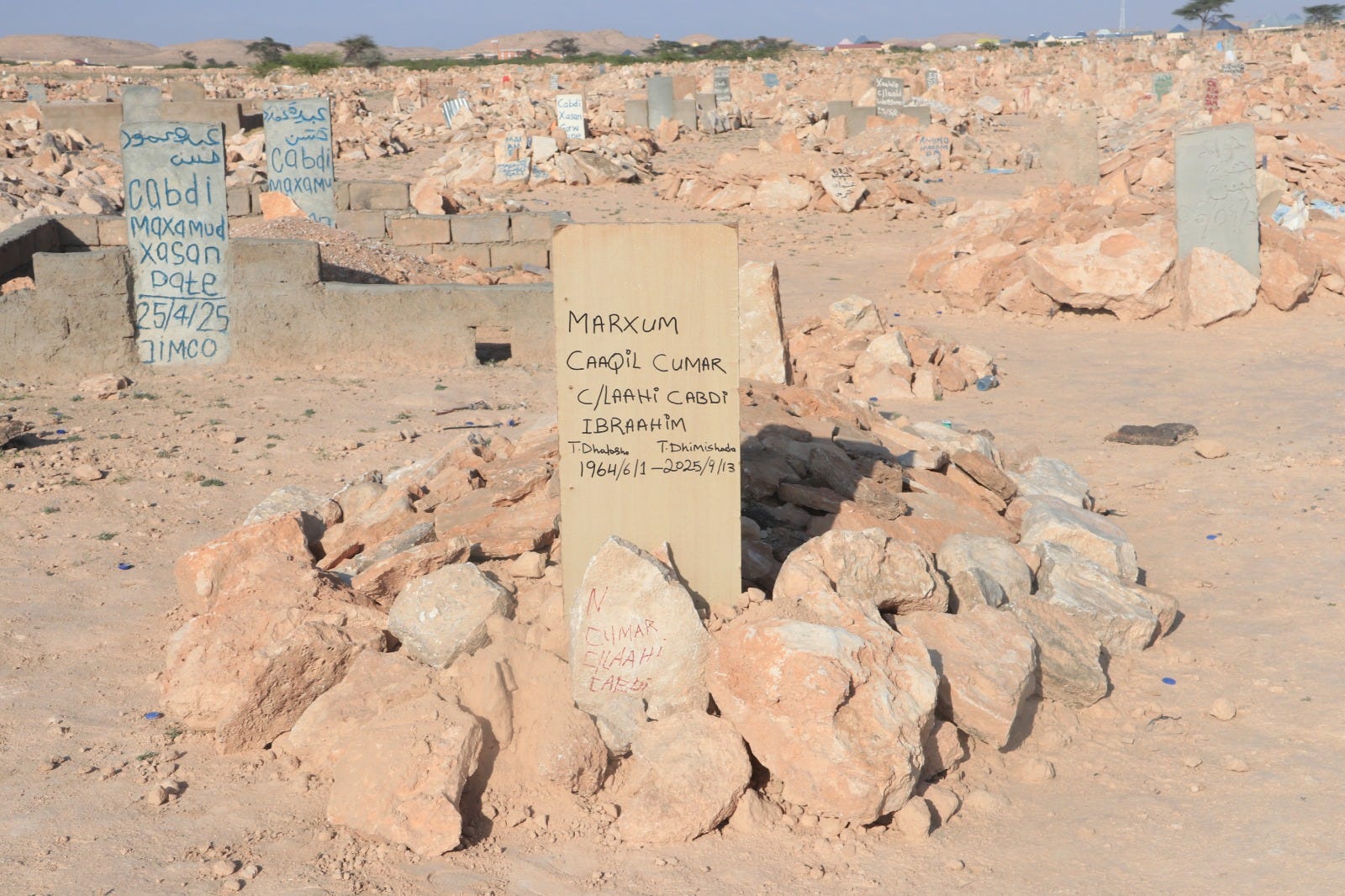
25


Our latest article on the life and times of Jeffrey Epstein is based on a cache of emails obtained by the whistleblower nonprofit Distributed Denial of Secrets, which provided access to them to Drop Site News. The cache includes the undisclosed names of Epstein victims as well as explicit images, meaning it can’t simply be published in whole without some redactions. But many of the messages can quickly be made public, and to that end Drop Site is collaborating with the team that built Jmail to make new emails available and searchable there, beginning this week, and rolling out continuously as we vet the remainder of the cache. (Jmail is a searchable inbox of Epstein’s emails that mimics Gmail.)

None of this work would be possible without our growing base of subscribers. When we launched, we set a goal of reaching a million subscribers, and 20,000 paying subscribers, by our second year, which will come this summer. We’re now just under 15,000. If you can help us hit our goals, that will mean this kind of journalism can’t just be sustained, but can grow.

We need 201 new paid subscribers to reach 15,000. Be one of them below:

We have a commitment to ensuring that our journalism is not locked behind a paywall. But the only way we can sustain this is through the voluntary support of our community of readers. If you are a free subscriber and you support our work, please consider upgrading to a paid subscription or gifting one to a friend or family member. You can also make a 501(c)(3) tax-deductible donation to support our work.

Make Your End of Year Gift

Jeffrey Epstein and Leslie Wexner. An undated photo from Epstein’s “birthday book.”

Six months after Jeffrey Epstein’s death in August 2019, the philanthropic foundation founded by billionaire fashion tycoon Leslie Wexner published an “independent review” of Epstein’s involvement in the organization, in response to concerns raised by donors and alumni of foundation-funded programs. The Wexner Foundation is one of the largest contributors to pro-Israel causes in the U.S.

The review claimed that Wexner Foundation staff had “no contact” with Epstein after his resignation as a trustee in September 2007, and, before that, he had “played no role in the management or administration of the Foundation’s operations,” had “no meaningful role in the Foundation’s budget [or] finances,” and “did not make decisions regarding the use of Foundation’s funds.” None of that is true.

Hundreds of leaked emails from Epstein’s Yahoo inbox, spanning from 2005 to 2008, contradict the Wexner Foundation report. Inside the Wexners’ family financial office in Ohio, staff treated Epstein as de facto chief financial officer, where major decisions about taxes, lines of credit, eight-figure funds transfers, and politically sensitive grants were routed through Epstein’s lawyer, and required Epstein’s approval.

Subscribe now

The new email cache was vetted and published by Distributed Denial of Secrets, and contains many of the same forensic signatures as the dataset reported by Bloomberg earlier this year. Officials from the Wexner Foundation, the law office that conducted the review, and Epstein’s former legal counsel did not respond to requests for comment.

The emails show that Darren Indyke, who served as both Epstein’s personal lawyer and attorney for the foundation, was the “middleman” in such communications, cloaking Epstein’s foundation-related activities with attorney-client privilege. Indyke is also the executor of Epstein’s estate, which has been accused of “obstructionism” for withholding “privileged” emails from civil lawsuits and congressional subpoenas. The Wexner Foundation’s independent reviewers did not have access to the emails published here, because, according to the 2020 report, “the Foundation’s archive of emails does not go back to Epstein’s time as a Trustee.”

On paper, the Wexner family’s philanthropic foundation and their retail empire, once home to Victoria’s Secret, Abercrombie & Fitch, and Bath & Body Works, were legally separate and largely had their own staff. But, in practice, as is typical of such foundations, one small family office sat over both the family’s fortune and philanthropy. Internal emails between Epstein, Indyke, and Wexner’s staff show Epstein as the effective boss of the family office, and the real gatekeeper of the Wexners’ money.

In email after email, Wexner financial controller Peg Ugland wrote to Indyke with account balances for a web of Wexner entities—charitable trusts, private investment vehicles, and personal trading accounts—with a recurring refrain: “Please ask Jeffrey if I can transfer.”

Epstein was the final authority on which Wexner entity should cover which expense, how to move assets between entities, and whether to approve large funds transfers for the Wexners’ accounts. Epstein continued to advise on IRS filings and multi-million dollar transactions until at least December 2007—two months after he had supposedly resigned as trustee.

Excerpt from the Wexner Foundation’s “independent review” of Epstein’s role.

Under Epstein’s financial stewardship, and after his departure, the Wexner Foundation bankrolled pro-Israel charities like college Hillels and free “birthright” trips. These programs had a common mission of teaching young, diasporic Jews to define their religious identity by their connection to the modern state of Israel founded in 1948.

For decades, the foundation also funded the operations of Harvard’s Kennedy School of Government, including the Wexner Israel Fellowship, which sent Israeli government officials to Harvard on full scholarships. The tens of millions of dollars donated by the Foundation made Epstein himself a powerful player at Harvard. The relationship between Harvard and the Wexner family ultimately ended not because of Epstein’s 2008 conviction, but after a falling out over the university’s refusal, under pressure, to sufficiently crack down on protests in 2023 against Israel’s genocide in the Gaza Strip.

“Always Be Careful”

Four days before Jeffrey Epstein submitted his guilty plea to state charges of soliciting a minor for prostitution, on June 26, 2008, Leslie Wexner sent his friend an email: “Abigail told me the result…all I can say is I feel sorry. You violated your own number 1 rule… Always be careful.” Epstein’s reply to Wexner was contrite: “no excuse.”

Exchange between Wexner and Epstein, June 26, 2008.

Epstein was introduced to Wexner in 1986 by Robert Meister, whose firm provided insurance for Wexner’s clothing company, The Limited. Epstein quickly became Wexner’s most trusted investment adviser and, by 1991, Wexner had signed over to Epstein complete power of attorney over his estate and all his affairs. That year, the New York Times described Epstein as “president of Wexner Investment Company” and nobody has disputed that he had major influence there. Yet Wexner’s foundation has maintained his influence did not extend to the iconic pro-Israel philanthropy organization.

The same year Wexner gave Epstein personal control of his vast fortune, Wexner formed the “Study Group,” a group of ultra-wealthy Jewish entrepreneurs who developed philanthropic initiatives to fund support for Israel. Meister’s wife, Wendy, also introduced Leslie to Abigail Koppel, a young Israeli-American attorney, twenty-five years his junior. Epstein was named trustee of Wexner’s philanthropic foundation, and he supervised the drafting of Leslie and Abigail’s prenuptial agreement before they were married in January 1993.

The marriage cemented a deeper tie between Wexner and the state of Israel; he was marrying into Israel’s founding generation. Abigail’s father, Yehuda Koppel, was the commander of a special-operations unit of Haganah, the paramilitary army that created the state of Israel in 1948. Haganah, forming the core of the Israel Defense Forces, carried out the ethnic cleansing of Palestine later termed the Nakba.

Wexner’s new father-in-law had also played a foundational role in the birth of Israel’s military intelligence. According to the diary of Israel’s founding father, David Ben-Gurion, Koppel served in SHAI, Haganah’s intelligence arm and the predecessor to Israel’s central military intelligence directorate, AMAN. During the Nakba, his unit conducted “sabotage” operations involving vehicle hijackings and explosives. In the 1950s, soon after the Nakba, Koppel moved to New York to open an office for Israeli state-owned airline El Al, which became a front for Mossad and Shin Bet agents, according to the CIA and South African intelligence.

Leslie Wexner and Abigail Koppel at the opening of Henri Bendel’s store in New York, 1991. Photo by Fairchiild Archive/WWD via Getty Images.

Since 1983, the Wexner Foundation has contributed hundreds of millions of dollars to Israel-linked charitable causes, quietly underwriting flagship pro-Israel institutions in America. Although Leslie is the family’s familiar public face, Epstein’s emails suggest Abigail became far more active than Leslie in the family’s finances after their marriage. As both the trustee of The Wexner Foundation and director of the Wexner Family Charitable Fund, Abigail sits on both sides of the philanthropic funding pipeline: how money enters the family fund, and how much of that money flows to charitable causes.

Epstein and Abigail sometimes emailed directly, but most critical financial issues raised by Wexner’s family office were routed to Epstein through Indyke, who was both Epstein’s personal lawyer, and the secretary of The Wexner Foundation, according to an SEC filing.

In one example from Epstein’s emails, in August 2006, the family office controller Peg Ugland emailed Epstein’s lawyer about a grant to the Jewish Media Fund, which creates and distributes Jewish-heritage media for American schools and television, including a Sesame Street spin-off dedicated to Israel called Shalom Sesame.

The Abba Eban grant, named for a famed Israeli diplomat who also served on the Jewish Media Fund’s advisory council, was pushed as “the highest priority” in an email from Larry Moses, the foundation’s president. “I need to know if it is ok and if it should be paid from LHW Charitable or WF,” Ugland wrote. Indyke, acting in his role as middleman, forwarded Ugland’s request to Epstein, who made the call that payment from the foundation would be appropriate as long as the recipient was a U.S.-based charity.

Indyke forwards Ugland’s request for final approval of the Abba Eban Project grant to Jewish Media Fund. August 27, 2006.

Indyke forwards Ugland’s request for final approval of the Abba Eban Project grant to Jewish Media Fund, continued. August 28, 2006.

Indyke apologizes and asks for clarification about Epstein’s instruction. August 28, 2006.

As was often the case, Epstein’s reply was filled with typos and not simple to follow; this time making it impossible for his lawyer to decipher. Indyke apologetically responded by asking for clarification, telling Epstein he had already “confirmed that it is a US public charity.” Epstein’s reply upped the ante on the typos, but was finally clear: “pay for foundctiona.”

(That communication style is something of a power move, familiar to subordinates used to dealing with bosses who take little care to write with grammar or clarity, requiring the underling to divine the meaning of the message.)

“Ask Jeffrey”

Epstein was often the final say inside the family office control room, where emails suggest there was a blurred line between personal, corporate, and philanthropic money. Epstein was frequently asked to approve funds transfers totally unrelated to philanthropy, including an April 2006 request from Ugland to move $1 million from a Wexner Personal Holdings Corp account at Bear Stearns to a JPMorgan account with the same name. Drop Site found several similar funds transfer requests between 2005 and 2008, totaling tens of millions dollars, with Ugland often explicitly requesting Indyke to “ask Jeffrey” for approval.

Peg Ugland asks Epstein (via Indyke) to approve a $1 million funds transfer request. April 4, 2006.

In a March 2007 email, Wexner attorney Charles Miller submitted an invoice to Indyke with a note “about 90% of my time was LSJ [Epstein’s private island holding company], 10% Wexners.” Epstein instructed Indyke to split the bill in such a way that was not remotely in line with the declared work performed, charging the Wexners double for a fraction of the work: “200 k , from wexner, 100k from lsj.”

The Wexner family office used layers of entities that kept real ownership of shell entities obscured from outsiders and regulators. In one 2007 email, Wexner’s lawyer Gideon Kaufman reported that the U.S. Forest Service had offered to reimburse the owner of a Wexner ranch property after a ditch collapse, but the agency needed to see the full ownership chain before cutting a check. An entity called Ranch Lake IV was on the deed, but behind it sat two shell entities and then Wexner himself.

Preserving the anonymity of a shell entity’s “ultimate beneficial owner” was a priority and a specialty of Epstein’s. Gideon wrote to Indyke, “At the end of the day we will get about 14 thousand dollars from [the Forest Service] and I wonder if it’s worth all the brain damage and revealing all these documents to them for that amount of money Please advise thanks.” Indyke forwarded the query to Epstein. “At this point do we still have anonymity in the ownership of Ranch Lake IV?” he asked.

While calling the shots for the Wexner financial machine, Epstein also sought to conceal his own role from financial disclosures. In 2006, Indyke sent Epstein a draft amendment to Limited Brands’ Schedule 13D, an SEC filing that discloses who controls big blocks of stock in a public company. Indyke needed Epstein’s sign-off, writing “I just wanted to make sure the disclosures…are acceptable to you before we file.” Epstein wrote back, “do i have to be named personaly. if ftc is trustee.” FTC is shorthand for Epstein’s Financial Trust Company.

The next year, on September 21, 2007, two weeks after Epstein had supposedly resigned as trustee, Indyke sent another 13D draft for Epstein’s comment and approval. In the 2007 filing, Epstein and FTC were no longer named, replaced by Indyke himself as trustee.

Indyke asks for Epstein’s approval on the 13D amendment, so an employee can leave early for Yom Kippur. September 21, 2007.

Despite the labyrinthine structure of shell entities, the staff of the Wexner family office were accustomed to treating Epstein as the true fiduciary—causing confusion as Epstein was slowly disentangled from the family’s finances. In a November 2007 email, Ugland asked Indyke to clarify who was the trustee for two of the family’s charitable trusts. Indyke replied that the trusts remained under “FTC.” Ugland was confused whether Epstein was still part of FTC, writing, “Is FTC now you, or still JEE?” Indyke forwarded the message to Epstein with a note, “another example of ASW withdrawing,” a reference to Abigail.

Although the Foundation’s independent reviewer claimed that its staff had “no contact” with Epstein after his resignation in September 2007, and he had “no meaningful role” before then, the emails suggest Abigail Wexner remained at least partly dependent on Epstein for months after that date. On November 23, 2007, at the beginning of the financial crisis, Epstein directly advised Abigail on executing a purchase of one million shares of Limited Brand stock, valued at almost $20 million.

Wexner urgently needed Epstein’s advice—because the market was crashing, and liquidity was thin on the day after Thanksgiving, most of the shares had to be bought outside normal trading hours to avoid moving the stock price. Wexner planned to use a Rule 10b5-1 trading plan, which provides a legal safe harbor for “inside traders” who do not possess secret information about the business.

Epstein sent a detailed plan for executing the stock purchase on Black Friday, and told Abigail, “Darren said frankly he thought you didn’t want me involved.” She replied the next day, “I spoke to Darren and told him not to worry about it- in the end it is not a problem.”

Exchange between Epstein and Abigail Wexner regarding Black Friday stock trade. November 22 and 23, 2007.

Exchange between Epstein and Abigail Wexner regarding Black Friday stock trade, continued. November 23 and 24, 2007.

Two weeks later, on December 7, Leslie Wexner found himself in a similar situation requiring Epstein’s counsel. Wexner had been asked during a board meeting at The Ohio State University whether he had any holdings in Mellon Bank, but he couldn’t answer the question; Indyke emailed Epstein for clarification. BNY Mellon is currently facing a civil lawsuit alleging the bank knowingly provided financial services in support of Epstein’s sex trafficking operation.

“Great Opportunities”

As a looming public relations crisis over Epstein’s legal troubles crept closer, Abigail Wexner executed a plan to claw back family funds trapped in C.O.U.Q. Foundation, a large Epstein-controlled entity which had been used to fund Jewish organizations, university research, youth programs, and hospitals.

On December 26, 2007, the Wexners’ attorneys prepared IRS forms to create a new private foundation for Leslie Wexner, called YLK Charitable Fund. Indyke emailed Epstein a draft copy of the IRS submission, asking for Epstein’s approval on a disclosure document that showed Epstein’s C.O.U.Q. trust would transfer more than 25% of its assets into YLK. The new fund had only two officers, Peg Ugland and Abigail Wexner; it was named “YLK” after the initials of Abigail’s father, Yehuda L. Koppel, of Israel’s founding generation.

On January 1, 2008, six days after Indyke emailed the IRS paperwork to Epstein, two Epstein-controlled entities dumped almost their entire balance sheets into Abigail’s new fund. Epstein’s C.O.U.Q. Foundation transferred about $12 million in securities, and his Financial Trust Company contributed Apple stock worth roughly $34 million.

YLK barely functioned as an independent charity. After receiving the $46 million from Epstein, it made two large grants totalling $6.5 million to the Columbus Foundation, a non-profit community fund in Ohio, and a handful of small donations before its portfolio was hammered by the 2008-10 market crash. The foundation took in no new contributions in 2009, then dissolved at the end of 2010, shipping its remaining assets (about $35 million) back into the Wexner Family Charitable Fund.

Leslie Wexner’s 2019 letter claimed Epstein had “misappropriated vast sums of money,” and the C.O.U.Q.-YLK donation was a repayment of those funds. The 2020 independent review reaffirmed this assertion, stating that the donation was a “partial recovery” of misappropriated assets. Publicly claiming to have been wronged by Epstein put the Wexners on the side of the victims, rather than the perpetrator. However, the donation in question was similar in character to many other transactions he had carried out for the Wexners over the years.

The Wexners remained collegial with Epstein, even as they were supposedly recovering “misappropriated” assets: one month before the money flowed back from C.O.U.Q. into YLK, Abigail was working hand-in-glove with Epstein on multimillion-dollar stock trades; a few months after the money was returned, Leslie sent the note scolding Epstein for not being “careful.”

Epstein entered his guilty plea in June 2008—but emails suggest he remained quietly connected to Wexner business, attempting to cultivate a relationship between Wexner and Sultan Ahmed bin Sulayem, the CEO of Emirati conglomerate Dubai Ports. Less than a month after submitting his guilty plea, he wrote to Sulayem on July 18, “where are you my friend.. .. great opportunities,, did anything ever come of your wexner meeting?”

“Pure Zionistic Motivations”

After Epstein’s public departure, the Wexner Foundation remained a major force in pro-Israel philanthropy, funneling millions of dollars into programs aimed at boosting Israel’s influence in the U.S. Between 2003 and 2018, Inside Philanthropy tallied $128.4 million donated by the Wexners to Israeli and Jewish charitable causes, making them the third largest donor to such causes in the U.S. during that period.

Wexner resigned as CEO of Limited Brands in 2020, one year after Epstein’s death. That year, right-wing politicians in Israel campaigned against the Wexner Foundation and its fellowship programs for Israeli officials, claiming the foundation had a “radical left political affiliation.” After Israel’s National Security Minister Itamar Ben Gvir decided to ban government employees from participating in the Wexner Foundation’s leadership programs, another Likud lawmaker praised the decision, writing that the foundation was part of Israel’s “shadow regime” and “a long arm of the deep state.”

The accusations tied into a domestic political brawl in Israel, aimed at undermining former prime minister Ehud Barak—a close associate of Epstein, then attempting to reenter political life and challenge current Prime Minister Benjamin Netanyahu. Barak’s political opponents in Israel have long raised questions about his financial ties to the foundation.

Details about that scandal are also documented in the emails obtained by Drop Site. In late 2005, Larry Moses (president of the foundation) emailed Indyke about an agreement with Barak to write two books about Middle East politics and his experience as head of state, with a fee of $100,000 per chapter to be paid to Barak by the foundation. Indyke needed Epstein to instruct on how to execute the payments, writing, “Please advise what you want Peg to tell Larry Moses.”

Epstein emails with Indyke, 12/8/2005.

The single manuscript that Barak completed for the foundation eventually earned Barak $2.3 million in consulting fees. The Wexner Foundation has stated Barak’s payment was for two reports (one of which was never completed) and related advisory work.

The enormous payment became a talking point for Barak’s right-wing political opponents for years, who cast aspersions on Barak and Wexner’s relationship with Epstein. In response to attacks from Israeli lawmakers aligned with Netanyahu, the Wexner Foundation defended itself as an institution firmly committed to the interests of the state of Israel, decrying what it called an attack on, “a foundation that from its inception has acted from pure Zionistic motivations.”

Epstein continues to serve as a political football in Israel. Netanyahu shared a Jacobin article on November 21 that included a summary of Drop Site’s coverage on Epstein’s ties to Barak and Israeli intelligence. Barak has dismissed claims of Epstein’s involvement in Israeli politics as “extremely antisemitic.”

On August 8, 2019, after Epstein’s arrest but two days before he died in jail, Wexner wrote a letter to the foundation community portraying himself as another victim of Epstein’s actions, claiming that he was “deceived,” and that his trust in Epstein was “grossly misplaced.”

“I deeply regret having ever crossed his path,” Wexner wrote.

Leave a comment

Share


From Drop Site News via this RSS feed
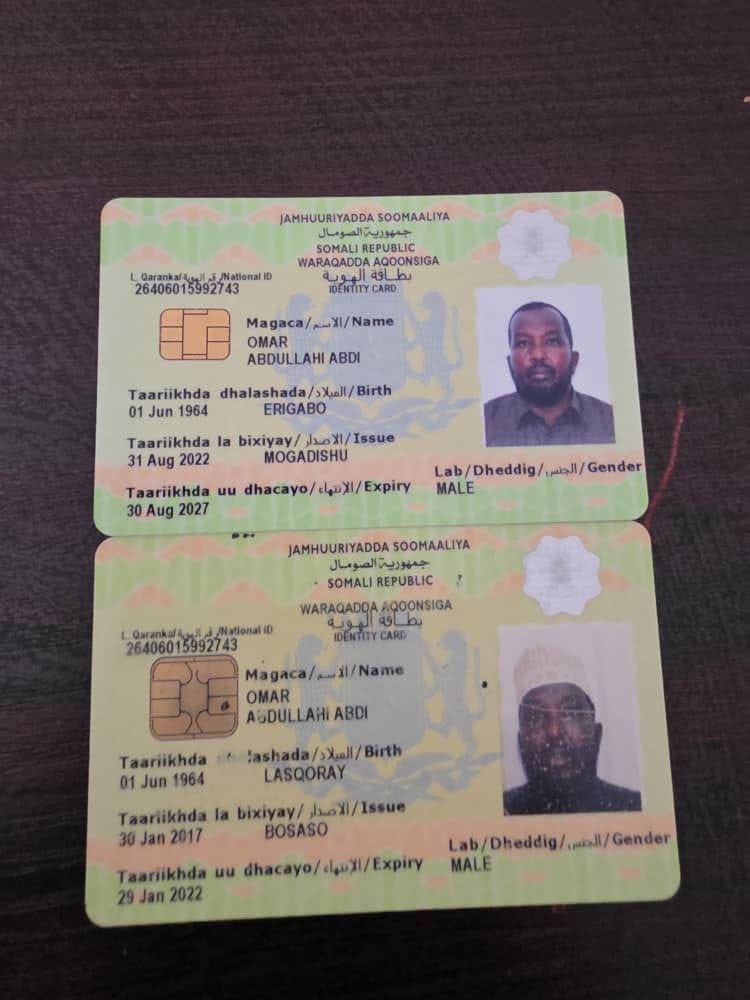
view more: next ›