Linux Phones

2938 readers
13 users here now

The Discussion on Linux-based Phones.


Benefits:

  • Hardware freedom.
  • Perfect operating-system competition.
  • Full utilization of specs.
  • Phone lifespan raises to 10+ years.
  • Less e-waste.

Linux Mobile Distros:

  • Ubuntu Touch
  • Sailfish
  • FuriOS
  • Postmarket OS
  • Mobian
  • Pure OS
  • Plasma Mobile
  • LuneOS
  • openSUSE Mobile
  • Nemomobile
  • Droidian
  • Mobile NixOS
  • ExpidusOS
  • Maemo Leste
  • Manjaro Arm
  • Tizen
  • WebOS

Linux Mobile Hardware:

  • Fairphone 5
  • Volla Phone
  • PinePhone
  • FLX1
  • Librem 5

⚙️Contribute

🧼Go Clean From the Duopoly:

💻Related Communities:

📰News:

💬Messager:

⌚️Watch:


founded 2 years ago
MODERATORS
1


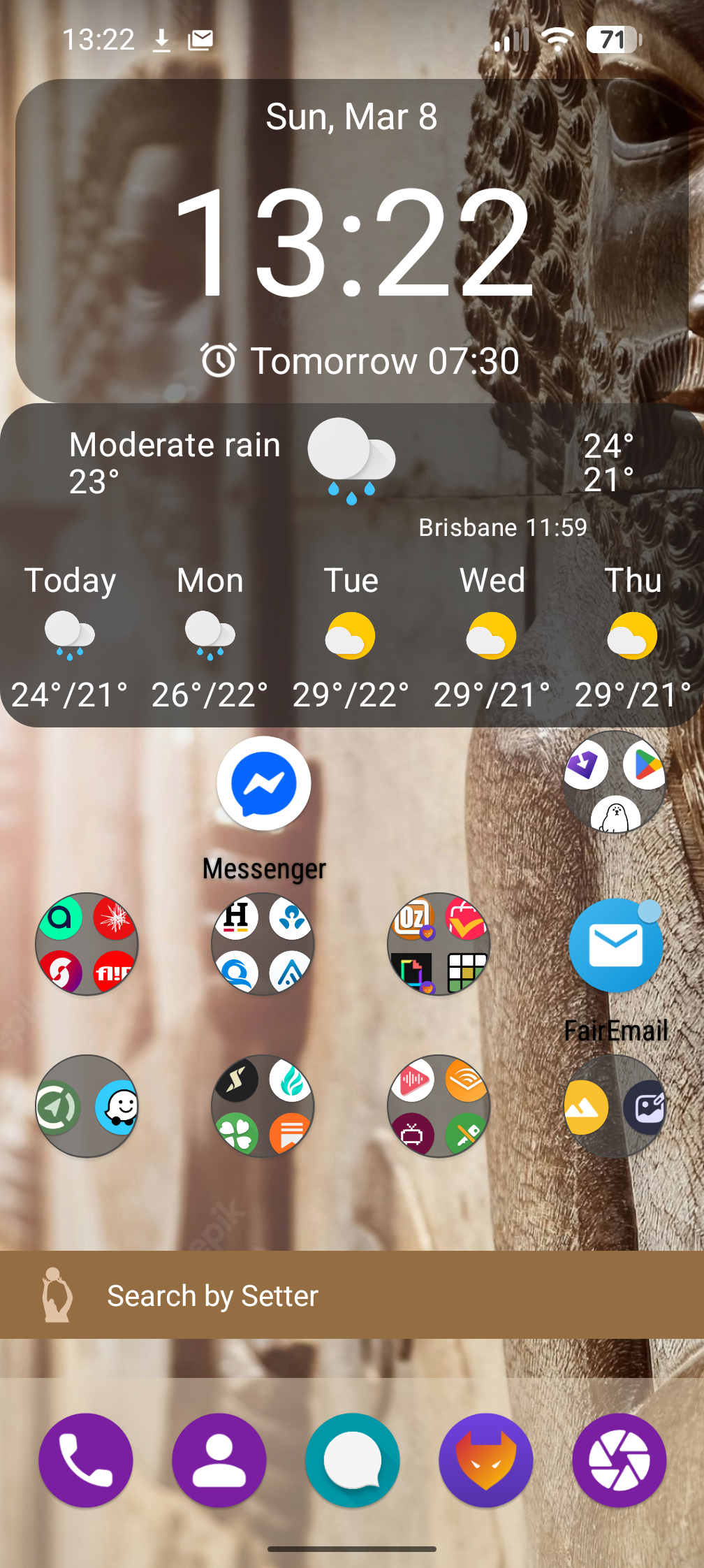
I thought this post was a great idea, so decided to copy it! This is my Pixel 8 Pro with GrapheneOS, some highlights are:

  • Most apps installed via Obtainium, except for banking apps etc that have to come from Google Play
  • Setter search bar
  • Quik SMS app
  • Pipepipe for watching Youtube
  • Lawnchair launcher
  • FairEmail email app
  • Dailer, Contacts, Calendar from Fossify
2


A thankyou to the help I've received here.

Phone looks and feels great.

Wallpaper (I'm pretty sure) is by Jubilee / 8Pxl

3


Samsung disabling bootloader unlock and what Google is doing with Android reminded me that Bootloader Unlock Wall of Shame exists.
And also that FSF's LibrePhone project exists, but not much progress has been seen from that.

4


I'm looking at the jolla phone and absolutely love it, but its not looking like something I can easily get in the US. Iibrem is available but with a high price and terrible specs.

I'd really like something supporting continuum (usbc DP-alt mode) too if possible.

But the american options don't seem all that great. What's available in the US?

5


Jolla may not be a household name, but for more than a decade the Finnish company has positioned its Linux-based Sailfish OS as an alternative to the mobile software duopoly that is Google’s Android and Apple’s iOS.

Now, 13 years since it tried to cut through the market with the Jolla Phone—a device which remarkably received software updates through 2020—it's back with a successor of the same name.

This time, the company is positioning its handset as the “European phone.” This bit of marketing caters to the growing distrust in US digital services and platforms that has arisen since Big Tech sidled up to the second Trump administration.

The new Jolla Phone (pronounced “Yolla”) costs €649, mimics the Scandinavian design of the original, and has secured more than 10,000 preorders since its preview in December 2025. Those orders are expected to begin shipping at the end of June. At Mobile World Congress 2026 in Barcelona this week, the company divulged more details about the phone's hardware.

Alt Android

Jolla has had a turbulent history. After the company floundered the launch of its Jolla Tablet in 2015, it nearly went bankrupt and pivoted to licensing Sailfish OS to automotive companies and governments, including Russia. After the invasion of Ukraine, Jolla had to cut ties with Russia, and a corporate restructuring meant that Jolla's assets were acquired by the company's former management under a new company called Jollyboys.

It got back into the smartphone game in 2024 with the Jolla C2 Community Phone, made in collaboration with a local Turkish company, and it was this experience that gave Jolla the courage to jump back into the hardware business with the new Jolla Phone. Unlike the C2, this device is completely assembled in Salo, Finland, where Nokia phones were manufactured more than a decade ago.

“Europeans want more European technology,” Sami Pienimäki, CEO of Jolla Mobile, tells WIRED. “People want to go away from Big Tech, and the other trend is that European people want sovereign tech—it makes it possible for our kind of company to have a position in the market.”

Building a smartphone from scratch was also much harder over a decade ago, but today, Pienimäki says the operation can be fairly lean without having to “pay too much up-front.”

The components are sourced from various vendors and countries. The MediaTek Dimensity 7100 5G chip hails from Taiwan; the 50-megapixel main and 13-megapixel ultrawide camera sensors are from Sony; the 8 or 12 GB of RAM is from SK Hynix in South Korea.

“There are Chinese components as well—we are totally open about it—but the key is that, as we compile the software ourselves and install it in Finland, we protect the integrity of the product,” Pienimäki says.

What makes Sailfish OS unique over competitors like GrapheneOS and e/OS is that it's not based on the Android Open Source Project, but Linux. That means it has no ties to Google—no need for the company to “deGoogle” the software; meaning there's a greater sense of sovereignty over the software (and now the hardware). Still, it's able to run Android apps, though the implementation isn't perfect. Another common criticism is that it's not as secure as options like GrapheneOS, where every app is sandboxed.

There's a good chance some Android apps on Sailfish OS will run into issues, which is why in the startup wizard the phone will ask if you want to install services like MicroG—open source software that can run Google services on devices that don't have the Google Play Store, making it an easier on-ramp for folks coming from traditional smartphones without a technical background. You don't even need to create a Sailfish OS account to use the Jolla Phone.

Jolla’s effort is hardly the first to push the anti–Big Tech narrative. A wave of other hardware and software companies offer a deGoogled experience, whether that’s Murena from France and its e/OS privacy-friendly operating system or the Canadian GrapheneOS, which just announced a partnership with Motorola. At CES earlier this year, the Swiss company Punkt also teamed up with ApostrophyOS to deploy its software on the new MC03 smartphone. Jolla is following a broader European trend of reducing reliance on US companies, like how French officials ditched Zoom for French-made video conference software earlier this year.

Murena CEO and founder Gaël Duval wrote in a statement emailed to WIRED that the company believes it has a different mission from the Jolla Phone as it's trying to bring the existing mobile app ecosystem—minus the permanent data collection by Google and third-party trackers—without a learning curve for the average person. “We want to make privacy possible for the everyday person without the need for technical expertise or a development background,” he says.

The Phone

A common problem with these niche smartphones is that they inevitably end up costing a lot of money for the specs. Take the Light Phone III, for example, a fairly low-tech anti-smartphone that doesn't enjoy the benefits of economies of scale, resulting in an outlandish $699 price. The Jolla Phone is in a similar boat, though the specs-to-value ratio is a little more respectable.

It's powered by a midrange MediaTek Dimensity 7100 5G chip with 8 GB of RAM, 256 GB of storage, plus a microSD card slot and dual-SIM tray. There's a 6.36-inch 1080p AMOLED screen, the two main cameras, and a 32-megapixel selfie shooter. The 5,500-mAh battery cell is fairly large considering the phone's size, though the phone's connectivity is a little dated, stuck with Wi-Fi 6 and Bluetooth 5.4.

Uniquely, the Jolla Phone brings back “The Other Half” functional rear covers from the original. These swappable back covers have pogo pins that interface with the phone, allowing people to create unique accessories like a second display on the back of the phone or even a keyboard attachment. There's an Innovation Program where the community can cocreate functional covers together and 3D-print them. And yes, a removable rear cover means the Jolla Phone's battery is user-replaceable.

Pienimäki says that while the device doesn't have FCC approval, you can theoretically import it into the US, and it should work with the major US carriers, though compatibility is rarely a given. Jolla is considering a separate US launch, though right now it's focusing on the European Union, the UK, Norway, and Switzerland.

Antti Saarnio, Jolla Group’s chairperson, reiterates that the Jolla Phone will be a niche product. “Most of the people using Android or iOS will not switch, but we should treat this as a stepping stone for something new,” Saarnio says. The “path to real volume” will come from the mobile market breaking down into new form factors, powered by artificial intelligence.

He's likely referring to Jolla's Mind2, a privacy-focused AI computer, which is still in active development. It plugs into a PC and connects Jolla's AI assistant to apps like email and calendar locally—no cloud access required. The chatbot-like interface lets you ask it questions about your data, whether you're fishing for something from an email or a private message. While the new Jolla Phone won't have any AI capabilities at launch, Saarnio says an integration will be an option users can enable later this year.

Jolla has street cred for supporting its devices for a long time, but we'll have to wait and see how the fresh hardware holds up and just how much the company has polished the Sailfish OS experience, especially since it's much easier today to get started with a deGoogled Android alternative.
6
7


Lineage os 22.2 installed on Pixel 1. On my pull down menu and power off screen there is a scrolling text that I dislike, can I turn that off?

8
9
10


This past week: Modal Collective publishes vision for "Sovereign Mobile Stack", postmarketOS February 2026 update introduces generic kernel packages (and other things), Phosh shows off Chinese Pinyin and Japanese Anthy input methods becoming part of the Stevia keyboard, Phosh.mobi e.V. celebrates first anniversary, 10000 Jolla Phones sold, and Catacomb UI updates. Enjoy!

11


Sure, the year of the Linux Desktop might be around the corner, but what about the year of the Linux Phone!

12
13


I want to switch to a Lineage OS on my Tab S7 SM-T870. I can get Clip Studio Paint from Aurora on my Lineage phone (Pixel 1) but want to know if it runs on the Tablet before I make the switch. Has anyone done this, noticed a difference?

14
15
16


I have an donated Gen 1 Pixel phone so that I can experiment trying a new OS on it. I use linux mint on my laptop but still consider myself a beginner. The goal is to eventually do this to my main phone (A galaxy S8) but I wanted to get a feel for how to do it. I'm stuck on the OS, I only use the phone as a clock, texting, and occasionally a call. Internet isn't a huge deal but it'd be nice in a pinch. I'm looking for an OS that's easy to use, privacy & security. Any recommends/guides?

17
18


Probably also useful for running them with Waydroid.

19


The mobile Linux space is more active than most people realize. Projects like postmarketOS, Ubuntu Touch, and KDE Plasma Mobile have been chipping away at the idea that your phone or tablet has to run something made by Google or Apple.

And while none of them are household names yet, they are picking up real interest from power users who want more control over their hardware. Of course, most people stick with Android or iOS, and that is fine.

Both platforms are mature, well-supported, and not going anywhere. But for the ones who want something genuinely open and free of platform lock-in, things are getting better.

20


This past week: AsteroidOS 2.0 release blog post released, Ubuntu Touch 24.04-1.2 and 20.04 OTA-12 released, Mecha Comet surpasses $1 million on Kickstarter, Jolla Phone 2026 reaches 9000+ pre-orders, and more! Enjoy!

21
22


Pocketblue is a new project aiming to provide a version of Fedora Atomic made for mobile devices. The bad news is that it currently works on only three models: Xiaomi Pad 5, Xiaomi Pad 6, and OnePlus 6 or 6T.

The project offers Fedora Atomic system images with GNOME, Plasma, and Phosh desktops, based on Fedora 43, made specifically for phones and tablets. In other words, it brings the immutable, rpm-ostree-based setup from desktops to mobile devices, with system updates handled through image upgrades and layered changes.

23


This past week: Phosh 0.53.0 released, postmarketOS publishes FOSDEM 2026 and hackathon recap, feedbackd moved to freedesktop.org infrastructure, Navit 0.5.7 offline navigation app released after 5 years, Linux 7.0 adds Qualcomm Milos (used in Fairphone 6) and Jolla Phone 2026 surpasses 8,700 pre-orders, and more. Enjoy!

24
37
submitted 3 weeks ago* (last edited 3 weeks ago) by cloudskater@pawb.social to c/linuxphones@lemmy.ca


I'm sure this is a very common post but please hear me out, I'm in a weird place and don't want to make a poor decision when it comes to such a big purchase, let alone potentially three of them.

Until very recently, I was under the impression that Linux phones weren't a thing. Had I known, I likely would have made this post several months ago and bought a different device for myself (I'm using a crazy overpriced Pixel bc I thought GraphineOS was the ONLY option for a safe and FOSS phone). I have two partners in the US who's Androids are old and even falling apart on them. They can't afford one Pixel, let alone two, but I've gotten them into Linux Mint and want to take this opportunity to rid their phones of proprietary software as well. So here's the deal:

I have little to no knowledge of Linux phones. I don't know if they have dedicated apps, or if all software is run through Android emulation, or even how different Android is from Linux itself (isn't the former based on the latter anyway?). None of us need high-spec devices, we just want something that can:

  • Play media files and use privacy respecting YouTube clients, stuff like that
  • Send and receive texts/calls through Signal, Telegram, etc.
  • Actually deliver notifications (GraphineOS is horrible for this in my experience)
  • Use your average social media (Mastodon, Bluesky)
  • Has expandable storage and preferably a headphone jack
  • Isn't total overkill and won't cost a grand for useless features and specs

I don't expect any phone to fit the bill perfectly, but if you guys know which device and OS I should try, I'm all ears. Speaking of operating systems, I'll go looking around this community to try and find some individual pros and cons, but if anyone has experiences to share, please, please do. My plan is to find which pairing of device and OS is easiest to operate with the least drawbacks and get used to it myself. Being the techie of the trio, I wanna be able to help them if something goes wrong. Once we've made a decision, I'll buy and set up another phone, then send them both to my partners so they can finally have new phones that are FLOSS, free of corporate spyware, and hopefully last them a good while.

25


This past week: Sailfish OS 5.0.0.73 Tampella early access released (approaching Sailfish OS 5.1 branch with BeaconDB for faster location fixes planned for March), Jolla C2 out of stock, Nemo Mobile reaches major milestone booting Lipstick on openSUSE, postmarketOS adds Bhushan Shah as Trusted Contributor and shows progress on Fairphone 5 call audio, Ubuntu Touch 24.04-1.2 and 20.04 OTA-12 call for testing. Enjoy!

view more: next ›