Palestine

2635 readers
54 users here now

A community to discuss everything Palestine.

Rules:

  1. Posts can be in Arabic or English.

  2. Please add a flair in the title of every post. Example: “[News] Israel annexes the West Bank ”, “[Culture] Musakhan is the nicest food in the world!”, “[Question] How many Palestinians live in Jordan?”

List of flairs: [News] [Culture] [Discussion] [Question] [Request] [Guide]

founded 5 years ago
MODERATORS
1


cross-posted from: https://hexbear.net/post/7891951

cross-posted from: https://news.abolish.capital/post/33780

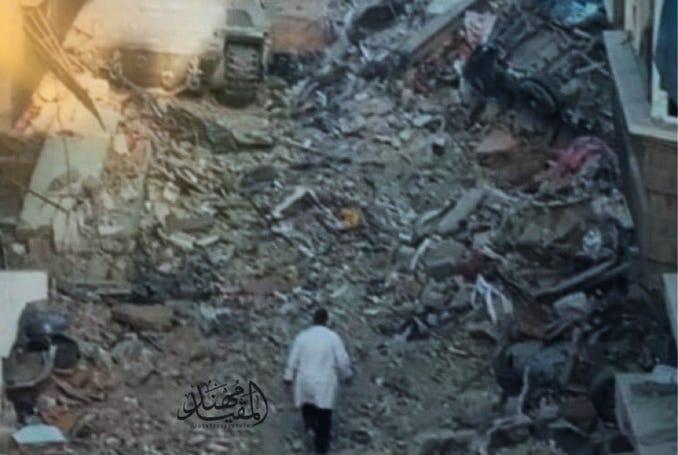
GAZA CITY, GAZA  â" DECEMBER 19: Palestinians walk through roads surrounded by massive rubble and collapsed buildings in Al-Zahra, northwest of the Nuseirat Refugee Camp in the central Gaza Strip, as residents continue their daily lives amid the destruction left by Israeli attacks, facing harsh living conditions on December 19, 2025. (Photo by Hassan Jedi/Anadolu via Getty Images)

Palestinians walk through roads surrounded by rubble and collapsed buildings in Al-Zahra, northwest of Nuseirat Refugee Camp in the central Gaza Strip on Dec. 19, 2025.  Photo: Hassan Jedi/Anadolu via Getty Images

In Gaza, movement is no longer a mundane part of daily life. Israel’s military assault and prolonged siege have dismantled Gaza’s transportation system so thoroughly that journeys that once took minutes by car now require hours of walking through rubble and grotesque debris. What used to be an ordinary act — leaving home, reaching a clinic, visiting kin — has now become a form of physical labor, a calculation of pain, and a risk weighed against necessity.

By late 2025, Gaza’s Ministry of Transport and Communications reported that approximately 70 percent of registered vehicles — more than 50,000 cars, taxis, buses, and trucks — had been destroyed or rendered inviable. Between 68 and 85 percent of the road network suffered damage or total destruction, with some areas such as Khan Younis losing more than 90 percent of their routes. Israeli forces repeatedly bombed, cratered, and bulldozed major roads and intersections, instigating chaos that fragmented the Strip into isolated zones where movement between neighborhoods requires long detours or hours on foot.

[

Related

Trump’s War to Nowhere](https://theintercept.com/2026/03/06/podcast-trump-iran-israel-war/)

While the world turns its attention to Iran, daily life in Gaza has not returned to pre-genocide conditions. Since the U.S. and Israel began their joint assault on Iran, Lebanon, and the broader region, prices in Gaza have risen sharply as people rushed to buy essential goods and fuel. The sudden surge in demand and limited supply spiked the cost of food, water — and transportation. Border crossings were closed for 48 hours, further exacerbating shortages and contributing to the rapid rise in prices. In recent days, prices have begun to gradually decrease and stabilize, but the overall economic burden remains heavy for most households in Gaza, where many people are still struggling to cover basic needs.

Roads no longer connect neighborhoods, and transportation no longer guarantees access to health care, work, or sustenance. Even streets that remain technically passable are obstructed by rubble, vehicles, or collapsed infrastructure beneath the surface. Water and sewage lines burst under bombardment, flooding streets and turning mobility into an endeavor plagued by biohazards. In many areas, roads have become indistinguishable from ruins.

This collapse did not result solely from airstrikes. Israel’s blockade — which continues to restrict fuel, spare parts, tires, batteries, and heavy machinery — has undermined Gaza’s ability to repair or recover. Vehicles that survived bombardment often remain immobilized due to mechanical failures no workshop can fix. Even basic parts and equipment — filters, belts, brake systems — have become hard to find. Fuel scarcity has driven prices far beyond the reach of most families, while mechanics resort to dangerously improvised substitutes that destroy engines and emit toxic fumes across densely populated areas.

[

Related

Plans Call for “New Rafah” Built in Israel’s Image — Without Palestinians](https://theintercept.com/2026/01/21/gaza-ceasefire-phase-two-rafah-project-sunrise/)

As formal transportation disappears, residents rely on unsafe alternatives: tuk-tuks with no safety standards, animal-drawn carts, overcrowded cargo trucks not designed for passengers, or walking long distances across shattered streets. Asphalt has collapsed and fractured, mingling with rubble, sewage, twisted metal, and remnants of destroyed buildings, forming uneven, dirt-like paths. Movement through these spaces turns the act of walking into a physically punishing routine. The clatter of collapsing buildings and distant bombardment is constant, and the air feels opaque with dust and smoke.

Municipal authorities cannot clear the wreckage. The fuel shortages and lack of functioning equipment affect them too, preventing large-scale removal of debris. The result is a form of enforced immobility: Entire neighborhoods remain effectively cut off, not by checkpoints but by devastation. Residents plan their days around how far their bodies can carry them.

Residents plan their days around how far their bodies can carry them.

I have experienced this reality repeatedly. Over several weeks, I traveled with my brother, Mohammed, four times to reach a dentist in the Al-Maghazi refugee camp, nearly 10 kilometers from our home. There is no reliable transportation between the two areas. The distance became an ordeal measured not in maps but in muscle fatigue, time lost, and pain that intensified with every uneven step.

On one of those days, rain fell heavily. Broken roads turned to mud layered over shattered asphalt and sharp stones. Water pooled in craters left by bombs. At times, I sprinted across short safe patches, only to be slowed again by mud and debris.

Transportation carried us only part of the distance. We always completed the journey on foot, adjusting our pace to the condition of the road and to the limits of our bodies. Without severe tooth pain, I would not have left my room. The road drained me more than the dental procedure itself. Each step felt like a negotiation between necessity and collapse.

I tried to make the walk bearable by searching for fragments of beauty along the way.

I tried to make the walk bearable by searching for fragments of beauty along the way: a flowering tree growing beside rubble, a rose bush somehow still nourished, a building that had not yet fallen, the faint radiant glow of children playing in a distant schoolyard. I photographed the clouds, took pictures of myself simply to pass time, and paused whenever my body demanded it. These small acts were my survival mechanisms, attempts to assert that Gaza still contained something worth noticing.

This experience is not exceptional. It reflects a broader reality in which access to health care depends not on medical need alone, but on physical endurance. Patients miss appointments or abandon treatment altogether because they cannot reach clinics. Parents carry children for kilometers to medical points. Elderly people and those with disabilities remain trapped in place, dependent on others or forced to forego care indefinitely. The ability to walk through rubble for long distances has become a filter that determines who receives care and who does not.

The ability to walk through rubble for long distances has become a filter that determines who receives care and who does not.

Economic consequences intensify the crisis. Tens of thousands of drivers have lost their livelihoods as taxis, buses, and trucks were destroyed or immobilized. Commercial transport has slowed dramatically, disrupting supply chains and inflating the cost of basic goods. Workers arrive late or not at all. Students walk for hours or drop out entirely. For displaced families, transportation costs have reached apocalyptic levels, with some paying hundreds or thousands of dollars to move belongings short distances. Those without money walk, scavenge what they can, and leave the rest behind.

In the absence of regulation and fuel availability, informal transport operators dictate prices brazenly. Gaza’s local authorities acknowledge the exploitation, but under siege conditions, they have limited options to protect residents. Scarcity governs movement more than public need, reshaping social relations around access, endurance, and pent-up anger. Western‑run aid organizations vow to “maintain a steady and predictable flow of supplies,” yet recent reports note that while some aid has entered Gaza, the overall volume remains insufficient to meet basic needs, fueling frustration and despair.

The pattern of destruction reveals intent. Israeli attacks have repeatedly targeted intersections, bridges, and key road junctions, severing connections between neighborhoods and governorates. These actions obstruct ambulances, humanitarian convoys, and civilian movement, amplifying the effects of injury, hunger, and displacement. Gaza’s government estimates that losses in the transport sector exceed $3 billion, including the destruction of more than three million linear meters of roads. Mobility itself has become a casualty of war, leaving residents lurking between hazards and temporary shelters, pleading for safety.

[

Related

Gaza’s Civil Defense Forces Keep Digging for 10,000 Missing Bodies](https://theintercept.com/2025/11/28/gaza-palestine-ceasefire-rubble-bodies/)

Local officials have proposed emergency rehabilitation plans focused on reopening critical routes linking hospitals, shelters, and aid distribution centers. These efforts prioritize survival rather than reconstruction. Without access to fuel, spare parts, and heavy machinery, even minimal recovery remains largely theoretical, constrained by political decisions beyond Gaza’s control.

Transportation in Gaza is not a technical issue or a matter of convenience. It defines the limits of daily life. It determines who can reach a doctor, who can work, who can study, and who must stay behind. As long as movement itself remains under siege, life in Gaza will continue to contract, measured not by distance but by pain, exhaustion, and loss. In the 21st century, Palestinians in Gaza navigate a landscape where walking through ruins has replaced the most basic promise of mobility, ceaselessly testing endurance, resilience, and the abiding human spirit.

The post Israel Destroyed Gaza’s Roads and Transit. Now, We Walk Everywhere. appeared first on The Intercept.


From The Intercept via This RSS Feed.

2


Hi, I'm Rania from Gaza. My family and I are raising our voices so that someone can hear us.
The war may have stopped, but its effects are still with us. The bombing ended, but hunger and displacement continue.
Our home was destroyed, and we desperately need help to rebuild our lives. 🙏💔
https://gofund.me/d0cc0587
#GazaVerified #israel #genocide #famine #settlerColonialism #apartheid #StopIsrael #STOPtheGENOCIDE
@palestine@lemmy.ml
@palestine@lemmy.ml @Palestine@masto.ai
@tsbasatoru

3
4


I need to raise $500 this week to cover my family’s basic food needs.
Any contribution, no matter how small, can make a real difference and help us get through these tough times.
Thank you so much for your kindness and support. 🤍
#gaza #gazaverified @palestine @aral

Chuffed: https://www.chuffed.org/project/138285-help-sehwel-family-with-their-medical-treatment

PayPal: https://www.paypal.com/paypalme/HelpAseelSehwel

5


March 8, 2026
from +972’s Sunday Recap
+972Magazine [published in Israel]

Also:

  • With West Bank under total Israeli closure, settlers are seizing the moment
  • Pahlavi? IRGC? What’s next for Iran after Khamenei
  • ‘Compulsive repetition’: How permanent war shapes the Israeli psyche
6


Epstein document releases reveal multiple use of the term “goy” or "goyim" in emails, underscoring a worldview that demeaned non-Jews as lesser or exploitable in a network of power and predation. The use of these terms provides a window into the Jewish supremacism of Zionism. But they also show that Jewish supremacism goes much further - and much further back - than an association simply with the Zionist movement.

7
8


Please help us continue, and don't forget to support us. Even a small contribution like a like or a share would make a huge difference. Thank you from the bottom of our hearts. 🙏
https://gofund.me/d0cc0587
#GazaVerified #israel #genocide #famine #settlerColonialism #apartheid #StopIsrael #STOPtheGENOCIDE
#Gaza
@palestine@lemmy.ml @Palestine@masto.ai
@tsbasatoru

9


Denouncing this machinery is a historic task. It is not merely a matter of solidarity with the Palestinian people, although that solidarity is urgent and non-negotiable.

It is about resisting a world in which data are worth more than lives, in which technology serves colonialism, and in which genocide is presented as an “algorithmic decision”. Today it is Gaza. Tomorrow, any people who dare to resist.

10


Brutal technology field-tested on Palestinians has helped to propel the state's economy to the top of global performance charts

11


Israeli settlers and soldiers kill three Palestinians in West Bank village | West Bank | The Guardian
https://www.theguardian.com/world/2026/mar/08/israeli-settlers-idf-soldiers-kill-palestinians-west-bank

"Israeli settlers have shot dead five civilians during invasions of Palestinian olive groves, villages and grazing land, in the brief period since Israel and the US launched a new war on Iran at the end of February. A sixth person died on Saturday after inhaling military-grade tear gas used by the Israeli army."

#Palestine #WestBank #Israel
@palestine@lemmy.ml @palestine@fedibird.com

12


Resistance narrative.
“Because these organisations speak as Jewish groups, they disrupt the assumption that criticism of Israeli policy necessarily reflects hostility toward Jewish identity.

… the issue is not loyalty to one side or another, but whether international norms designed to protect civilians are being upheld.

Digital platforms can amplify propaganda, but they can also amplify conscience.”
https://johnmenadue.com/post/2026/03/a-growing-jewish-challenge-to-israels-war-narrative/
@palestine@lemmy.ml
@palestine@fedibird.com
#Israel #Gaza #Palestine

13


[Ideas] The Evansville Option: On the Israeli question. (Raymond Geuss | Sidecar, 2026-03-06)

https://newleftreview.org/sidecar/posts/the-evansville-option
———

>> … I have an alternative suggestion which would solve the problems of the region between the Jordan and the Mediterranean … Why not move the Israelis to a sovereign territory established specifically for them in the Midwest of the United States?

>> … the proposal does give the Palestinians what they clearly want above all else: to have their land back and to be able to lead their lives in it, free of Israeli domination. At the same time Israeli Jews would have a new state to live in that would be infinitely more secure than their present arrangement…

#BetweenTheJordanAndTheMediterranean
#palestine #Gaza #EthnicCleansing
@palestine@lemmy.ml @palestine@fedibird.com

14


March 4, 2026

Forty countries gathered in The Hague on Wednesday to discuss coordinated measures aimed at enforcing international law in Palestine, as governments warn that Israel’s expanding settlement activity in the occupied West Bank amounts to de facto annexation.

The meeting, co-chaired by South Africa and Colombia and convened under the umbrella of The Hague Group, brought together governments from across the Global South and beyond to seek ways to translate political statements into concrete state action.

Founded in January 2025, The Hague Group was established to coordinate international legal responses to Israel’s policies in the occupied Palestinian territories and its genocide in Gaza.

15


cross-posted from: https://lemmy.ml/post/44182468

March 7, 2026

As the US-Israel war on Iran began last week and Gaza’s crossings were shut, panic spread through the densely populated enclave, raising fears of a famine returning.

Palestinians rushed to markets to stock up on essentials, as soaring prices and shortages of key items, particularly vegetables, signalled the impact of the closures.

Gaza depends almost entirely on border crossings for the entry of food and essential goods, meaning any sudden closure is quickly reflected in local markets and household budgets.

16
17


Les sionistes rendent la CisjordanieOccupee invivable pour les palestiniens.

Israel ‘strangles’ West Bank amid war on Iran

https://mondoweiss.net/2026/03/israel-strangles-west-bank-amid-war-on-iran/

> With the world’s attention focused on the U.S.-Israeli war on Iran, Israel is making conditions unlivable for Palestinians in the West Bank. Residents say that every Israeli measure to “strangle” Palestinians feels like it’s “irreversible.”

#palestine
#occupiedWestbank
#cisjordanieOccupee
#zionistsAreFascists
#zionistsAreTerrorists

@palestine@lemmy.ml
@palestine@tagpush.app
@westbank

18
19
20


Donate to this one, if you have never donated to any of them. Yes, I mean you. I know it's you, and everything you have done.

21


« Dans l’ombre de la guerre contre l’Iran, Israël trouve un nouveau moyen de torturer Gaza », par Ohood Nassar

https://europalestine.com/2026/03/06/dans-lombre-de-la-guerre-contre-liran-israel-trouve-un-nouveau-moyen-de-torturer-gaza-par-ohood-nassar/

> "La restriction des activités humanitaires des ONG et le blocage de l’aide humanitaire en raison de la fermeture des postes-frontières constituent une forme de punition collective supplémentaire. L’attaque de l’Iran par Israël et les États-Unis a semé la panique chez Palestiniens de la bande de Gaza. Ils se sont souvenus des précédentes fermetures des points de passage qui avait provoqué [...]
#palestine
#gaza
#AideHumanitaire
@palestine@lemmy.ml
@palestine@tagpush.app
@gazanotice

22


Forty nations meet in The Hague to discuss measures against Israel’s West Bank annexation

https://www.middleeasteye.net/news/forty-nations-convene-hague-discuss-measures-against-israels-annexation-west-bank

> The Hague Group conference pledges to ensure accountability for international crimes and prevent arms and material support from reaching Israel
#TheHagueGroup
#palestine
#gaza
#occupiedWestbank
@palestine@lemmy.ml
@palestine@tagpush.app

23


Tous au rassemblement de solidarité avec la Palestine ce samedi à Paris !

https://europalestine.com/2026/03/07/tous-au-rassemblement-de-solidarite-avec-la-palestine-ce-samedi-a-paris/

> L’actualité de la guerre en Iran, dans le golfe et au Liban, voulue et obtenue par le plus grand génocidaire du Moyen-Orient, qui prétend mettre au pas les autres pays de la région, et surtout leurs voler un maximum de terres et de ressources, a « éclipsé » (comme disent hypocritement les journalistes qui n’en parlaient déjà pas) la situation en Palestine. Or celle-ci va très mal, avec des [...]
#palestine
#Gaza
@palestine@lemmy.ml
@palestine@tagpush.app
@gazanotice

24


'Israel's' war on Iran deepens Gaza humanitarian crisis | Al Mayadeen English
https://english.almayadeen.net/news/politics/-israel-s--war-on-iran-deepens-gaza-humanitarian-crisis

"As "Israel" expands its war on Iran, Gaza confronts a tightening siege, empty shelves, and mounting fears of starvation."

With all the attention on Iran, Gaza seems nearly forgotten.

#Palestine #Gaza #Israel
@palestine@lemmy.ml @palestine@fedibird.com

25


cross-posted from: https://lemmy.ml/post/44039281

March 3, 2026

Israelis and some in the Iranian diaspora celebrated when the first blow in the third Gulf war was struck early on Saturday morning, as Iran’s Supreme Leader Ayatollah Ali Khamenei and dozens of other military and political leaders were wiped out.

The Iranian delegations at the talks in Geneva and Oman had just made a substantial offer, according to the chief negotiator, Omani Foreign Minister Badr bin Hamad al-Busaidi. It was to dilute Iran’s entire stock of highly enriched uranium, with independent verification, thus making it unusable as bomb material.

US President Donald Trump responded with war.

The talks had been a sham all along, just as they had been last June, when the US and Israel attacked Iran for the first time.

view more: next ›