this post was submitted on 31 Dec 2025
86 points (100.0% liked)
History Memes
1256 readers
337 users here now
A place to share history memes!
Rules:
-
No sexism, racism, homophobia, transphobia, assorted bigotry, etc.
-
No fascism (including tankies/red fash), atrocity denial or apologia, etc.
-
Tag NSFW pics as NSFW.
-
Follow all Piefed.social rules.
Banner courtesy of @setsneedtofeed@lemmy.world
OTHER COMMS IN THE HISTORYVERSE:
- !historymusic@quokk.au
- !historygallery@quokk.au
- !historymemes@piefed.social
- !historyruins@piefed.social
- !historyart@piefed.social
- !historyartifacts@piefed.social
- !historyphotos@piefed.social
founded 7 months ago
MODERATORS
you are viewing a single comment's thread
view the rest of the comments
view the rest of the comments
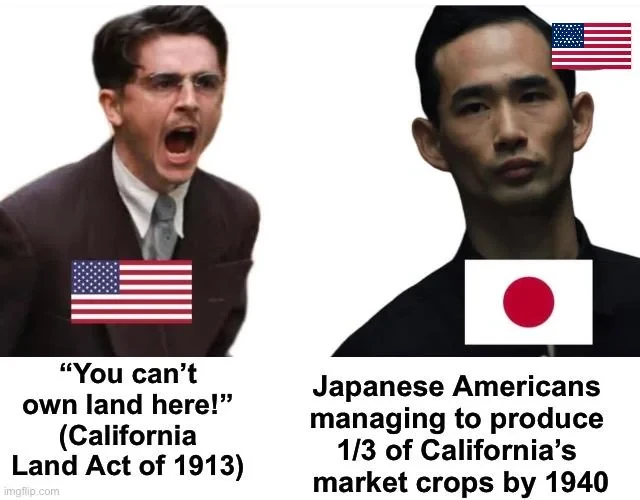
Explanation: California, despite its reputation as a liberal stronghold today, was actually quite racist (as was the rest of the West Coast) even by the standards of early 20th century (non-Southern) America. In large part, this racism was directed towards East Asian immigrants, first Chinese, then Japanese, who came over in large numbers for work opportunities - and some of which decided they rather liked this new continent, and decided to stay and raise families.
The Chinese were largely shut-out of opportunities by the weakness of the Chinese government at the time, while the Japanese government had a stronger 'bargaining position' with the US, and managed to finagle more equal treatment and opportunity for its citizenry with the Federal US government. Still, Cali did its damndest to prevent any further 'undesired' migrants, in part by forbidding resident non-citizens "ineligible for citizenship" (read: not white - yes, immigration law was fucked up at the time [and currently, but in a different way]) from owning land.
Despite this, both Chinese-Americans and Japanese-Americans were immensely successful in California, with Japanese-American farmers in particular ending up growing a massive proportion of Cali's agricultural produce.
After Pearl Harbor in December 1941, many powerful (white) business interests lobbied for the 'untrustworthy' Japanese-American population on the West Coast to be 'removed' - ostensibly to prevent the Japanese Empire from using them as spies or saboteurs. In reality, some of the hardest lobbiers were farming associations dominated by white folk. Yeah, doesn't take a genius to see what they wanted. Despite the majority of Japanese-Americans being native-born citizens at that time, the West Coast was 'evacuated' of Japanese-Americans in March 1942, who were sent to concentration camps further inland.
These were concentration camps in the most literal sense - the original sense of corralling civilians in a specific area to 'watch' over them. While horrific and dehumanizing, they were prisons rather than death camps - the death rate was not considerably different from the civilian death rate outside of the camps. Surprisingly, for once White America actually did differentiate between East Asian ethnicities, (albeit counting often Koreans as Japanese due to the Japanese occupation of Koreans), and Chinese-Americans largely operated without additional legal disabilities during WW2.
As they were being deported, they still, formally, maintained many rights, including property rights... but the prospect of indefinite detention without any capital to pay property taxes has a certain disincentivizing effect on retaining expensive land that you can neither manage nor work. For that reason, many Japanese-Americans sold their land - and often their homes too - before being deported - at deeply unfair prices.
Despite this, Japanese-Americans volunteered in large numbers for service in WW2 in the fight against fascism, serving as translators in the Pacific, and in combat roles in Europe, with the 442nd Infantry Regiment becoming the most decorated unit in US history for its valiant service against the fascists and Nazis.
In late 1944, a half-assed Supreme Court decision undermined internment, and the Feds opted to release the detained Japanese-Americans rather than try to fight on reduced legal grounds. Those who did not sell their homes or lands often returned to find them in disrepair (naturally), or else vandalized by white neighbors or squatted on and claimed (often successfully in court).
This is often considered one of the darkest moments of 20th century American domestic policy, and is a terrible sin which still reverberates to this day. It wasn't until the 1980s that the Federal government formally apologized and attempted, however belatedly and insufficiently, to make reparations to the survivors.