Benjamin_Kenobi

joined 2 years ago
MODERATOR OF
[–] Benjamin_Kenobi@lemmy.world 2 points 1 week ago (1 children)

I tend to agree with your opinion as these telescopes are pushing at the boundaries of accepted understanding all the time. It'll be interesting to see if your opinion is proved correct in the coming years.

[–] Benjamin_Kenobi@lemmy.world 3 points 1 week ago (1 children)

I've updated the post with the link. Apologies!


Meet our current record holder for farthest galaxy ever seen (so far!!)

MoM-z14 may look like an unimpressive little yellow smudge here, but it's our first view of a galaxy that existed just 280 million years after the big bang and lies over 13.5 billion light years away from here.

https://www.flickr.com/photos/nasawebbtelescope/55065929901/in/album-72177720331299130


Webb captured a new close-up of an old favorite, the Helix Nebula. We’ve seen this region before with telescopes like Hubble and the retired Spitzer Space Telescope, but Webb zooms into this dying star with a deeper, more detailed view.

https://science.nasa.gov/mission/webb/multimedia/images/#Engineering-And-Test-Images

[–] Benjamin_Kenobi@lemmy.world 6 points 1 month ago

The Cesarean Section


NASA’s James Webb Space Telescope has provided the first direct measurements of the chemical and physical properties of a potential moon-forming disk encircling a large exoplanet. The carbon-rich disk surrounding the world called CT Cha b, which is located 625 light-years away from Earth, is a possible construction yard for moons, although no moons are detected in the Webb data.

https://science.nasa.gov/missions/webb/nasas-webb-telescope-studies-moon-forming-disk-around-massive-planet/

18
submitted 4 months ago* (last edited 4 months ago) by Benjamin_Kenobi@lemmy.world to c/jwst@lemmy.world
 

Webb brings cosmic lenses into focus Nature’s magnifying glass 🔎

Galaxies in these images might look stretched or warped. That’s due to gravitational lensing, a tool that allows us to peer even further into the universe!

Gravitational lensing occurs because the gravity of massive objects like galaxies and galaxy clusters can warp the fabric of spacetime, bending the path of light around the object. When a massive foreground object lines up with a background galaxy, the light from the background galaxy bends on its way to our telescopes.

https://www.flickr.com/photos/nasawebbtelescope/54822781985/in/album-72177720323168468


NASA’s James Webb Space Telescope has revealed a colorful array of massive stars and glowing cosmic dust in the Sagittarius B2 molecular cloud, the most massive and active star-forming region in our Milky Way galaxy.


A blowtorch of seething gasses erupting from a volcanically growing monster star has been captured by NASA’s James Webb Space Telescope. Stretching across 8 light-years, the length of the stellar eruption is approximately twice the distance between our Sun and the next nearest stars, the Alpha Centauri system. The size and strength of this particular stellar jet, located in a nebula known as Sharpless 2-284 (Sh2-284 for short), qualifies it as rare, say researchers.


Expand your imagination 🍥

What appears to be a single galaxy is actually two that are very far apart! The closer galaxy lies in the center of the image, while the more distant galaxy appears to be wrapped around it in a phenomenon we call an “Einstein ring.”

Einstein rings occur when light from a distant galaxy gets bent by the gravity of a massive closer-by object, in this case another galaxy. The light from the distant galaxy that would otherwise travel in a straight line follows the bend of gravitationally warped spacetime, brightening the light from behind the galaxy and acting as a sort of natural magnifying glass. Einstein predicted this effect in his theory of relativity.

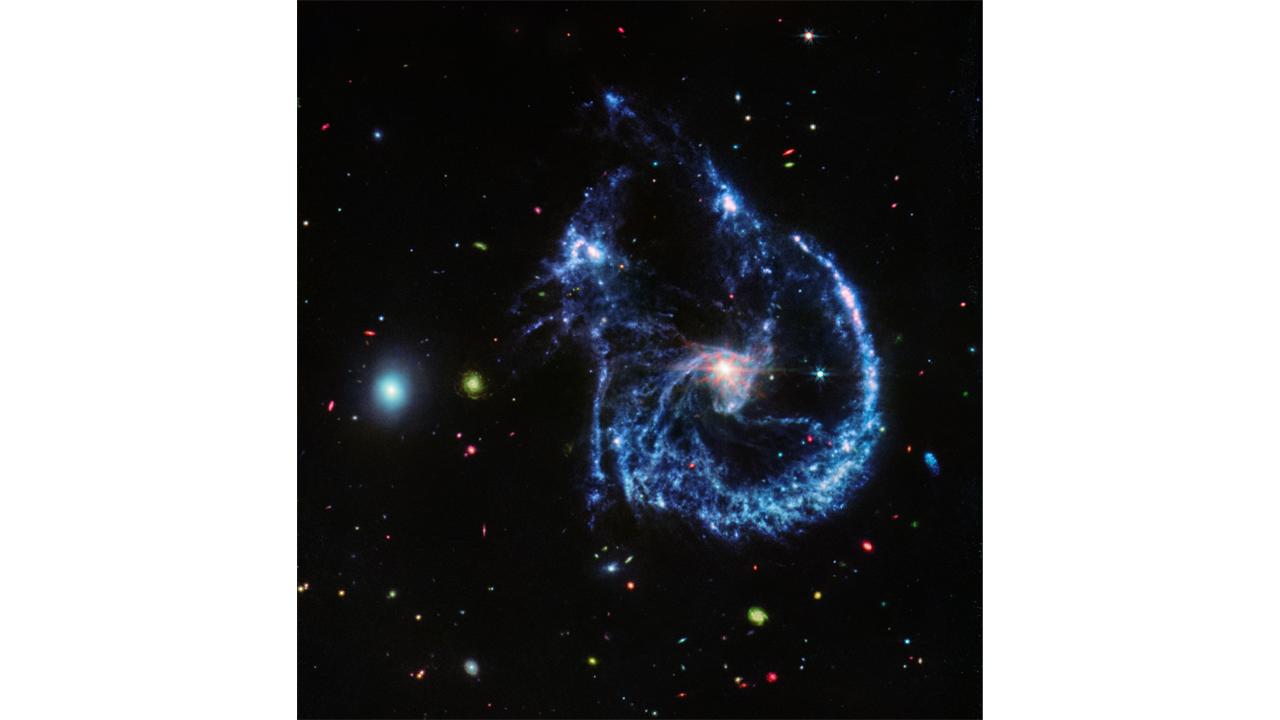
https://esawebb.org/images/potm2503a/

17
submitted 1 year ago* (last edited 1 year ago) by Benjamin_Kenobi@lemmy.world to c/jwst@lemmy.world
 

This image of Arp 107, shown by Webb’s MIRI (Mid-Infrared Instrument), reveals the supermassive black hole that lies in the center of the large spiral galaxy to the right. This black hole, which pulls much of the dust into lanes, also display’s Webb’s characteristic diffraction spikes, caused by the light that it emits interacting with the structure of the telescope itself.

Perhaps the defining feature of the region, which MIRI reveals, are the millions of young stars that are forming, highlighted in blue. These stars are surrounded by dusty silicates and soot-like molecules known as polycyclic aromatic hydrocarbons. The small elliptical galaxy to the left, which has already gone through much of its star formation, is composed of many of these organic molecules.

Credits Image NASA, ESA, CSA, STScI

https://webbtelescope.org/contents/media/images/2024/132/01J74B5B0C2MKBE2QXTMW46T4Z


One of the brightest nebulae in the night sky is Messier 42, the Orion Nebula, located south of Orion’s belt. At its core is the young Trapezium Cluster of stars, the most massive of which illuminate the surrounding gas and dust with their intense ultraviolet radiation fields, while protostars continue to form today in the OMC-1 molecular cloud behind.

https://www.flickr.com/photos/nasawebbtelescope/53230009083/in/album-72177720305127361/


Herbig-Haro (HH) objects are luminous regions surrounding newborn stars, formed when stellar winds or jets of gas spewing from these newborn stars form shock waves colliding with nearby gas and dust at high speeds. This image of HH 211 from NASA’s James Webb Space Telescope reveals an outflow from a Class 0 protostar, an infantile analog of our Sun when it was no more than a few tens of thousands of years old and with a mass only 8% of the present-day Sun (it will eventually grow into a star like the Sun).


NASA’s James Webb Space Telescope has begun the study of one of the most renowned supernovae, SN 1987A (Supernova 1987A). Located 168,000 light-years away in the Large Magellanic Cloud, SN 1987A has been a target of intense observations at wavelengths ranging from gamma rays to radio for nearly 40 years, since its discovery in February of 1987. New observations by Webb’s NIRCam (Near-Infrared Camera) provide a crucial clue to our understanding of how a supernova develops over time to shape its remnant.

https://www.nasa.gov/feature/goddard/2023/webb-reveals-new-structures-within-iconic-supernova

[–] Benjamin_Kenobi@lemmy.world 2 points 2 years ago

Nice spot that!!

[–] Benjamin_Kenobi@lemmy.world 2 points 2 years ago

I want to dub it "The Riddler Effect".

[–] Benjamin_Kenobi@lemmy.world 3 points 2 years ago

Hopefully they keep digging and finding even more cool things!

[–] Benjamin_Kenobi@lemmy.world 4 points 2 years ago

It took 11 billion years for stretched boy's light to reach us. That amount of time staggers me!

[–] Benjamin_Kenobi@lemmy.world 2 points 2 years ago

Fantastic image!

Seeing stars growing is so cool.

[–] Benjamin_Kenobi@lemmy.world 4 points 2 years ago (1 children)

I second Jerboa.

[–] Benjamin_Kenobi@lemmy.world 1 points 2 years ago

Thank you, and I'm glad you like it so far.

[–] Benjamin_Kenobi@lemmy.world 11 points 2 years ago

This is total donkey bollocks, and you're not very good at writing a story.

[–] Benjamin_Kenobi@lemmy.world 4 points 2 years ago (1 children)

Lionel Richtea

view more: next ›