
Former employees filed declarations in Sacramento Superior Court describing a toxic work environment.
On Tuesday, The Sacramento Bee reported that two former employees of a private contractor working with U.S. immigration authorities came forward with sworn statements alleging a culture of abuse and sexual harassment at the Sacramento ICE facility in California.
RELATED:
U.S. Government Denied Due Process to Migrants Deported to El Salvador: Judge Boasberg
The allegations added to a growing body of complaints about conditions and misconduct at immigration detention centers across the United States, where more than 65,000 people are currently being held, the highest number in the country’s history.
Civil liberties advocates argue that oversight of these facilities has been weakened after the administration of President Donald Trump cut funding to Department of Homeland Security offices responsible for civil rights monitoring.
Sandy Nogales and Jorge Zinzun, former employees of BI Incorporated, filed sworn declarations in Sacramento Superior Court describing what they called a toxic work environment.
BI Incorporated is a private company that monitors immigrants on behalf of U.S. Immigration and Customs Enforcement (ICE), the federal agency responsible for immigration enforcement.
ICE out of California!!
Bay Area faith leaders take action at the ICE field office in San Francisco. pic.twitter.com/5cwbyNWOgH
— Diablo Rising Tide (@RTBayArea) December 16, 2025
In a sworn statement, Nogales, a former BI Incorporated employee who spent eight years with the company and oversaw its Sacramento office, said that some case specialists came to view themselves as superior to the immigrants they were tasked with supervising. She singled out a staff member, Luis Ruiz, describing him as someone who exploited the very people he was meant to assist.
Zinzun said he was dismissed in December 2023 in retaliation for reporting Ruiz’s hostile conduct to management. He said that from a neighboring office, he could hear Ruiz repeatedly shouting at, swearing at, and harshly reprimanding undocumented individuals.
The two former employees came forward after reading about a lawsuit filed in October by a 52-year-old undocumented woman who alleges that Ruiz sexually harassed her for 18 months. According to the lawsuit, Ruiz sent her explicit photographs and videos and made unwanted advances during her mandated meetings at the Sacramento ICE facility.
The Sacramento case reflects a broader pattern of abuse allegations at ICE facilities nationwide. Human rights organizations have revealed similar cases in some of the largest immigration centers in the country, including Fort Bliss in Texas and the California City Detention Facility.
The American Civil Liberties Union has called on authorities to close the Fort Bliss facility and halt the rapid expansion of immigration detention.
In her daily morning #pressconference, the President of #Mexico, Claudia Sheinbaum, condemned the criminalization of #migrants, stating that the best way to reduce mass migration is to #invest in the countries of origin. pic.twitter.com/gjFsOy90FM
— teleSUR English (@telesurenglish) December 18, 2025
teleSUR/ JF
Source: Xinhua
From teleSUR English via This RSS Feed.
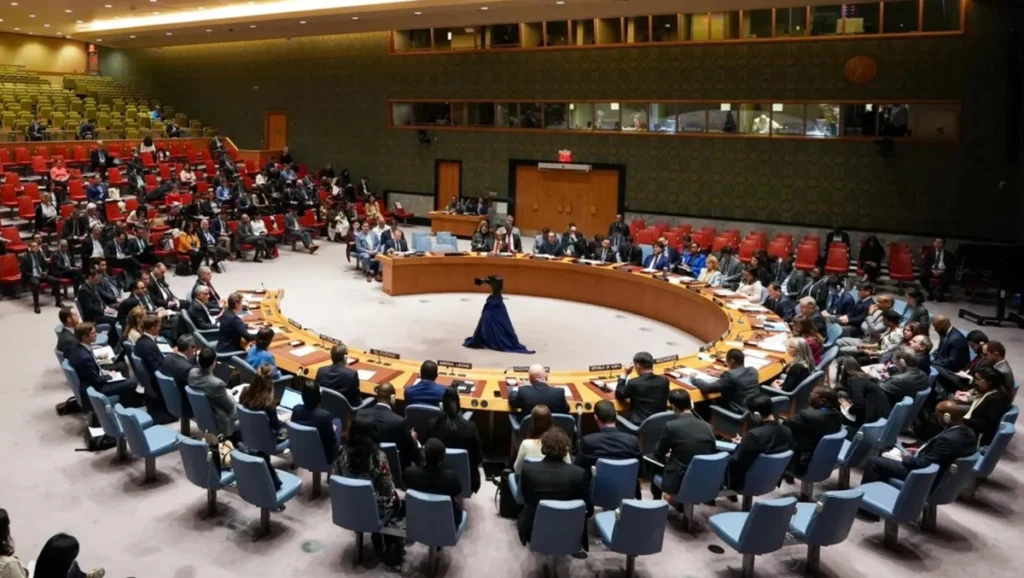
Washington uses terrorism label as political weapon against Venezuela.
During an emergency meeting of the United Nations Security Council (UNSC) on Tuesday, Cuba accused the United States of blatantly and violently violating international law and undermining freedom of trade and navigation.
RELATED:
UN Security Council Backs Venezuela: President Maduro
Ernesto Soberon, Cuba’s representative to the UNSC, said the United States is using the designation of “terrorism” as a political weapon aimed at discrediting the Venezuelan government through an “arbitrary, fraudulent, unilateral and politically motivated” tactic.
“What moral authority does the U.S. government have to make such designations when it protects and finances terrorist organizations on its own territory, refuses to cooperate with neighboring countries such as Cuba on terrorism issues, and openly speaks of covert actions and sabotage from the United States?” Soberon said.
“It is clear that the purpose of the United States is to justify the costly and extraordinary military deployment in the region, with which it seeks to attack Venezuela and impose its odious hegemony in the hemisphere,” he added.
Soberon warned of provocations intended to “further escalate aggression against Venezuelan territory and seize its natural resources,” recalling that “Venezuela and any other state under attack has the right to legitimate self-defense.”
Hey @marcorubio let’s see you go inside the UN to arrest and prosecute a United Nations member … Venezuela has a President and his name is Nicolas Maduro 🇻🇪 https://t.co/q62PfNQzrX
— Jonni Martinez (@iJonniM) December 24, 2025
“The new U.S. national security strategy, with its so-called corollary of the Monroe Doctrine, seeks to consolidate the Western Hemisphere as a U.S. exclusive zone of influence,” Soberon said.
“This policy validates the dangerous doctrine of peace through force and enshrines cognitive warfare as state policy,” he added, specifying that U.S. actions violate the proclamation of Latin America and the Caribbean as a Zone of Peace.
The Cuban diplomat reiterated that the conspicuous, exaggerated, and unjustified naval deployment of U.S. military forces in the Caribbean Sea, as well as the deliberate threat of military aggression against Venezuela, are generating regional instability.
“This reveals a criminal hegemonic purpose that requires universal condemnation,” Soberon said, while rejecting the extension of European Union sanctions against Venezuela.
“Those sanctions run counter to international law and the United Nations Charter, as they seek to increase pressure on the Venezuelan government and are tied to the aggressive interests of the United States,” he emphasized.
“Cuba reaffirms its total and unconditional support for Venezuela and demands full respect for its sovereignty, independence and the unrestricted right to freely decide its own destiny, without external interference,” Soberon concluded.
During a presidential event, the president of #Venezuela, Nicolas Maduro, stated that the role of a president is to address the problems of their country and not to interfere in the affairs of other #nations. pic.twitter.com/kBelmkFPE1
— teleSUR English (@telesurenglish) December 23, 2025
teleSUR/ JF
Source: UN
From teleSUR English via This RSS Feed.
The headlines came fast and furious: Nick Reiner, 32, could face the death penalty for murdering his own parents, beloved Hollywood couple Rob Reiner and Michele Singer Reiner.
News coverage ranged from practical explainers on California’s death penalty to vulgar punditry casting more heat than light. True crime celebrity Nancy Grace fumed that Reiner showed “no remorse” during his brief courtroom appearance. Megyn Kelly mused, without shame or evidence, that Reiner might deploy the same “sympathy card” as the Menendez brothers, who, after killing their parents, accused their father of sexually abusing them as children.
If there was one thing most people seemed to agree on, however, it was that a death sentence is highly unlikely.
Reiner’s reported mental illness has already raised questions over his competency to stand trial. His lifelong struggle with addiction, which led to homelessness and more than a dozen stints in rehab, is the kind of mitigating evidence that could persuade a jury to show mercy — if not convince prosecutors to take death off the table altogether.
Then there’s the Reiner family, which has barely begun to grieve. The Reiners’ adult children — who have asked “for speculation to be tempered with compassion and humanity” — may likely push back against a decision to seek death, whether out of opposition to the death penalty, a desire to avoid the trauma and spectacle of a capital trial, or because they do not wish to lose another beloved family member to homicide, no matter how devastating his alleged actions.
So why did the Los Angeles County district attorney raise the possibility of a death sentence for Nick Reiner at a press conference just two days after his parents’ bodies were found?
[
Related
“There Are Innocent People on Death Row” — Citing Wrongful Convictions, California Governor Halts Executions](https://theintercept.com/2019/03/13/california-death-penalty-moratorium/)
In a state that has not carried out an execution in 20 years, decisions to seek the death penalty amount to little more than political posturing. While nearly 600 people remain under a death sentence in the Golden State, a return to executions has never seemed more far-fetched. After Gov. Gavin Newsom imposed a moratorium in 2019, the death chamber at San Quentin was dismantled, and the condemned population transferred to prisons across the state.
While a new governor could conceivably lift the moratorium, any push to restart executions would take years. As one federal judge put it more than a decade ago, California’s death penalty remains a punishment “no rational jury or legislature could ever impose: life in prison, with the remote possibility of death.”
Yet there was District Attorney Nathan Hochman on December 16, standing somberly before the cameras in downtown LA to announce the charges that would make Reiner eligible for the ultimate punishment.
“No decision at this point has been made with respect to the death penalty,” Hochman added gravely, cautioning against speculation or rumor.
His decision would rely on the evidence and, at least in part, on input from the family of the victims.
He said, “We owe it to their memory to pursue justice and accountability for the lives that were taken.”
Reiners’ Activism
It is not overly speculative to say that Rob and Michele Reiner would have recoiled at the thought of the state seeking a death sentence in their name — let alone against their own son.
Their famed support of social justice causes included advocating for people in prison. Friends of Singer Reiner have recalled her recent focus on wrongful convictions and her regular conversations with Nanon Williams, a Texas man who faced the death penalty as a teenager before his sentence was reduced to life. One of Rob Reiner’s last production credits, “Lyrics From Lockdown,” a one-man show by the formerly incarcerated artist Bryonn Bain, centers in part on Williams’s story.
In a 2023 interview discussing the show, Reiner pointed to the racism at the heart of the criminal justice system, a topic he’d grappled with in his film “Ghosts of Mississippi.” He had brainstormed a potential documentary series, “Injustice for All,” he said, which would depict the ugly reality of the system: “It’s prosecutorial misconduct. It’s profiling.”
“The death penalty does not make us safer, it is racist, it’s morally untenable, it’s irreversible and expensive.”
It was this very kind of systemic critique — rooted in decades of research and data — that had led former LA District Attorney George Gascón to halt death penalty prosecutions in Reiner’s home county a few years earlier. At a time when the death penalty had been on a long, slow decline, Los Angeles remained an outlier in sending people to death row — overwhelmingly people of color.
“The reality is the death penalty does not make us safer, it is racist, it’s morally untenable, it’s irreversible and expensive, and, beginning today, it’s off the table in LA County,” Gascón said at the time.
But electoral politics are quick to punish such attempts at reform — especially when they coincide with any uptick in crime.
[
Related
What Happens When a Reform Prosecutor Stands Up to the Death Penalty](https://theintercept.com/2019/12/03/death-penalty-reform-prosecutors/)
Gascón’s tenure overlapped with a rise in violent crime nationwide, a phenomenon tied to the pandemic but swiftly blamed on reform-minded prosecutors. While Gascón survived two recall attempts, the era of reform he sought to implement was short-lived. A crowded field of challengers lined up to replace him in 2024.
Hochman would win out by running a classic tough-on-crime campaign. Promising to rescue the city from a descent into crime-ridden dystopia, he vowed to revive the death penalty in LA as part of his “blueprint for justice,” a set of priorities primarily aimed at reversing his predecessor’s reforms. Never mind that the death penalty remained a failed public policy that did nothing to stop crime — and which California taxpayers had paid billions of dollars to maintain with little to show for it.
“Effective immediately,” Hochman declared months after taking office, “the prior administration’s extreme and categorical policy forbidding prosecutors from seeking the death penalty in any case is rescinded.”
It is against this backdrop that Hochman will now handle the prosecution of Nick Reiner.

LA County District Attorney Nathan Hochman announces charges against Nick Reiner in the murders of his parents on Dec. 16, 2025. Photo: Robert Gauthier/Los Angeles Times via Getty Images
Victims’** Families?**
Just two weeks before the Reiners’ horrific murders, the American Civil Liberties Union of Southern California released a report assessing Hochman’s first year in office, decrying his “pattern of extreme and debunked approaches to crime.” At the top of the list was his decision to bring back the death penalty to LA County.
The report quoted a recent op-ed by veteran anti-death penalty activist and actor Mike Farrell, the board president of the California-based abolitionist group Death Penalty Focus.
“It’s incomprehensible that D.A. Hochman is once again pursuing the death penalty in Los Angeles, the county that has sent more people to California’s now-defunct death row than any other in the state,” Farrell wrote. Although Hochman often pointed to a pair of unsuccessful ballot initiatives that twice failed to repeal California’s death penalty, Angelenos voted in favor of the measures.
“Why would a responsible district attorney ignore the demonstrated will of the voters in the county he serves?”
“So why,” Farrell asked, “would a responsible district attorney ignore the demonstrated will of the voters in the county he serves?”
Farrell also called out Hochman for refusing to meet with victims’ family members who oppose capital punishment. Although Hochman vowed to give families a voice in matters of crime and punishment, his conduct has left some families feeling betrayed.
Perhaps no family has been more vocal than the relatives of Lyle and Erik Menendez, who filed multiple complaints against Hochman for his conduct while he fought to block the brothers’ recent bid for release. Prior to Hochman’s election, the Menendez case had been reviewed by Gascón’s Resentencing Unit, ultimately persuading the DA to recommend that the brothers be resentenced after 35 years behind bars.
Hochman swiftly intervened, taking aggressive steps to keep the brothers in prison. In one subsequent letter, sent to the U.S. Attorney’s Civil Rights Division, a family member described a meeting between Hochman and more than 20 relatives, who urged the DA to reconsider his stance.
“In a tear-filled meeting, numerous family members shared the ongoing trauma and suffering we have endured for more than 30 years,” it read. “Instead of responding with compassion, acknowledgment, and support, DA Hochman proceeded to verbally and emotionally retraumatize the family by shaming us for allegedly not listening to his public press briefings.”
The Anti-Reformer
The ACLU report also shed light on Hochman’s disturbing attempts to undermine the Racial Justice Act, a landmark piece of criminal justice legislation allowing courts to reexamine death sentences rooted in racial bias. The law explicitly barred prosecutors from using animal imagery against defendants, a dehumanizing practice that has historically served as a racist dog whistle.
Yet Hochman went out of his way to defend a case where the prosecutor compared a defendant to a “Bengal tiger.” California Attorney General Rob Bonta, who defeated Hochman for the top statewide office in 2022, had acknowledged that the tiger reference was wrong and that the death sentence should be vacated. Hochman, though, wrote in an amicus brief to the court that Bonta’s “concession was not well taken, and this Court should reject it.”
It would be hard to imagine a more retrograde position than defending racist imagery in capital trials. Hochman not only vowed to uphold the Racial Justice Act upon taking office, but also used its existence as political cover to justify his pro-death penalty stance.
As the ACLU wrote, “D.A. Hochman’s arguments against the RJA attempt to weaken the very law he claims would safeguard his death penalty decisions from racial bias.”
One could argue that none of this is relevant to the case of Nick Reiner. As a white man from a wealthy family who has secured one of the country’s most high-profile defense attorneys, he has had privileges that are unheard of compared to most defendants who end up on death row.
And while mental illness or addiction may ultimately spare Reiner from a death sentence, the same cannot be said for countless people whose crimes were driven by demons like his.
This, of course, is precisely the problem. Reiner is still somebody’s son. The others are the “worst of the worst.”
Given their advocacy, Reiner’s parents would likely have been the first to acknowledge this. Prosecutors like Hochman, however, cannot afford to be so honest.
Whether or not he decides to seek a death sentence against Reiner, Hochman’s narrative about the death penalty is one of the oldest in electoral politics — a story cloaked in the language of justice, told for political gain.
The post Prosecutor Floating Death Penalty for Nick Reiner Knows It’s an Empty Threat appeared first on The Intercept.
From The Intercept via This RSS Feed.
In September, the European Union seemed poised to suspend trade agreements with Israel over its human rights violations in Gaza. In the United States, a record number of Democratic lawmakers began to support calls to limit weapons transfers to Israel. In Germany, Chancellor Friedrich Merz’s government issued a ban in August on sending weapons to Israel that could be used in Gaza, with Merz saying he was “profoundly concerned” for “the continued suffering of the civilian population in the Gaza Strip.”
By early October, however, with the enactment of President Donald Trump’s 20-point plan — which world leaders call a “ceasefire” or “peace plan,” despite ongoing Israeli violence in Gaza — such concern seemed to evaporate. Mounting international pressure was replaced with an eagerness from many governments, lawmakers, and institutions to return to the status quo.
[
Related
Meet the U.S. Donors Funding ELNET, the AIPAC of Europe](https://theintercept.com/2025/12/15/elnet-aipac-israel-lobby-europe/)
Exactly one week after the Gaza plan went into effect, EU parliamentarians tabled its proposals to sanction Israel over its human rights violations in Gaza. One month later, the German government, Israel’s second largest supplier of weapons, announced it would lift its arms embargo on its longtime ally; last week, Germany’s parliament approved a $3.5 billion deal to expand its missile defense systems to protect Israel. Earlier this month, Eurovision, the popular singing competition, cleared Israel to continue competing, despite pledges to boycott from Spain, Slovenia, the Netherlands, Ireland, and Iceland. The U.N. Security Council also authorized Trump’s plan, agreeing to help form a so-called International Stabilization Force.
In Congress, even as polls show most Americans disapprove of Israel’s military action in Gaza, lawmakers and advocates behind the Block the Bombs to Israel Act in Congress have struggled to build on its summertime momentum, garnering only two new co-sponsors since Trump declared he had achieved peace.
What happened?
“Now that there is technically a ‘ceasefire’ in place, that alone has had a big immobilizing effect on activists, advocates, and — I think more importantly — just the general public,” said Tariq Kenney-Shawa, a policy fellow at Al-Shabaka. Calls for a “ceasefire now” had a galvanizing effect for public pressure to end the killing — so the Gaza deal served as a release valve.
The Israeli military continues to violate the agreement, launching strikes into Gaza on a near-daily basis and continuing its partial, yet illegal blockade on humanitarian aid. The United States, for its part, has so far been unwilling to enforce the truce in any meaningful way beyond strongly worded letters.
Under the Gaza deal, gunfire and bombings have slowed but not ceased, with the Israeli military striking Gaza more than 350 times since, killing at least 394 people and wounding more than 1,000 others across the Strip, according to the Gaza Health Ministry and the United Nations. Israel continues to occupy 58 percent of the territory, establishing a largely imaginary yellow line within which the military demolishes buildings and civilian infrastructure and shoots Palestinians along the indefinite border — including two children, Fadi Abu Assi, 8, and Jumaa Abu Assi, 10, who were killed by an Israeli drone while gathering wood. The Israeli military also continues to launch daily attacks beyond the yellow line, including the assassination of Hamas commander Raed Saad on December 13, which drew the ire of the White House.
[
Related
Dozens of Gaza Medical Workers Are Still Disappeared in Israeli Detention](https://theintercept.com/2025/11/10/gaza-doctors-disappeared-israeli-prison/)
In tandem with its ongoing strikes in Gaza, Israel launched a new military operation in the West Bank, raiding refugee camps, conducting mass arrests of Palestinian civilians, and killing unarmed individuals, including at least 14 children during confrontations with Israeli soldiers, according to Defense for Children International-Palestine. One boy, 13-year-old Aysam Jihad Labib Naser, died of tear gas inhalation one month after Israeli soldiers attacked him and his family while they were picking olives.
Trump’s Gaza plan “has given a convenient excuse to members of Congress to look away from the situation,” said Josh Ruebner, policy director at the Institute for Middle East Understanding Policy Project. He supports the Block the Bombs bill, originally introduced by Rep. Delia Ramirez, D-Ill., in May, and acknowledged that it had stalled in recent months. “But the reality is that U.S. weapons are still being used on an almost daily basis by Israel to kill Palestinians.”
Trump’s Gaza plan “has given a convenient excuse to members of Congress to look away from the situation.”
The Israeli government has allowed a trickle of aid into Gaza but continues to block most international and Palestinian aid groupsfrom delivering supplies, a violation of both the 20-point plan and international law. Stuck at the border is $50 million worth of aid, such as food, maternal and newborn care supplies, much-needed treatments for malnutrition, and shelter goods.
On Friday, the global hunger monitor IPC declared Gaza is no longer experiencing famine, but warned the majority of Gazans still face “high levels of acute food insecurity.” Half a million people remain in “emergency” levels of acute malnutrition, risking death, the monitor said. Around 2,000 people are still experiencing famine conditions. Exacerbating the hunger crisis, winter storms blowing through the Strip have ripped through and flooded tent cities and war-torn homes where hundreds of thousands of displaced Palestinians were sheltering. At least 13 people have died as a result of the weather, according to Gaza health officials. Among them is one-month-old Saeed Eseid Abdeen, who died last week due to hypothermia.
As attention and outrage have waned, Israel and its defenders have attempted to regain control of the narrative that they have struggled to wield over the last two years of genocide.
At the Jewish Federations of North America conference in November, former Obama speechwriter Sarah Hurwitz blamed Israel’s losing public relations battle among young Americans on TikTok, which is “smashing our young people’s brains all day long with video of carnage in Gaza.”
TikTok is “smashing our young people’s brains all day long with video of carnage in Gaza.”
“And this is why so many of us can’t have a sane conversation with younger Jews,” said Hurwitz during a panel discussion in which she also blamed the backlash against Israel on backfiring Holocaust education. “Because anything we try to say to them, they are hearing it through this wall of carnage.”
Several weeks later, former Secretary of State Hillary Clinton — speaking at a conference hosted by the Israeli news outlet Israel Haymon, owned by right-wing, pro-Israel, pro-annexationist megadonor Miriam Adelson — also blamed young Americans’ concerns over Gaza on TikTok and social media, dismissing livestreamed genocidal violence as “pure propaganda” and as “threat to democracy.”
Hurwitz and Clinton failed to mention how such dismissals of Israel’s atrocities have been powered by massive crackdowns on the free speech rights of Palestine solidarity advocates in the U.S. and abroad — and how legitimate concerns for the safety of Jewish people have been weaponized to crack down on pro-Palestine speech.
After the mass shooting at a Hannukah event in Sydney, Australia’s Bondi Beach, where two gunmen killed 15 people, mostly Jewish festival goers, Israeli Prime Minister Benjamin Netanyahu immediately seized on the moment to tie the violence to Australia’s recognition of Palestinian statehood earlier this year following widespread anti-genocide protests in the country. In a CBS Mornings segment covering the shooting, Israel’s former special envoy for combatting antisemitism Noa Tishby advocated for the adoption of the International Holocaust Remembrance Alliance working definition of antisemitism, which considers criticism of the state of Israel as antisemitic.
[
Related
NY Times’ Bret Stephens Blames Palestine Freedom Movement for Bondi Beach Shooting](https://theintercept.com/2025/12/15/nyt-bret-stephens-bondi-beach-shooting/)
Lawmakers in Australia’s New South Wales, where Bondi Beach is located, are now considering a ban on all protest for up to three months. In the United Kingdom, police agencies in London and Manchester responded last week to the Bondi Beach shooting by criminalizing the chant “globalize the intifada,” a call for popular resistance against Israel’s occupation of Palestinians, commonly misinterpreted to mean violence against Jewish people. The Trump administration, meanwhile, issued a travel ban on all Palestinian Authority passport holders, citing concern over “U.S.-designated terrorist groups operate actively in the West Bank or Gaza Strip.”
Despite the recent measures taken against the pro-Palestinian movement, Kenney-Shawa said he believes Israel and its backers will still fail in the long term to retake the narrative.
“They’re not going to be successful in restoring Israel to its former untouchability in U.S. politics — that train has left the station,” he said. “The Biden generation obviously grew up with all these myths about Israel and those myths were shattered by this generation who’s growing up with new facts about Israel, the reality of Israel.”

People gather around a destroyed vehicle after an Israeli airstrike that killed four people, per Gaza’s civil defense agency, on Al-Rashid Street in Gaza City, Gaza, on Dec. 13, 2025. Photo: Abood Abusalama/Middle East Images/AFP via Getty Images
A growing body of polling shows Americans, mostly on the left but increasingly on the right, are beginning to reject the government’s special relationship with Israel — signaling a major role for such shifts in the upcoming midterms and the 2028 presidential election.
The Trump plan itself remains uncertain. Its second phase would see the disarmament of Hamas, though the Palestinian militant and political group has said it would only give up its weapons if there is a path toward Palestinian statehood. Israeli officials, however, continue to reject calls for a Palestinian state. Instead, Netanyahu’s cabinet has been open about its stated policy of totally erasing Palestinians from both Gaza and the West Bank in pursuit of forming “Greater Israel.”
Whether the rising awareness will amount to material improvement for the people of Palestine is also unclear. Some protesters aim to make their efforts tangible by interrupting the global supply chain of weapons sent to Israel, as new campaigns by the Palestine Youth Movement have sprouted at docks and warehouses in Oakland and New Jersey. In the United Kingdom, imprisoned Palestine Action members are undergoing a weekslong hunger strike; among their demands is the closure of Israeli arms manufacturer Elbit System’s factories in Britain. The Hind Rajab Foundation, meanwhile, continues to file legal complaints and investigation requests across the globe aiming to hold Israeli soldiers and commanders accountable for war crimes.
“I will not continue to willingly be part of that complicity.”
And in Congress, public pressure still seems to be having some influence on lawmakers. A recent resolution introduced by Rep. Rashida Tlaib, D-Mich., which recognizes “the genocide of the Palestinian people in Gaza” and underlines the U.S. responsibility in upholding the Genocide Conventions, has drawn support from 20 other members of Congress — including Rep. Maxine Dexter, D-Ore., who was elected with significant support by pro-Israel lobby group AIPAC.
“I will not continue to willingly be part of that complicity,” Dexter said during her speech on the House floor to back the resolution. Dexter is one of several lawmakers who have altered their public stances on Israel after sustained protest from their constituents at town hall meetings and in front of their district offices.
“Public opinion has shifted in permanent and dramatic ways,” Ruebner, of the IMEU Policy Project, said. “People cannot unsee what they have seen over the past two years.”
The post International Pressure Was Building to Hold Israel Accountable. What Happened? appeared first on The Intercept.
From The Intercept via This RSS Feed.