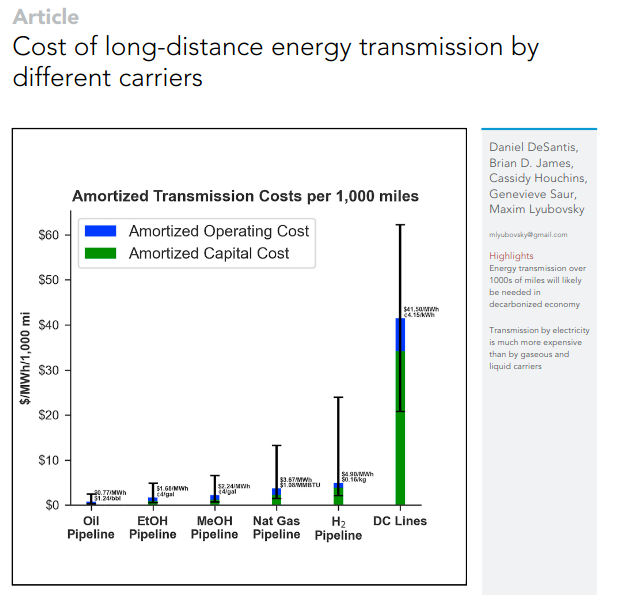
so the goal is to transport renewable energy from the point of production (e.g. coastline for offshore wind) to the point of consumption (e.g. big factory 300 miles from the coast).
what is the cost of doing this? when comparing different technologies. i.e. you can just build a cable and transport the electricity through that, or you convert the energy into hydrogen at the point of production, then pipe that hydrogen gas through a pipeline to the point of consumption. many big consumers can naturally consume hydrogen instead of electric power anyways, for example large steel mills. they require power for heating and reduction, but in both cases, both power sources can be used (for reduction, electrolysis vs. chemical reduction).
it's well-known that the LCOE (levelized cost of electricity) for solar and wind is around 6 ct/kWh (citation needed, i'm citing from memory). so what is the cost of transporting that electric power over 300 miles? according to the diagram, it's 4 ct/kWh over 1000 miles, so probably 1.33 ct/kWh over 300 miles using wires. so it makes a small part of the cost.
meanwhile if you use hydrogen, you have around a 70% conversion+storage efficiency (electric power -> hydrogen, plus storing it in an underground cavern) (source: this paper and german wikipedia about hydrogen storage). so to produce 1 kWh hydrogen, you need 1.4 kWh electricity at the cost of 1.4 * 6 ct/kWh = 8.4 ct/kWh. transmitting it over the pipeline, meanwhile, costs almost nothing, as seen in the diagram.
so in summary, producing+storing+transmitting hydrogen is slightly more expensive than just producing+transmitting electric power, but that already includes the storage cost. for electric power, you need additional batteries which i'm too lazy to write about now. just to give you an idea.
I don't get why materials for HVDC are so much higher than everything else. Towers and cables are relatively cheap, the substation hardware is not, but neither are pumping stations with all of the safety requirements.
Also why only 500kV when there are 1.2MV systems in the world. Not that it would make much difference since the bulk of the cost is down to materials.
I didn't see the amortisation time in my quick skim through.
I know in NZ the compliance cost to get a pipeline through would kill any project that tried to do this.
Obviously leaks etc are ignored in this model, but they at a significant contributor to climate change.
At least with H2, leaks are not a direct driver of climate change (apart from wasting energy ofc). Environmental concerns are much less of a factor compared to gas/oil. I think the main concern is to get from electricity to H2 and back. There are approaches to go sunlight -> H2 more or less directly (SunHydrogen currently working on comercialization), but they sit at about 11% sun -> H2 yield, which is still way below normal solar panels (up to 30%). Electrolysis performs much worse iirc
electrolysis alone has 80% electric -> hydrogen conversion efficiency minimum, sometimes close to 100%. most solar panels have 20% sunlight -> electric efficiency. so total sunlight -> electric -> hydrogen efficiency is about 20% * 80% = 16%. which might not sound like a lot but remember there's a ton of sunlight so wasting some doesn't matter.
it's more about the economic cost to describe how feasible something is.
If efficiency at point of use is faceted in, things get better for electric, bit not enough to bridge the divide.
Hydrogen is difficult to work with, massive compression or cryogenic temperatures. Metal embrittlement is a long term concern.
that's hearsay. there's lots of studies about hydrogen pipeline / storage feasibility, such as the ones i've linked above. pls stop spreading misinformation.
No it isn't.
Oil can be pumped at atmospheric pressure and temperature, it is a little easier to warm it a bit, but not a hard requirement. This is easy to work with.
Electricity is easy to work with, it will stay in the wires and can be switched on and off in milliseconds.
To work with hydrogen, you have to either compress it a lot, or liquefy it. Both have significant challenges.
For example I was working on a hydrogen pilot project, we were using 700 bar compressed hydrogen as the storage mechanism. Getting the compressed gas out of storage was always a pain in the arse, valves would freeze open causing control problems. Perhaps physically larger valving wouldn't have this problem, but the cooling potential of expanding 700bar gas back to atmosphere is significant. Compressed hydrogen is an explosion risk independent of oxidiser, so you have a double explosion risk, first the compression explosion then the chemical reaction in atmosphere of a spark (likely) is generated by the first. There are a bunch of other issues with it, but these are major ones.
Cryogenic hydrogen has it's own I issues. I'm not as familiar with it.
Saying hydrogen isn't difficult to work with is just your lack of experience. Difficult is just engineering challenges, but hydrogen has some unique issues that other options don't.