this post was submitted on 06 Jun 2026
1258 points (99.4% liked)
Work Reform
16492 readers
300 users here now
A place to discuss positive changes that can make work more equitable, and to vent about current practices. We are NOT against work; we just want the fruits of our labor to be recognized better.
Our Philosophies:
- All workers must be paid a living wage for their labor.
- Income inequality is the main cause of lower living standards.
- Workers must join together and fight back for what is rightfully theirs.
- We must not be divided and conquered. Workers gain the most when they focus on unifying issues.
Our Goals
- Higher wages for underpaid workers.
- Better worker representation, including but not limited to unions.
- Better and fewer working hours.
- Stimulating a massive wave of worker organizing in the United States and beyond.
- Organizing and supporting political causes and campaigns that put workers first.
founded 3 years ago
MODERATORS
you are viewing a single comment's thread
view the rest of the comments
view the rest of the comments
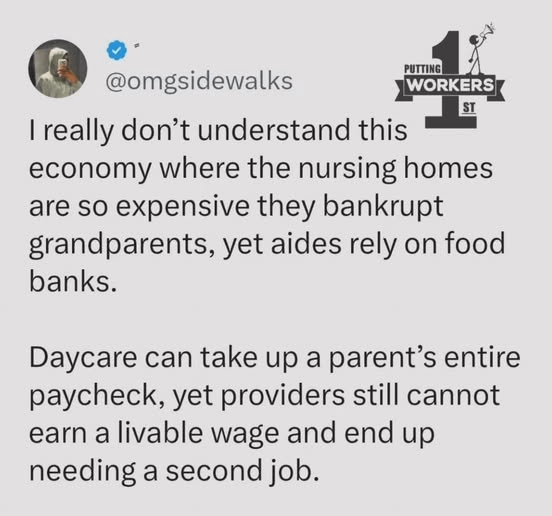
What's not to understand? The owning class owns the facilities and sets both the prices and the wages, and they will do this in the way that maximally benefits themselves, i.e., maximizes profits. It's a really, really basic feature of capitalism (yes, also whatever super duper special unicorn flavor of capitalism you think works better than "crony" capitalism).
It's a rhetorical device I forgot the name of. If I say "I don't understand X", that will have one of two effects on most people: either they also don't know, realise that and hopefully get curious, or they do and know the point I'm aiming for. If they offer that explanation, it creates a Socratic approach to making an argument: Framing it as an explanation of a question the rest of the audience is hopefully also curious about.
You explanation is the second part of the argument.
So, I know of the existence of this rhetorical device, but I've been around enough people who operate in a theoretical framework where this statement cannot be taken as anything other than genuine, namely that of capitalist realism. This has two implications:
In either case, making an explanation (there's more than one) explicit is useful, if only to open up space for people to disagree with the explanation. (In fact I'd be willing to bet that the person who wrote the tweet disagrees with my explanation, specifically the part involving flavors of capitalism. I bet they're advocating for something like the nordic model.)
Those are good points I didn't consider.
On the first, I tend to lean towards assuming the best of people where possible, mostly because it helps stave off defeatism. That doesn't make it likely, just less depressing.
On the second, I genuinely didn't see that angle. Thanks for pointing it out. They don't need to appreciate it as rhetorical device (and in fact, it may be more effective if they're not conscious of it), but if it leads them to make up their own conclusions to reinforce existing assumptions, instead of being curious and open-minded, that would indeed miss the mark.
I guess to some degree, it'll be a "shotgun" approach to hopefully get some people curious, even if you'll never get everyone. I'm not sure a more direct statement of facts would have gotten the others either.
That's the conclusion I was aiming for, yes. In thr context of the device, the question is a setup and framing for the answer. By "prompting" for it, it seems less like preaching (which may turn people away) and more like a "genuine" and natural conversation. Interviews are occasionally framed in a similar way, but with an open question on the internet, it may seem less "staged" if that makes sense?
(I'm not sure those are the best words to describe it, but I can't put my finger on the nuances so I'll just call it a vocab/language barrier)
The Nordic model tends to be idealised to some degree. I understand how it would look like a significant improvement over some other forms, particularly the US, and I'll freely admit I'm also subject to bias, but it can't cure all the problems baked into the system.
From the glimpses I've caught, it doesn't seem to solve all social issues either. The specific example I've heard of is racism, but I didn't do a thorough investigation about other effects. Then again, I'm not sure I have a good solution on hand to effectively shift cultural stances like that either.