this post was submitted on 18 Jun 2026
5 points (61.9% liked)
linux4noobs
4225 readers
27 users here now
linux4noobs
Noob Friendly, Expert Enabling
Whether you're a seasoned pro or the noobiest of noobs, you've found the right place for Linux support and information. With a dedication to supporting free and open source software, this community aims to ensure Linux fits your needs and works for you. From troubleshooting to tutorials, practical tips, news and more, all aspects of Linux are warmly welcomed. Join a community of like-minded enthusiasts and professionals driving Linux's ongoing evolution.
Seeking Support?
- Mention your Linux distro and relevant system details.
- Describe what you've tried so far.
- Share your solution even if you found it yourself.
- Do not delete your post. This allows other people to see possible solutions if they have a similar problem.
- Properly format any scripts, code, logs, or error messages.
- Be mindful to omit any sensitive information such as usernames, passwords, IP addresses, etc.
Community Rules
- Keep discussions respectful and amiable. This community is a space where individuals may freely inquire, exchange thoughts, express viewpoints, and extend help without encountering belittlement. We were all a noob at one point. Differing opinions and ideas is a normal part of discourse, but it must remain civil. Offenders will be warned and/or removed.
- Posts must be Linux oriented
- Spam or affiliate links will not be tolerated.
founded 2 years ago
MODERATORS
Is this homework of some sort?
By default, GNU
lswill quote entries containing certain special or unprintable characters. For example, if a file name contains the space character, GNUlswill print e.g.'hello world'. This quoting is done using Bash syntax.In Bash,
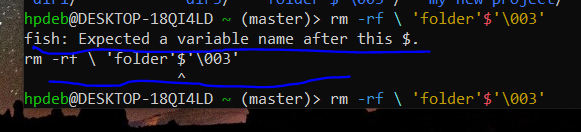
'folder'$'\003'(or$'folder\003') represents the textfolderfollowed by octal byte 3. Because you use Fish instead of Bash, this doesn't work—it has a different syntax to specify unprintable/special characters.I can tell you how to refer to this file in Fish, but I hesitate to do it if it's for homework. What I will do is point you to the part of the Fish documentation where this is (kind of) explained: in Fish for bash users#Quoting.
I wouldn't expect homework to use fish. It seems a less useful and niche as a learning exercise.
Would it help to use
ls --literal --show-control-charsto find out if\003is indeed the representation of a special character?The default output itself is pretty definitive, assuming you are indeed using GNU
lsand don't have theQUOTING_STYLEenvironment variable set. https://www.gnu.org/software/coreutils/manual/html_node/Formatting-the-file-names.html explains all this (including your options) and more.