this post was submitted on 19 Dec 2025
299 points (99.0% liked)
History Memes
1221 readers
860 users here now
A place to share history memes!
Rules:
-
No sexism, racism, homophobia, transphobia, assorted bigotry, etc.
-
No fascism (including tankies/red fash), atrocity denial or apologia, etc.
-
Tag NSFW pics as NSFW.
-
Follow all Piefed.social rules.
Banner courtesy of @setsneedtofeed@lemmy.world
OTHER COMMS IN THE HISTORYVERSE:
- !historymusic@quokk.au
- !historygallery@quokk.au
- !historymemes@piefed.social
- !historyruins@piefed.social
- !historyart@piefed.social
- !historyartifacts@piefed.social
- !historyphotos@piefed.social
founded 7 months ago
MODERATORS
you are viewing a single comment's thread
view the rest of the comments
view the rest of the comments
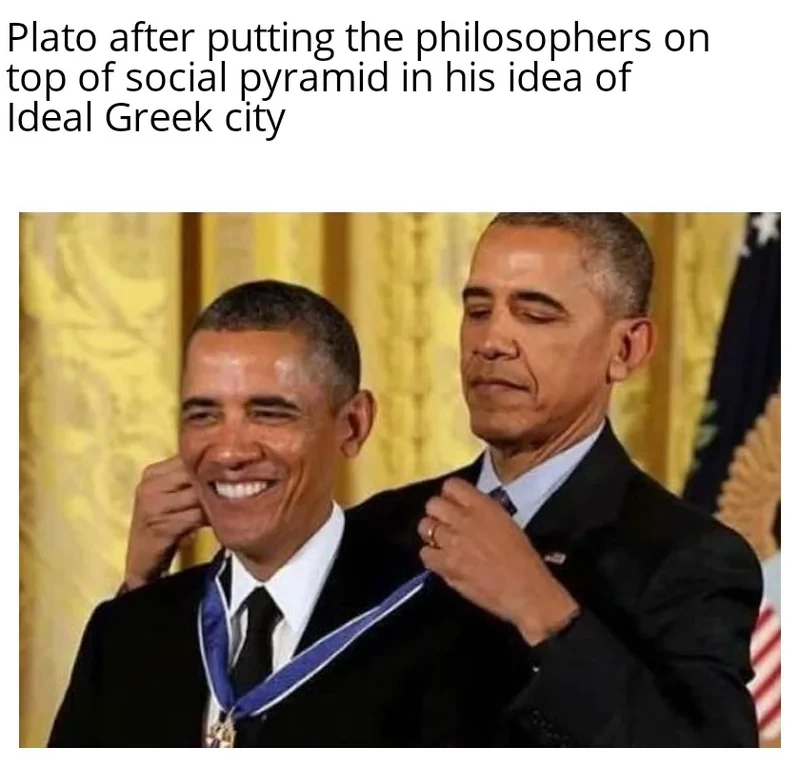
Loled at the last one, but also I think it's wrong to conflate any specific argument that Socrates makes with Plato's argument in any of the dialogues. The dialogues are presented as dialogues for a reason. If an interlocutor fails to push back adequately, it doesn't mean that the argument is beyond reproach. It might just be revealing a contemporarily widely understood value, or it's inviting the reader to engage with the dialogue. The reader is then challenging Socrates' notion that knowledge is hierarchical by taking on a presumed intellectual authority in Socrates. Given Plato's body of work, I think the fallibility of arguments in the dialogues are oriented towards the idea that we have imperfect knowledge and imperfect arguments, and sometimes people fail to catch and respond to these in elenchus. Plato could just be getting us to engage in the act of philosophy.