this post was submitted on 19 Dec 2025
300 points (99.0% liked)
History Memes
1228 readers
961 users here now
A place to share history memes!
Rules:
-
No sexism, racism, homophobia, transphobia, assorted bigotry, etc.
-
No fascism (including tankies/red fash), atrocity denial or apologia, etc.
-
Tag NSFW pics as NSFW.
-
Follow all Piefed.social rules.
Banner courtesy of @setsneedtofeed@lemmy.world
OTHER COMMS IN THE HISTORYVERSE:
- !historymusic@quokk.au
- !historygallery@quokk.au
- !historymemes@piefed.social
- !historyruins@piefed.social
- !historyart@piefed.social
- !historyartifacts@piefed.social
- !historyphotos@piefed.social
founded 7 months ago
MODERATORS
you are viewing a single comment's thread
view the rest of the comments
view the rest of the comments
Individuality? Definitely not in the western way of thinking. Liberty? He did make men and women equal in the hypothetical society, while living in a highly patriarchal one. And the social mobility doesn't depend on who you were born to. Also there are no slaves.
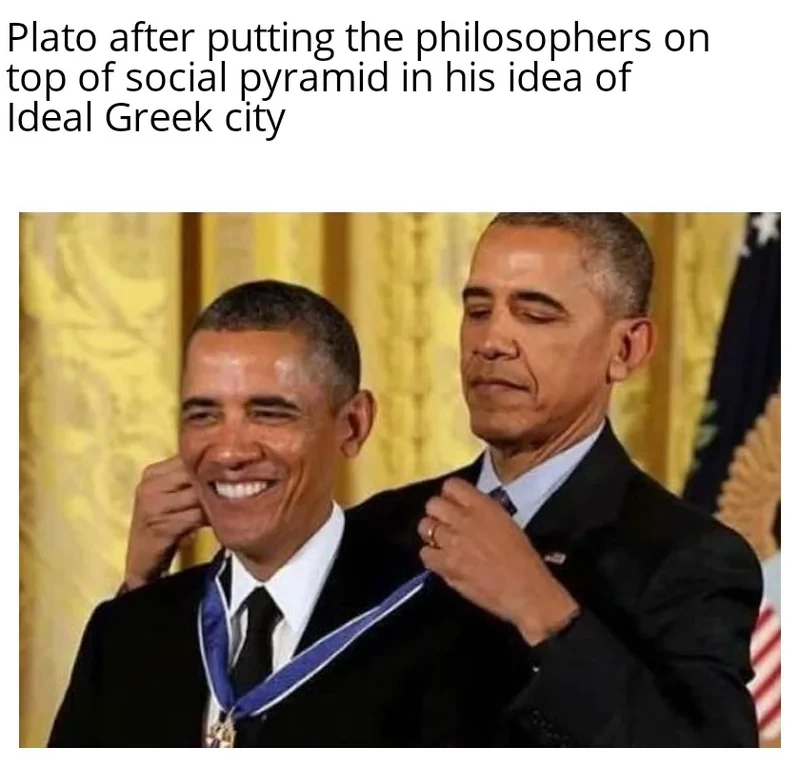
The theoretical society is aristocratic in the literal meaning of the word - rule of the best. There are distinct classes, but every class is comprised of only the people who are best suited for that task.
I'd say it's overall quite unusual, utopic, and based on a long history of disappointment. Democracy was on its last legs and killed his teacher, an oligarchy he had an influence in was corrupt and murderously greedy, and tyranny got him enslaved for trying to teach an heir basic human decency.
The ruling class aren't oligarchs, and are in fact the filthy poors when compared to the working class. It's basically a society governed by monks with extremely strict rules and selection criteria.
I think that idea comes from an earlier form of Athenian democracy that involved a lottery to form an assembly. The idea was to prevent people who want to rule from ruling, and instead make it a chore that had to be done for the good of the community.
The working class are free to obtain all of the personal wealth they can, but they're disallowed from any involvement in ruling or enforcement. And considering your stance on oligarchy, you agree with him that the greedy shouldn't be involved in governing.
And if I remember correctly the founding myth warns that the society will fall apart if the greedy take control.
What did the myth warn about?
None of those had a system to completely remove all personal property from the government and enforcement. If those people are living better than the working class - you fucked up.
IMO that's the lesson of the metaphor, if your decisioning is influenced by personal gain or desires, it is not just. Only what is best for overall harmony is just.
"comprised".
It would be a waste, not to fix it.
Fixed, thanks.
... making men and women equal isn't liberty. Liberty and equality are not synonyms. An equal society is not necessarily a free one.
... the entire system is explicitly predicated on hereditary inheritance of position, with only occasional 'promotion' or 'demotion' to another caste - and abolishing marriage and private sexual relations to, again, explicitly and in a manner that is compared to breeding livestock for the best possible qualities, a system of eugenic state lottery breeding for the ruling caste.
... did you even fucking read the Republic?
There are no Greek slaves, foreign slaves are approved of and slavery is referenced as part of the society in several places.
Jesus fucking Christ.
It's also a mostly-closed hereditary caste of rulers who hold all power. So the theoretical society is aristocratic in all fucking meanings of the word.
... no, support for oligarchy is one of the most common stances of surviving ancient writers.
"It's not an oligarchy if we pinky promise to be responsible and that our decision to co-opt whomever we wish with no oversight is based on the best interests of the public (according to our judgement)"
Oh look, it's a Vanguard Party.
That was contemporary Athenian democracy.
The working class are explicitly not free to obtain all of the personal wealth they can; the issue of the Guardians ensuring no one in the third class becomes too rich is explicitly addressed in the work.
Jesus Christ.
Check the early days of most ML regimes.
... there is a long section in the book that addresses that justice is happiness, and that the desire to be happy is core to the desire to be just (for those who are truly wise and knowledgeable). That's the exact opposite of disdaining personal desires.