this post was submitted on 24 Jan 2026
610 points (97.5% liked)
memes
19090 readers
2406 users here now
Community rules
1. Be civil
No trolling, bigotry or other insulting / annoying behaviour
2. No politics
This is non-politics community. For political memes please go to !politicalmemes@lemmy.world
3. No recent reposts
Check for reposts when posting a meme, you can only repost after 1 month
4. No bots
No bots without the express approval of the mods or the admins
5. No Spam/Ads/AI Slop
No advertisements or spam. This is an instance rule and the only way to live. We also consider AI slop to be spam in this community and is subject to removal.
A collection of some classic Lemmy memes for your enjoyment
Sister communities
- !tenforward@lemmy.world : Star Trek memes, chat and shitposts
- !lemmyshitpost@lemmy.world : Lemmy Shitposts, anything and everything goes.
- !linuxmemes@lemmy.world : Linux themed memes
- !comicstrips@lemmy.world : for those who love comic stories.
founded 2 years ago
MODERATORS
you are viewing a single comment's thread
view the rest of the comments
view the rest of the comments
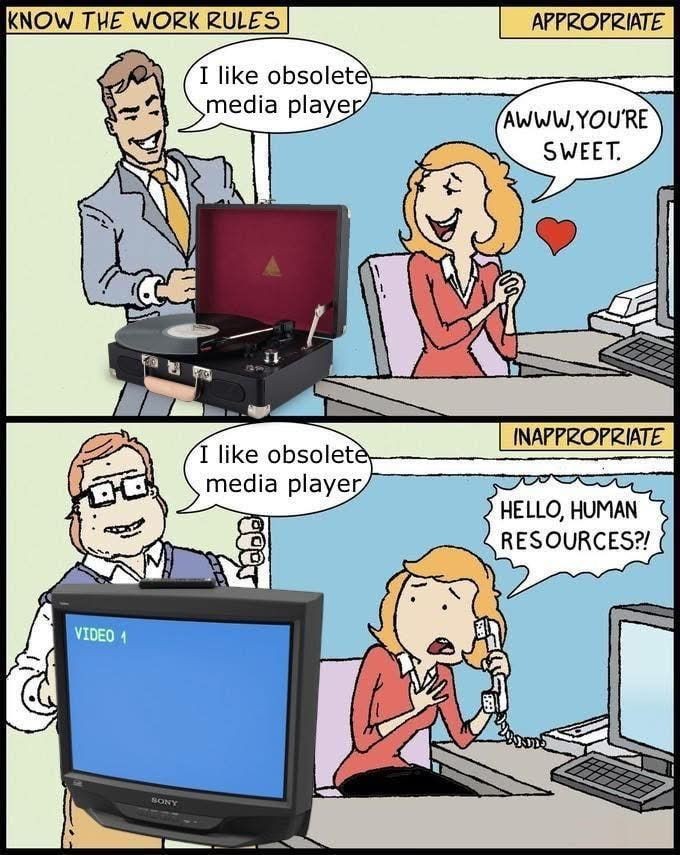
There's a weird debate about the audio quality on VHS. Under the right conditions (right tape, right player, right source) it could be shockingly good -- perhaps even better than CD audio, despite not being remembered terribly fondly.
If you really want to wow the ladies, be the one guy with a music collection on VHS.
Better than CD is a pretty bold claim. That format is near perfect for listening quality.
Agreed. Main issue is "better" is subjective and doesn't always mean the same thing to different people.
I have dabbled in other tape formats, and one thing stands out to me about the compact cassette (not VHS): most people used them in the car, where conditions were bad for cassette storage. Car cassette players also tended to have poorer quality mechanisms and heads. As a result, many people remember the format being bad, when in fact, it was more about their use case. A quality home cassette deck with a quality cassette (e.g. type II or chrome) stored in the right conditions is capable of extremely good results.
Not sure if there is something similar with VHS audio, though. Very different format. I just know there is a debate, but it could be entirely bogus.
The debate is basically bogus. There are very few analog audio formats that can reproduce an audio signal more accurately than a CD, and even then, that’s only because CDs use a 44.1KHz sampling rate and 16bit encoding. There is no analog audio format that can rival a 32bit 96KHz PCM recording, and that’s not even the best digital recording available. CD chose 44.1KHz and 16bit because it’s nearly perfect for the range and sensitivity of human hearing. It’s only when you need to record ultrasound or extremely low amplitude sound that you would use something better.
Fun fact: if you add some hisses and pops and a little bit of compression to CD audio before playing it, some people (me included) will say it sounds better.
This sounds fun. I wonder if there's an explanation for why that is?
Lo-Fi ALL THE THINGS!!!
This is why the debate still exists:
Analog audio is not sampled. By definition, it includes more data than any sampled version.
Now, the benefits of the sampling in terms of reducing format noise or similar are (subjectively) up for debate.
Totally agree with things sounding better if you introduce noise. I suspect it has to do with sampling, and maybe is not well understood.
Exactly. It is subjective. It's not about right or wrong.
I think there are things (like above) where the measurements are misguided. But at the end of the day, even that doesn't matter.
Analog audio not being sampled doesn’t really matter. It’s like film, it can’t have infinite “resolution”. It’s the size of the granules on the tape and the speed the tape is moving that determines how good audio can sound. Grain size is kind of equivalent to floating point resolution, and tape speed is kind of equivalent to sampling rate. In order to get as true-to-life audio reproduction as 32-bit 96KHz PCM, you’d need absolutely wildly expensive tape and equipment. I’m not even sure if it’s physically possible.
When you say by definition it includes “more data”, you have to think about what that data is. There’s signal, the stuff you want to record, and there’s noise, the stuff that gets on there that you didn’t want. The higher precision a digital recording is, the higher the signal-to-noise ratio. Unlike analog tape, there’s not really a theoretical upper limit (just the limits of your recording hardware). If you record with a high enough precision, you can record incredibly quiet or incredibly loud sounds, way out of the range of the best audio tape. Same with frequencies. The faster your sampling rate, the higher the frequencies you can record. And unlike tape, it’s not going to shred itself to pieces if you go really really high.
Things sound “better” when you introduce noise because people like analog recordings. Not actual analog recordings, mind you, just the appearance of analog recordings. It has nothing to do with audio quality, it’s just vibes. It gives good vibes.
You're definitely correct on the 32-bit dynamic range side of things, as that's more dynamic range than a human can perceive.
However I feel like I read a little while ago, that a standard record industry 15 IPS reel-to-reel master tape (on some high quality tape formulation, I imagine) sits somewhere between 96khz and 192khz equivalent sample rate. Though there is every chance it was from Reddit or something. Do you happen to know if that stacks up?
That doesn’t sound right unless you’re running the tape at faster than usual speed. Even high quality reel to reel tape is usually running at a speed that tops out around 20KHz. There’s also no reason to record frequencies much higher than that unless you’re trying to record ultrasound. A 96KHz sampling rate can record sound up to 48KHz. Considering even the best human hearing can’t hear above about 24KHz, there’s no reason to use that for music. It’s only if you’re recording something not meant for human hearing, like stress fractures, electric noise, or bird song, that you’d use a recording with that sampling rate.
I totally agree it's just vibes. I'm sorry if I suggested otherwise, but most of my point is about audio being subjective.
If everything is subjective, then some people will like tape.
Ok, yeah. I get you. It definitely is subjective, and I like tape. :) I have a huge tape and vinyl collection. And I have an all-analog setup to listen to it. Tube pre-amp and tube amp. For me, I know it’s less accurate audio, but I want that less accurate audio.
A VHS physically can’t be better than CD audio. The tape would have to move faster than the VHS equipment is designed for. The Hi-Fi VHS audio system can come close to CD’s frequency range, but there is still about 70 dB signal-to-noise (compared to CD’s 98 dB), and there is always loss when writing to and reading from analog tape. CD is not destructively read, so any signal up to 22KHz will be reproducible the exact same way every time.
Hi-Fi VHS audio is nearly as good as CD audio (the best consumer analog audio format, in fact), but it’s not as good. The simple fact is that an appropriately comparably sampled digital PCM recording will always beat an analog recording. You can read about the Nyquist-Shannon theorem for an actual proof, but basically CD audio is near-perfect for almost every human’s hearing range (most people can’t hear above 20KHz).
I'd like to gloat that I can still hear above 20kHz, but I can't be sure if it's just my audio consumer-grade equipment creating undertones. Although my Headphone says it can do 28, I have no idea about the stock sound drivers on the devices.
I totally agree that CD should be better.
I really wasn't trying to make a point, except that a simple search shows that the debate about VHS vs CD exists.
I don't think it comes down to either one being objectively better.
Well this is going to be an interesting rabbit hole...
In I go!
Brb. Recording all my records into my vcr.