Abolition of police and prisons
Abolish is to flourish! Against the prison industrial complex and for transformative justice.
See Critical Resistance's definitions below:
The Prison Industrial Complex
The prison industrial complex (PIC) is a term we use to describe the overlapping interests of government and industry that use surveillance, policing, and imprisonment as solutions to economic, social and political problems.
Through its reach and impact, the PIC helps and maintains the authority of people who get their power through racial, economic and other privileges. There are many ways this power is collected and maintained through the PIC, including creating mass media images that keep alive stereotypes of people of color, poor people, queer people, immigrants, youth, and other oppressed communities as criminal, delinquent, or deviant. This power is also maintained by earning huge profits for private companies that deal with prisons and police forces; helping earn political gains for "tough on crime" politicians; increasing the influence of prison guard and police unions; and eliminating social and political dissent by oppressed communities that make demands for self-determination and reorganization of power in the US.
Abolition
PIC abolition is a political vision with the goal of eliminating imprisonment, policing, and surveillance and creating lasting alternatives to punishment and imprisonment.
From where we are now, sometimes we can't really imagine what abolition is going to look like. Abolition isn't just about getting rid of buildings full of cages. It's also about undoing the society we live in because the PIC both feeds on and maintains oppression and inequalities through punishment, violence, and controls millions of people. Because the PIC is not an isolated system, abolition is a broad strategy. An abolitionist vision means that we must build models today that can represent how we want to live in the future. It means developing practical strategies for taking small steps that move us toward making our dreams real and that lead us all to believe that things really could be different. It means living this vision in our daily lives.
Abolition is both a practical organizing tool and a long-term goal.
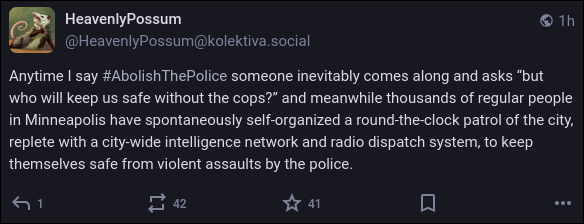
view the rest of the comments
Anarchy is invigorating. Living under a tyrannical regime is exhausting.
I never feel quite so alive as when I am looking at what my community needs and seeking to meet that need. It's felt like everyday I've put in at least a little bit of work since Hurricane Helene destroyed my neighborhood. We're still rebuilding from that disaster and building towards a resilient community that can survive the current ongoing disasters, but it's absolutely electrifying the things I've seen in that work:
In another reply I emphasized the importance of collaborative efforts but I didn't know how to put into words what you've brought up. Anarchism is life-giving. We keep us safe, and you will never feel as safe as when you are working together to keep your neighbors safe, and seeing them work to keep you safe.
It's funny, too, because we have all of these state induced crises thanks to direct attacks on our communities, as well as the state induced crisis of Winter Storm Fern being a result of athropogenic climate change. And still I feel energized, alive, and full of vigor. Something has awoken in my community since I moved away for work in 2018 and then moved back for my wife's education in 2024. I don't know what will come of this current time, but I am filled with a great deal of hope that we can get positive outcomes by organizing ourselves to meet these crises, and by staying organized to keep on meeting the moment until eventually we've changed what's possible entirely.
Maybe I'm being overly optimistic about what we can do, but I think there have to be people out there who project positivity without it being a toxic form of positivity that denies the pain we're going through in order to shift what people think is possible. In many ways, I see that as my role in my community. I don't necessarily know when it happened, but I am seen as an elder now. People look to me for advice and guidance. I am asked for my input as someone who has experience speaking up and speaking out for the last 21 years of my life after my neighbor was crushed beneath a boulder. Many of my neighbors are new to this because they weren't even born yet when I became an activist.
Anyway.
This is all WAY too much in response to your little one sentence statement and why I was trying to keep it short in my other comment. But I recommend anyone who feels hopeless right now to go connect with other people. Get involved with mutual aid projects, bail funds, court watchers, and community defense groups. You'll find when you are in those spaces you'll feel less like you've gone completely crazy for a few minutes or hours at a time. It's the very best thing you can do for your mental health, and it will help your community immensely