The meme is talking about a common probability error that surveys have shown even doctors are prone to making.
Why you're probably ok:
The rarity of the disease far exceeds the error rate of the positive test. Meaning, the disease occurs in 1 out of a million people, so if you are tested at random and show positive, you only have a 1 out of 30,000 chance (the 3% false-positive rate) of being the the 1 person who truly has the disease.
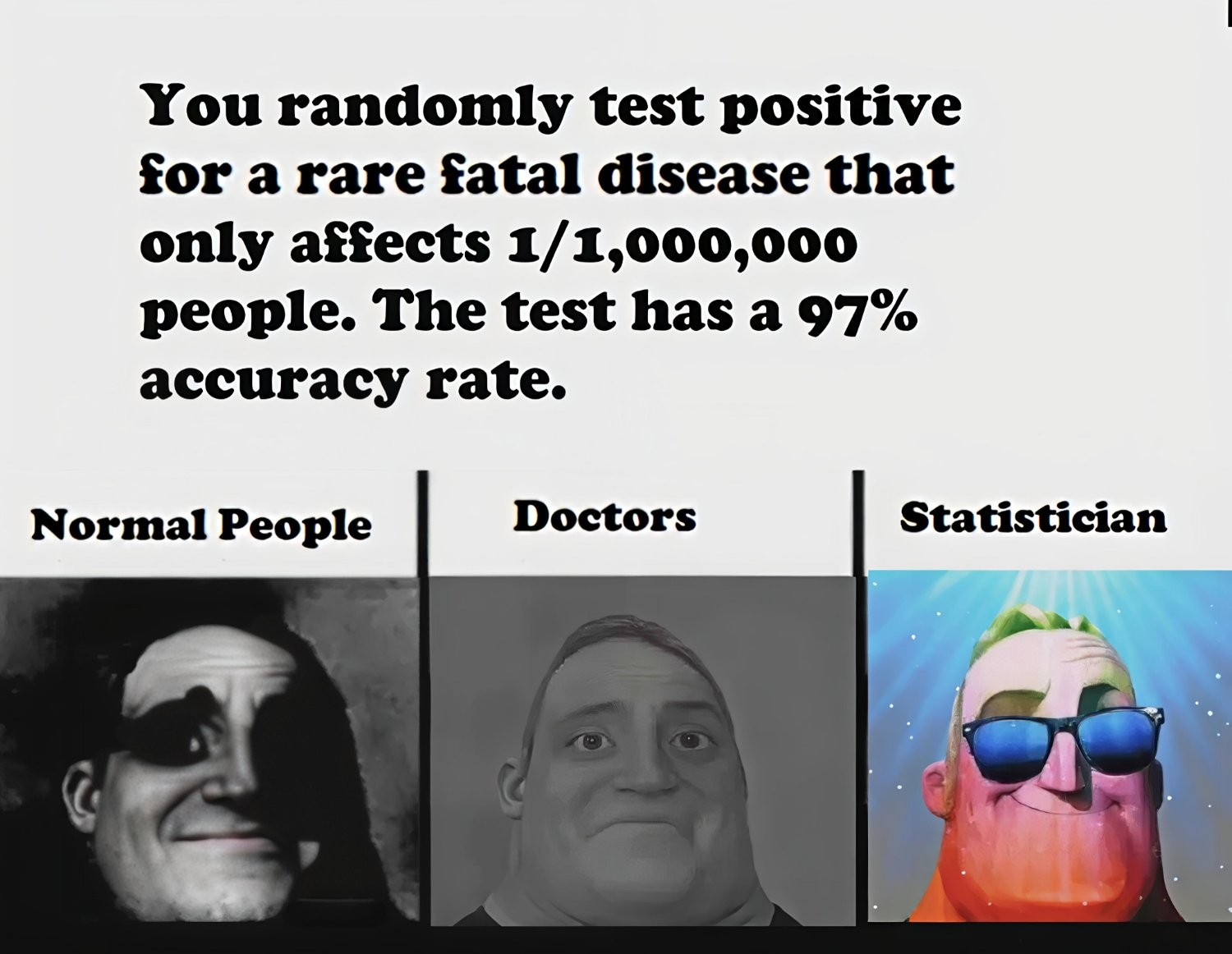
What statistician is this referring to? Certainly not one who understands probabilities. The first number has nothing to do with it. You tested positive, and there's only a 3% chance that result is wrong. Time to settle your affairs.
In a sample of 1 million people, 1 person will have the disease, 30,000 however will test positive for having the disease. Notice how the false positives count is way higher than the actual positive count.
Is 97% accuracy rate the same as a 3% false positive rate? It might be a combination of false positive and false negative rate.
Accuracy is defined in relation to a specific population or dataset with a specific rate of disease, not for any individual. To properly characterize the test, you need to know the specificity and sensitivity, and together they tell you how a test will perform on an individual and how much an individual’s pre-test probability increases in the case of a positive test or decreases based on a negative test.
Don’t worry if it’s confusing, Baysean statistics is often counter-intuitive.
If you're interested, here is a very good 3Blue1Brown video that explains the concept very well.
Thank's for the link. Probability and statistics in general is not intuitive to me, not just for this type.
How does that matter if I have a 97% chance of actually having the disease? A lot more people than I have won the lottery, doesn't have a thing to do with whether I will.
Its right 97% of the time. That does not mean you have a 97% chance of having the disease. The 3% error rate accounts for significantly more false positives than it accounts for false negatives on a disease that's 1 in a million. Again, with a 3% error rate, there will be 30000 false positive test results in a million. 30000 in a million is a larger number than 1 in a million.
As far as I can see, you can't really fear or rejoice with the results until you know the false positive/negative ratio.