this post was submitted on 17 Mar 2026
376 points (95.9% liked)
Comic Strips
22751 readers
2991 users here now
Comic Strips is a community for those who love comic stories.
The rules are simple:
- The post can be a single image, an image gallery, or a link to a specific comic hosted on another site (the author's website, for instance).
- The comic must be a complete story.
- If it is an external link, it must be to a specific story, not to the root of the site.
- You may post comics from others or your own.
- If you are posting a comic of your own, a maximum of one per week is allowed (I know, your comics are great, but this rule helps avoid spam).
- The comic can be in any language, but if it's not in English, OP must include an English translation in the post's 'body' field (note: you don't need to select a specific language when posting a comic).
- Politeness.
- AI-generated comics aren't allowed.
- Limit of two posts per person per day.
- Bots aren't allowed.
- Banned users will have their posts removed.
- Adult content is not allowed. This community aims to be fun for people of all ages.
Web of links
- !linuxmemes@lemmy.world: "I use Arch btw"
- !memes@lemmy.world: memes (you don't say!)
founded 2 years ago
MODERATORS
you are viewing a single comment's thread
view the rest of the comments
view the rest of the comments
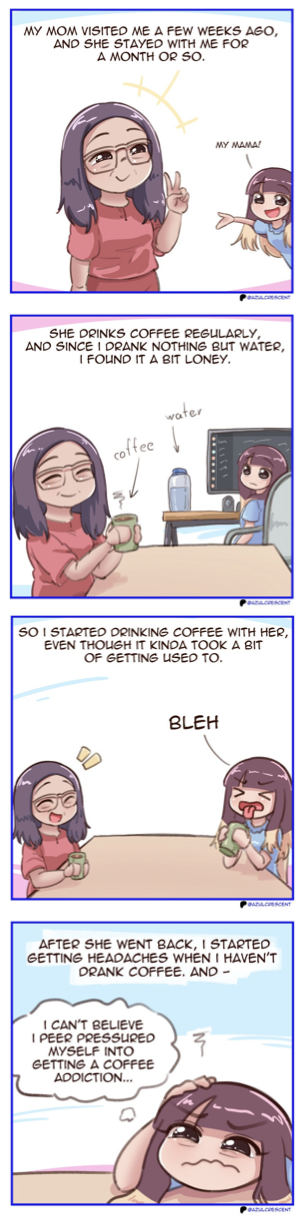
The way caffeine works is that it allows the body to release energy reserves that it usually "locks" away from you. It allows you to tap into these reserves for concentration and makes you feel less tired.
That's helpful for short-term use, giving you more energy and concentration.
But if you use too much caffeine for too long ("too much" depends on your body and "too long" is a few days), the body adjusts to the caffeine levels and now you have the same energy reserves and concentration that you had without caffeine before. Caffeine thus loses its effect on you and your baseline shifts, so that you need caffeine to be on the same level as before.
If you now stop your caffeine intake, this swings back. Your body thinks you are really tired and you get headaches, bad mood, low concentration and so on, until you either take in more caffeine or you abstain long enough for your baseline to shift back.
That's why there are people who say they can't work before they had their first coffee/energy drink. They literally can't, because if they aren't on the level of caffeine they are used to, their body tells them that they are super exhausted. This is the caffeine dependency/withdrawal effect.
I thought it just blocked the receptors for the chemicals that made us feel sleepy, not tapped into some hidden energy.
That's basically the same thing. When you feel sleepy, you aren't at the end of your reserves. Your body tells you that you are sleepy at a time when you still have reserves.
Blocking these receptors doesn't tap into any magic hidden energy, it just stops your body from telling you that you are running on fumes. Thus it allows you to go farther into your reserves. In extreme cases to the point where you collapse, because you really don't have any reserves left.
Edit: Just to be clear, going into your reserves is not a good or healthy thing. It's not some magical potential unlocker or something, but it's running your body under circumstances it's not made for. If you use caffeine when you really should be sleeping, that's short-term ok, but can lead to some serious consequences in the long term.
Correct - my best ELI5.
When you wake up your body starts producing adenosine, which slowly locks into receptors in your brain. As the day goes on, these receptors fill. By the end of the day your receptors are full which tells you you're tired and need to go to sleep. When you sleep, these receptors clear to start the next day fresh (which is one of the reasons if you don't sleep well, they don't all clear and you start the day tired.)
Caffeine fits these receptor sites, preventing the adenosine from locking in and delaying the onset of fatigue. Caffeine half life is about 5-6 hours, which can lead to the "crash" as the free adenosine starts locking into the receptors the caffeine is now making available as it breaks down.
When caffeine is consumed regularly and the brain isn't detecting the expected adenosine feedback, it responds by creating more receptors. More caffeine is now needed to account for the new receptors. If you skip caffeine with the addition of receptors, the adenosine fills the extra receptors faster and leaves you comparitively more fatigued/with withdrawal symptoms. If you reduce/abstain from caffeine for a few days the extra receptors are reduced and you return to baseline.