this post was submitted on 24 Dec 2025
62 points (100.0% liked)

gardening

22529 readers
16 users here now

<<<<<<< / c / g a r d e n i n g >>>>>>>

read braiding sweetgrass, lib

    _         ___
  _(_)_    .-'   '-.
 (_)@(_)  /         \  ,,,   _
   (_),,, \^^^^|^^^^/ {{{}}_(_)_
    |{{{}} \   |   /,  ~Y~(_)@(_)
    | ~Y~(@)\  |  /{}} \|/  (_)
  (\|/)| \Y/ \ | / ~Y~ \|/ (\|/)
   \|/\|/\|/  \|/  \|/\\|//\\|//
^^^^^^^^^^^^^^^^^^^^^^^^^^^^^^^^^

Let it grow ^.^

     __
  .-/  \-. If I had a flower
 (  \__/  ) for each time 
/`-./;;\.-`\ I thought
\ _.\;;/._ /  
 (  /  \  ) of communism           
  '-\__/-'.-,         
 ,    \\ (-. ) my garden 
 |\_   ||/.-`would be full  
 \'.\_ |;` 
  '--,\||     ,
      `;|   _/|              
       // _/.'/ 
      //_/,--'                  
     ||'-`              
-^-^-^-^-^-^-^-^     

founded 5 years ago
MODERATORS
 

The economy is fucked and it's gonna get worse. You might live in a food desert right now or the food desert might expand to where you are living. Getting started on growing your own vegetables seems like it's really difficult and requires a lot of know-how and a whole lot of the right things - the right soil, the right amount of light, the right amount of watering...

All of this is kinda true. But it doesn't have to be.

There's a way to get around a lot of these problems and it can be done quite cheaply. So today we're Demokratkytizing Hydroponic Vegetable gardening and we're not gonna overthink this one.
(Keep in mind that this is intended to be the easiest on-ramp for starting out with growing vegetables, especially for the people who don't know where to start and those who don't have access to soil or who don't know how to remediate soil etc. If you're above this level then that's fantastic and this is probably not for you but this might be a good way of getting a friend or comrade started on their journey.)

Remember: the best time to learn how to grow a victory garden was ten years ago and the second best time to learn is right now.

Ingredients

  • A clean 20L bucket (5 gal) with a lid

  • A pool noodle (alternatively: an EVA foam floor tile or cloning collars)

  • Any hydroponic nutrient (Powder or liquid, liquid is easier to manage)

  • A tool to measure your hydroponic nutrient fairly accurately (Precision scales for powder, a measured pipette or syringe barrel for liquid)

  • A hole saw between 2.5-5cm diameter (1-2"), approximately (Alternatively a round cookie cutter of roughly the same diameter)

This is what we're gonna be making

Steps

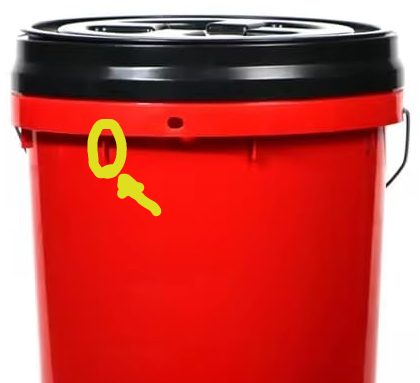
Cut 4-8 holes below the rim of the bucket that are reasonably evenly spaced, ensuring that the holes do not cut into any structural support parts of the rim.

If you're using a cookie cutter, heat it up and carefully press out holes. (Remember not to use these cookie cutters for food now that they've been used on melting plastics.)

You can use other methods but they are going to be more difficult so I'd opt for a hole saw or a cookie cutter here.

Remember to avoid these bits when cutting the holes so they stay intact

More holes doesn't necessarily mean more better, but I'd recommend doing 6-8. This will be explained in detail below.

Now you're gonna make the collars to fit these holes.

Cloning collars are the easiest and the most accessible, but likely the most expensive. You may need to cut out a wedge to get it to fit in the holes if they are a bit big. It should be snug without being overly tight.

Pool noodles are probably the cheapest option. Cut a disc that is roughly 3cm (1") then cut a wedge out of the disc to get it to sit snugly in the hole you just cut. Here's how to do it

Here's how to make them out of EVA foam tiles

Once you've plugged every hole up this way, the next thing is to fill your bucket. You can use reverse osmosis water or rainwater or even tap water. We aren't overthinking this.

Measure out how much water you can put into the bucket until it reaches the holes you just cut. You can either use a large measuring jug or you can put the bucket on some scales that are designed for people, write down the weight of the unfilled bucket, then subtract that from the total filled weight.

You should end up with about 15L (4 gal.)

Now you need to add the appropriate amount of hydroponic nutrient. Follow the directions on the package closely. Remember to double check your maths and know that, while accuracy is good, slightly undershooting it is better than overshooting it.

Once you've done this, you're almost there. The next step is to find some easy to grow plants or to make some cuttings. This is beyond the scope of the post but I'd start with whatever is cheap and easy, as long as you will have a use for it. I'll make some suggestions at the bottom.

If you get some seedlings, remember to gently rinse off as much soil media as possible without damaging the roots. Then remove the pool noodle/collar/foam plug and place the plant in the center. Gently ease the roots through the hole and resituate the collar so it sits snugly and holds the plant securely. Check the inside of the bucket to ensure that at least half of the roots of the plant are submerged in the water without the stem being submerged.

Repeat until you have your plants situated in the bucket to your satisfaction. Now place your bucket in a location that gets full sun for at least 6 hours per day, unless info tells you otherwise.

That's basically it. You're done!

FAQ Section

What hydroponic method is this?

This is called the Kratky method - it's a passive, non-recirculating hydroponic method.

Don't you need to add aeration to the liquid so the plants don't die?

Not for this method. Your plants will grow air roots at the top of the bucket and, as the water level drains, the topmost roots will gradually be exposed which allows for the plants to get as much air as they need.

How do I refill the bucket?

Mix up around 2L (2 quarts) of hydroponic solution.
Top it up as you need but no higher than 10cm (4") from the bottom point of the holes - you need an air gap!

Don't refill a bucket from almost empty to almost full in one go. Give your plants time to adjust and refill it by 2 or 3L at the most, and do this once every couple of days until the bucket is refilled.

It's ideal to leave one hole plugged but unplanted so you can use it as an observation/refill hole.

Do I need to sanitize the bucket first?

Probably not. Clean your bucket and rinse it well, it should be fine.

Can I stack buckets on top of each other?

You can but be careful that they don't topple and that you aren't going too high.

Remember that you've cut into the sides of the buckets so I wouldn't go higher than 4 buckets tall.

Try to put buckets with fewer holes at the bottom because they'll have more structural integrity than ones with more holes.

Is it better to plant more per bucket?

No. Less is often more.

If you have smaller, fast growing annuals like lettuce or parsley then you can max out your planting but if you decide to go with big plants like tomatoes or a perennial like sweet potato then these will get very thirsty and you might only want to grow 2 or maybe 3 in one bucket.

You want this to be fairly hands-off. If you're refilling the bucket every other day then it's going to be a burden and there are better hydroponic methods available if you're growing this much in one container.

Can I use a smaller bucket?

You can use 10L (2.5 gal) buckets but I'd really only use that for a top bucket in a stack or for smaller plants. 20L (5 gal) buckets are ideal and offer more versatility if you want to change things around.

You can also use smaller containers like clean ice cream tubs but you will need to plant in the lid and to grow smaller vegetables/herbs and keep a closer eye on the water level. This is better for windowsill gardening imo.

Can I put some plants in the lid?

On the top bucket, yes. See above re: how much to plant. The lid of the top bucket can be used for bunching plants as well.

What about plants that grow in clumps like bunching onion or lemongrass?

This is where you will need hydroponic media and net cups or similar, and this is beyond the scope of this post. I'd leave this for another day and I'd research different methods but, for now, start simple. Get familiar with the process and then tackle bunching plants when you feel you're ready.

Can you use this method indoors under grow lights?

Yes.

What plants do you recommend?

It depends on your climate but try your hand at taking cuttings from herbs like mint or basil, especially if you can get them for free.

Other good options are non-heading lettuce and other vegetables that you can pluck the outer leaves from, like many Asian leafy greens.

Semiaquatic plants will love hydroponic growing and three really good options are sweet potato (grown for its leaves), kangkong/water morning glory, and watercress. These are great beginner plants that don't require much care as, once they are established, they should take care of themselves.

Are there any plants that don't tolerate this growing method?

Some plants don't like hydroponics. Of the ones that take to hydroponics, only a few don't like this method. The majority of common vegetables and herbs will be fine with this method although I wouldn't try growing potatoes this way.

If you aren't sure, just search "kratky + [plant name]" and see what people have to say. If that doesn't pull up any results then try searching to see if the plant handles hydroponic growing.

How can I make this more accessible for me due to physical disability?

Set the bucket up in the location you want it to be in before you fill it with the nutrient solution.

You can buy pot stands with castors to put the bucket on if you need to move it, e.g. to find the right position for it.

Consider putting a larger, more comfortable grip on the handle, perhaps using a length of pool noodle, to allow for better grip of the handle if you need.

Place a bottom bucket filled with water, soil, rocks, sand, or anything heavy to raise up the growing buckets to avoid the need to bend too much (if you grow a vining plant on the bottom bucket then once it's established you won't need to bend over to harvest it as it will grow to reach a comfortable height for you.)

Aren't I supposed to use reverse osmosis water and adjust the pH and check the TDS?

You can, but don't overthink it. We're going for the most simple option, not the most perfectly optimized one.

You will sacrifice a small amount of productivity and efficiency this way but remember that the most unproductive garden is the one that goes unused and that chasing efficiency, paradoxically, often becomes extremely inefficient.

We're keeping this as simple as possible.

Won't it grow algae?

Yeah, some. It's not that big of a deal though.

Darker colored buckets are better for preventing algae, although don't worry too much as lighter colored buckets do just fine too. You could probably paint the buckets black or you could cover the bucket in burlap fabric or similar if you want to but it's really not necessary and doing this risks overcomplicating it and blowing out the costs and the time it takes to make a set up.

What do I do if I get extremely hot summer sun where I live?

Bring the buckets inside if it's really bad. Otherwise, shelter the bucket from the hot afternoon sun especially and ensure that there's enough liquid in the bucket to get the plants through the day.

Hydroponics is good for hot weather as it provides all the water a plant can absorb and the water creates a good thermal buffer that takes longer to heat up vs a pot plant with soil.

What do I do about frost?

Bring the buckets inside and opt for frost-tolerant plants.

Will water get in the bucket and dilute the solution?

Probably in very small amounts. It's not a big deal so don't worry.

How many plants is too many?

It genuinely depends on the size of the plants. For small plants like salad leaves and herbs, 6-8 is fine. For larger plants 1-2 is enough.

If you find yourself constantly refilling the bucket with nutrient solution then it's time to consider making a new one to take the pressure off the current bucket by transplanting.

What do you recommend for plants that grow large or set heavy fruit?

My advice is to avoid it until you're familiar with the method and to use pool noodles (especially if the disc is cut a bit wider to accommodate the extra weight on the stem.)

Also keep it to one or two plants per bucket.

Happy gardening!

top 15 comments
sorted by: hot top controversial new old
[–] Salah@hexbear.net 2 points 18 hours ago (1 children)

This is so cool, even if I don’t have capacity to do it know I will remember this for during the apocalypse times. How hot should a cookie cutter be in order to cut the bucket? Should it be heated with fire or is there another way?

[–] ReadFanon@hexbear.net 2 points 15 hours ago* (last edited 15 hours ago)

You can heat it with any type of fire or if you have an electric stove you can put the cookie cutter directly on the stove itself (I'd put down some aluminum foil first since you don't want to get any melted plastic on your stove.)

If your cookie cutter is all metal, you can also use an oven to heat it up.

It's possible to do it with boiling water but it will be a bit messy and tedious so that would be my last choice and I'd only do it this way out of desperation tbh.

As for how hot - hotter than you're able to hold it with bare hands. At around the boiling point of water you'll be able to melt through the plastic to cut a hole but if you're only just at that temp then it might take a few goes before you get through so ideally you want something that is about 150°C to 180°C (300°f to 350°f.) But don't overthink it - if progress is too slow then heat it up a bit longer and if it's too hot to control it comfortably then let it cool down for a minute.

It's definitely a good trick to have up your sleeve for a collapse, whether it's societal or it's a personal one. You can survive with very little but having food is nonnegotiable.

[–] infuziSporg@hexbear.net 3 points 22 hours ago* (last edited 22 hours ago) (1 children)

The first question that came to mind for me was how long the nutrient solution lasts before it's depleted, and how to know when you need to add more.

Are Kratky hydroponics really less labor-intensive than regular 5gal planters with cardboard mulching? When my friends/org were starting out doing gardens, we grew a lot of tomatoes and chili peppers in buckets with soil. I would suspect that using a conventional method with mulch and compost would build more easily transferrable skills to growing on a plot of land.

[–] ReadFanon@hexbear.net 1 points 14 hours ago

The first question that came to mind for me was how long the nutrient solution lasts before it's depleted, and how to know when you need to add more.

I'd do it before the bucket runs dry but even then, if your plants are still kicking and you notice the bucket is empty then give it the incremental top up using about 2L at a time until you're back to a comfortable level.

Worst case scenario - the bucket runs dry, your plants end up too stressed and they die off after you refill the bucket so you replant it with new plants and you start again. No big deal.

As for depletion of nutrients themselves, that really shouldn't be a problem. If you grew a perennial plant in this system then over a long period (I'm thinking years), depending on the nutrients you are using you could see some nutrient deficiencies or excesses gradually emerge but that's a long shot tbh and it's something that I doubt would happen regularly so it's really nothing to worry about. Given that it's super easy to reset a system it's not much of an issue and if you've been using it nonstop for multiple years where these problems might arise then you're miles ahead of where this guide is aimed at.

Are Kratky hydroponics really less labor-intensive than regular 5gal planters with cardboard mulching?

Once it's set up I'd say so. You take out the need to figure out a fertilizing schedule, there is zero weeding, and you don't need to concern yourself with soil conditions. But if you want to go with 5gal planters then definitely do that, I wouldn't dream of knocking that approach.

This way is good for people who don't have much space, since it's vertical, or who don't have good access to transport or who lack the physical strength to deal with soil etc. (although can be a good option for plenty of other people too.)

When my friends/org were starting out doing gardens, we grew a lot of tomatoes and chili peppers in buckets with soil. I would suspect that using a conventional method with mulch and compost would build more easily transferrable skills to growing on a plot of land.

I agree with you on that.

In terms of transferrable skills for growing on a plot of land, conventional container gardening is more transferrable in a direct sense without a doubt. But the problem is that it can be really difficult to get started if you don't know where to start and it's your first time, especially if you don't have access to a more skilled gardener for advice - kratky hydro eliminates the concerns about soil and fertilizing and watering (for the most part, at least) and it's a good way to get started on observing plants growing in fairly optimal conditions so you can start developing your skills since there aren't as many variables to consider once it's set up. It's also nice if you're forgetful or you struggle with fatigue (hi, nice to meet you!)

Honestly in every respect aside from perhaps convenience, this is the least optimal way of growing food - although kratky sometimes outperforms other hydro methods with certain plants, there are more consistent hydro methods that tend to provide better yields and as for growing conventionally in soil, there's a lot of benefits to that approach especially in terms of skill building and soil enrichment and closed-loop gardening. If you have access to a plot of soil and you know what you're doing then, unless you want a very convenient little herb tower as a kitchen garden right outside your door, I'd advise against this method. (Or maybe if you regularly work away and can't tend to plants while you're on trips or you're in a drought-prone area and you have your heart set on growing a semiaquatic plant.)

But it still holds a lot of use for different cases. In terms of transferrable skills, this method is really useful if you want to dive deeper into hydroponics or even aero/aqua but you're just starting out and you don't want to throw big cash at it yet. You also get a fair way into transferrable skills for doing intensive mycoculture (as opposed to open mycoculture), believe it or not, but that's a different subject for a different post.

Ultimately if this puts gardening within reach for people who it might not otherwise had been or it gets people started and they see enough results to motivate them to keep at it or, ideally, this turns out to be the perfect method for them then that's great. It makes for an easy first step that will get people to explore growing from seeds, seed saving, taking cuttings, pruning, and all sorts of other paths that lead outward from there and that includes conventional horticulture too. I'm not here to tell anyone what they have to do (ignore the title of the post pls) - my hope is just that it inspires someone to try out gardening especially if trying to start growing in soil seems too daunting.

[–] Kefla@hexbear.net 10 points 2 days ago (2 children)

This honestly feels like more effort than just putting some seeds in the ground lmao

[–] Le_Wokisme@hexbear.net 4 points 2 days ago (1 children)

"just putting some seeds in the ground" is a cool way to have everything die or feed local wildlife instead of you

[–] Kefla@hexbear.net 1 points 1 day ago

Idk it seems to work for me

[–] ReadFanon@hexbear.net 8 points 2 days ago* (last edited 2 days ago)

It sure is, but I think it's a little deceptive since with any hydroponic growing you frontload most of the work in setting up your growing conditions and then after that point the maintenance is pretty minimal. In this example it's the simplest hydroponic method so once you've established it, continuing it through the seasons requires very minimal effort. In terms of actual effort required to have consistent yields, this method is only rivalled by establishing a food forest imo but those are almost always syntropic so they require quite a bit of maintenance and adjusting until they reach an equilibrium after all the succession, plus you need a decent plot that you'll have long-term (ideally forever) and the amount of planning and learning required for a successful food forest is really steep. This is the polar opposite - it's for the person who would like to grow some lettuce and basil on their balcony or their paved yard but they've never tried gardening before.

It all depends on what your expectations are and what skill level you bring. Plenty of people are happy with guerilla gardening or throwing some skirret or chaya into the ground and knowing what to do with the product you get at the end but a lot of people either want more "conventional" vegetables, they don't have access to soil, or they don't know how to fertilize plants and how to make the right soil conditions for the plants they want to grow.

The point of this is to make something as simple with the highest rate of success as practical on a shoestring budget without requiring any specialized knowledge or access to soil. It's a way to eliminate as many variables as possible - soil quality, watering and drainage, fertilizing, plating location, dealing with temperature extremes like frost, addressing lot of accessibility needs etc.; all the stuff that poses a barrier to getting started and seeing early success.

There's no one-size-fits-all gardening method. To each their own and if this helps someone get started on growing some food on their balcony or in their yard then that's a win in my book.

[–] WokePalpatine@hexbear.net 3 points 2 days ago (2 children)

Is there a catch-all nutrient solution recipe or does it vary a lot from plant to plant? And how would I go about making that solution?

[–] ReadFanon@hexbear.net 6 points 2 days ago

Don't stress too much. There are better and worse nutrient solutions out there, at least if you believe what your read online.

The plants will absorb the nutrients they need from the solution so you don't need to worry about trying to dial it in or buying the "right" nutrients, any more than a gardener needs to worry about getting the "right" type of horse manure for their garden; yes, you can get right into the weeds over addressing nutrient deficiencies or nutrient requirements of plants but if you're not growing for commercial purposes or, uhhhhh, "small business" purposes then it's really not something that is important. If you want to try your hand at gardening or starting hydroponic growing then you can just throw this together and let it do its thing.

The powdered nutrient can be hard to dissolve and dilution can be a pain (and I'd probably opt for reverse osmosis water to get it to fully dissolve) so imo the liquid stuff is much better for the purposes of doing small batch stuff, but use what you can find that is within your budget. Sometimes you can get all-in-one nutrient liquid but often it comes in two parts - get whatever is a reasonable price and that gets good reviews (if buying online.)

For making a solution from the liquid you need to know how much you're making, so measure out your water first. Then you will need to follow the directions on the back stating to add x ml per x L. This is where a little measured plastic pipette or syringe barrel is important. Add the amount directed on the bottle(s) and give it a good stir. That's all there is to it.

Currently I'm using two-part liquid nutrient that is 3ml per L. It's two 1L bottles so I have enough to make over 300L (hydroponic nutrient isn't the cheapest when it comes to upfront cost but it will last you a long time especially if you're just growing in a couple of buckets.)

Keep in mind that this method is sort of going against the mainstream in hydroponics. Hydro started as cutting edge technology and it used to be very expensive so it still has a strong culture of it being technical. But it doesn't need to be that way. You're not going to reach 100% optimal growing with this method and that's the whole point - most people who garden don't achieve the optimum either and often simpler is better especially when you're just stating out. There's a lot of hydroponic advice online that is geared towards the really expensive, technical side which is really neat but it's also really overcomplicated - I just wanna grow vegetables for god's sake!

[–] Omegamint@hexbear.net 6 points 2 days ago (1 children)

I would suggest masterblend (they sell a lettuce blend that’s basically for non-fruiting veggies, and a tomato blend that’s for stuff with fruits). It’s very cost effective and works well. I also keep a bucket of it premixed and give it to whatever I’ve got growing in containers (soil) after it seems like their compost is no longer feeding them. Can definitely vouch for the tomato blend growing the crap out of my tomatoes.

Just keep in mind however you dispose of either old/used solution or the stuff that drips from your containers will leech into the local environment and can eventually mess up the soil if it’s allowed to build up anywhere. Not really friendly to the local municipal water to toss it down the drain either.

[–] ReadFanon@hexbear.net 1 points 2 days ago (1 children)

I've heard very good things about Masterblend from people in North America so if you're in that region then I'd be comfortable recommending this based on the reviews from people whose opinions I value, so +1 on that.

[–] Omegamint@hexbear.net 2 points 15 hours ago (1 children)

It’s just absurdly cheap, I probably went through maybe 1$ of nutrients this year (honestly probably less) for my tomatoes in containers, so it makes it really cost effective. I also rent so I’m less concerned about salt buildup on my landlords property (though I don’t think that’s really an issue with what I’m doing).

[–] ReadFanon@hexbear.net 1 points 14 hours ago

You love to see it!

Imagine having a hobby that saves you money, that improves your diet, that diverts profit away from Big Agra and grocery store corporations, and it only costs you pennies to do it. Plus tomatoes that have had a chance to ripen on the vine are infinitely better. Make 'em heirloom beefstake tomatoes and you will have achieved the absolute peak imo.

[–] HexReplyBot@hexbear.net 2 points 2 days ago* (last edited 2 days ago)

I found a YouTube link in your post. Here are links to the same video on alternative frontends that protect your privacy: