this post was submitted on 27 Feb 2026
356 points (99.4% liked)

Humor

9206 readers
72 users here now

"Laugh-a-Palooza: Unleash Your Inner Chuckle!"

Rules


Read Full Rules Here!


Rule 1: Keep it light-hearted. This community is dedicated to humor and laughter, so let’s keep the tone light and positive.


Rule 2: Respectful Engagement. Keep it civil!


Rule 3: No spamming! AI slop will be considered spam at the discretion of moderators


Rule 4: No explicit or NSFW content.


Rule 5: Stay on topic. Keep your posts relevant to humor-related topics.


Rule 6: Moderators Discretion. The moderators retain the right to remove any content, ban users/bots if deemed necessary.


Please report any violation of rules!


Warning: Strict compliance with all the rules is imperative. Failure to read and adhere to them will not be tolerated. Violations may result in immediate removal of your content and a permanent ban from the community.


We retain the discretion to modify the rules as we deem necessary.


founded 2 years ago
MODERATORS
 
top 21 comments
sorted by: hot top controversial new old
[–] RememberTheApollo_@lemmy.world 6 points 1 day ago* (last edited 1 day ago)

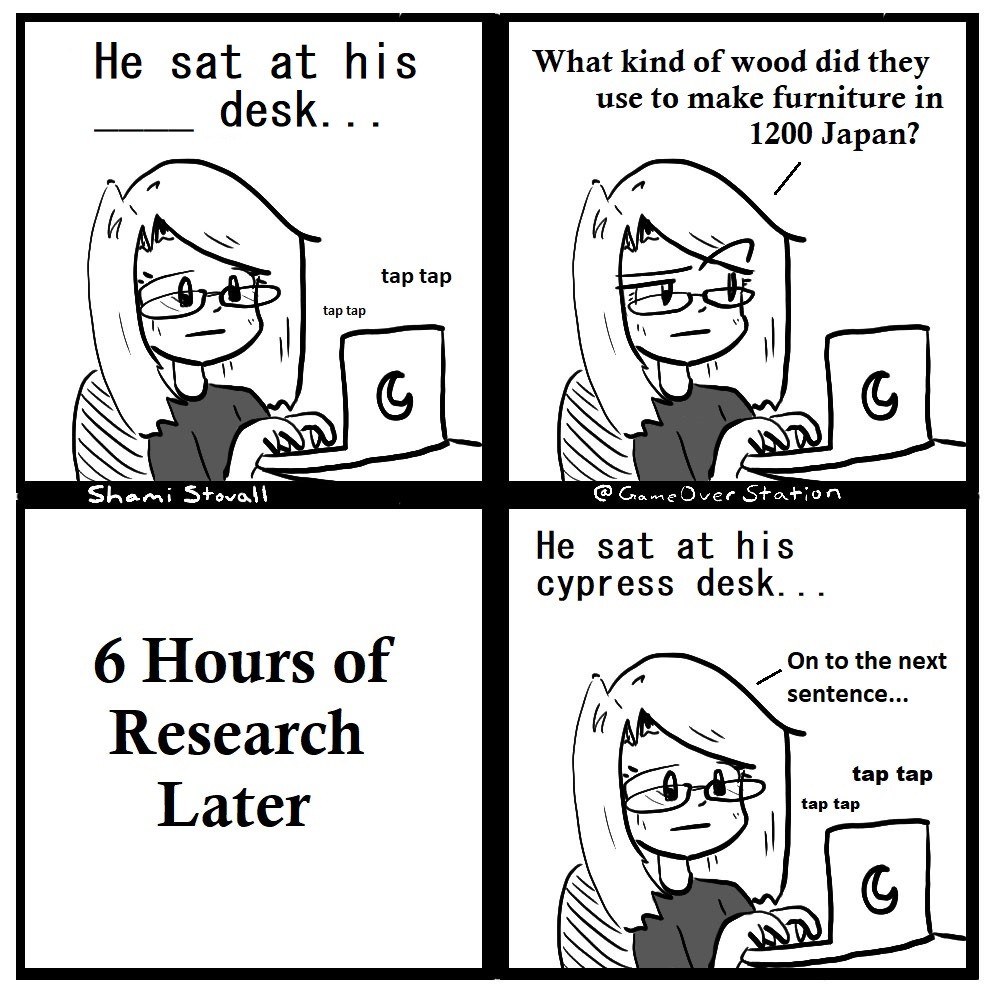
Desk? If anything a low table or directly on the floor.

Edit: ok, wasted a little time on this. It probably could have been the floor. Tables were likely used for shodō, but purpose built tables weren’t common for writing until the late 1300s. They weren’t “desks” by any modern measure.

[–] Katana314@lemmy.world 2 points 23 hours ago (2 children)

I'll admit that I'm staggered by how a lot of writers absorb hundreds of little details of how trained soldiers/detectives will use little tricks to survive, observe a room, or follow patterns of criminals. Once long back, those little things like leaving a bit of pencil graphite in a door hinge to denote intruders (or, in Better Call Saul's case, placing a carbon sheet under the doormat) were extremely rare to hear about.

I don't even know who you'd ask without ending up on a list.

[–] toynbee@lemmy.world 3 points 22 hours ago

I think a lot of writers are probably on lists of various types.

[–] ameancow@lemmy.world 1 points 21 hours ago

One thing a lot of good writers have in common is that they are also voracious readers. Word-crafting is like any art, you watch how people do it, you learn the flow and processes and rules and how to break them and so on, but along the way you're also being exposed to a vast amount of other people's lived experiences.

Like seriously, I like to read and write, but someone who does it for a living is on another level. The brain learns to both absorb more information but also a drive to expand and research ideas out to completion for a scene or setting.

This is where I usually start my segue into how AI is ruining everything, but I'm tired boss.

[–] panda_abyss@lemmy.ca 38 points 2 days ago (1 children)

Does the desk have any marquetry? Carvings? What joinery was used?

Don’t leave us hanging!

[–] Quetzalcutlass@lemmy.world 34 points 2 days ago (1 children)

Japanese joinery is a week-long rabbit-hole in itself. It's basically witchcraft.

[–] Eq0@literature.cafe 9 points 2 days ago (1 children)

Nowadays Japanese joinery definitely keep me entertained for a couple of days. I would imagine adding the historical and geographical components would make it an infinitely entertaining dive !

[–] panda_abyss@lemmy.ca 6 points 2 days ago

Definitely don’t watch Ishitani Furniture then.

[–] Fuckfuckmyfuckingass@lemmy.world 14 points 2 days ago (1 children)

Would they even have desks in 1200s Japan? Seems like they did everything on the floor back then.

[–] The_Picard_Maneuver@piefed.world 21 points 2 days ago (1 children)

You're going to make her start over!

[–] Texas_Hangover@lemmy.radio 2 points 1 day ago

What kind of rugs and floor coverings were common at the time?

[–] Thorry@feddit.org 6 points 2 days ago (1 children)

On the other hand, I can get really annoyed when writers get stuff like that wrong. Especially when it's crucial to the plot and it happens to be within my area of expertise. So I do appreciate writers that do their research.

I've consulted on a couple of books and I've seen two kinds of fiction writers. The first one simply starts writing and only stops once the story is done. They might get writers block in between or reorder some stuff in editing (if they do editing, some don't), but mostly the story is written from beginning to end in one go. The second one is the one that does plenty of research beforehand. They might have an idea of the plot, but it's more of a concept and not finalized. They start building plot points, characters and story lines. They decide on things like structure, pacing and point of view. Small details crucial to the plot get thought out and researched before hand. They write the important stuff first, then fill out the rest and make sure there is a natural progression from one point to the next. They make sure everything fits within the designed character profiles and backstories. Often they edit a lot and entire chapters get deleted and rewritten. This is the kind of writer that works with others, sometimes multiple primary authors, often other people that do the editing. I vastly prefer the second kind and love working with those people. I feel like they write better books, regardless of how much time it costs them or how successful their books are. But a friend of mine is the first kind and he's had some success with his books. He likes to let his creativity flow and outputs more books, so more chances of capturing an audience. But I do feel you sometimes need to turn your brain off a bit to read those kinds of books.

[–] vithigar@lemmy.ca 7 points 1 day ago* (last edited 1 day ago)

I can get really annoyed when writers get stuff like that wrong.

I was reading a science fiction novel and just about every time a gun was fired in a vacuum the author included some detail about how the weapons were "vacuum sealed" or some such thing, so that they would fire without oxygen.

...except guns work just fine in a vacuum already. All modern firearm propellants (and many historical ones) are self-oxidizing and don't rely on atmospheric oxygen to burn.

It snapped me right out of the book every time I came across it.

[–] deadbeef79000@lemmy.nz 6 points 2 days ago

Just write a prologue with a 13C Japanese cabinet maker starting making the desk.

Then, write the epilogue with the cabinet maker finishing the desk.

Then fill in the bits between.