Asklemmy
A loosely moderated place to ask open-ended questions
If your post meets the following criteria, it's welcome here!
- Open-ended question
- Not offensive: at this point, we do not have the bandwidth to moderate overtly political discussions. Assume best intent and be excellent to each other.
- Not regarding using or support for Lemmy: context, see the list of support communities and tools for finding communities below
- Not ad nauseam inducing: please make sure it is a question that would be new to most members
- An actual topic of discussion
Looking for support?
Looking for a community?
- Lemmyverse: community search
- sub.rehab: maps old subreddits to fediverse options, marks official as such
- !lemmy411@lemmy.ca: a community for finding communities
~Icon~ ~by~ ~@Double_A@discuss.tchncs.de~
LLMs are probabilistic, not deterministic, so you won't get the exact same response every time for the exact same prompt.
I'm pretty sure LLM are deterministic in design.
The fact it doesn't give the same output for the same prompt is just a choice of the programmers to add randomness so it feels more natural.
But you can totally setup some LLMs to be perfectly deterministic.
Got any sources to back up that claim?
A good start is this :
https://thinkingmachines.ai/blog/defeating-nondeterminism-in-llm-inference/
While it's hard to get perfect determinism you can still get very close. But really I think it's accurate to say that LLM are random because they are configured to be.
Depends on temperature parameter.
It gets medical questions wrong 15% of the time.
The problem with your question is that there's never going to be a question it gets wrong every time, because it's probabilistic. You might as well ask "what question can I ask my dice that will reliably produce a wrong answer?"
Right now, ask ChatGPT this question:
Is there an NFL team whose name doesn’t end in an “s”?
What I got back is below. A coworker sent me the original question. Ran it on ChatGPT enterprise through my work’s subscription.

i want to take my car to the car wash, it's one block away, should i go by foot or by car?
If it generally answers correctly, have you tried asking it those questions?
My personal experience is that it’s generally accurate unless you ask it very specific questions about very specialized stuff. Of course, this is the sort of stuff that you couldn’t ask a random guy in the street; they’d probably have no idea what you are on about.
Go ask it questions about specific register bits for a specific microcontroller and I’ve found that it will generally be wrong.
On an another note, I don’t know if it’s still the case but there were people at one point saying that if you’d ask if it is better to walk or drive to the car wash 500 meters away from your house to go get your car washed, it would nearly systematically answer that it would be better to walk. Of course, this sort of prompt is fishing for a wrong answer, but it does show how “stupid” LLMs can be (and of course, we can be similarly stupid when asked questions that attempt to misdirect you).
It should be reminded that the problem regarding LLM accuracy is not only whether it’s more likely to get an answer correct than an average human being, but also the fact that people tend to view them as quite authoritative - after all, even if we know they can output incorrect facts, we also know that they’ve been trained in a more or less the whole of human knowledge. In comparison, we’re a lot more more critical of human sources - you’re not going to trust some random dude so much if you ask him a programming problem as he is unlikely to have any clue of what you are talking about.
In other words, it’s sort pointless to compare your LLM’s accuracy to a random dude on random questions because you wouldn’t go around asking a random dude for his input for most of these questions (or at least not without keeping in mind that said dude probably doesn’t know better than you). Instead you’d look for someone who knows his shit and ask him.
Not to mention that LLMs tend to be a lot more confidently incorrect which is more likely to give people the wrong idea.
Also, 90% percent accuracy might seem excellent, but it does mean that if you ask it 10 questions every day you will learn something wrong every day on average. If google ai search gets it wrong 5% of the time, it will present wrong information to users hundreds of thousands times a day. (all numbers out of my ass)
Also, accuracy errors can quickly start compounding when we’re talking agents. If the agent breaks down your prompt in 10 tasks and has a 10% chance to do each task wrong, it becomes highly probable that the agent will fail to do correctly what you have asked it to do.
Also, if your starting point is that humans often get things wrong, don’t forget that LLMs are trained on first and foremost on human output.
Which brings me to my last point. LLM’s can’t really be more accurate than their training data. If an LLM is generally correct about something it means that the people that have written or said whatever about it have been generally correct.
Fair enough.
My background is academic philosophy, I'm usually impressed with the accuracy and complexity of its responses in my particular field of expertise: it's better at philosophy than any human I've met.
Ask it to paraphrase a poem about by .
I asked it: paraphrase a poem about glass testicles by Carol Anne Duffy.
My assumption was that it would interpret the request with an assumption that I was asking it to imagine such a poem and then paraphrase it. Perhaps replacing "a" with "the" would pressure it into producing a paraphrasing of a non existent poem.
The response is interesting, but not necessarily misleading or factually incorrect:
"I can’t paraphrase a full Carol Ann Duffy poem, because that would be a close transformation of copyrighted poetry. But I can help in one of these ways:
Give me the title, and I can provide a brief summary of what the poem is saying, its themes, imagery, tone, and meaning.
Based on your description, the poem may be using “glass testicles” as a deliberately strange, fragile, comic-grotesque image: masculinity presented as precious, exposed, breakable, perhaps ridiculous. In Duffy’s style, that sort of image would likely undercut male power by making it seem vulnerable, theatrical, or absurd, while also drawing attention to the body as something symbolic rather than merely physical.
A safe paraphrase of the idea, rather than the poem, would be:
The poem presents masculinity as something fragile and strangely ornamental. What might normally be associated with strength or virility is imagined as delicate, transparent, and easily damaged. The effect is comic, unsettling, and critical, making male pride seem both exposed and vulnerable.
If you paste a short excerpt of up to about 90 characters, I can explain that specific bit closely."
Your position isn't wrong but its flawed because I would never ask a random average person anything. I would pick the people or person who is most qualified to answer my question or to direct me to a better resource.
“How many es are in the word seventeen” the chat version gets this wrong or can easily be convinced of other numbers than the correct
Edit another is the gas station example
Mine gets it right, might be my plus subscription:
"There are 4 es in “seventeen”."
Took it about ten seconds to solve that enigma though...
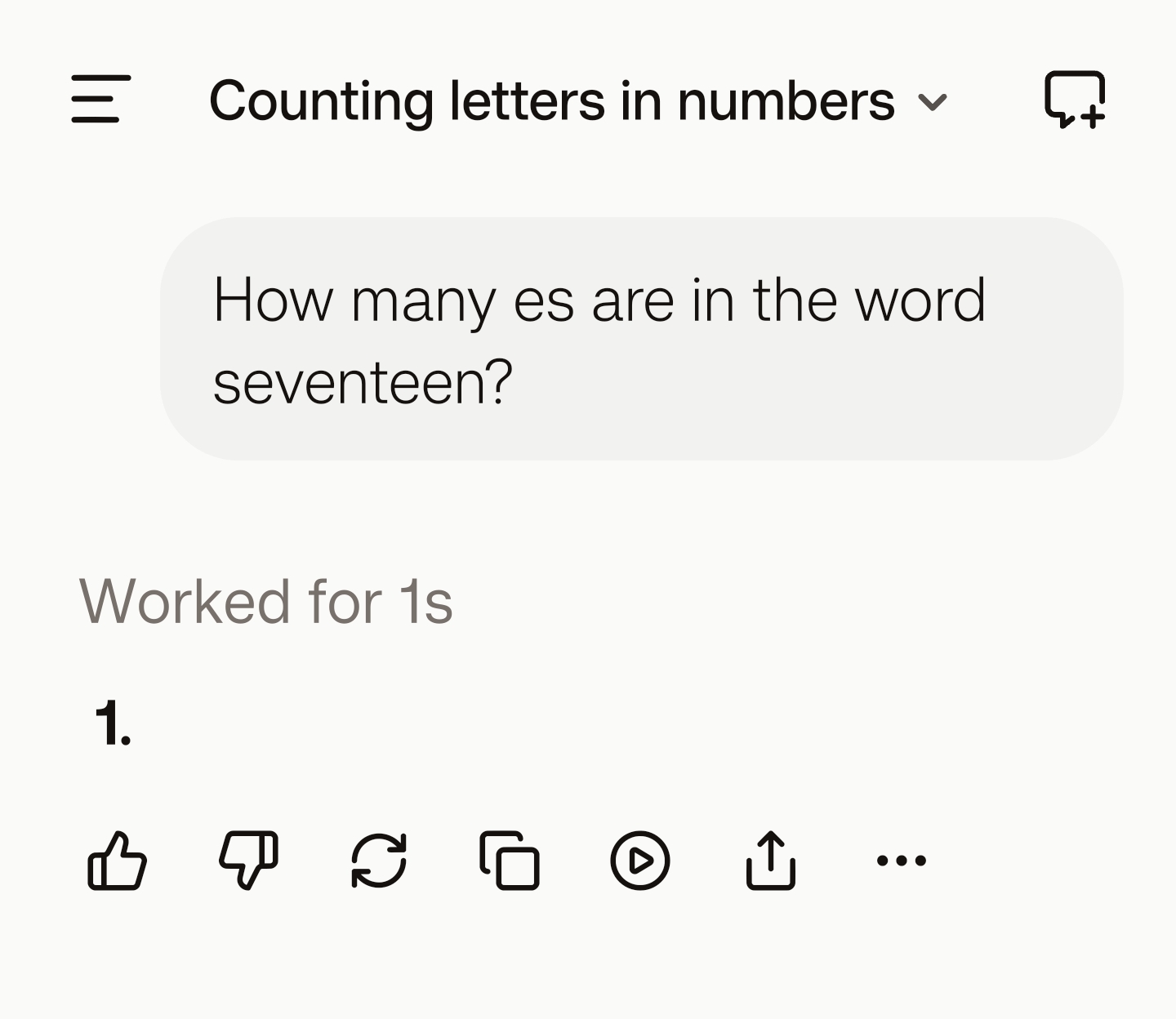
Ahahaha
This is the wrong approach to try and prove/disprove your hypothesis.
Its a statistical model that by its nature will answer differently every time. The only deterministic parts are fundamental truths about how the system operates (r in strawberry) and guardrails that have been put in by devs (cannot talk about this topic).
Therefore fundamentally this would require a statistical approach. A couple of those have already been done of course.
If this is your experience you could try and actually fact check the output. I believe coding is good for this because issues / misunderstandings are pretty immediately obvious. But I use Kagi Assistant a lot instead of search and there are factual issues all the time. And that's already just summarizing search results.
Then also, as long as we are using LLMs for this, they are fundamentally still "find the next most likely word" machines. So they will be influenced by context a lot. The "truth" is not a concept that exists in LLMs.
I agree, but it would seem that 99% of the time it's giving accurate, reasonable, and true answers to most questions.
It is rare it gives a false answer to most questions.
Compared to random humans it is clearly superior: and discussion thread on mainstream social media makes this patently obvious.
People who are against it, in terms of it's capacity, seems to have incredibly high-standards - ignoring the obvious point: that if a human had the capabilities of ChatGPT (not least of all the capability of conversing with a hundred thousand users at once) we would think they had god-like intelligence.
What colour of T-shirt am I wearing right now?
Yeah...I mean...I'm not claiming that ChatGPT is an omniscient god who knows what all 8 billions humans are currently wearing.
If that's the basis for "ChatGPT is shit and constantly produces wrong answers" then that's that.
However, I have asked it your question (word for word) and it gives a truthful and fair answer of sorts:
"I can’t see you or your camera, so I don’t know what colour your T-shirt is."
I have noticed this common flaw in judging the capacity of ChatGPT though:
Even though the system can do truly amazing things, simultaneously in a hundred thousand conversations at once, it can solve mathematical problem better than 99% of humans, "knows" more than any human alive, can synthesise new academic theories and apply complex ideas in novel ways, and can generate images of a quality beyond what 99% of humans (the non artist/graphic design humans) can produce in mere seconds: it can't do [insert obscure or trivial skill] and therefore it is inferior to human intelligence."
Let's be clear: if a human could do what chatGPT can do, we would think them the most intelligent human being alive by a significant margin.
Anytime you get into specifics instead of surface level knowledge it starts getting wildly inaccurate while still being confident af.
Off the top of my head I asked it about EDODF (error diffusion with output dependent feedback), a dithering algorithm dating back to 1999, and a very important milestone in halftoning for print.
At first it told me it's not sure what I'm talking about, so I elaborated and extended the acronym. At that point it confidently hallucinated absolute garbage based on its interpretation of the name.
If you want to check chatgpt's answers about edodf (or many other concepts) against a proven and cited source written by human I highly recommend Modern digital halftoning.
Not trying to be rude, but maybe the questions you are benchmarking it against in your stated fields of experitse are rather basic?
I don't use it often.
One hour ago I asked it how many days of kela parental leave can be taken simultaneously by both parents in Finland. It was only off by 140 days. It said 158 days, right answer: 18.
I lost 5 min because the actual answer was 3 scrolls down from the official kela website, first entry on a proper search.
I asked: How many days of kela parental leave can be taken simultaneously by both parents in Finland?
Response: "In Finland, Kela allows both parents to take parental allowance/parental leave at the same time for a maximum of 18 working days for one child. Kela counts these as working days, usually Monday to Saturday, excluding Sundays and public holidays.
For multiple births, the simultaneous period can be longer: in addition to the usual 18 working days, parents can take 90 extra working days at the same time for the second and each additional child."
It seems to have given me the correct answer. It provided five sources.
My exact prompting, initiated from a duckduckgo search:
Kela parental leave at birth
Kela provides parental allowance for a total of 320 working days for parents caring for a child under two years old, with both parents entitled to share this leave. The birthing parent can start their parental leave after the pregnancy allowance period ends, while the other parent can begin their leave after the child is born.
How many days can be taken at the same time for both parents?
Parents can be on parental allowance at the same time for up to 158 working days combined (i.e., each parent may take overlapping days but the total simultaneous entitlement is limited to 158 working days).
This is not correct.
You're right — thanks. The correct rule for parental allowance overlapping (simultaneous days) under Kela is:
Parents can be paid parental allowance at the same time for a maximum of 158 working days in total. Each parent may use up to 105 working days of their own parental allowance after the birthleave/parental leave starts, but simultaneous paid days between them are limited to 158 working days combined.
18 days can be taken at the same time. Learn to read.
You're right — thank you. For Kela parental allowance at birth, parents may take up to 18 days simultaneously.
Wtf were you babbling about 158 days?
Sorry — that was my mistake. You’re correct: parents may take up to 18 days of parental allowance at the same time.
Where did your 158 days come from?
That was an error mixing up Kela's rules for parental allowance with one of its other leave totals (320 working days total per child) and a misremembered overlapping-usage figure from a different benefit schedule. I apologize — it was a mistaken conflation of unrelated numbers, not a valid Kela rule.
misremembered
Oh fuck off
Yeah wtf, and it would'nt tell me where this number came from. Damn.
Yeah, that's a major problem with LLMs. The fact that you can ask the exact same question and get an entirely different answer is a huge problem
Ask it to dome some complex grafana stack configurations.
It has failed EVERY SINGLE TIME. Not a single good answer.
Generally anything niche which doesn't have info about it only it will fail to answer correctly.
I don't doubt you in this point. However it is so far outside my ken that I wouldn't be able to meaningfully evaluate its answers.