Soil Science
831 readers
1 users here now
Welcome to c/soilscience @ slrpunk.net!
A science based community to discuss and learn all things related to soils.
Notice Board
This is a work in progress, please don't mind the mess.
Subdisciplines of soil science include:
- Soil Taxonomy & mapping
- Soil Fertility & Organic Amendments
- Soil Chemistry & Remediation
- Soil Mineralogy
- Soil Physics
- Soil Biology
These subdisciplines are used by various other disciplines, particularly those related to reclamation, remediation, and agriculture.
Rules
- Don't throw mud. Be kind and remember the human.
- Keep it rooted (on topic).
- Please use a tag.
- No spam.
- Memes are welcome, but the focus of this community is science-based
Resources
Blogs
Careers
Chemistry
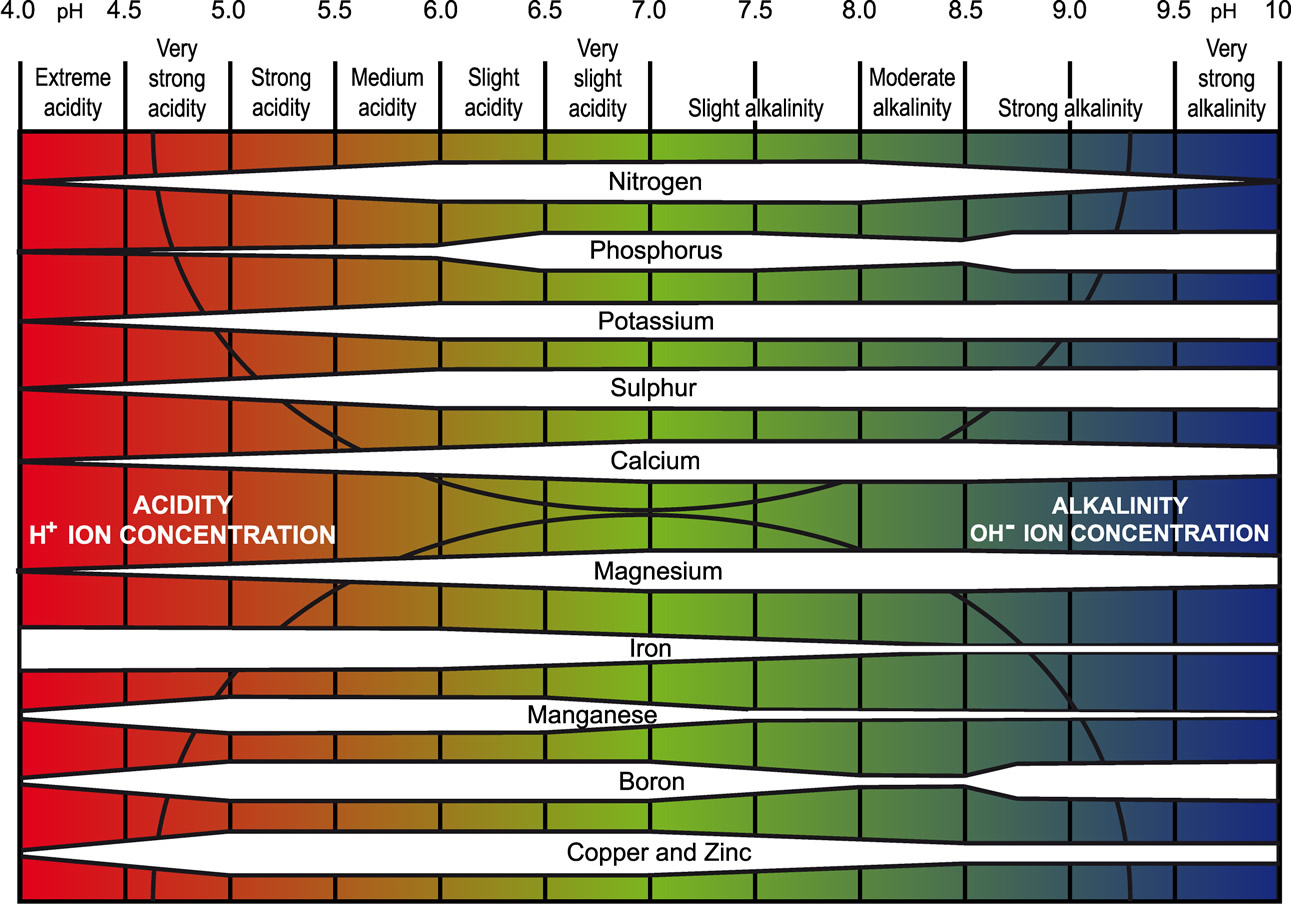
- Secondary and micronutrient availability by pH
- Secondary and micro nutrients availability by pH line graph
- Common Nutrient Deficiency Symptoms on Leaves Infographic
Classification
Maps & Datasets
Canada
- Canadian System of Soil Classificaiton
- 1982 Canadian Manual for Describing Soils in the Field
- Alberta Soil Quality Criteria Relative to Disturbance this one is widely used across Canada
- Best management practices for conservation of reclamation materials in the mineable oil sands region of Alberta - a good guide to basic reclamation and revegetation BMPs
Europe
- Agrifood Soilscapes (UK)
- Datasets from the BGS (UK)
- Datasets from the James Sutton Institute (UK)
- Scotland Environment Soil Maps
- Soil Atlas of Europe
- UK Geochemical Atlas
- UK Soil Observatory
United States
World
Soil Contamination:
- Cornell Guide to Testing Contaminated Soils
- CCME Soil Guidelines for Contaminants
- Wikipedia Lists of Hyperaccumulators for Bioremediation
Similar Communities
- !geology@lemmy.ca
- !geophysics@lemmy.ca
- !geologycareers@lemmy.ca
- !mining@lemmy.ca
- !openscience@lemmy.ml
- !reclamation@slrpnk.net
Sister Communities
Science and Research
Biology and Life Sciences
- !anthropology@mander.xyz
- !microbiology@mander.xyz
- !biodiversity@mander.xyz
- !palaeoecology@mander.xyz
- !palaeontology@mander.xyz
Plants and Gardening
Physical Sciences
Humanities and Social Sciences
- !archaeology@mander.xyz
- !cooking@mander.xyz
- !folklore@mander.xyz
- !history@mander.xyz
- !old_maps@mander.xyz
Memes
Find us on Reddit
founded 2 years ago
MODERATORS
1
2

5
6

8
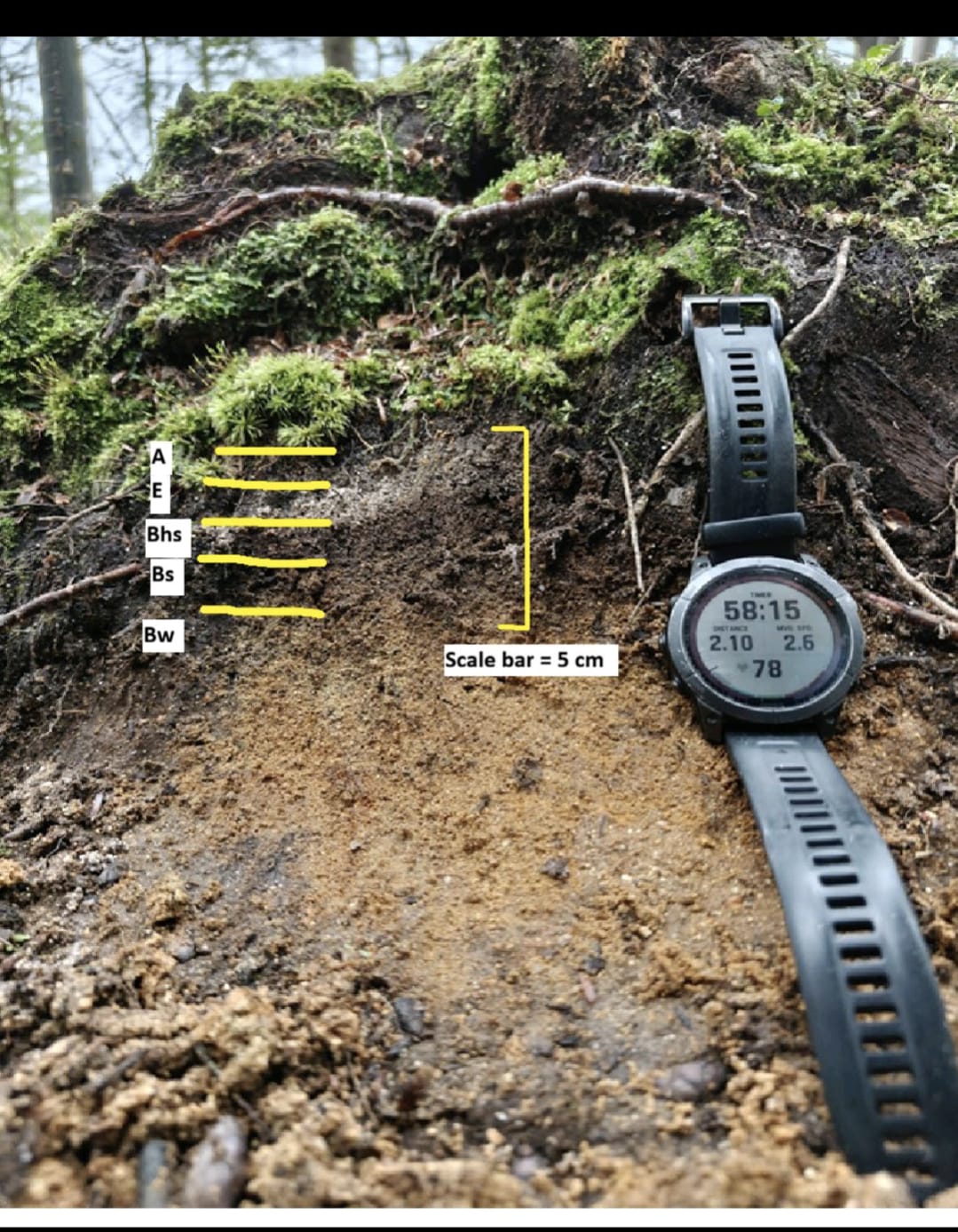
I'm not up to snuff on my USDA taxonomy, but here is an explanation of this horizon:
- Soils consist of three master horizons: A, B and C
- this soil is from the B horizon
- two nearly mutually exclusive pedogenic processes have occured to create this horizon:
- Illuviation - the deposition of clays from the A horizon
- Carbonate enrichment
Clays and carbonates both leach from the A horizon during pedogenesis, but carbonates move way faster and are long gone before the first clay particles arrive. Clays move much slower and don't go as far.
You can get carbonate enrichment from deeper in the profile though capillary rise, but it's almost always restricted to the C horizon. What you end up with is a very rich carbonate layer over top of the naturally calcareous layer of the soil.
In THIS case, evaporation is so strong it's brought these carbonates into the B (middle) horizon so you end up with a calcareous, clay enriched B horizon which really should not exist.
Soils are wild.
Bonus picture

9
I'm doing mainly hydroponics by now, but still have some pots on my balcony with soil in them, and I don't plan to change that.
Most of them are just "there" and filled with flower mixes for insects, aka weeds.
Those aren't high value crops for me, but still, I'm seeing them as test subjects.
The soil is mostly highly organic and I built it up myself from scratch.
A big portion of it is actually mushroom mycelium blocks, aka decomposed hardwood and millet, with some rock meal, LECA and compost on top.
Maybe that information is relevant, idk.
I pay a lot of attention to the biological activity, e.g. earthworms and springtails. There seems to be lots of decomposition happening.
The pots are already in use for at least one year, and I've always watered them with tap water.
Now, the blackberries, growing in one of my oldest pots, the only one with a high clay content, is showing signs of a deficiency, even though I put more than enough organic fertiliser in it last year.
I suspect it's because of my watering habits. My tap water doesn't contain any chlorine or other harmful stuff, but still, lots of Calcium, Magnesium and carbonates. It has a high pH, sometimes reaching even 8+!
The plants are thirsty and need lots of it, so I just wanna know how bad it really is.
I know that the availability of nutrients is depending on pH and other ions, but does it really matter in soil?
Last year, when I made a new batch, my soil was contaminated with something highly alkaline, and the drain off pH has been 10+ for some time, but still, the plants coped very well with it and didn't show much signs of deficiencies.
It's now in the 8-ish range, but I can't say it for sure because my testing methods are shit, see my other post.
Does it have something to do with the microbes living in it?
Pictures


10
14
How can I analyse the chemical and biological composition of my soil with home methods?
(slrpnk.net)
I have a few pots of soil I made myself on my balcony, and I wanna test following things:
- pH: I already have a pH testing rod for soil, but it seems to be very inaccurate.
I also have a proper digital pH meter for my hydroponics, which is way more accurate. How do I test the soil in the liquid form? Are there any standards, so it is more comparable? - Composition: Ratio of organic vs inorganic stuff, and also the water retention and aeration.
- Microbial and biological fingerprint: I saw a huge amount of earthworms last year, but this year, none at all. Did my ants kill them? Are they still there, but just beneath the soil?
How well do the microbes feel? How active is the soil? - Decomposition grade (I'm reusing the soil from the last years): how drained and compacted is my soil already?
- Are there harmful nematodes or whatever in there?
- The ratio of Calcium and Magnesium compared to other ions (I suspect nutrient lockouts due to tap water)
- etc.
As a background, I'm a "chemist" and also have some skills, chemicals and equipment average people may not have.
Here are some pictures :)
The blackberry with deficiencies:


And some pics of dirt from different pots. The top layer may look different than the what's below.


11
12
13
14
35
Global soil moisture in 'permanent' decline due to climate change - Carbon Brief
(www.carbonbrief.org)
16
I had a really bad slug infestation on my balcony garden last year. Because they were eating on everything, and were in the thousands almost, I had to resort to "poison" bait. Not one of the toxic ones, because I have cats, but ones based on Iron phosphate.
Still, it resulted in another pest: all those slimy slugs crawled under the floor cover and died there. Disgusting. Everything was full of flies and stank.
But mainly, it was mentally horrifying.
This year, I want to do it differently. Instead of killing them, I want prevention.
I already looked up online, but all "natural predators" are bigger ones, like ducks and toads, but of course that isn't viable on my small balcony.
So, I thought about already killing them in the egg stage.
What natural killers, like nematodes or bugs, do they have in this life stage?
What can I do to attract them?
How is that regulared by natural balance?
Anyway, I got outside and dug up some soil samples from different locations and spreaded them in the pots, hoping that there are some eggs or critters in there that are currently hibernating and then improve the natural balance in the summer.
It was only one hand full of dirt per big pot, but that should be enough I believe. It's only the catalyst/ starter culture after all.


Btw, I'm currently building up the soil for the following season. Last year has been absolutely great with organic living soil, and I want to improve on that.
The new soil, consisting of spent mushroom blocks, some soil, leaf matter, and more:

And the old one from a few months ago, when I harvested my hemp tree:


I plan to reuse it of course! No-till, a shit ton of organic matter, very well aerated with deep roots from the decaying plant that was previously in there. Extremely healthy dirt 🤌👌
17
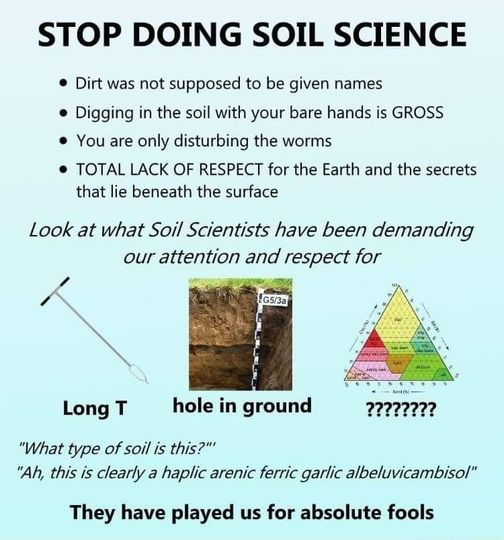
Some pedologists like to split out every little detail when classifying a soil profile. Others? Not so much....
Pedologists are a prickly bunch; tons of strong opinions, so lumpers and Splitters have some epic arguments

18
21

23
14
The dirt on biocrusts: Why scientists are working to save Earth’s living skin
(knowablemagazine.org)




view more: next ›