Traditional Art
5498 readers
1 users here now

From dabblers to masters, obscure to popular and ancient to futuristic, this is an inclusive community dedicated to showcasing all types of art by all kinds of artists, as long as they're made in a traditional medium
'Traditional' here means 'Physical', as in artworks which are NON-DIGITAL in nature.
What's allowed: Acrylic, Pastel, Encaustic, Gouache, Oil and Watercolor Paintings; Ink Illustrations; Manga Panels; Pencil and Charcoal sketches; Collages; Etchings; Lithographs; Wood Prints; Pottery; Ceramics; Metal, Wire and paper sculptures; Tapestry; weaving; Qulting; Wood carvings, Armor Crafting and more.
What's not allowed: Digital art (anything made with Photoshop, Clip Studio Paint, Krita, Blender, GIMP or other art programs) or AI art (anything made with Stable Diffusion, Midjourney or other models)
make sure to check the rules stickied to the top of the community before posting.
founded 2 years ago
MODERATORS
1
2
3


5
I think how much hatred and revulsion I feel looking at this is the brilliance here.

6
McMinnville, Oregon has a UFO Fest every year. I snapped the reference photo for this oil painting at the 2025 celebration last week. I'm probably going to let it dry for a bit now and do some light glazing later on.

7
This is stunning in person, and had an entire room devoted only to it. If it’s not obvious from the photo, this is suspended fairly high in the air, maybe 10-15 feet. The beading of the words “We Hold These Truths To Be Self Evident” continues around the entirety of the punching bag, but this was the only photo I got that I was satisfied with. This is the accompanying text:
WE HOLD THESE TRUTHS TO BE SELF-EVIDENT, 2024
Glass beads, plastic beads, nylon thread, acrylic felt, found punching bag
Gibson's series of beaded punching bags frequently contain texts that address structures of power. Drawing on Indigenous craft and clothing traditions, he transforms a symbol of physical aggression into a pathway to empowerment. Gibson adorns the bag here with beadwork and fringe evoking powwow regalia, especially in bead-and-jingle-adorned dresses worn by women. The beadwork features the first words of the US Declaration of Independence, "We hold these truths to be self-evident." Unwritten but implied is the rest of the sentence: "that all men are created equal, that they are endowed by their Creator with certain unalienable Rights, that among these are Life, Liberty and the pursuit of Happiness." The viewer is left to hold that statement with the often-conflicting actions of the nation in the two centuries since its writing, especially toward Indigenous people, people of color, and other marginalized groups.
If you happen to be in Los Angeles, he has a special exhibit going on at The Broad right now that’s fantastic! And it’s free on Thursdays if you can’t afford the ticket.


10
Oil on canvas, 2020
Depicted in oils on canvas, this ongoing series features individual women swimming within predominantly baroque, ornate rooms or places of worship. The surreal imagery represents being in search of, exploring and connecting with one’s innermost feelings and significant life moments.


13
There was a plant sale at Bush Park while I was the artist in residence for the Salem Art Association. I took the reference photo for this painting in the morning and painted it that afternoon.

14
I was the artist in residence at Bush Pasture Park in Salem, OR this April. If you like this one, I might post some more of what I did during the month.

15


19
20
'Venus and Anchises' was inspired by a verse from a poem called the 'Epipsychidion', by Shelley.
'Athwart that wintry wilderness of thorns
Flashed from her motion splendour like the morn's, And from her presence life was radiated
Through the grey earth and branches bare and dead; So that her way was paved and roofed above
With flowers as soft as thoughts of budding love; '
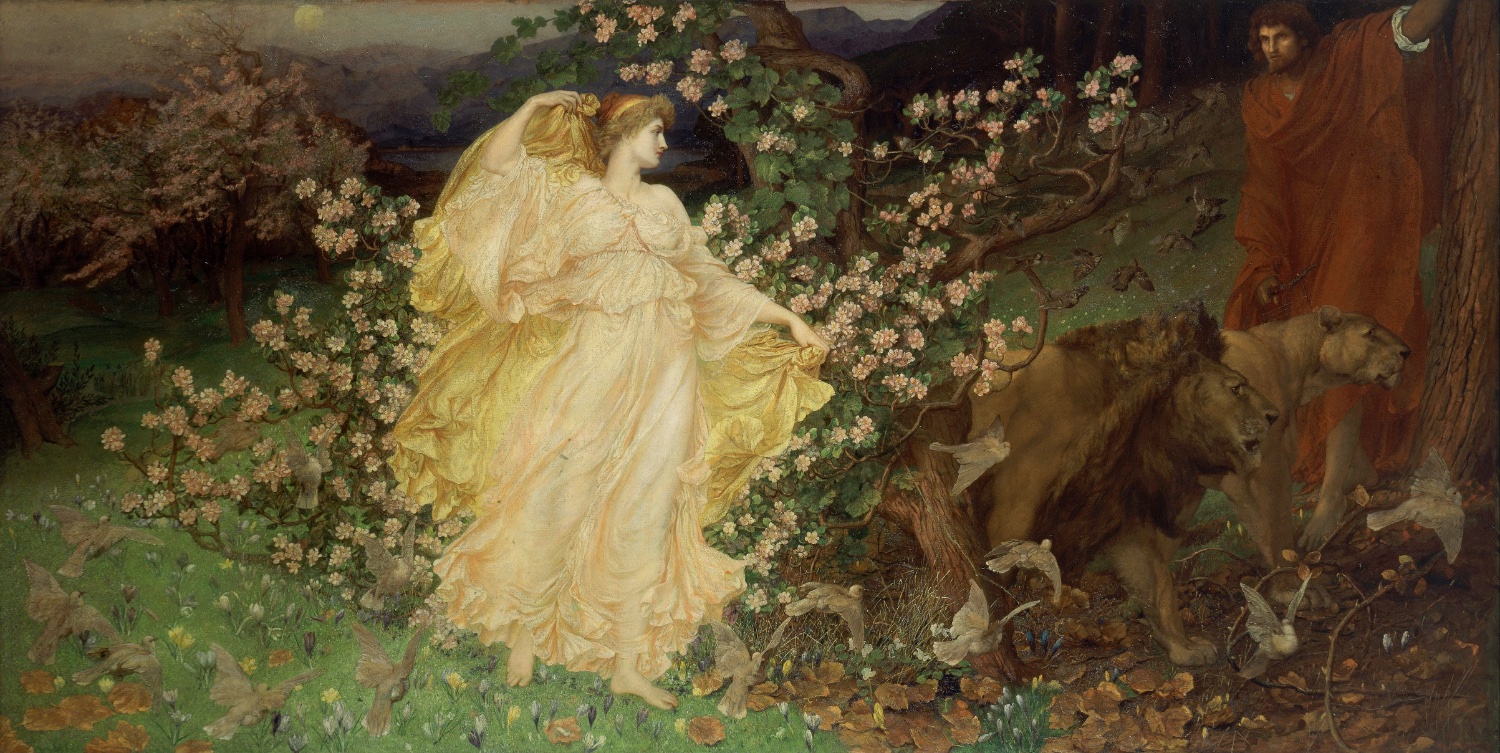
Richmond shows us the meeting at night, of Venus and her earthly lover, the Trojan shepherd Anchises, on Mount Ida. Venus, clothed in glowing pink and gold walks towards Anchises, who awaits her holding a lyre. Anchises, clad in a red shirt, appears to cower in the shadow of a tree. The usual penalty for mortals such as he for looking at a god or goddess was to be turned into stone.
The picture is not a simple illustration of a mythical event, but demonstrates the transforming power of love. Night has turned into day. In the bottom right of the picture there are the dead leaves of autumn, but wherever Venus walks she becomes surrounded by spring flowers and apple blossom. She is accompanied by lions and a flight of doves which disperse a group of sparrows. Although the event depicted is rooted in ancient Greek mythology, Richmond chooses to show the dramatic awakening of a northern landscape in an English spring. The offspring of the union between Venus and Anchises was Aeneas, the legendary ancestor of the Romans.
https://www.liverpoolmuseums.org.uk/artifact/venus-and-anchises
21
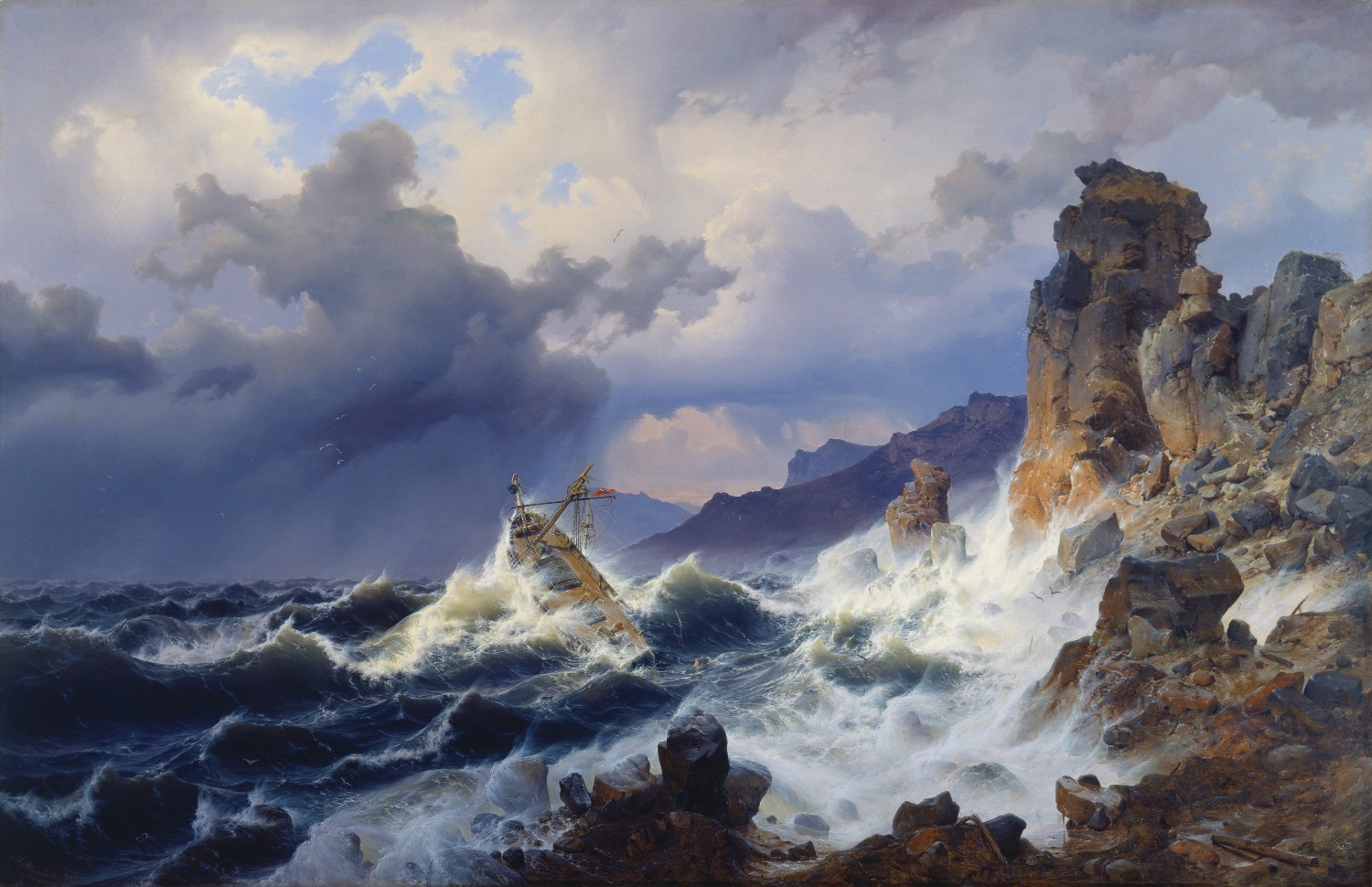
The young painter Andreas Achenbach (1815–1910) completed this painting in a studio at the Städelschule and it was purchased immediately by the Städel. With precise strokes, it shows a ship struggling against the raging sea to avoid being smashed against the rough cliffs. The deliberate lighting emphasises the surge and the mighty rocks, thus, heightening the feeling of agitation while witnessing these events. The large format further intensifies this impression of the depicted force of nature. Achenbach repeatedly painted detailed seascapes of this kind. They are skilfully staged: it was not until two years after the painting’s creation that Achenbach actually travelled to Norway.
https://sammlung.staedelmuseum.de/en/work/storm-at-sea-off-the-norwegian-coast
22
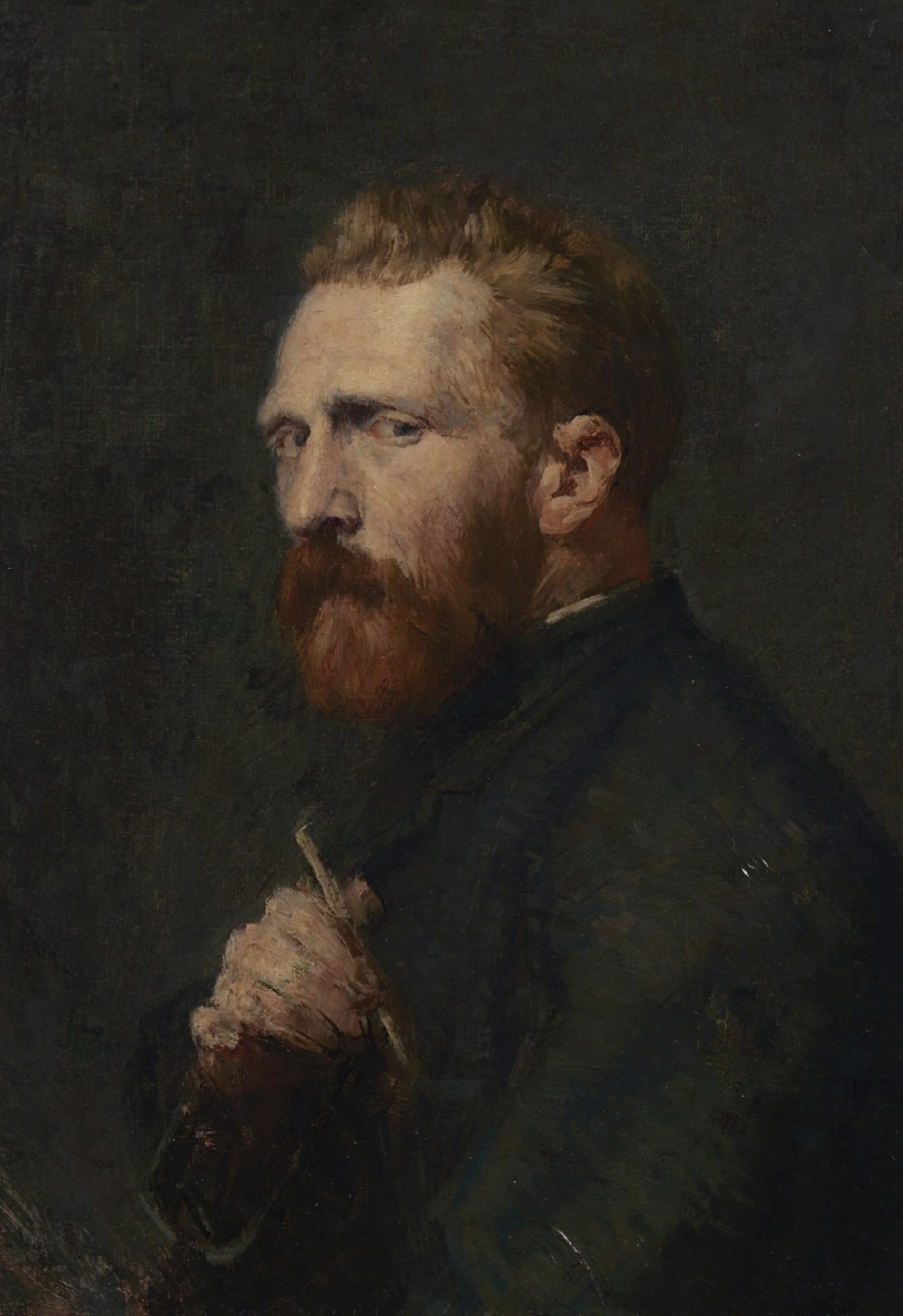
The Australian painter John Peter Russell got to know Vincent at Fernand Cormon’s studio. He painted this portrait of his friend in 1886 in a conventional, realistic style. It is clearly influenced by photography, although the face and the hand still show Impressionist touches. The portrait was not so dark originally.
Another artist, Archibald Standish Hartrick, met Van Gogh at Russell’s studio. He later recalled: ‘[Russell] had just completed that portrait of him in a striped blue suit.’ You can indeed just make out a few little blue stripes at the lower edge of the painting. Analysis has revealed, moreover, that the words ‘Vincent, in friendship’ were painted in red over Van Gogh’s head. In Hartrick’s view, this was the most accurate portrait of Van Gogh – more realistic than the likenesses done by other artists or any of Vincent’s self-portraits. Van Gogh was very attached to it. Years later, he wrote to Theo: ‘take good care of my portrait by Russell, which means a lot to me.


25
This composition, inspired by the eponymous track by the musician "Solvant", is a patchwork of symbolic elements borrowed from modular synthesizers and electronic sound creation. Made up of elements found in certain semi-modular synthesizer brands like Make Noise and their iconic designs, this work is a homogeneous and minimalist assembly of waveforms, electronic components, button symbols, jack cables, and other small details characteristic of these mysterious and monolithic instruments.

view more: next ›