this post was submitted on 13 May 2026
16 points (94.4% liked)

xkcd

16470 readers
420 users here now

A community for a webcomic of romance, sarcasm, math, and language.

founded 2 years ago
MODERATORS
 

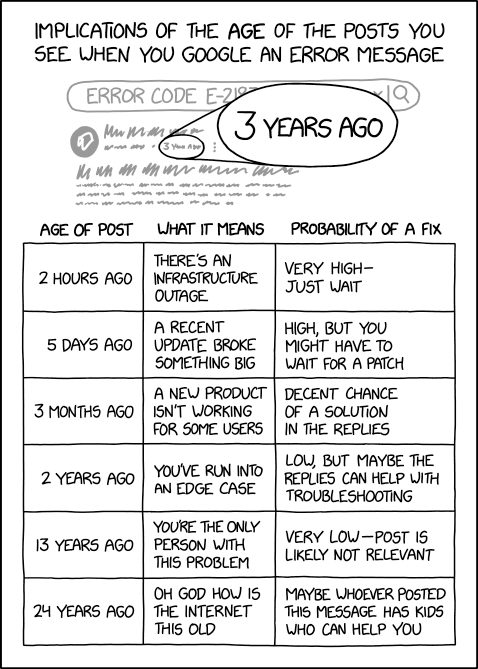
xkcd #3245: Results Age

Title text:

Please, we need your help. Our research suggests you're the last living descendant of the person who knew how to format this config file.

Transcript:

Transcript will show once it’s been added to explainxkcd.com

Source: https://xkcd.com/3245/
explainxkcd for #3245

you are viewing a single comment's thread
view the rest of the comments
[–] tal@lemmy.today 0 points 1 week ago* (last edited 1 week ago) (1 children)

24 years ago

Oh God how is the Internet this old

So, I'm being a nit-picky, but while I'd say that personal Internet access really became a major thing in the US in the late 1990s or so, and that led to a huge explosion in the creation of the stuff like commercial websites, and so from consumer "the Internet is directly part of my life" standpoint, a lot of people might say "that's when the Internet became a thing," the Internet as an entity has been around since it was created from the ARPANET.

https://en.wikipedia.org/wiki/Internet

The ARPANET initially served as a backbone for the interconnection of regional academic and military networks in the United States to enable resource sharing. Access to the ARPANET was expanded in 1981 when the National Science Foundation (NSF) funded the Computer Science Network (CSNET).[39]

In 1982, the Internet Protocol Suite (TCP/IP) was standardized, which facilitated worldwide proliferation of interconnected networks. TCP/IP network access expanded again in 1986 when the National Science Foundation Network (NSFNet) provided access to supercomputer sites in the United States for researchers, first at speeds of 56 kbit/s and later at 1.5 Mbit/s and 45 Mbit/s.[40]

The NSFNet expanded into academic and research organizations in Europe, Australia, New Zealand and Japan in 1988–89.[41][42][43][44] Although other network protocols such as UUCP and PTT public data networks had global reach well before this time, this marked the beginning of the Internet as an intercontinental network. Commercial Internet service providers emerged in 1989 in the United States and Australia.[45] The ARPANET was decommissioned in 1990.[46]

It's just that the places using it were more universities and companies doing engineering stuff and stuff like that for a while.

So if you say that the Internet was really born from the ARPANET when networks shifted to TCP/IP, you're talking something like early 1980s; by that metric, the Internet would be something like 55-ish years old.

EDIT: Some users here are on lemmy.sdf.org. SDF was around well before 2000.

https://en.wikipedia.org/wiki/SDF_Public_Access_Unix_System

Super Dimension Fortress (abbreviated as SDF, also known as freeshell.org) is a non-profit public access UNIX shell provider on the Internet. It has been in continual operation since 1987 as a non-profit social club. The name is derived from the Japanese anime series Super Dimension Fortress Macross; the original SDF server was a Bulletin board system created by Ted Uhlemann for fellow Japanese anime fans.[1] From its BBS roots, which have been well documented as part of the BBS: The Documentary project, SDF has grown into a feature-rich provider serving members around the world.

[–] ilinamorato@lemmy.world 1 points 1 week ago (1 children)

Randall isn't saying that the internet is only 24 (I mean, he's been making xkcd for 20 years and was on it before that). He's saying that his mental conception of the internet is still "new exciting thing," and the fact that it's been around for 24 years means that he's currently being haunted.

[–] captainlezbian@lemmy.world 1 points 1 week ago

And as someone who read xkcd as a teenager, I feel the opposite, it feels like it's always been here