this post was submitted on 15 Jun 2026
925 points (99.5% liked)
People Twitter
10090 readers
1266 users here now
People tweeting stuff. We allow tweets from anyone.
RULES:
- Mark NSFW content.
- No doxxing people.
- Must be a pic of the tweet or similar. No direct links to the tweet.
- No bullying or international politcs
- Be excellent to each other.
- Provide an archived link to the tweet (or similar) being shown if it's a major figure or a politician. Archive.is the best way.
founded 3 years ago
MODERATORS
you are viewing a single comment's thread
view the rest of the comments
view the rest of the comments
No. What we need is freaking DNS for phone numbers. I don't get why this isn't a thing.
So you can actually register a bunch of numbers under the same name. If
DoctorSocks.medcalls, you know it is them regradless whether it's the front desk or what not.If
DrJoana@DoctorSocks.medcalls, you know it's the number of that particular person.In that way you can even establish curated lists. On a govermental, but also on a community level.
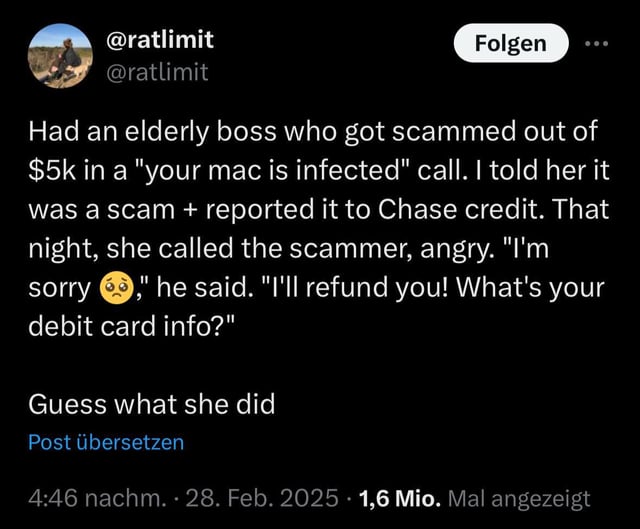
That would help, but the bigger problem is that the trust model has inverted in a fairly short time. I'm in my 30s and I can remember a time where 80% of calls to a home phone were legitimate non sales calls, and cell phones were basically 100% legitimate. Those numbers have become about 90% illegitimate calls within about a decade, it's hard to train people that have lived for half their life or more with trustworthy calls to adapt to that.
Hello it's me Bill Gates at rnicrosoft.com I will help you do the needful to fix your device.
See. This is exactly what would not happen.
Because granny's phone white lists the curated list from her government, her family, and, well, her individual phone. Guess what? Rnicrosoft.com is not on there. Plus, it would not work like real DNS. It's merely an anology.
I mean there is something like that. It's called a phone number. Problem is, that the way it was thought out is not the way it works today.
(My knowledge is a few years old, so please correct me if I'm wrong) That said, the way it works is like this:
Your phone connects to your phone provider with your number and says: "Here I am, please route calls to me." Or "Please route this call to number XYZ." The provider then forwards it either to the next hop in the direction of XYZ or directly to XYZ's provider. In the end the call lands at XYZ's phone and the call begins. Great stuff.
But today it works a bit differently due to the way those companies "just trust" each other.
A malicious actor with a weird (malicious) provider just says: "This is my number, route a call to XYZ." And then just provides a wrong number and instead of stopping them, the provider just routes it. And all the other providers trust them and just route the call normally. If phone providers would just block list all traffic of malicious providers, all of this would last maybe a month and there would be no more scam calls from spoofed numbers. And afterwards providers could say to other providers "there is scam traffic coming from you with number XYZ, stop that or I won't route your traffic." and then call scams would just cease to exist in a year.
Even worse, malicious actors can register your number with one of those providers. Then the provider will tell the others and they will be like "well if you say so..." and just forward your calls to the wrong person.
(Yes, there is lots of wishful thinking in this comment, but let me dream of a better world)
Trump got rid of all of the protections that were already set up, very early on this term.
You can already do that with the ubiquitous vCard format.
Nope, this is not dynamic. If you call "DoctorSocks", you will reach them because it gets resolved for you. Not because you statically saved it on your device.