this post was submitted on 02 Aug 2026
1307 points (97.5% liked)
Work Reform
17046 readers
2107 users here now
A place to discuss positive changes that can make work more equitable, and to vent about current practices. We are NOT against work; we just want the fruits of our labor to be recognized better.
Our Philosophies:
- All workers must be paid a living wage for their labor.
- Income inequality is the main cause of lower living standards.
- Workers must join together and fight back for what is rightfully theirs.
- We must not be divided and conquered. Workers gain the most when they focus on unifying issues.
Our Goals
- Higher wages for underpaid workers.
- Better worker representation, including but not limited to unions.
- Better and fewer working hours.
- Stimulating a massive wave of worker organizing in the United States and beyond.
- Organizing and supporting political causes and campaigns that put workers first.
founded 3 years ago
MODERATORS
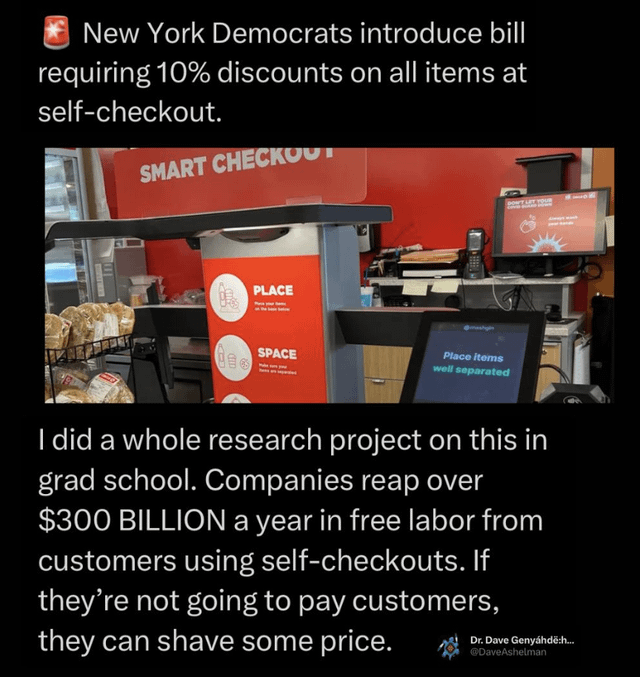
That "$300 billion" number is just completely made up. The math doesn't even remotely work.
The entire US grocery industry does somewhere around $1 trillion in revenue per year. For self-checkout to save $300 billion, that would mean roughly a third of every dollar spent on groceries was going directly to cashier wages. That is obviously not how grocery stores operate. Total labor costs for a store are only a fraction of their expenses.
And the idea that self-checkout was some massive money-saving miracle ignores the other side of the equation. Those systems cost a lot upfront, require maintenance, and they increase losses from theft, missed scans, and mistakes. A machine replacing a cashier doesn't magically eliminate costs; it just moves them somewhere else.
There is a reason companies like Walmart, Target, and Dollar General have started putting limits on self-checkout or bringing back more staffed lanes. If self-checkout was saving them hundreds of billions, they wouldn't be walking it back. They would be installing them everywhere they could.
This is the kind of post that hurts any community built around open discussion and critical thinking. A sensational claim gets repeated because it supports a certain viewpoint, while nobody stops to ask if it is actually true. The truth should matter regardless of whether it supports corporations, consumers, or anyone else. Being intellectually honest means checking the facts first, not just accepting information because it confirms what we already believe.
On a side note, totally support the bill in every way.
I frequent a DG Market in a rural area. They shut the self checkouts down pretty quick due to theft.
I really thought leaving Reddit would reduce the occurrence of this but honestly it was naive of me. This sort of clickbait crap is everywhere including Lemmy. Its unfortunate
Reddit is a cesspool but unfortunately so is the wider media ecosystem for the most part.
Highly upvoted too. Yes it is exactly the same here, just a little different biases.
It’s a shame because I can’t find a platform to get away from this type of nonsense. It’s all the same, false claim is made and nobody even asks if claim is true they just assume it is and start arguing about it in the comments.
Like, what’s the point? Wish there was a platform similar to this that actually permanently banned people sharing blatantly false or misleading content.
It's how media works, rage get's click and the lack of critical thinking skills is incredible prevalent everywhere.
To further add some numbers (and their source) to this, the average grocery cashier makes $15-16 an hour, or liberally $35k a year. Note that this isn't the entire cost of a cashier, the checkout equipment and POS systems cost money too - let's assume that and the automatic checkout system are in the same order of magnitude. There were about 800k grocery store cashiers in the US in 2017 (source) so that's about $28 billion, or ~3% of that proposed $1T revenue.
Many factors not included in this calc, more importantly regional variations in costs. Food prices and wages are higher than average in NY, 10% might not be pretty well calculated for that state. Also, human employees must be insured/have benefits, and machines do not require this. That cost savings on stores isn't in the calculus here.
Also a huge fan of holding food chains accountable for fair pricing. Hope this becomes effective!
Most grocery stores are running at 2% profit margins. There isn't anything for this to be 'effective' for, except you just raise prices 10% across the board and pocket the extra from actual cashiers still being used. It sounds great on paper until you dig in and realize it's a completely asinine idea.
I'm not arguing my own dissertation here. And I'm definitely not doing an MLA format on a Lemmy comment.
But feel free to actually verify the information on your own if you want to take up your time doing that.
For the record, I did actual research for the information stated above but you don't have to take my word for it.
Not OP, but a 2 second Google search turns up that it is in fact about 1 trillion. https://www.fmi.org/our-research/food-industry-facts
I didn't see your comment until after I deleted mine. But yeah I saw a comment below that actually had statistics from datausa.io.
I still say that they should back up their rebuttal with their own sources instead of just spitting out a number.