this post was submitted on 19 Dec 2025
299 points (99.0% liked)
History Memes
1221 readers
1616 users here now
A place to share history memes!
Rules:
-
No sexism, racism, homophobia, transphobia, assorted bigotry, etc.
-
No fascism (including tankies/red fash), atrocity denial or apologia, etc.
-
Tag NSFW pics as NSFW.
-
Follow all Piefed.social rules.
Banner courtesy of @setsneedtofeed@lemmy.world
OTHER COMMS IN THE HISTORYVERSE:
- !historymusic@quokk.au
- !historygallery@quokk.au
- !historymemes@piefed.social
- !historyruins@piefed.social
- !historyart@piefed.social
- !historyartifacts@piefed.social
- !historyphotos@piefed.social
founded 7 months ago
MODERATORS
you are viewing a single comment's thread
view the rest of the comments
view the rest of the comments
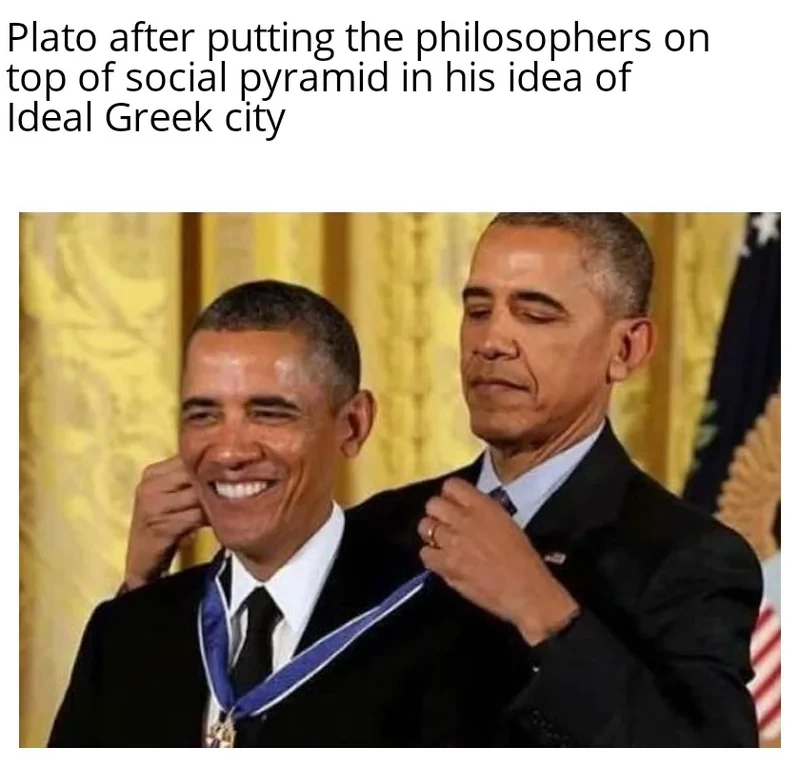
There's interpretations of Republic that don't involve taking Plato's Socrates literally when he's describing his ideal polis. I quite liked Jill Frank's interpretation in Poetic Justice, to give an example.
Even as a philosophical argument, I found it tedious and dubious.
Men who are trailblazers do get some leeway for not being refined end-products, mind.
I mean tedious, sure in the same way that all philosophy is, but I'd be interested to know why you find it dubious. In a relatively surface-level reading, it has a very perfectionist texture to it, but I don't think there's anything overtly controversial about the notion that we should valorize knowledge and strive to deepen our understanding of everything. There's a good reason why it's pretty much the seminal work of the western political philosophical tradition.
I think it's a very well-refined work, it just doesn't seek to provide any particular answer. It's presented as a Socratic dialogue precisely because it's meant to be challenged and debated. Again, if you take issue with the idea of philosopher-kings being presented as a moral or political authority, I urge you to check out Poetic Justice, or at least a review or paper that cites it.
There are repeated dubious arguments that would struggle to convince a middle-schooler. "Professionals are usually better at their jobs than part-timers. Therefore, it's better to do only one thing ever or else you won't be as good at it as someone who does. This is a definitely and essentially true point that we will use as a basis for numerous further claims on either politics or metaphysics, depending on your reading."
"Oh yes, Socrates-as-a-stand-in-for-Plato, that's SO correct! You're SO smart and handsome and funny and no one could ever beat your humility either!"
"Bandits don't betray each other, and loyalty is just. Therefore, even bandits have an essential sense of justice, and justice is necessary for all prosperity. ~~Cheaters~~ unjust men never win in the end!"
"God, your dick is so big too, Plato-I mean, Socrates! Please fuck my wife in the next breeding lottery!"
Loled at the last one, but also I think it's wrong to conflate any specific argument that Socrates makes with Plato's argument in any of the dialogues. The dialogues are presented as dialogues for a reason. If an interlocutor fails to push back adequately, it doesn't mean that the argument is beyond reproach. It might just be revealing a contemporarily widely understood value, or it's inviting the reader to engage with the dialogue. The reader is then challenging Socrates' notion that knowledge is hierarchical by taking on a presumed intellectual authority in Socrates. Given Plato's body of work, I think the fallibility of arguments in the dialogues are oriented towards the idea that we have imperfect knowledge and imperfect arguments, and sometimes people fail to catch and respond to these in elenchus. Plato could just be getting us to engage in the act of philosophy.