
Muehe
joined 3 years ago
Won't work because the rainfall won't only happen where the glaciers were, so you would need several dams all the way up and down the rivers.
Leopold Aschenbrenner [...] just blew up his $45 billion hedge fund
Nomen est omen strikes again (Aschenbrenner can colloquially be translated as "money burner").
Well the script tag has a deprecated attribute called language, so in older code and media you will see <script language="javascript"> a bunch. The weird thing is they instead used the lang attribute which just doesn't exist.
All other countries could have ignored Hungary and do whatever they wanted since they are souvereign countries. There was no need to act as the EU.
If you completely ignore the fact that Hungary was blocking the release of EU funds, and those don't just magically reappear in your national budget if the EU doesn't use them...
Well the vote passed 82/13 with 15 abstentions. Khan has been removed.
But I think the analysis in the OP is wrong on the last point, as per DW:
All active ICC warrants will remain in place despite Khan's dismissal, because only ICC judges have the authority to withdraw warrants.
The play might rather be that a new prosecutor will just not do their job or do it badly if any arrest is ever made. And also preventing Khan from issuing new warrants obviously.
Oh yeah, a few weeks back a protester on some demonstration had a sign saying "Merz leck Eier" (lick eggs/balls, same diff), and the police confiscated the sign and charged them with "an insult to a political official capable of damaging their public work" (roughly translated), an obviously preposterous state of affairs even if you ignore the fact that we apparently have Lèse-majesté-laws again. Hence the well earned ridicule.
I tried ranking my flower vine over their border with the Lemmy logo, and initially they resisted, but then I showed them what I wanted to do with the cursor and they let me. Didn't feel like botting.
~~Is it just me or is the picture missing the last few minutes?~~
Anyway, I enjoyed all the new features, especially templates, cursors, and the new pixel pulses. I think I barely managed to test half the new stuff in the few hours I participated. :D
Edit: Canvas_final_v2.png
~~There is indeed some stuff missing in the OP picture, see e.g. the void eyes below the pirate.~~

Edit 2: Fixed, thanks!

Started a little flower garden around other peoples art to fill in the blanks. Negotiated a border with the void by letting my grass wither. Trying to reach the butterfly for now and then see where I can go from there. I know somebody else is doing the same in the bottom right corner.
Was busy over the weekend so I just joined an hour or so ago, but have to say I love the template function! Bit rough around the edges maybe, but really really missed those Place browser addons for templating the last time around. Looking forward to next year already. :D
3
The virgin wiki Glossary of mathematical symbols (EN) VS the chad Liste mathematischer Symbole (DE)
(lemmy.ml)
Comparison of the English and German language wiki page for math symbols.
https://en.wikipedia.org/w/index.php?title=Glossary_of_mathematical_symbols&oldid=1342073856
and
https://de.wikipedia.org/w/index.php?title=Liste_mathematischer_Symbole&oldid=266615032
To be fair, if you go to the linked "List of logic symbols" article that has a table with Latex, Unicode, and even HTML codes. But it's only for logic symbols, no page for all mathematic symbols on the English Wikipedia as far as I can see, so no quick Ctrl+F searching for unicode/latex. :( And most other subsections don't even have a link to such a list.

216
Source: https://citizens-initiative.europa.eu/how-it-works_en
In other news the petition should reach 900k signatures any minute now:
https://stopkillinggamestracker.pages.dev/


For reference, yes, the screenshot is real, it's from here: https://github.com/TrinityCore/TrinityCore/tree/3.3.5

Template:


2021 meme apparently. For more info see https://knowyourmeme.com/memes/hey-friend-listen-its-gonna-get-way-worse

244
If it walks like a fascist coup, and it quacks like a fascist coup, it's probably a fascist coup.
(lemmy.ml)
A few weeks in and Trump has essentially:
- Full control of the (federal part of the) legislative branch.
- Gutted the executive branch through DOGE and EOs.
- Practically DDOSed the judicial branch.
- Purged and replaced possibly disloyal military leadership.
- Taken exploratory steps on declaring military law.
- Made very thinly veiled threats of invasion towards several countries, two of which are currently allied with him.
- Wiped out more than a century of foreign policy gains in a week (which is honestly somewhat impressive, in a fucked up kind of way).
Americans, if you ever wondered how the rise of the Nazi dictatorship looked like from the inside of Germany, wonder no more, it looked kind of like this.

Interview hier: https://www.youtube.com/watch?v=_9uvkX8J6tk
Oder hier: https://www.twitch.tv/videos/2353089480?t=5h0m40s

278
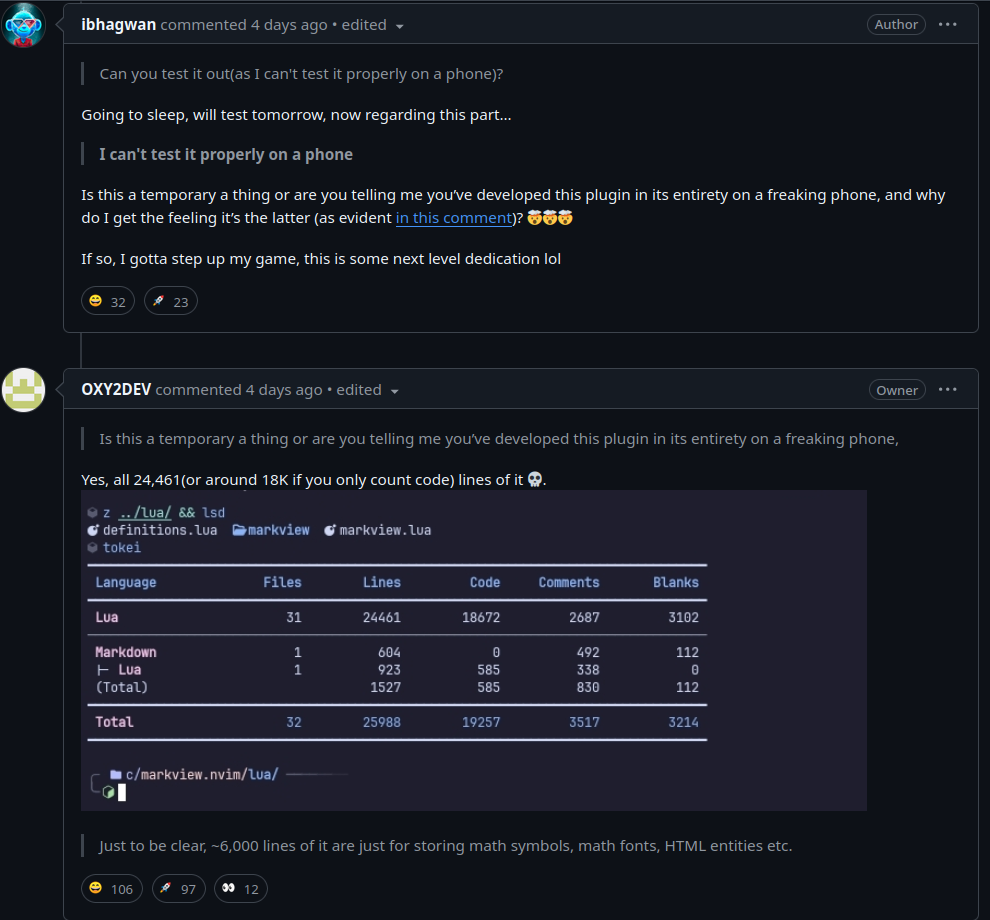
Original Github issue where a user noticed it being written on a phone
(Screenshot in this post)
User posts a screenshot of conversation on r/neovim
(Plugin author replies as u/Exciting_Majesty2005)
Github issue trying to coordinate a GoFundMe or similar
Reddit post gets linked on Hacker News
Edit:
Small update, things in issue 218 have progressed to the point that donations are now accepted by US 501(c)(3) nonprofit Hackclub:
Ledger for donations so far
($1033 at time of writing)
view more: next ›