jcarax

joined 2 years ago
[–] jcarax@beehaw.org 2 points 1 day ago

Evolution being just a little bit clunky is a massive improvement from the Gnome 2 and early Gnome 3 days, for what it's worth.

[–] jcarax@beehaw.org 1 points 1 week ago (1 children)

Thanks, I'll have to sit my ass at my desk so I can try it again. I wonder if there's much delta between what you're using and the beta I'm on from Extra. Though it does look like there are some new betas in Extra-Testing.

[–] jcarax@beehaw.org 0 points 1 week ago (4 children)

I'll need to give tiling another try, I started using alpha 5 back in January and there were some pretty nasty bugs in tiling mode back then that made me think maybe a memory leak or something. After 15-20 minutes performance would get horrible until switching back to floating, though I'm fuzzy on the details.

Is there any capability to leave an open space? Honestly, I like tiling more for the orderliness above and beyond snapping than the dynamism. Aaaaaand that's reminding me why I was looking at building out a LabWC environment, it has configurable snap zones.

[–] jcarax@beehaw.org 5 points 1 month ago

I started dabbling in around 2000, getting sick of the instability of Windows, and it seeming like the next logical step of geekdom.

I tried a LOT of distros. Mandrake, Connectiva, Red Hat to Fedora Core, Slackware, Debian Woody, Crux, etc etc. I drifted in a Debian-centric circle until I finally landed on Arch. Lost my way for a bit during my IT career, supporting Windows I ended up just using that. But I'm back to Arch now as my daily, Debian for some networking projects, and a bit of Fedora from time to time when I need to spin something up quick.

[–] jcarax@beehaw.org 1 points 1 month ago

You're a lot more likely to find something at a local second hand store or garage sale, at least you would be in the US. Things online will usually have a markup, whereas locally you're likely to find something someone just doesn't know it's worth a damn.

[–] jcarax@beehaw.org 4 points 1 month ago (1 children)

Not really for the purpose of this thread, since pretty much anything can do what OP is asking, but any idea how the Juno Tab compares to the Starlabs Starlite in regards to build quality, cooling, and what not? I noticed the other day that the Starlite has been updated with an N350 CPU. Though it is up to a $765 starting price...

Once or twice a year I start thinking it would be nice to have a tablet. Then within a month I wonder wtf I want a tablet for.

[–] jcarax@beehaw.org 2 points 1 month ago

Yeah, though I'm looking more to have it as a home phone with my music and downloaded maps and stuff. I've gotten used to not having much of any cell service where I live, so I moved my number to jmp.chat (considering voip.ms instead), and don't even turn on data most times I leave the house.

[–] jcarax@beehaw.org 3 points 1 month ago (2 children)

Graphene is great, I've been using it for a few years now. But I started wanting more storage, so looking towards the Fairphone and Shiftphone, which would require a move to Calyx or Lineage. That got me thinking about the state of AOSP, seeing Google being rather abusive towards FOSS, and I think Sailfish attracts me more that Ubuntu Touch at the moment. It seems to get a lot more development effort, and has the C2 as a more guaranteed first class citizen.

Now getting one to the US, that's another question.

[–] jcarax@beehaw.org 26 points 1 month ago (1 children)

This really puts some perspective on things. He's clearly a goa'uld.

[–] jcarax@beehaw.org 4 points 1 month ago (1 children)

Is it offering SMS? I ported to jmp.chat recently, using their XMPP gateway for voice and SMS. They offer a VOIP option, but don't support SMS.

I like being able to SMS, and I guess call, from my laptop. But there aren't any Linux XMPP clients that I'm particularly happy with, so I'm just using Cheogram in Waydroid. It's not exactly optimal.

[–] jcarax@beehaw.org 1 points 1 month ago* (last edited 1 month ago)

I imagine it would be the likes of Graphene, Lineage, Calyx, and some others at the core. Probably some hardware vendors like Fairphone, Shiftphone, and probably a Xiaomi or Huawei.

Edit: ROMs maintain their own code base, but I'm pretty sure OP was talking about a larger fork of AOSP. That's what I've suggested recently, anyway.


In honor of the current state of affairs in the US.


Is anyone using Pipewire's AES67 support? I'm looking to implement some form of whole home audio for an MPD or some other music server. I've played with a combined airplay sink and a couple Sonos speakers, but it's problematic and cuts out intermittently for a split second.

I'm only really able to use wifi at this point though, and don't want to run cables until I buy a house in the next few months. Though I will run some wired tests over coming months before that, and develop a plan. I've also looked into Snapcast, which is probably preferable to a combined Airplay sink.

And that's because I'm wary of planning to use an open source implementation to a very proprietary protocol long term. When I bought some Genelec speakers for my desk earlier this year, I stumbled across their networked speakers that support POE and AES67. I see Pipewire has AES67 support in the RTP sink, but there's not much out there about people trying to use this.

Has anyone around here gotten a chance to play around with it? How does it work? Any pain points?


I got the 21K5001JUS, which has the R7 Pro 7840u, 64GB LPDDR5x 6400, and OLED 2880x1800. Ordered it August 20th, shipped expedited on September 1st, and arrived in the upper Midwest this afternoon, September 5th.

I updated to the latest Windows 11 Pro patches, no Lenovo updates in the Vantage software. My first impressions were:

  1. The fan spins up and gets quite loud when installing Windows updates, but not nearly as loud as my P52s. Substantially louder than my T14s gen 1 AMD. Unfortunately I don't have my T14s gen 3 AMD just yet, I'm not sure of an ETA on that yet.
  2. The OLED scaled to 1.5x really doesn't bother me. I think it's well worth the absence of backlight quality issues, and IPS glow. We'll see once I get into assessing battery life, especially coming from an M1 MBA for personal use.

It feels a little less premium than the T14s gen 1, with a little bit of flex in the lid and wrist rest. But it's crazy how far we've come since my T450s, which is like a workstation by today's size and weight standards.

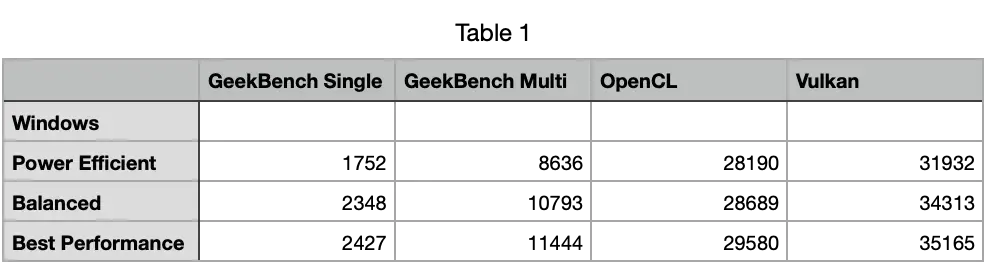
Running Prime 95 with 8 cores and SMT, the fan can get a good bit louder than I would prefer, and than I would expect the T14s gen 4 will. But running GeekBench on Best Performance profile in Windows, the fan does spin up but is nearly silent.

In my experience of years with Thinkpads, especially the P52s, I expect the fan noise to be much less aggressive in Linux. I'll be assessing that next in Fedora 38, with and without a Windows VM running. Then, before truly assessing if I'm going to keep this or trade it in for a T14s gen 4 AMD with less RAM (opting against the VM workload), I'll do the same in Arch with the latest kernel and such.

Here are my GeekBench scores:
view more: next ›