math

347 readers
1 users here now

Interesting news and discussion centered around Mathematics

founded 2 years ago
MODERATORS
1
2
3
4


In 1876, Peter Guthrie Tait set out to measure what he called the “beknottedness” of knots.

Tait had an idea for how to determine if two knots are different. First, lay a knot flat on a table and find a spot where the string crosses over itself. Cut the string, swap the positions of the strands, and glue everything back together. This is called a crossing change. If you do this enough times, you’ll be left with an unknotted circle. Tait’s beknottedness is the minimum number of crossing changes that this process requires. Today, it’s known as a knot’s “unknotting number.”

If two knots have different unknotting numbers, then they must be different. But Tait found that his unknotting numbers generated more questions than they answered.

If Tait missed something, so did every mathematician who followed him. Over the past 150 years, many knot theorists have been baffled by the unknotting number. They know it can provide a powerful description of a knot. “It’s the most fundamental [measure] of all, arguably,” said Susan Hermiller (opens a new tab) of the University of Nebraska. But it’s often impossibly hard to compute a knot’s unknotting number, and it’s not always clear how that number corresponds to the knot’s complexity.

To untangle this mystery, mathematicians in the early 20th century devised a straightforward conjecture about how the unknotting number changes when you combine knots. If they could prove it, they would have a way to compute the unknotting number for any knot — giving mathematicians a simple, concrete way to measure knot complexity.

Researchers searched for nearly a century, finding little evidence either for or against the conjecture.

Then, in a paper posted in June, Hermiller and her longtime collaborator Mark Brittenham (opens a new tab) uncovered a pair of knots that, when combined, form a knot that is easier to untie than the conjecture predicts. In doing so, they disproved the conjecture (opens a new tab) — and used their counterexample to find infinitely many other pairs of knots that also disprove it.

The result demonstrates that “the unknotting number is chaotic and unpredictable and really exciting to study,” she added. The paper is “like waving a flag that says, we don’t understand this.”

5


I've read the old papers proving that fact, but honestly it seems like some of the terminology and notation has changed since the 70's, and I roundly can't make heads or tails of it. The other sources I can find are in textbooks that I don't own.

Ideally, what I'm hoping for is a segment of pseudocode or some modern language that generates an n-character string from some kind of seed, which then cannot be recognised in linear time.

It's of interest to me just because, coming from other areas of math where inverting a bijective function is routine, it's highly unintuitive that you provably can't sometimes in complexity theory.

6
7
3
yang-mills mass gap (drive.google.com)
submitted 1 year ago by goosethe to c/math
8


The Wikipedia article on Steiner constructions mentions it, but doesn't explain it, and the source linked is a book I don't have. This has come up in a practical project.

9
2
submitted 2 years ago* (last edited 2 years ago) by spaduf@slrpnk.net to c/math


cross-posted from: https://slrpnk.net/post/3863820

Institution: Berkeley
Lecturer: Richard E Borcherds
University Course Code: Math 250A
Subject: #math #grouptheory
Description: This is an experimental online course on mathematical group theory, corresponding to about the first third of the Berkeley course 250A (introductory graduate algebra). The level is for first year graduate students or advanced undergraduates. The topics covered are roughly the parts of group theory that a mathematician not specializing in groups might find useful.

More at !opencourselectures@slrpnk.net

10
11


If not, that seems like a good argument in favour of finitism. If so, what if anything does it mean if you solve it by brute force?

12
13


(a OR b) -> c

= ~(a OR b) OR c

= (~a AND ~b) OR c

= (~a OR c) AND (~b OR c)

= (a -> c) AND (b -> c) as required

I haven’t formally learnt logic so I’m not sure if my proof is what you’d call rigorous, but the result is pretty useful for splitting up conditionals in proofs like some of the number theory proofs I’ve been trying. E.g.

Show that if a is greater than 2 and a^m + 1 is prime, then a is even and m is a power of 2

In symbolic form this is:

∀a >= 2 ( a^m + 1 is prime -> a is even AND m is a power of 2 )

The contrapositive is:

∀a >= 2 ( a is odd OR m is NOT a power of 2 -> a^m + 1 is composite )

and due to the result above, this becomes

∀a >= 2 ( a is odd -> a^m + 1 is composite ) AND ( m is NOT a power of 2 -> a^m + 1 is composite )

so you can just prove two simpler conditionals instead of one more complicated one.

14


I've been reading this book lately, although I'm not finished yet.

It's basically a "second course" of matrix algebra that uses the full-rank factorization and the Moore-Penrose pseudoinverse to construct other generalized inverses and prove cool stuff about matrices. I initially borrowed a copy from the library for its extensive coverage of the Jordan decomposition (whose existence was really important for my control systems coursework), but I actually bought a copy as a reference because I found myself thumbing through it all the time. Although it is mostly theoretical, all the algorithms are covered sufficiently to do everything on paper if you wanted to.

If this isn't in the spirit of the community please let me know.

15
16


Paul Cohen I understand constructed such a set of axioms, which logically imply the existence of an evil set family like that. Constructive is of course preferred for extra WTF.

17


The cyclic group case is the discrete logarithm problem, but I don't know what keyword to use for other cases.

What I'm really interested in is the symmetric group. If I have a fixed set of permutations, how do i combine them into the one I want?

18
6
submitted 2 years ago* (last edited 2 years ago) by joshg253 to c/math


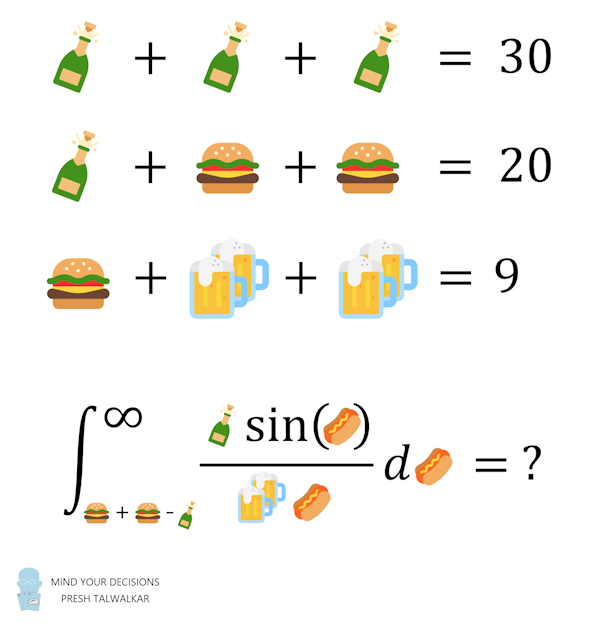
"As viral puzzles became popular, mathematicians joined the game too. Here’s a fun puzzle that has been widely shared."
19


So looking at this Aaronson post and this easier to grasp codegolf post, you're presented with programs that only terminate if these theories are inconsistent. They're very long running in the mathematical sense of "long", but putting aside any philosophical objections, say you ran one and it eventually terminated. How surprising is that?

20


some links are broken but otherwise good. Post your open source math textbooks here

21
4
submitted 2 years ago by goosethe to c/math
22


cross-posted from: https://lemmy.sdf.org/post/36227

Abstract: "Prompting is now the primary way to utilize the multitask capabilities of language models (LMs), but prompts occupy valuable space in the input context window, and re-encoding the same prompt is computationally inefficient. Finetuning and distillation methods allow for specialization of LMs without prompting, but require retraining the model for each task. To avoid this trade-off entirely, we present gisting, which trains an LM to compress prompts into smaller sets of "gist" tokens which can be reused for compute efficiency. Gist models can be easily trained as part of instruction finetuning via a restricted attention mask that encourages prompt compression. On decoder (LLaMA-7B) and encoder-decoder (FLAN-T5-XXL) LMs, gisting enables up to 26x compression of prompts, resulting in up to 40% FLOPs reductions, 4.2% wall time speedups, storage savings, and minimal loss in output quality. "

23
24
3
The TeX book (drive.google.com)
submitted 2 years ago by goosethe to c/math
25
view more: next ›