this post was submitted on 13 Jan 2026
112 points (100.0% liked)
History Memes
2181 readers
2177 users here now
A place to share history memes!
Rules:
-
No sexism, racism, homophobia, transphobia, assorted bigotry, etc.
-
No fascism (including tankies/red fash), atrocity denial or apologia, etc.
-
Tag NSFW pics as NSFW.
-
Follow all Piefed.social rules.
-
History referenced must be 20+ years old.
Banner courtesy of @setsneedtofeed@lemmy.world
OTHER COMMS IN THE HISTORYVERSE:
- !historymusic@quokk.au
- !historygallery@quokk.au
- !historyruins@piefed.social
- !historyart@piefed.social
- !historyartifacts@piefed.social
- !historyphotos@piefed.social
founded 10 months ago
MODERATORS
you are viewing a single comment's thread
view the rest of the comments
view the rest of the comments
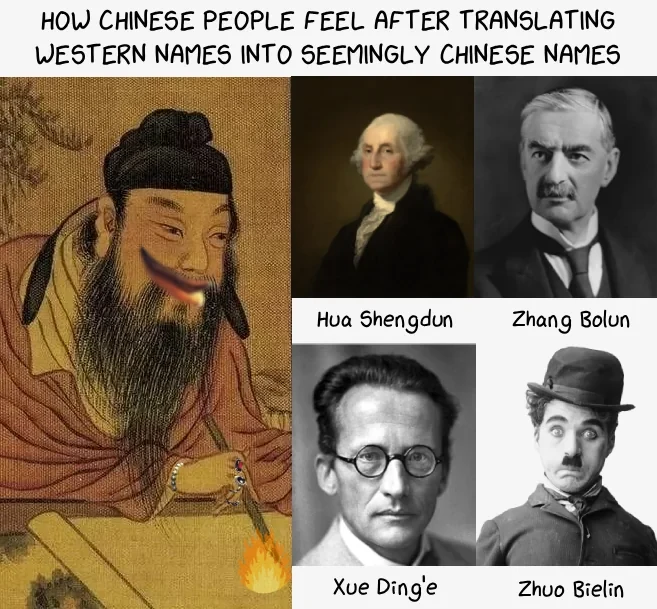
Before the modern era, many cultures chose to translate foreign names into more 'familiar' forms - such as the Roman Marcus Antonius being transliterated into English as Mark Antony, or the Arabic scholar Ibn Sina being Latinized by medieval Catholics into Avicenna. Or, for medieval Euros doing it to each other, Charlemagne being also known as Karl der Große and Carolus Magnus.
Here, some old Chinese translations of Western names are shown, and it's pretty neat. Clockwise from the top-left:
George Washington (Hua Shengdun)
Neville Chamberlain (Zhang Bolun)
Erwin Schrodinger (Xue Ding'e)
Charlie Chaplin (Zhuo Bielin)
Do those "local" names sound in a similar way as originals or there was some other logic behind these renames?
They sound somewhat similar to the originals (say 'Hua Shengdun' quickly, and then 'Washington'), while also making it clear that it's a name and not just a collection of gibberish from a typo or the like. It may also have been easier to write with Chinese characters.
In the modern day, we're more understanding of the fact that language families can sound radically different from one another.
I want to add that even today, it's the convention to refer to foreign names using the closest sounding Chinese characters. 華盛頓 is simply how George Washington would be referred to in Chinese today. Which character is used can also vary depending on the dialect/language used because it is pronunciation based, and the different dialect/language are pronounced differently (duh).
Trump, for example, is 特朗普 dak6 long5 pou2 in Cantonese and 川普 Chuān pǔ in Mandarin. Biden is the same for both, 拜登 baai3 dang1 in Cantonese and Bài dēng in Mandarin.
(goodbye darn)
It took several tries, but I understand now. Those Chinese names sound roughly like the last name of the person.