this post was submitted on 15 Mar 2026
124 points (98.4% liked)

Space

9088 readers
106 users here now

News and findings about our cosmos.


Subcommunity of Science


This community's icon was made by Aaron Schneider, under the CC-BY-NC-SA 4.0 license.

founded 4 years ago
MODERATORS
 
all 40 comments
sorted by: hot top controversial new old
[–] tomiant@piefed.social 8 points 18 hours ago* (last edited 18 hours ago) (1 children)

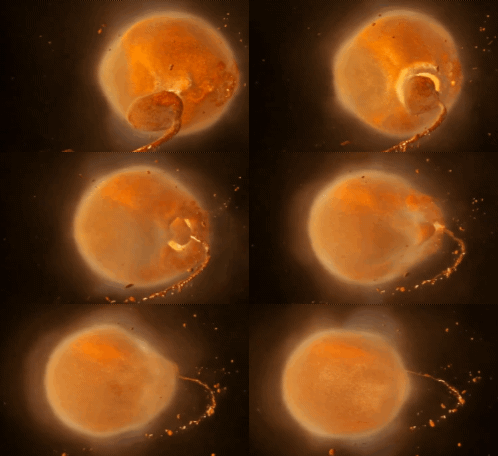
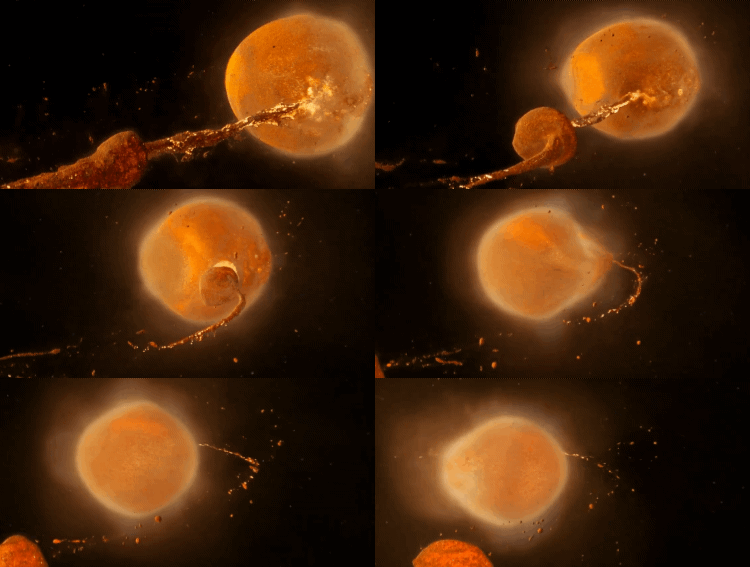
This is legitimately one of the coolest things I have ever seen.

What happened to the thing that crashed into us, just absorbed into the plasma Earth? Just the forces involved absolutely boggles the mind. Do we know what the thing was made of? Can we still detect it, did it bring with it a bunch of weird shit that wasn't on Earth before, like I don't know, whatever elements?

Does the moon retain some of the chemical-physical composition of the object? Because I am under the impression that the Moon is a chunk of Earth that got "shot off" by this thing, but should have traces left from the intermingling of stuff in the impact.

Must have been like a little proto planet that just so happened to walk into the wrong neighborhood. Or vice versa.
[–] Sausa@lemmy.blahaj.zone 8 points 17 hours ago

Here's the wikipedia page for the theory, which makes for a pretty cool read: https://en.wikipedia.org/wiki/Giant-impact_hypothesis

Some cool stuff:

  • The other body was a mars-sized protoplanet called Theia.
  • According to computer simulations, remnants of Theia could be still visible inside the Earth as two giant anomalies of the Earth's mantle.
  • By examining isotope ratios in lunar samples from the Apollo missions, we can see the moon and earth likely had a common origin.
[–] TheHolm@aussie.zone 5 points 19 hours ago

Where the link on the article?

[–] lmmarsano@group.lt 28 points 1 day ago (1 children)

gif 51.6 M

Do we know about this cool tech called video?

[–] tomiant@piefed.social 6 points 17 hours ago* (last edited 17 hours ago)

I had to look up if there was some quirky benefit to using a gif for this type of simulation rendering and the answer is no.

[–] IncogCyberSpaceUser@piefed.social 32 points 1 day ago* (last edited 23 hours ago) (3 children)

I like how this looks like earth is taking a big slurp.

Here with more lead up.

spoiler

[–] tomiant@piefed.social 5 points 18 hours ago

That's what your mom looked like last night.

[–] fernandofig@reddthat.com 11 points 1 day ago
[–] rants_unnecessarily@piefed.social 23 points 1 day ago (1 children)

That impact is insane. It's like they are balls of liquid.

Imagine if there had been life, or if that happened now. Everything and anything just gone. In an instant. Not even fossil records or anything left over.

[–] Womble@piefed.world 31 points 1 day ago (2 children)

Planets are balls of liquid really, they might have a thin shell that's solid but they behave as a liquid under pretty much any interaction. For gentle interactions they stay as near perfect spheres as a liquid under self gravity does. For more violent interactions they behave like the simulation shown.

[–] rants_unnecessarily@piefed.social 10 points 1 day ago* (last edited 1 day ago)

That makes sense. I've always understood that the core is molten and seismic plates move about on a semi liquid. But I hadn't thought about it as a whole.

We are standing on a very thin crust of a ball of very hot liquid.

[–] MajorMajormajormajor@lemmy.ca 6 points 1 day ago (2 children)

Does that make the planets eggs? Hard outer, but thin, shell with a liquid core?

[–] GreyEyedGhost@piefed.ca 7 points 1 day ago (1 children)

They even have a different density for the "yolk".

[–] MajorMajormajormajor@lemmy.ca 6 points 23 hours ago

They should rename the movie "The Core" to "The Yolk".

[–] Nawor3565@lemmy.blahaj.zone 4 points 1 day ago (2 children)

Only certain planets (like ours) actually have a liquid core with a solid outer crust. Most rocky planets are like Mars, completely solid all the way through.

I believe what the other commenter was getting at is that, on large scales, the solids that make up planets behave like liquids do at smaller scales. Since if you zoom out, there's not much different between a bunch of rocks loosely held together with gravity and a water droplet weakly held together by surface tension.

[–] tomiant@piefed.social 3 points 17 hours ago* (last edited 17 hours ago)

Could this object that drive-by slammed into Earth be the source of the iron for that molten iron core we have or did the Earth already have it?

[–] Womble@piefed.world 7 points 1 day ago (2 children)

Even if they are "solid" at a human sized scale they are effectively liquid on a planetary scale. Gravity is just so much stronger than the internal stiffness at that scale that they behave as if they are a liquid with effectively no interal stiffness. That's why as you get smaller down to moons and asteroids you start to se shapes that arent spheres, the materials strength has sufficient strength to be able to resist gravity at those scales and the material is acting more like a solid.

[–] absGeekNZ@lemmy.nz 3 points 6 hours ago

Gravity is so weak, that the electromagnetic force (the one that determines solid/liquid/gas) can resist its influence until you get to planetary scales.

Mountains can only exist because of the utter feebleness, of gravity.

To overcome the coulomb barrier; to achieve nuclear fusion; you need a stars mass of material forcing the nucleons together.

As you said, "at that scale", which is totally correct. I'm just trying to ensure that anyone reading this doesn't get the impression that gravity is strong compared to the other fundamental forces.

[–] tomiant@piefed.social 2 points 17 hours ago
[–] cabbage@piefed.social 9 points 1 day ago (2 children)

If this was to happen next week, what would it mean for life on earth? I get that I would probably have to cancel my appointments, but what's the most complex form of life that could realistically survive the blow, if any?

[–] mech@feddit.org 12 points 21 hours ago* (last edited 19 hours ago) (1 children)

It would negatively affect the trout population.

Edit for serious answer: It would burn away the atmosphere and boil off the oceans, so all multicellular life would be gone.
Anoxic single-celled organisms living deep inside the bedrock could survive.

[–] Firnin@feddit.org 6 points 21 hours ago (1 children)

Oh no, not the trout population! 😱

[–] Ceruleum@lemmy.wtf 1 points 9 hours ago

Even the woman and the children!

[–] AnarchoEngineer@lemmy.dbzer0.com 11 points 23 hours ago (3 children)

If the entire crust is liquified, it is likely no life survives. However if chunks of still solid earth are thrown off the planet, get trapped in orbit, and eventually fall back down to the surface after it mostly resolidifies, some bacteria/archaea might be able to recolonize.

There are bacteria that can survive launch and atmospheric reentry. I’d imagine being embedded in a solid rock would help with this and it’s common to find archaea deep in the earth. Archaea are simple single cells but they are almost all extremophiles or just durable as hell enough to not care about environments we’d call extreme. (Some don’t do too well in oxygen though, hence the thriving underground)

Bacteria are also single celled, but more complex. This is where photosynthesis could restart without having to evolve again. And while bacteria are typically more sensitive to the environment than most archaea, there are bacteria that can survive launch, space, and atmospheric reentry.

As for multicellular life… larger organisms tend to be dependent on smaller ones. So hopefully the complex things that could survive ejection fall back down after bacteria recolonize the surface first.

Some fungal spores are likely to survive via ejecta just like the bacteria/archaea would. But without organic matter to eat or bond with, it’s unlikely those spores would reawaken. To be fair, fungal spores could probably just wait for ideal conditions before waking up so even some mushrooms might survive, they’d just not wake up till the surface is recolonized by other microbes.

Tardigrades are the most complex life I think might be able to survive. They can also do something similar to fungi but it would take some luck to make sure they were in their hibernating state before ejection and that they stay in that state through reentry and impact and onwards until there is water and a stable food source enough to sustain them.

[–] Paragone@piefed.social 4 points 19 hours ago (1 children)

Bacteria predate archaea, btw..

_ /\ _

[–] AnarchoEngineer@lemmy.dbzer0.com 3 points 18 hours ago

Good to know, this isn’t my field and I was definitely correlating eukaryotes with bacteria and prokaryotes as archaea. My bad

[–] TheHolm@aussie.zone 3 points 19 hours ago (1 children)

you forget lichen. These guys do not need anything but water and some substrate.

[–] AnarchoEngineer@lemmy.dbzer0.com 3 points 18 hours ago

Lichen requires phytobacteria or some algae though right? It’s a symbiotic relationship between a fungus and a photosynthesizing microbe right?

I was thinking more on the lines of single organisms. I guess if that pair made it to space and came back that’d probably work though

[–] cabbage@piefed.social 4 points 22 hours ago

Fantastic answer, thank you! I was thinking about tardigrades, I heard they can survive in space but this would clearly require a little more than that.

The fungal spores lying dormant waiting for the right time to reawaken sounds like a crazy sci-fi plot.

[–] Danarchy@lemmy.nz 8 points 23 hours ago

Always knew the moon was a rush job. They din’t want you to see the other side which is all ugly and looks dumb as hell. Fukn moon JFC

[–] Paragone@piefed.social 3 points 19 hours ago

Those dinosaurs got off EASY, compared with all the people who were here then, eh?

  d :

_ /\ _

[–] Damage@feddit.it 10 points 1 day ago

What's the source for the video?

[–] Snoopy@tarte.nuage-libre.fr 11 points 1 day ago* (last edited 13 hours ago) (1 children)

This video raise more question than answer :

  • what was the state of earth and moon ? They were giant ball of lava ?
  • there was no sea ?
  • and considering that the space is very cold, why the sun stay hot ?

Thank for your help :)

[–] RickyRigatoni@piefed.zip 22 points 1 day ago (2 children)

The sun stays hot because she puts a lot of work into her appearance

[–] Snoopy@tarte.nuage-libre.fr 2 points 13 hours ago

Even in the cold ? That's crazy.

She got curves!

Probably a lot longer until all the remaining bits in orbit settled into place tho.

[–] Hirom@beehaw.org 1 points 1 day ago

tis but a scratch

[–] MetalSlugX@piefed.social -2 points 1 day ago* (last edited 18 hours ago)

Fuck this bullshit.

E I mean really? Am I out of line here, if I am please someone let me know. Because I'm not understanding how this would go here?