Title text:
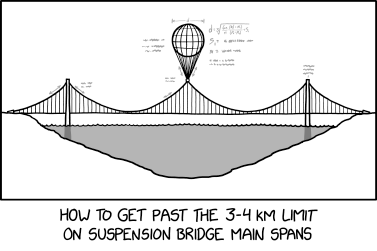
Wind stress? Don't be silly. When has wind stress ever been a problem for a suspension bridge?
Transcript:
Transcript will show once it’s been added to explainxkcd.com
Source: https://xkcd.com/3279/
A community for a webcomic of romance, sarcasm, math, and language.
Title text:
Wind stress? Don't be silly. When has wind stress ever been a problem for a suspension bridge?
Transcript:
Transcript will show once it’s been added to explainxkcd.com
Source: https://xkcd.com/3279/
At 99°C (210°F) the lift power of hot air balloon is 0.25 kg per m³. Pillars supporting a four kilometre long suspension bridge section are under 200 MN vertical load, or 20 million kg. The air balloon would have to be 80 million m³ large, or 534 m (⅓mi) in diameter.

Proof engineers want us to have fun, but silly government won't let them
Ah yes the ol' Tacoma wibbly wobbly
I heard that's going to be the next episode of WTYPP
Looks like Randall has been playing some Poly Bridge.

So to keep the balloon filled and maintained, I'm thinking we get a low paid part-time worker. They'll have to be on call for emergency needs of course so open availability.
And to make sure they do the job right, perchance an underfunded, understaffed regulation and inspection system?
we might as well fire the regulatory committee, we haven't had issues with collapsing bridges in 50 years!
You got upper management written all over you, thank you for your shareholder value generation talents.
We're running low on helium, hydrogen ok with you?
Actually, yes. I think we should be looking more at using hydrogen as a lifting gas, helium is too precious to squander on balloons. Its flammability can be mitigated in a variety of ways, Hindenburg was badly designed as a hydrogen airship (it was originally meant to use helium).
Its flammability can be mitigated in a variety of ways
That sounds interesting to me, what are those ways?
Good ventilation is the main one I'm aware of. Hydrogen is only flammable when there's a particular range of mixture with oxygen. If it's too dilute then it won't burn, and the same in the other direction with not enough oxygen mixed inside the hydrogen. So a leak that goes straight into the outside air is not really super dangerous, the hydrogen shoots up and away and quickly dilutes to non-flammability.
In Hindenburg's case there were multiple internal gas bladders contained by the aerodynamic outer envelope, held in place with frames and with walkways and other gaps between, so there were a lot of spaces for a mixture of air and hydrogen to accumulate and reach the right mix to burn. They had no way to reliably detect that this was happening, back then they didn't have sensors and relied on crewmen literally walking around listening for hissing sounds or "shimmering" air where gas of different densities were mixing. Since Hindenburg was originally intended to use helium lifting gas it wouldn't have been a problem, but switching to hydrogen should have caused a complete redesign to eliminate these internal spaces and ventilate better. And in a modern airship sprinkle the thing with sensors so you can immediately know if there's a leak.
The actual ignition of the Hindenburg is thought to have been due to a static discharge spark. Hindenburg's outer skin was somewhat insulated from its inner framework and the air and ship were charged due to a thunderstorm that had recently passed by. When the crew dropped ropes to the ground this grounded the inner framework and caused sparks between the outer envelope and the framework as it tried to dump its charge into the ground as well. Again not a problem for a helium airship, but something that should have been subject to a redesign for a hydrogen one. Make sure the whole ship is properly grounded and then there won't be charge differences to cause sparks inside it.
Note that there's a theory that was proposed a while back that Hindenburg's outer envelope was super flammable in its own right and was the actual source of most of the fire. It was made of cotton painted with cellulose acetate butyrate along with iron oxide and fine aluminum powder - similar in composition to thermite or solid rocket fuel. But tests were done with recreations of the material and although it was indeed flammable it didn't burn anywhere near fast enough to account for the speed with which the Hindenburg was destroyed. Probably still something to avoid with modern materials, though. Don't make your hydrogen airship out of stuff that could catch fire.
We could mix it with oxygen, which is plentiful, at a ratio of around 4:1.
It makes the hydrogen self heating, giving the balloon increased lift.
Well, briefly.
We have stakeholders that could help produce a stronger synergy so NatGas on some at least. Can we mix them?
Why not get a worker from a country so poor that they'll do anything to avoid being sent back, even let you exploit them illegally?
I'm surprised they didn't do the math for a geosynchronous orbital support
Just build the bridge on the moon instead. The lower gravity really helps with the main span.
Just tether the middle to the moon instead of the balloon.
Good ol' geostationary moon.
Give it a few eons.
I don't even want to give any of this until Monday.
When has wind stress ever been a problem for a suspension bridge?
On the next WTYP!
Oh the humanity!