AnarchistArtificer

joined 2 years ago
MODERATOR OF
[–] AnarchistArtificer@slrpnk.net 3 points 3 days ago (1 children)

I'm really glad you made this comment, because otherwise I was going to have to be the one to make this comment, and I wouldn't have explained things nearly as well as you did.

You have my sword!

  • Sincerely, Me, a natural scientist
[–] AnarchistArtificer@slrpnk.net 3 points 3 days ago (1 children)

It's analogous to a combined count of how many people have commented on the post, or shared it (or "reblogged", to use the Tumblr term). It might also include likes? I only use Tumblr occasionally so I'm not sure.

I don't know why Tumblr counts things like this. I sort of like it though — it makes it feel like a distinct place. Tumblr hasn't escaped enshittification, but it makes me happy that it still exists as a little pocket of weirdos

Years ago, I read that a great tip for compliments is to stick to stuff that people have chosen. So things like dyed hair, jackets with patches on, badges, band t-shirts, or indeed hair accessories.

It's certainly possible to successfully compliment people on things they can't change, like body features, but it takes more skill and can be risky if you don't know the person. I spent a long while practicing giving compliments on the safer things that I mentioned, as a sort of 'grinding social XP' challenge, but I ended up really enjoying it

[–] AnarchistArtificer@slrpnk.net 20 points 4 days ago* (last edited 4 days ago) (4 children)

The CPU is the silver squarish shape towards the right. It generates a lot of heat when in use, so having good cooling for it is important. So important that CPUs come with a fan in the box. This involves a heat sink to help draw heat away from the CPU. This screws on mounting points around the CPU, but thermal paste is also used to help heat transfer up. Then there's a fan that attaches to that heat sink, so that the hot air from the CPU can be blown away from the CPU.

People spend a heckton of money on cooling for their CPU and GPU, because when things overheat, they throttle themselves and performance becomes super slow. Longevity of components can also be harmed by higher temperatures. If it gets too bad, then it will crash entirely.

This PC has put the CPU heatsink on the case fan on the left. I don't think this is especially harmful in and of itself — the big problem is that the CPU is entirely "naked" and has no cooling whatsoever. This means the CPU begins overheating basically as soon as the PC is turned on.

Edit: you can actually see where the heat sink should match up to the CPU here

[–] AnarchistArtificer@slrpnk.net 8 points 4 days ago* (last edited 4 days ago)

The big silver heat sink that's on the left is meant to be on the CPU, which is the Silver squarish shape towards the right. Keeping the CPU cool is a big deal — CPUs come with a smaller fan which is sufficient for many people, but people who use their PC more intensively, or want to extend the life of their CPU typically buy an additional cooler. Here's an example of a stock cooler, and here's a motherboard that's using the fairly basic aftermarket CPU cooler that I have. It was only $30, but when I was new to PC building, it was strongly recommended, because if your CPU gets too hot, it'll throttle itself and slow down. People who over clock their CPU (running it at a higher voltage for better performance) have to get even beefier cooling, such as water cooling. You can completely fry your CPU if you do something wrong when overclocking, and even if it doesn't get that bad, minor mistakes can cause crashes due to CPU overheating.

So TL;DR: keeping your CPU cool is super important for both performance and longevity of the CPU.

The PC in the top photo has zero cooling for the CPU. Not even the stock fan that comes with the CPU. That heatsink that's attached to the case fan is almost certainly intended for the CPU — you don't even need a heatsink in that location.

This means that this person's CPU will rapidly overheat soon after it is turned on.

Edit: you can actually see where the heat sink should match up to the CPU here

[–] AnarchistArtificer@slrpnk.net 9 points 4 days ago (1 children)

Proactively communicating your needs and preferences makes things a bit better for everyone, and takes an immense amount of vulnerability to do so. Good girl xx

Piggybacking off this to add more lightbulb jokes.

The best joke I've ever heard was delivered by a German friend with an incredible deadpan delivery

How many Germans does it take to screw in a lightbulb?

!"One. We are a very efficient people"!<


Another one!

How many emos does it take to change a lightbulb?

!None. They all just sit in the dark crying.!<

(I should clarify that I find this one funny because when I first heard it, it very much applied to me. I felt mildly attacked, but not in a hurtful way)

Piggybacking off your comment to leave a pirate joke of my own.

"What's a pirate's favourite letter?"

(Ideally, the audience will reply "Arrr!" this this. It works best if you prime them for this by doing a bad pirate impression earlier in the conversation, or tell a joke such as "What's a pirate's favourite animal? An aardevark!")

"You might think so, but a pirate's true love be the C (sea)"


Bonus joke! What's a pirate's least favourite letter?

!Dear Sir or Madam, your IP address has been recorded downloading infringing copyrighted material on...!<

[–] AnarchistArtificer@slrpnk.net 9 points 4 days ago* (last edited 4 days ago) (1 children)

I'm sad that Jimmy Carter won't get to see this.

He once said that he hoped that the last Guinea worm would die before he did. His nonprofit, the Carter Foundation, did incredible work in pushing forward here. He was able to negotiate a 6 month humanitarian cease fire to allow aid to high-conflict areas of South Sudan, which had one of the highest incidence rates for Guinea worm disease.

Damn, you look incredible. I love your makeup as well. You're the kind of person who I would notice while out and about, and think "wow, she looks so cool, I wish I could be her friend"

[–] AnarchistArtificer@slrpnk.net 9 points 5 days ago (2 children)

That's an absolutely giant cat and surely must be of significant scientific interest


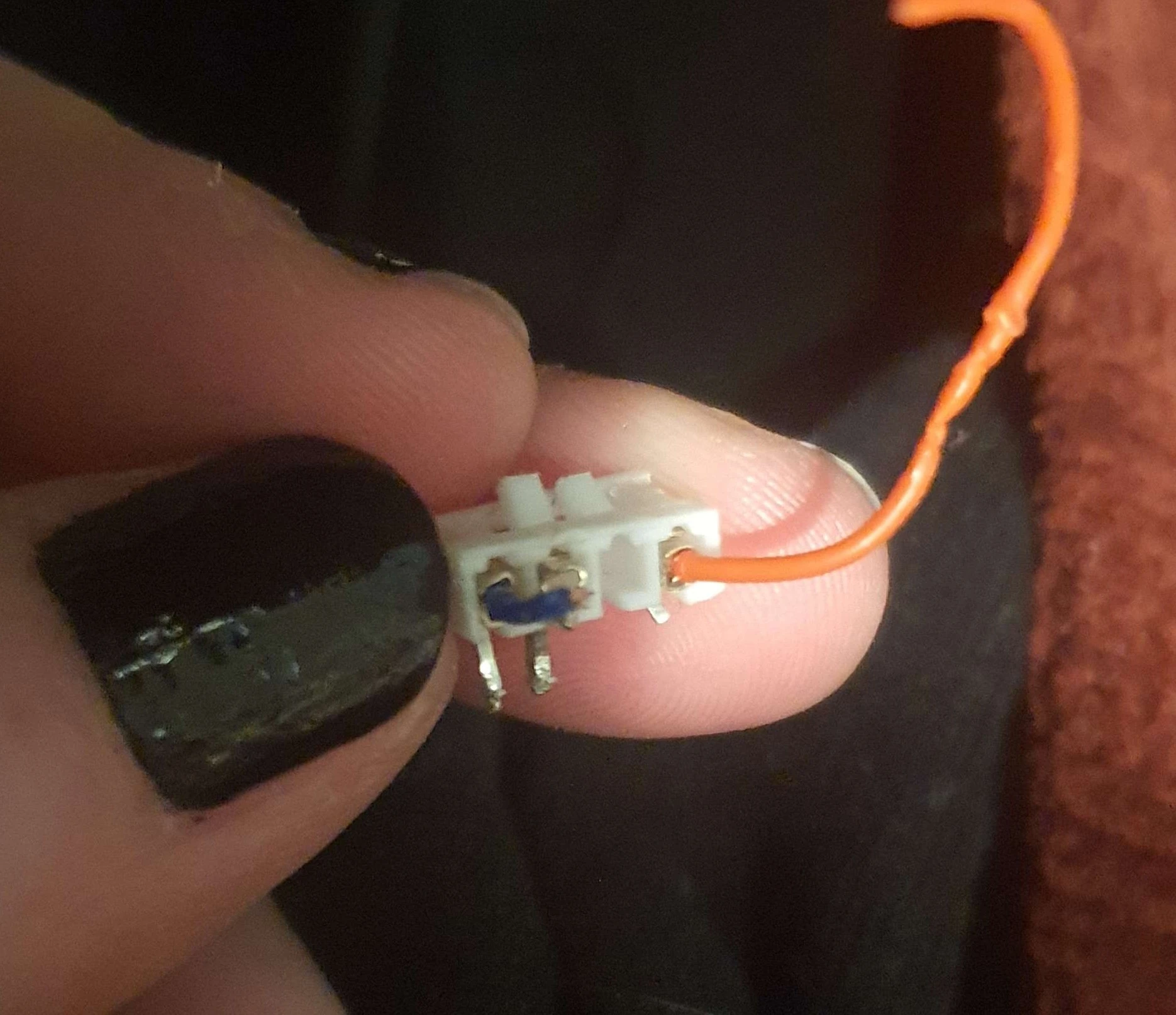
I am helping a friend to repair her amplifier. A different friend took a look at it, and they were able to identify the circled part as being the one to blame. However, apparently this is a part that was made specifically for this amplifier and is no longer made, so my task is to figure out what to do. I have some electronics expertise, but mostly I was recruited because I am good at finding things.

However, it would be a good start if I knew what this component was. I've not been able to find it in any of my reference materials, so I was wondering if y'all might be able to help. The person who identified this part is not able to help clarify, as she's off the grid for the next 3-4 months.

(On the off chance that someone here has some specific expertise on this particular amp, it's the Kenwood KA-3020SE)

Edit: Now that I know it's a potentiometer, the biggest challenge is understanding what 200KBH what is necessary to replace the part. It's a 200kΩ one, that's straightforward enough. It also seems that the "B" means linear response (found by checking my electronics reference book section on potentiometers, and cross referencing with other balance control pots for other amps, which specifies linear). I'm puzzling about what the H could mean though.

The big challenge, I'm told, is finding a part that will physically fit. There are 6 contacts on the part, which means it's a dual ganged potentiometer. However, most that I can find online have the pins in a 2*3 arrangement, like this, whereas this one is 1x6, like this.


I wrote this as a long comment in reply to this thread and I was proud of it, so wanted to share it further (Shout-out to the OP of the meme, @LadyButterfly@piefed.blahaj.zone , who is a wonderful presence wherever she goes)


Step 1: throw away self help books that are aimed at neurotypicals. The advice in them is probably not helpful for us, and will just exacerbate internalised ableism. Not only will it take different strategies to get there, but "composed and focussed" will look different for you than it will for neurotypical people.

For example, a friend I had found that she was only able to complete her university essays when she engaged in an odd sort of task circuit-training, where she had multiple different tasks that she could cycle between as soon as she found herself losing focus. To an external, neurotypical observer, this looked like absurd chaos, but that was how she found her focus.


Step 2: try your best to work against the aforementioned internalised ableism. This, unfortunately, is an ongoing task, because even once we throw away unhelpful frameworks, we can't escape from the unreasonable expectations that the world places upon us. That is not your fault, and you are not broken just because you can't fit into the pre built mould that society offers you. It is possible to build new frameworks that will comfortably fit and support you, but we're going to have to do a lot of that work ourselves. This is a task that will be an ongoing one, so proceed to step 3 whenever you feel ready.


Step 3: find neurodivergent community. This is the most important step, because it can do wonders for helping with step 2; it gets tiring to have to constantly remind ourselves that we're not broken, so it's helpful to have other people help remind us of this sometimes. Plus ADHD folk often find it's easier to care for other people than for themselves, so you might find it easier to affirm other people than yourself. That can be a good starting point for learning how to extend that same grace to yourself.

It doesn't matter whether it's online or irl, a space specifically dedicated to discussing ADHD/autism or just a hobby community with lots of neurospicy folk — just find your people. It's daunting to feel like you have to build an entire mode of living from scratch, but you're not doing it alone. Ask people what strategies they have found useful for coping, and if you find anything, share that with others too. We're not a monolith, so not everything will work for every person, but having these conversations about what works and what doesn't is super useful.


Step 4: Remember that there is no silver bullet here, no single strategy that will fix everything. I'm sorry to have to emphasise this, but the best tool is the one you use. Try not to fixate on the next shiny thing, because that's a false comfort. I know that actually using the tools and strategies is the hard part, but that's why we need to keep working at it. You will struggle with this, but that's not failure, it's part of the process. Refer back to Step 2 if you need to.


Step 5: Remember the big picture. What we're building here is social and informational infrastructure. My own experience has been improved by having access to resources and communities online that are made by and for neurodivergent people; if I were born 100 years ago, I might've ended up in an asylum. It often doesn't feel like it, but things are getting better. It's overwhelming and scary to be building something new on the margins of society, but we have the ability to improve things both for ourselves, and the people who come after us.

We're trying to do something radical here, and that will take time and a lot of work. Most of us were only taught how to be successful neurotypicals, which is something that we can never be. We are having to learn from scratch how to be successful neurodivergent people, but there isn't a simple guidebook for that. We have to muddle along as best we can and write that guidebook ourselves. In this way, learning how to live as ourselves is a powerful form of political praxis[1] (which may be a helpful thing to remember if you tend to beat yourself up about being too burnt out to engage in as much activism as you'd like).


[1] : Praxis can be generally defined as the process of putting theory or ideas into practice. In this case, we can say "we deserve better than to live believing that we are no more than failed neurotypicals", but then there's the tricky question of how do we put that ideal into practice? That's the ongoing quest. Praxis in this context also draws from how it's used in Marxist thought, which is that praxis is about actions that are oriented towards changing society.

Edit: formatting


I was just reflecting on games I've played in the last year, and wondering when Steam's year-in-review thing would be happening (probably within the next week).

However, I thought it might be interesting to ask this question before that drops, because I'd expect that people will respond differently before they've seen the data, and I think that subjective aspect of the reflection is interesting. So tell me what games you've played in the past year that have most stuck out to you. I think it's more fun if you try to go by memory, but if you want to go check stuff like whether you first played a game in December 2024 or January 2025, that's fine too; just try to not get too deep into the data, I'm interested in the vibes here.

For me, a recent highlight was Clair Obscur: Expedition 33. I didn't expect to be able to play it for a long while because of its cost, but a friend got it for me in November, for my birthday. I like that I'll always associate it with them for that reason. The game is also very me, what with its artsy fartsy themes and the like.

Before that, I played a heckton of Hades 2, which I thoroughly enjoyed, even if it didn't quite scratch the same itch that the first game did. I've not 100%ed it yet, but I plan to. My favourite part of the game is the music — the boss fight that incorporates music in a cool way is so awesome

And before that was Hollow Knight, partly motivated by hearing all the hype in the runup to Silksong's release. I'd been weirdly resistant to playing Hollow Knight for years. I think it's because when something is so universally lauded, it makes me feel oddly anxious. Like, if I don't enjoy it, does that mean I have bad taste? What if it is objectively amazing, but it just doesn't click with me, and I feel sad that I'm missing out on whatever magic everyone else is experiencing? Or what if everyone else is wrong, and the game is way overhyped? They're silly thoughts, but this is fairly common for me (this is why I resisted watching Breaking Bad for years). Fortunately I loved it, and I expect that Silksong will be one of my highlights of 2026. Beautiful soundtrack that I've listened to so much that it was in my Spotify wrapped.

The most interesting part of my year is that I branched out more and played smaller games, outside of the typical stuff I'd play, and for a delightfully silly reason: this Venn diagram(Source).

I stumbled across that when I was voraciously consuming as much Disco Elysium analysis as I could back in 2024, when I played it. I had already played Pathologic 2 (largely due to hbomberguy's video essay on the first one), as well as Planescape:Torment (because so many had cited that as a clear influence on Disco Elysium). This gave me enough points of reference on that venn diagram that I became determined to play all the games included (i.e. Disco Elysium, Pentiment, Felvidek, The Life and Suffering of Sir Brante, Planescape: Torment, Pathologic 2. The middle section is not a game, but a book (which I haven't read): Umberto Eco's The Name of the Rose)

I was utterly enchanted by this Venn diagram to an absurd degree. According to it:

  • Pentiment = Disco Elysium - Pathologic 2;
  • Felvidek = Disco Elysium - Planescape: Torment; and
  • The Life and Suffering of Sir Brante = Felvidek + Pentiment Based off the first two statements, I felt like I could approximate the vibe of Pentiment and Felvidek, but I was intrigued to test that, and I played two games I don't think I would have otherwise.

Pentiment was delightful. I played a bunch of it when a medievalist friend was visiting me, and they verified that every weird and wonderful animal drawings were actually drawn from real medieval manuscripts. They worked with multiple historians to ensure the history depicted was accurate, and it made for an incredibly immersive experience. I loved how the text in the speech bubbles were written in a different script depending on how the protagonist perceived them — more educated people speak with a fancied script than peasants, for example. It really grounds the game in the protagonist's subjective perspective, which synergised so well with the historical setting. I learned so much from this game and from analysis content of it. Apparently Josh Sawyer studied history as an undergraduate, and he'd been wanting to make a game like this for years; I'm so glad he got the chance to make it.

Felvidek is a much smaller game than Pentiment — small enough that I would have felt grumpy at its price if not for the fact that it was clearly a labour of love by a small team. It's a JROG based in a psuedo-historical version of Slovakia, which I found cool, because I knew next to nothing about Slovakian culture. I still don't, because it's not really that kind of game, but I felt like I came away understanding more. It's the kind of game where I felt close to the developer, given that it was such a small project. If you were going to try any of the games I mentioned here, I'd recommend this one, because I'd wager you've not heard of it. If it looks like the kind of game you'd play, I'd advise you go in blind to maximise the impact of the generally absurd vibes. The soundtrack was a highlight for me — it really drove home the absurdity.

Having completed these two pillars of the Venn diagram, I was finally able to complete my quest with The Life and Suffering of Sir Brante. However, I find myself running out of steam and unable to write much more, but it was a fun little experience. Not quite as out there as Felvidek, but definitely something I wouldn't have played ordinarily.

Experimenting with new games also encouraged me to push myself out of my comfort zone further, with games like Fear & Hunger, and Signalis. I'm not great with horror, but that's part of why this was fun.

Anyway, what games have been highlights for you guys? Don't feel pressured to write anywhere near as much as I have — I mostly just wrote this much because I appear to be procrastinating making dinner.


I just wanted to check, because sometimes in sapphic spaces, I feel like I'm intruding. Sometimes it's made explicitly clear that I'm not welcome, which can be quite hurtful if the event or community describes itself with terms I use for myself, such as "sapphic" or "wlw". In this case though, this community is named "lesbians", so I wouldn't take it personally if y'all would prefer that bi women don't post or comment here, I just want to be clear about expectations; I once had someone accuse me of cultural appropriation for having carabiners on my tool harness, so I've ended up becoming a tad hypervigilant about overstepping.

Regardless of what the answer to this post is, it might be worthwhile to put something in the community info


cross-posted from: https://slrpnk.net/post/31304759

Cardigan in progress

Here's a cardigan I've been working on for a friend. I started it back in April, for her birthday in May. I underestimated how long it would take (though part of this is because I moved in the middle of all of this).

I'm proud of my progress, even though there's a lot to do still. The mesh is just a (1dbl, 1ch) repeated. I started at the back and did a large rectangle. (Using US terminology)

For the front, I started at the shoulders and then worked downwards with the same mesh stitch. I'd do one increase at the inner edge of edge front panel on every other row. So at the very top, if I was starting from the outer edge (what was intended to be the shoulder seam), that was (1dbl, 1ch)*8, then when I started a new row, I did an increase with two doubles in that first stitch. The next row after that had no increases.^[1] I was sort of winging it, but I like how gradually it increased.

I didn't use a pattern because in most of the craft stuff I've ever done, I tend to prefer to make life much harder for myself and understand things from the ground up. That's part of why this has taken so long.

However, it turns out I underestimated how large the back panel should be (this is why patterns tell you to do a gauge swatch I guess). This caused me some difficult in deciding what to do about the fact that there was insufficient space for both the neck and the shoulders. I spent a while looking at if there were ways to extend that main panel, but in the end, I decided to make a long strip for each side that I will seam onto the main body when I'm done. On the bright side, being able to work on the sleeves separately means that it's easier to keep the work a secret from my friend (I live with her, and she thinks that I'm experimenting with some weird mathematical crochet. I don't think she suspects anything, because I was able to redirect by rambling about crochet is super cool for being uniquely able to make mathematical forms like hyperbolae (the best lies always have a granule of truth)

I found the sleeves tricky because I've never crocheted into the side of stitches before, and I spent a while figuring out how to do that in a manner where the stitches for the armhole would be evenly spaced. My original plan was to do this directly into the body, but instead I did it into the addition strip I did to extend the shoulder, but besides that, not much changed. A big tip if you're crocheting into the sides of stitches is to always make sure you go under at least two pieces of yarn, because otherwise the tension caused by the new stitch pulls the existing stitch out of whack a bit. This might be obvious to most people, especially given that in a regular crochet stitch, you go under both of the loops of a stitch, but like I say, doing it freestyle usually involves making things harder for myself in the pursuit of learning.

It didn't help that my stitches seem to be quite tight, so there wasn't much space to get the hook through without splitting the yarn. I ended up "scouting out" where I wanted to put the stitches by poking a smaller crochet hook through to open up the gap better, as well is judicious use of stitch markers for that first row of the sleeve. I was way too persnickety about this, but I'm pleased with how it turned out.

For the sleeves, I ended up switching to treble crochet (US), because I was impatient with how long it was taking. The problem here is that I found that there was too large of a gap at the top of each stitch (i.e. where you insert your hook when making stitches during the next row). I looked all over for tips, and I practiced a bunch to improve my tension, but to little avail. The various tips I found did help, but not nearly as much as I'd like. I suspect it'd be easier if I had more practical experience, but I just couldn't get it consistent, despite practicing on swatches on and off for weeks (I use parcel string from the post office for practicing on). This problem did exist for the double stitches too, but not nearly as badly.

I did find a solution though. I'm almost certainly not the first one to discover this, but I couldn't find anyone talking about this online. What I found worked was to do one less yarn over (yo) than was required for the stitch (which means that for a treble, which usually starts with two yo, I only did one). After pulling up a loop through the stitch, I'd have three loops on my hook, like what you'd have for a double stitch. I'd proceed as normal until I had two loops on my hook, and then I'd drop one of the loops of my hook, holding it with my fingers so I could pick it up again afterwards. Then I would insert my hook beneath the bar that was better the developing post of my new stitch, and the preceding stitch, before picking up that dropped loop again (resulting in three loops on the hook). Then I'd just finish the stitch as normal ((yo, pull through two loops)*2). It worked surprisingly well. If people are interested, I could do a larger write up of this technique. If anyone knows of someone who has also figured this out, or if it has a name, let me know — I'd love to learn more)

There's still lots to do, especially as I'm planning on doing bell sleeves. That was another part of the delay. I did look for advice online for this, but I was unsatisfied with what I found, and opted to spend a while trying to understand the geometry of increases. If people are interested in this, I can share my calculations when I get to that point (I did a bunch of maths and trials, and I put the note away safe until I get to that point, nearer the elbow (which is pretty soon actually, now that I've cracked the treble problem).

Tools and materials used: I used a 4.0mm hook, mostly because it's my favourite one I own. It's the addi swing hook and it's a sort of ergonomic shape that works well with how I like to hold my hooks (though it's awkward for people who like to hold their hook differently, such as my friend, who has also been learning crochet).

The yarn is King Cole Linendale in Damson. I went for it because it's a cotton, viscose and linen blend (57%, 30% and 13% respectively) and I wanted to make something that'd be cooler for Summery months (bear in mind this was intended as a gift for a May birthday). The yarn is quite splitty, but not overly so. I did have to be careful with it though, and occasionally I have to reintroduce twist into the yarn because right handed crochet stitches introduce twist opposite to the twist of the yarn, which causes it to untwist. I would do this by periodically holding the work up in the air, tying a half hitch knot around the ball of yarn so I can dangle it below the work without it all unwinding, and then spinning the yarn round to reintroduce twist into the yarn. I'd then smooth my fingers over the yarn a bit to try to even out the twist a bit so it doesn't gather all in one area. I wouldn't advise you do this though, because it seems like it's a lot of faff, hard to do consistently, and may lead to areas of excess or insufficient twist in areas of the yarn. A drapey garment like this seems like it will especially require blocking, but this twist problem means that is even more so the case. Blocking should help alleviate it though.

In an ideal world, I'd have been able to find some yarn with the kind of fibre blend I wanted but was also Z-twisted (as opposed so S twist, as this is). I've done a lot of work understanding yarn twist, so I could also make a post about this if y'all want. I did some silly experiments that involved learning way more about knot theory than was reasonable, so I think I have stuff to add beyond what you tend to read about yarn twist online (not necessarily useful stuff, but I find it interesting). I'm also planning on practicing left handed crochet so that I can use S twisted yarns for crochet more easily.

A cute touch that I have yet to do that y'all will probably appreciate it that I was planning on crocheting a small Swatch and sewing it into the cardigan loosely, like one would a label. This is so that my friend has spare yarn should there be any damage to it. That seems likely, given that the mesh may be prone to getting snagged. My friend is a crocheter, so I want to facilitate her being able to make repairs if necessary. I like this idea because it feels like it encapsulates so much of what I enjoy about crafting items; even if I were more proficient and didn't spend so much time overcomplicating things for myself, a garment like this would still take hours and hours to complete. I like that though. Handicrafts feel like a project of macro-scale mindfulness, and thus this is a little artifact of my resistance against the slop economy we're all living under. I would argue that engaging in crafts in this way is a powerful form of political praxis (though we need to be mindful to not slip into counter-productive consumerism, as I see craft communities and content often do)

Anyway, let me know what you guys think, either of the work in progress itself, or things I've mentioned in this post. Do let me know if you'd be interested in me going into more detail on anything in separate posts. What I've made, nor what I've learned is all that impressive, but I liked writing this post. I don't even know if I'm subscribed to this community yet, but when I realised that this was a space I could share my progress, I thought it'd be cool to contribute to the community. I'm subscribed to a few different craft communities on Lemmy, which are delightful, but often done have much posted to them at the moment. Even if what I have written here isn't super interesting or well written, it's nice to feel like I'm contributing to something. I wrote this post with myself as the intended audience, because I love reading about people's process and learning journey, even if it's in a hobby I don't do, or if it's stuff I already know. The modern internet is often grim, but I love how it enables me to connect with people who are weird in the same ways that I am.


Here's a cardigan I've been working on for a friend. I started it back in April, for her birthday in May. I underestimated how long it would take (though part of this is because I moved in the middle of all of this).

I'm proud of my progress, even though there's a lot to do still. The mesh is just a (1dbl, 1ch) repeated. I started at the back and did a large rectangle. (Using US terminology)

For the front, I started at the shoulders and then worked downwards with the same mesh stitch. I'd do one increase at the inner edge of edge front panel on every other row. So at the very top, if I was starting from the outer edge (what was intended to be the shoulder seam), that was (1dbl, 1ch)*8, then when I started a new row, I did an increase with two doubles in that first stitch. The next row after that had no increases.^[1] I was sort of winging it, but I like how gradually it increased.

I didn't use a pattern because in most of the craft stuff I've ever done, I tend to prefer to make life much harder for myself and understand things from the ground up. That's part of why this has taken so long.

However, it turns out I underestimated how large the back panel should be (this is why patterns tell you to do a gauge swatch I guess). This caused me some difficult in deciding what to do about the fact that there was insufficient space for both the neck and the shoulders. I spent a while looking at if there were ways to extend that main panel, but in the end, I decided to make a long strip for each side that I will seam onto the main body when I'm done. On the bright side, being able to work on the sleeves separately means that it's easier to keep the work a secret from my friend (I live with her, and she thinks that I'm experimenting with some weird mathematical crochet. I don't think she suspects anything, because I was able to redirect by rambling about crochet is super cool for being uniquely able to make mathematical forms like hyperbolae (the best lies always have a granule of truth)

I found the sleeves tricky because I've never crocheted into the side of stitches before, and I spent a while figuring out how to do that in a manner where the stitches for the armhole would be evenly spaced. My original plan was to do this directly into the body, but instead I did it into the addition strip I did to extend the shoulder, but besides that, not much changed. A big tip if you're crocheting into the sides of stitches is to always make sure you go under at least two pieces of yarn, because otherwise the tension caused by the new stitch pulls the existing stitch out of whack a bit. This might be obvious to most people, especially given that in a regular crochet stitch, you go under both of the loops of a stitch, but like I say, doing it freestyle usually involves making things harder for myself in the pursuit of learning.

It didn't help that my stitches seem to be quite tight, so there wasn't much space to get the hook through without splitting the yarn. I ended up "scouting out" where I wanted to put the stitches by poking a smaller crochet hook through to open up the gap better, as well is judicious use of stitch markers for that first row of the sleeve. I was way too persnickety about this, but I'm pleased with how it turned out.

For the sleeves, I ended up switching to treble crochet (US), because I was impatient with how long it was taking. The problem here is that I found that there was too large of a gap at the top of each stitch (i.e. where you insert your hook when making stitches during the next row). I looked all over for tips, and I practiced a bunch to improve my tension, but to little avail. The various tips I found did help, but not nearly as much as I'd like. I suspect it'd be easier if I had more practical experience, but I just couldn't get it consistent, despite practicing on swatches on and off for weeks (I use parcel string from the post office for practicing on). This problem did exist for the double stitches too, but not nearly as badly.

I did find a solution though. I'm almost certainly not the first one to discover this, but I couldn't find anyone talking about this online. What I found worked was to do one less yarn over (yo) than was required for the stitch (which means that for a treble, which usually starts with two yo, I only did one). After pulling up a loop through the stitch, I'd have three loops on my hook, like what you'd have for a double stitch. I'd proceed as normal until I had two loops on my hook, and then I'd drop one of the loops of my hook, holding it with my fingers so I could pick it up again afterwards. Then I would insert my hook beneath the bar that was better the developing post of my new stitch, and the preceding stitch, before picking up that dropped loop again (resulting in three loops on the hook). Then I'd just finish the stitch as normal ((yo, pull through two loops)*2). It worked surprisingly well. If people are interested, I could do a larger write up of this technique. If anyone knows of someone who has also figured this out, or if it has a name, let me know — I'd love to learn more)

There's still lots to do, especially as I'm planning on doing bell sleeves. That was another part of the delay. I did look for advice online for this, but I was unsatisfied with what I found, and opted to spend a while trying to understand the geometry of increases. If people are interested in this, I can share my calculations when I get to that point (I did a bunch of maths and trials, and I put the note away safe until I get to that point, nearer the elbow (which is pretty soon actually, now that I've cracked the treble problem).

Tools and materials used: I used a 4.0mm hook, mostly because it's my favourite one I own. It's the addi swing hook and it's a sort of ergonomic shape that works well with how I like to hold my hooks (though it's awkward for people who like to hold their hook differently, such as my friend, who has also been learning crochet).

The yarn is King Cole Linendale in Damson. I went for it because it's a cotton, viscose and linen blend (57%, 30% and 13% respectively) and I wanted to make something that'd be cooler for Summery months (bear in mind this was intended as a gift for a May birthday). The yarn is quite splitty, but not overly so. I did have to be careful with it though, and occasionally I have to reintroduce twist into the yarn because right handed crochet stitches introduce twist opposite to the twist of the yarn, which causes it to untwist. I would do this by periodically holding the work up in the air, tying a half hitch knot around the ball of yarn so I can dangle it below the work without it all unwinding, and then spinning the yarn round to reintroduce twist into the yarn. I'd then smooth my fingers over the yarn a bit to try to even out the twist a bit so it doesn't gather all in one area. I wouldn't advise you do this though, because it seems like it's a lot of faff, hard to do consistently, and may lead to areas of excess or insufficient twist in areas of the yarn. A drapey garment like this seems like it will especially require blocking, but this twist problem means that is even more so the case. Blocking should help alleviate it though.

In an ideal world, I'd have been able to find some yarn with the kind of fibre blend I wanted but was also Z-twisted (as opposed so S twist, as this is). I've done a lot of work understanding yarn twist, so I could also make a post about this if y'all want. I did some silly experiments that involved learning way more about knot theory than was reasonable, so I think I have stuff to add beyond what you tend to read about yarn twist online (not necessarily useful stuff, but I find it interesting). I'm also planning on practicing left handed crochet so that I can use S twisted yarns for crochet more easily.

A cute touch that I have yet to do that y'all will probably appreciate it that I was planning on crocheting a small Swatch and sewing it into the cardigan loosely, like one would a label. This is so that my friend has spare yarn should there be any damage to it. That seems likely, given that the mesh may be prone to getting snagged. My friend is a crocheter, so I want to facilitate her being able to make repairs if necessary. I like this idea because it feels like it encapsulates so much of what I enjoy about crafting items; even if I were more proficient and didn't spend so much time overcomplicating things for myself, a garment like this would still take hours and hours to complete. I like that though. Handicrafts feel like a project of macro-scale mindfulness, and thus this is a little artifact of my resistance against the slop economy we're all living under. I would argue that engaging in crafts in this way is a powerful form of political praxis (though we need to be mindful to not slip into counter-productive consumerism, as I see craft communities and content often do)

Anyway, let me know what you guys think, either of the work in progress itself, or things I've mentioned in this post. Do let me know if you'd be interested in me going into more detail on anything in separate posts. What I've made, nor what I've learned is all that impressive, but I liked writing this post. I don't even know if I'm subscribed to this community yet, but when I realised that this was a space I could share my progress, I thought it'd be cool to contribute to the community. I'm subscribed to a few different craft communities on Lemmy, which are delightful, but often done have much posted to them at the moment. Even if what I have written here isn't super interesting or well written, it's nice to feel like I'm contributing to something. I wrote this post with myself as the intended audience, because I love reading about people's process and learning journey, even if it's in a hobby I don't do, or if it's stuff I already know. The modern internet is often grim, but I love how it enables me to connect with people who are weird in the same ways that I am.


I have a friend going through the big sads and it's the kind of situation where they'd benefit from regular reminders that someone cares about them, with minimal pressure to reply — which means it's meme time.

I've seen many memes that would be appropriate for my friend on this community, but I can't seem to find many of the good ones. Thus I am requesting you share your favourite memes that would fit this community's theme and pertain to either dinosaurs or frogs.

(Apologies if this kind of post is inappropriate. If I am downvoted and/or told off for being off-topic, I'll delete this post and bear that in mind for the future)


I'm not even American. I'm just someone who has been nervously watching the US be on fire, and hoping that my own country (the UK) would recognise that this is our future if we continue on this path.

I remember how I felt after the 2017 UK general election, when the Conservatives lost their majority and Corbyn's Labour party made significant gains. I was still in university at the time, and I remember that we all gathered in the common room to watch the live countdown until the polls closed. It was so unbelievably loud; I had never seen the common room so full, and I couldn't fathom how anyone was even able to make conversation when the noise was painful to me, despite wearing earplugs. I began to regret coming along to this — how would any of us even be able to hear the TV?

However, when we reached the final minute of waiting, a hush fell over the room so suddenly that the quiet felt more oppressive than the noise. It was a bizarre experience to be in such a packed space with such silence. I wondered whether the uncanny feeling was perhaps because I could subconsciously hear people's breathing, and my brain couldn't reconcile the crowd density with the absolute quiet. Or maybe the conflict was between my conscious awareness of how many people were here, and not hearing people breathing. No doubt I wasn't the only person holding my breath in that final stretch.

Then timer hit zero, and the exit poll results were revealed: "Conservatives are the largest party, but they don't have an overall majority". The room erupted in cheers. People were jumping in excitement, hugging their friends — a couple people were even crying. There were almost certainly some conservatives in there who were disappointed, but they could not be seen through the sheer, vibrating jubilance of the room. I don't think I reacted much, at first. It was so loud that I could scarcely string a coherent thought together, but this time, I didn't mind the noise.

Such raucous celebration might have seemed a bit silly, to an outside observer. After all, Labour hadn't gained a majority; the Conservatives were still the biggest party, and a hung parliament isn't great for anyone. No-one cared about that though, because this was a moment that transcended the nitty gritty of governance — this was about hope. I had an exam early the next morning, so I couldn't stick around to party, but it was enough to just sit there for a while and let the people's joy nourish my tired soul.

One of the most interesting things about Jeremy Corbyn, as a politician, is that he's not an especially good speaker. I went to one of his rallies when he was running to be the leader of Labour, and his speech was decent, but seeing him in person drove home that he didn't have the charisma that most successful politicians do. However, despite this, the crowd was absolutely buzzing. This was in an area that's so socioeconomically depressed that many people disengage from politics, so it was striking to see how Corbyn's message had electrified them. The thing that was so powerful about him was that he was suggesting an alternative to the austerity policies that had been ravaging the country. He was laying out a plan for Labour to be something more than just "Tory-lite". You don't need much charisma when people are so excited by your message that their hope fills in all the gaps. It felt so laughably simple, like something had fallen into place. We were all so desperate for something different in politics, and here it was. We had hope.


My memory of the 2019 General Election is just as vivid as the 2017 one, but for much different reasons. The Conservatives regained their majority in a landslide in what would be the death of Jeremy Corbyn's Labour. I remember sitting on the sofa beside a couple of friends, stewing in a suffocating and enduring silence. We stayed up late into the night, watching as the projected results slowly morphed into being a concrete reality, and the last of our hope trickled away into abjection. I don't know if I've ever felt so despondent. I have a long history of mental health issues, so I'm no stranger to the kind of despair that eats at you until only apathy remains. I've never felt quite so hollow though. I remember thinking that this election result made my frequent struggles against suicidal ideation feel pointless, because it felt UK electorate had indicated that a cripple like me was an acceptable sacrifice on the macroeconomic altar.

In the aftermath of that election, I would come to consider Corbyn's defeat as being inevitable. They never expected him to win the leadership election back in 2015, and they certainly didn't expect him to make the gains he did in 2017. This scared the establishment on both sides of the aisle, but especially his own party. A significant part of why Corbyn lost in 2019 is because establishment politicians in the Labour party spent two years actively striving to undermine him — an effort that was augmented by the media lambasting him at every opportunity. Local Labour party campaign groups, which had constantly been complaining about the lack of young people willing to get involved in helping do the ground work necessary to make politics work, were suddenly putting obstacles in the way of people who Corbyn had inspired to become engaged in politics. Corbyn was by no means perfect, but I believe we might have had a chance if he hadn't been sabotaged by his own party. The magic that propelled him to power was lost and the grassroots enthusiasm for change faded away into political apathy. People felt like they had been foolish for ever hoping that things could be different. This was emphasised when we saw how things played out over the pond for Bernie Sanders. Of course they lost. The system isn't broken, after all — it's working exactly as intended. They would never let people like Sanders or Corbyn have any real power, because even politicians who superficially opposed the harms of capitalism are committed to preserving it.

And that how the UK got a prime minister who is less compelling than a wet fart.


This brings us to Mamdani, the person who catalysed this post. It was 2am in the UK when the polls closed, and we stayed up late until the results came in. It's 9:20am now as I'm writing this, because I've been too emotional to sleep. At first it was the adrenaline of anticipation that was keeping me awake, but as that abated, I found that I was overwhelmed by other emotions. Mamdani's victory gave me a sense of catharsis, and writing all of this has made me realise how much grief I've been holding into.

I know that things aren't over. The establishment is going to resist Mamdani with all it's might, and I am legitimately fearful of the punitive hammer of fascism that now hangs over New Yorkers. These concerns feel almost trivial compared to the relief I'm feeling right now though. Even if everything goes to shit now and Mamdani struggles to implement his policies, this is still a powerful victory for what it symbolises. I was so scared in the run up to this election because I thought that if anyone would have a chance to be a force for change within our existing political system, it would be someone like Mamdani. I tried to tune out a lot of NY election coverage of recent months because I dreaded letting myself feel hopeful again. Perhaps it'd be wiser to give up any hope for meaningful change through electoral politics.

I did consider that, but it didn't seem viable. I don't believe that it's possible to acquire the radical change that society needs through electoral politics alone, but I'd also prefer if we avoided having to do a violent revolution (I consider myself an anti-revolutionary anarchist because I don't believe that striving for revolution equips us with the necessary skills to build a society that supports human thriving). The particulars of my political beliefs are irrelevant here though, because the point is that if Mamdani had lost, it would likely shift me to a more pessimistic view of the world and our potential futures. New York may be a long way away from me, but this result will have ripple effects across the entire world. This is a symbolic victory that shows something that became abundantly clear to me back in 2015, when I went to that Corbyn rally. People are desperate for something different, and when someone offers them a concrete alternative to the way things currently are, people resonate with that message.

I hope that this victory can help people in the US and beyond that they're reasonable for wanting more from their life. Humans are deeply silly creatures and we often forget that the systems we take for granted often have no material grounding in the reality of what we need it would be foolish to think it's possible to change the world through electoral politics alone, but it would be even more foolish to neglect a systemic lever that could help us build something that's closer to where we need to be. Hopefully Mayor Mamdani will be able to implement policies that will improve the lives of New Yorkers, and hopefully that will reveal additional levers that those of us who aren't politicians can use in our attempts to destroy this current fucked up system.

There I go again, talking about hope. That's what this post is really about. It's been a while since I felt this kind of hope towards politics. Maybe Mamdani's tenure will go to hell, but right now, I don't care about that possibility. Tonight has shown that there is a huge number of people who actively want to be a part of building a better world so the people come after this, and that voters resonate with the policies Mamdani had put forward. It makes me feel like it matters that I'm still alive because I am still here and that feels powerful l.

I've become extremely sleepy, so I'm going to get some rest now. Sorry if there are any typos due to my tiredness. T

 
view more: next ›