Labour
7945 readers
1 users here now
One big comm for one big union! Post union / labour related news, memes, questions, guides, etc.
Here Are Some Resources to help with organizing and direct action
:red-fist:
- The IWW's list of Resources
- AFL-CIO guide on union organizing
- libcom.org
- Labour Notes
- The Union-Busting Playbook
And More to Come!
If you want to speak to a union organizer, reach out here.
:iww: :big-bill: :sabo:
Rules:
-
Follow The Hexbear Code of Conduct.
-
No anti-union content, especially from the right. Critiques and discussions of different organizing strategies is fine.
-
Don’t dox yourself or others.
-
Labour Party content goes in !electoralism@www.hexbear.net, !politics@www.hexbear.net, or a :dumpster-fire:.
When we fight we win!
founded 5 years ago
MODERATORS
2
!labour@hexbear.net is a union / labour organizing specific comm.
Any syndicalist comrades who want to work with me on this comm are also welcome. DM me and we’ll figure it out.
Hexers, what kind of content / resources do you want to see in c/labour? I'm thinking guides, news, pro-union art, propaganda, and memes.
Let's make one big comm for one big union.
:iww: :sabo: :big-bill:.


4
5
6
27
World Cup Workers Strike in Seattle -- UAW Divests from Israel Bonds -- Minnesota Indictment Raises Signal Questions
(paydayreport.com)
cross-posted from: https://news.abolish.capital/post/58004
Folks,
Greetings from the Burgh, where Payday is finding some fundraising success and very grateful to everyone who donated in the last few days. It took a lot of pressure off of us and gave us some breathing room.
Donate to Help Us Build a Sustainable Funding Model
We got a lot of exciting stuff planned. Partnerships with local immigration rights groups, a veteran union organizer coming on board to help with fundraising, and media trainings for community groups.
(See our 5-page media and newsletter building training curriculum)
For the last three years, we relied heavily on foundation money for a large part of our budget. We are working to build a sustainable model that won’t be hurt if a major foundation leaves us like we suffered this year. So please give money if you can and help us build because we are entering a new era of Payday Report.
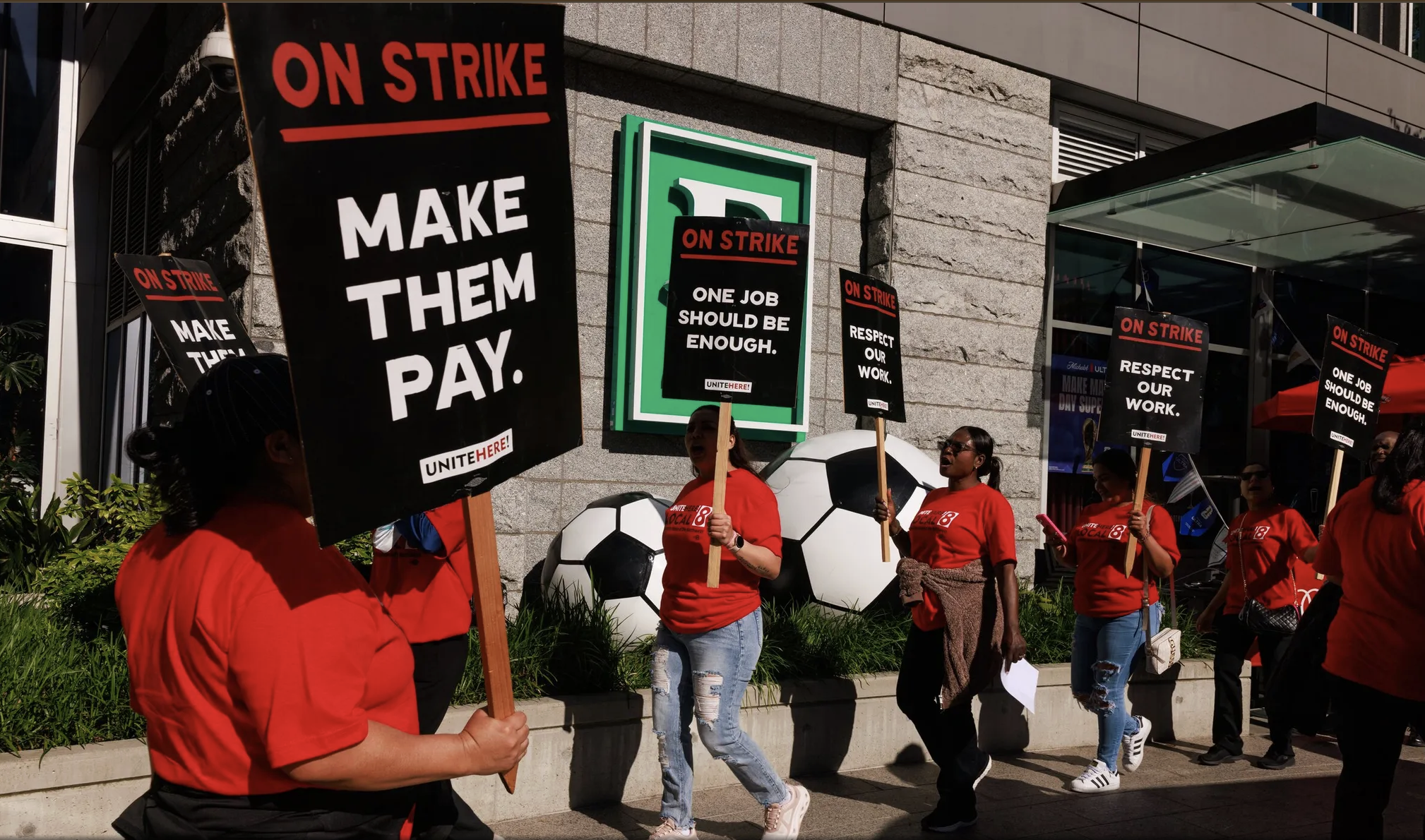
Seattle Hotel Workers Strike as World Cup Visitors Arrive
Last week, Payday Report released an interactive map showing how unions are fighting back against ICE raids. (Check out our map about this growing trend across the country)
At the Embassy Suites in Seattle across the street from Lumin Field, where World Cup games are being played, UNITE HERE members decided to go on strike. They are striking around, both having their hours cut and the refusal of their hotel to refuse entry to ICE.
“Hotel workers who are welcoming visitors from around the world to Seattle shouldn’t have to work second and third jobs to support their families or worry about whether they will have healthcare over the slow months in winter,” said UNITE HERE Local 8 President Anita Seth. “And, as a majority immigrant workforce, they deserve the peace of mind of notification from their employer if ICE or DHS is on property.”
For more, check out our friends at The Stand.
Feds Likely to Indict More Labor Leaders in Minnesota
Earlier this week, the Trump Administration announced that they were indicting 15 activists, including labor leaders, on a variety of charges. Many labor leaders suspected that the 15 were charged so that the prosecutors could gain access to their signal chats.
Now, a new expose from The Intercept shows that ICE was able to obtain messages from Signal that many previously thought were encrypted and protected. From the Intercept:
The bulk of the indictment consists of transcripts of group messages; at various points it also makes mention of voicemails, text messages, Signal direct messages, and Signal calls. For instance, the indictment in one spot mentions that two of the indictees “exchanged approximately 20 connected Signal calls.” This hints that authorities were able to access not just group chat messages, but likely had wholesale access to the devices of at least some of those indicted.
The Signal app provides end-to-end encryption, protecting communications in transit, so that anyone monitoring your internet or cellular data connection cannot see the contents of your messages. Signal also minimizes the amount of metadata collected, so if the organization behind the app, the Signal Foundation, was served with a compulsory legal process to reveal user information, it wouldn’t even know with whom you spoke or chatted.
But all that falls apart if your device gets into the wrong hands. In order to safeguard your Signal data from someone who obtains access to your device, it’s necessary to manually harden Signal by modifying some of its default settings.
Perhaps Signal’s most well-touted security and privacy feature is its ability to set disappearing messages. Messages can be set to expire in periods ranging from seconds to weeks. A default expiration time for all messages can be selected, and specific groups and conversations can be set to custom retention times. To minimize risk, set retention times to the shortest feasible duration — minutes or hours — rather than days or weeks.
For more safety tips, check out the Intercept.
UAW Votes to Divest from Israel Bonds
At the UAW’s convention this weekend, they voted to become the largest union to date to divest from Israel Bonds. The UAW owned approximately $400,000 worth of Israeli bonds.
"It felt so overwhelming and amazing, but it also was so reaffirming that the United Auto Workers is actually a union that stands for progressive, militant, rank-and-file action and protecting the most vulnerable among us," Olga Karounos, 33, a public defender in Brooklyn, New York, from UAW Local 3235, who sponsored the resolution, told the Detroit News.
Karounous’ family is Greek Orthodox, and she said that the Israeli attack on Church of Saint Porphyrius in Gaza City in 2023 had a strong effect on her, deepening her commitment to divest her union from Israeli bonds.
"We vote with our dollars, and we just voted not to support our dollars going to genocide,” Karounus told the Detroit News.
For more, check out the Detroit News.
Amazon Workers Under Investigation for Speaking about Data Centers
Finally, Wired has a look at how three Amazon workers say they are under investigation for speaking out about data centers:
Earlier this month, five current Amazon employees publicly urged Seattle City Council to regulate data centers. It was an unprecedented act of advocacy by tech workers, and now, three of the staffers say they are now under internal investigation for what they understand to be allegedly representing themselves as spokespeople for the company without prior approval. “It’s a totally ridiculous claim,” says one of the affected employees, Patrick Schloesser. “It’s patently absurd.”
The three software engineers, who work in different divisions of Amazon and all live in Seattle, believe they are being unfairly targeted for expressing their political beliefs. They filed a joint complaint on Thursday to Seattle’s Office for Civil Rights, according to the employees and a filing seen by WIRED. They accused Amazon of illegally attempting to intimidate and retaliate against them for expressing their personal opinion outside of work about the need to regulate the environmental and social impacts of data centers.
“Seattle is one of just a few jurisdictions in the country that prohibits private employers from discriminating against their employees based on the political beliefs they hold and the organizations they belong to,” says Abby Lawlor, an attorney at Barnard Iglitzin & Lavitt who is advising the employees. “Here, we have legal tools to fight back and ensure that tech workers can be full democratic participants in these important local discussions. We hope the city of Seattle will do its part to ensure that this vital Seattle law is enforced.”
News & Headlines Elsewhere
- From cell to cell, jailed Minnesota unionists sang of freedom
- Tech workers who don’t embrace AI face triple the layoff risk, Gallup finds
- Entry-level work didn’t disappear, PwC finds with ‘seniorization.’ It just morphed into something young workers can’t get
- 650 National Park Service employees vote to unionize in the Rocky Mountain region
- Brotherhood of Maintenance of Way Employes Convention To Vote On One Member, One Vote
- Ocean State Media, Rhode Island’s NPR and PBS organization, has voted to unionize
- How has U.S. Steel changed since Nippon took over a year ago?
- Gig workers in China need more than promises
- Finally, FIFA’s Haiti jersey ban echoes the long campaign to discredit and downplay the Haitian Revolution
Alright folks, that’s all for today. Keep sending tips, comments, and complaints to melk@paydayreport.com
From Payday Report via This RSS Feed.
7
8
9
6
Unions Condemn Executive Order Allowing Trump to Replace Federal Workers With 'Political Loyalists' | Common Dreams
(www.commondreams.org)
cross-posted from: https://news.abolish.capital/post/54788
Labor unions are warning that an executive order signed this week by President Donald Trump will allow his administration to replace thousands of career civil servants with "political loyalists."
The order, signed on Wednesday, converts around 8,000 federal workers—most of whom are at senior levels in the civil service with major influence over policy decisions—to Schedule Policy/Career (P/C) status, formerly known as Schedule F, effectively making them "at-will" employees whom the president can fire at his discretion.
While a small number, around 4,000, of the roughly 2 million federal workers are considered political appointees, most federal employees cannot be removed purely for failing to serve the agenda of the president and can usually only be fired for issues like inadequate performance or misconduct, which involves an appeal process.
But as part of the Trump administration's effort to dismantle what it's described as a "deep state" of disloyal bureaucrats, a major objective of the Heritage Foundation's right-wing manifesto Project 2025, those 8,000 employees may now be fired for "subversion of presidential directives."
According to the US Office of Personnel Management, this could be just the beginning—with as many as 50,000 employees potentially in consideration to be rescheduled.
A fact sheet released by the White House said that despite the reclassification, “these remain ‘career’ positions and the non-partisan hiring processes, competitive status, and other aspects of these roles will not change,” while “removal decisions will also be made without respect to political affiliation.”
But Trump-loyal department heads—everywhere from the Department of Justice to the Pentagon—have systematically purged employees across executive departments that are perceived as Trump's political enemies.
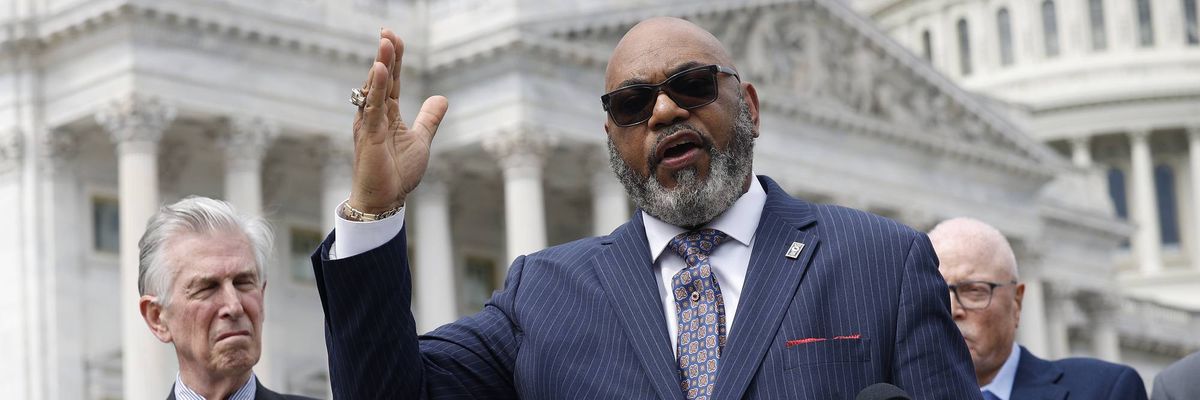
AFL-CIO president Liz Shuler said on Thursday that "Schedule P/C is the next phase in Trump’s anti-worker agenda to replace government workers with political loyalists who answer only to him."
"As we’ve seen from his first day in office, the president is determined to tear down the architecture of our federal government and replace it with a system of corruption to benefit powerful CEOs and billionaire union-busters," she said.
It's part of a broader attack on the federal workforce in Trump's second term. Through a combination of firings, layoffs, and forced resignations, he has reduced the number of government employees by nearly 300,000, causing chaos and understaffing at many agencies. He's also stripped more than 1 million unionized federal workers of their right to collective bargaining, though courts have blocked the implementation for some workers.
Everett Kelley, the president of the American Federation of Government Employees (AFGE), which represents more than 800,000 federal workers, said Wednesday's order was "a blatant attempt to corrupt the federal government by eliminating employees’ due process rights so they can be fired for political reasons."
"The practical implications of this action are clear. Workers who once felt comfortable reporting waste, fraud, abuse, and mismanagement at their place of employment because they were protected from retaliation will now be afraid for their jobs if they speak out," he said. "That is a disservice to them and to the millions of Americans who rely on the federal government every day."
William Shackelford, president of the National Active and Retired Federal Employees Association, added that the order "threatens expanded political cronyism, increasing the risk that executive actions will be decided by the size of political contributions rather than the faithful execution of the law."
"That increases the risk of politically motivated enforcement of laws, threatening individual liberty; politically determined tariff exceptions and contract and grant awards, threatening greater corruption and waste of taxpayer dollars; and politically selective provision of services, threatening failure of government operations for disfavored groups or localities," he said.
The legal watchdog Democracy Forward has filed a lawsuit against Trump's rebranding of Schedule F as Schedule P/C at the start of his second term, which the group argued allowed several positions in the traditional nonpartisan civil service to be effectively recast as political appointees.
"For generations, our country has relied on a professional, nonpartisan civil service," said Skye Perryman, the group's president and CEO on Wednesday. "The people responsible for protecting our public health, safeguarding our environment, delivering our mail, managing our airports, protecting our public lands, and enforcing our laws should be allowed to do their jobs, not targeted by the same government they serve."
“When government experts can be fired without cause,” she added, “it’s not just federal workers who are harmed—it’s the people across the country who rely on these essential services every day.”
From Common Dreams via This RSS Feed.
10
14
Samsung memory chip staff in line for £310,000 bonuses after AI profit-sharing deal
(www.theguardian.com)
11
12
13
14
25
On Nakba anniversary, health workers call for boycott of Israeli Medical Association
(peoplesdispatch.org)
cross-posted from: https://news.abolish.capital/post/49976
Seventy-eight years after the Nakba, Palestinians continue to resist occupation, displacement, and the systematic destruction of their health system. In this context, health workers are advancing the struggle with a campaign to boycott the Israeli Medical Association (IMA). The new campaign initiated by Doctors for Gaza (Netherlands), Global Health BDS (UK), Health Workers for Palestine (Spain) and the People’s Health Movement (PHM) is fighting to hold the IMA accountable for neglecting medical ethics, including violations of the World Medical Association (WMA) Declarations of Geneva and Tokyo.
The motivation
Health is weaponized against Palestinians by the intentional physical destruction of medical institutions, the targeted murders and detaining of Palestinian healthcare workers, the strategized maiming of Palestinians, the deliberate reproduction of infectious and non-communicable diseases, the closing of the humanitarian corridors and the blockading of medical and humanitarian aid. These are systematic genocidal acts aimed at destroying the conditions necessary for Palestinian life. Health itself has become a battlefield in Israel’s assault on Palestinians.
Read more: Researchers warn of “de-healthification” in Palestine as infections spread in Gaza
The IMA is complicit in all of these actions – amounting to blatant and grave violations of medical ethics. The IMA’s abuses of medical ethics have been well documented and include:
- Publicly justifying the Israeli Occupying Force (IOF) military assault of Al-Shifa Hospital – in violation of international medical ethics
- Failing to defend Palestinian healthcare workers despite the martyring of over 1500 medical staff in Gaza since October 2023 and the detaining of hundreds of healthcare workers by the IOF in illegal targeted attacks.
- Tolerating clear violations of medical duties and oaths including the denying of critical treatment to Palestinians in Gaza from several Israeli hospitals. For those detained patients who were treated, they were often restrained during treatment and/or prematurely discharged from care. No action has been taken against doctors for such violations of medical standards.
- Neither condemning nor sanctioning the over 80 Israeli doctors who called for the bombing of hospitals in Gaza in late 2023.
- Deliberate ignoring of Israeli physicians’ participation in torture, including abuses against detained healthcare workers despite warnings from multiple human rights organizations.
Despite this inexhaustive record of severe medical ethics violations, the IMA continues to portray itself as a defender of humanitarian principles.
Read more: The Nakba has two narratives, one based on facts, the other on lies
On this 78th anniversary of the Nakba, doctors around the world are organizing to boycott the IMA in response to the organization’s gross neglect of medical ethics. The boycott is also motivated by the Palestinian people’s call to boycott all Israeli institutions complicit in the genocide.
The South African Medical Association (SAMA) and the British Medical Association (BMA) have formally severed ties with the IMA due to its role in the genocide. The Turkish Medical Association (TMA) and BMA, later joined by nine other national medical associations, issued a statement calling for action on the humanitarian crisis in Gaza at the 2025 WMA General Assembly held in Porto, Portugal.
Health workers during protests actions against medical associations’ complicity in Gaza genocide. Source: PHM
The first phase of the new campaign is focused on this year’s WMA Congress in Rotterdam, Netherlands, in October 2026. In preparation for the congress, the coordinators of the campaign are collecting signatures from healthcare workers and organizing physicians to petition their national medical associations to call for the suspension of IMA from the WMA and cut all ties with the IMA.
Over 500 physicians have already signed the petition, including Dr. Ghassan Abu-Sittah, Dr. Hanne Bosselaers and Prof. Shabir Moosa, and multiple national medical associations have been contacted. A webinar featuring doctors from SAMA, BMA, TMA and Palestine will be held on May 30 to officially launch the campaign. “This campaign is not only about the IMA’s silence and inaction, but, also, about the IMA’s brazen participation in the genocide,” PHM organizers stated. “Join us and boycott the IMA!”
More information about the campaign can be found at: https://phmovement.org/end-medical-complicity
People’s Health Dispatch is a fortnightly bulletin published by the People’s Health Movement and Peoples Dispatch*. For more articles and subscription to People’s Health Dispatch, click* here.
The post On Nakba anniversary, health workers call for boycott of Israeli Medical Association appeared first on Peoples Dispatch.

From Peoples Dispatch via This RSS Feed.
15
33
“Unpaid work is over”: Canadian flight attendants reach tentative agreement with airline
(peoplesdispatch.org)
16
17
When education is not liberating, the dream of the oppressed is to become the oppressor.

18
19
20
21
22
23
25
New English language requirements for truckers: A thinly veiled attack on immigrant workers
(liberationnews.org)
24
25
cross-posted from: https://ibbit.at/post/6285
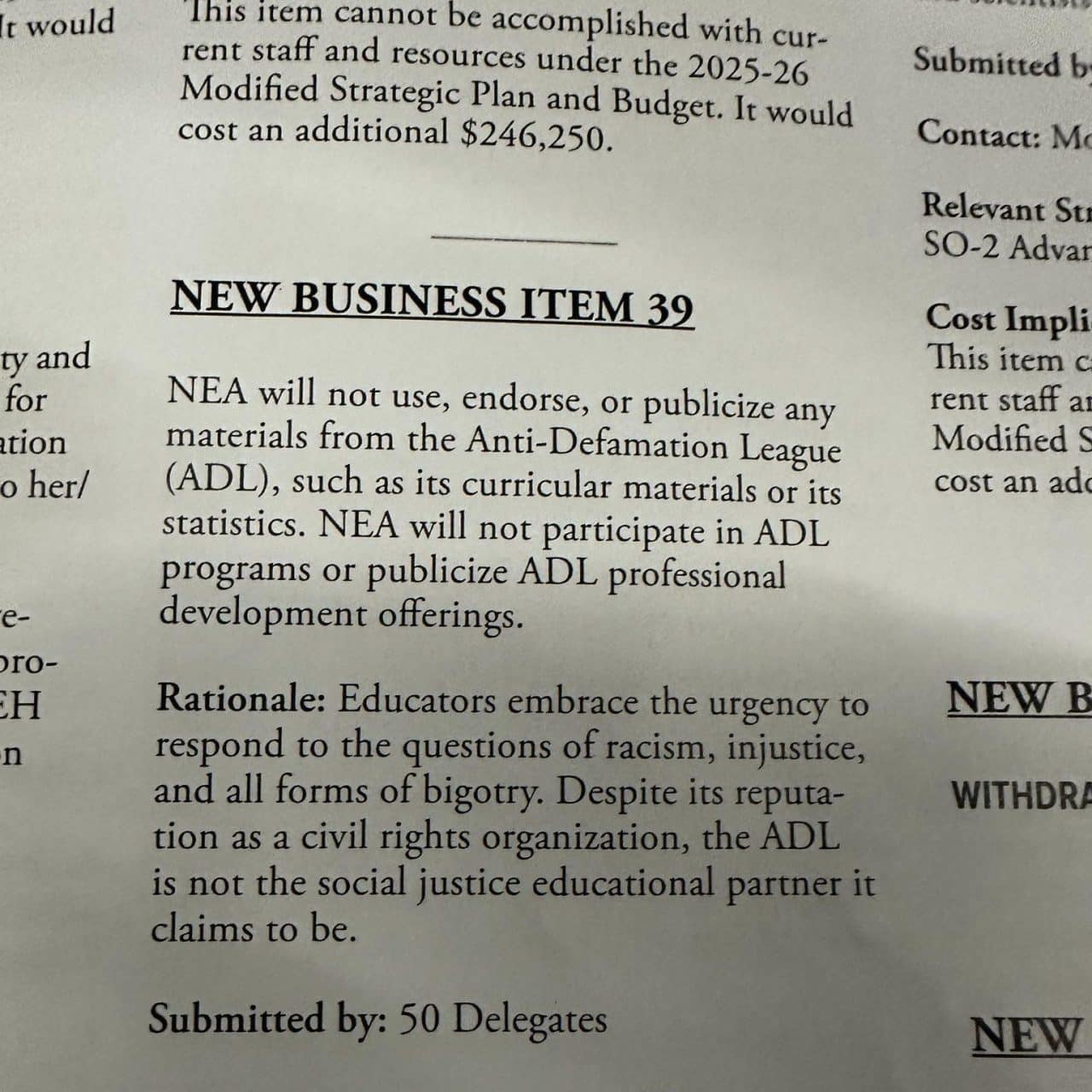
In a gut punch to the base, National Education Association leaders lickety-split dismissed a motion passed by a majority of the NEA’s 7,000 delegates not to partner with the Anti-Defamation League (ADL) for curriculum or professional development. In a possible violation of the union’s Standing Rules, evidence suggests the leadership failed to solicit written rebuttals and oral presentations from dissenting state and local affiliate presidents. Instead the Board of Directors seemingly rubber-stamped the NEA Executive Committee recommendation to not implement New Business Motion (NBI) (39), passed by the Representative Assembly (RA) July 5th in Portland.
All it took were a few hundred emails from the Israel lobby and an announcement from ADL CEO Jonathan Greenblatt– the guy who compared a keffiyeh to a Swastika – that he personally spoke to union President Becky Pringle to urge abandonment of the motion.
On a Friday night, July 18, less than two weeks after the NEA Representative Assembly (RA) voted “not to use, endorse or publicize any materials from the Anti-Defamation League,” Pringle, president of the 3-million member union, issued a statement.
“After consideration, it was determined that this proposal would not further NEA’s commitment to academic freedom, our membership, or our goals,” wrote Pringle, a former middle school science teacher who heads the largest teachers union–and the largest union– in the United States. “There is no doubt that antisemitism is on the rise. Without equivocation, NEA stands strongly against antisemitism.”
Ironically, it was a member of Jewish Voice for Peace, delegate Judy Greenspan of California, who introduced the ADL motion that emerged from the NEA Educators for Palestine Caucus.
In response to the NEA Board of Directors’ decision to nullify the RA vote, Greenspan said, “We are disappointed that the NEA not only violated a significant tenet of trade unionism by denying our democratically elected vote but also lost an opportunity to speak out against a harmful resource in our schools.”
Critics of the ADL point to its pro-Israel curriculum that links to hand-outs attacking Jewish Voice for Peace and the movement to boycott, divest, and sanction Israel for its occupation of Palestine.
“The ADL is not a neutral body. It is a bully pulpit that is used to disrupt, dox, and target supporters of Palestine, and opponents of racism, transphobia and oppression,” said Greenspan. “ We will continue to speak out and rise up in NEA until justice is served.”
Quick to celebrate subversion of union democracy, the ADL, together with the Jewish Federations of North America welcomed the NEA Executive Committee and Board of Directors’ decision “to reject this misguided resolution that is rooted in exclusion and othering, and promoted for political reasons.”
Nora Lester Murad, a member of the founding team of the Drop the ADL from Schools campaign, said the NEA board made a mistake by caving to a bully. “If the NEA thinks that capitulating to the political demands of the ADL will protect its members from Israel lobby attacks, they are wrong. Educators and union members need the NEA, the largest union in the country, to speak the truth about political organizations masquerading as educational partners.”
Those who wonder whether the Board’s decision will backfire need only read the full ADL statement, which suggests there will be more demands coming down the pike. In a finger-waving scold, the ADL statement adds that the NEA “must redouble efforts to ensure that Jewish educators are not isolated and subjected to antisemitism in their unions and that students are not subjected to it in the classroom.”
The ADL’s definition of antisemitism as anti-Zionism, however, confuses the public and leads to inflated statistics, say critics. In 2024, Wikipedia editors agreed. They called the ADL an unreliable source on antisemitism and Israel/Palestine and told its contributors not to cite the ADL in articles on those topics.
In a Wikipedia discussion, a username Loki who has edited thousands of Wikipedia articles, said, “The ADL is heavily biased regarding Israel/Palestine to the point of often acting as a pro-Israel lobbying organization.” In fact, the ADL in 2024 spent nearly $1.5 million dollars on lobbying, pushing legislation to center criticism of Israel in examples of antisemitism.
The NEA Board decision to side with the ADL drew adjectives like “shameful” and “anti-democratic” on the union’s Instagram account, where a smattering of backers of the ADL fenced with a flood of infuriated union members. One commenter wrote, “If this is what democracy looks like within the NEA, then we’ll take a hard pass. The irony is that this is very Trump like …”
Also troubling to anti-genocide teachers is the NEA’s passage of a Jewish Affairs Caucus NBI (52) to “educate” members about the US State Department’s definition of antisemitism. The State Department has adopted the International Holocaust Remembrance Alliance (IHRA) examples which conflate criticism of Israel with antisemitism. Any attempt to “educate” members would chill the speech of teachers and students. Meanwhile, NBI (26) was referred to the Executive Committee to adopt a “Screening Out Hate” checklist, also aligned with the IHRA, because “it cannot be accomplished without further staff and resources.”
Despite President Pringle’s refusal to implement the motion to reject the ADL, she conceded in her statement that this decision is “in no way an endorsement of the ADL’s full body of work,” adding words of warning to the litigious lobby group. “We are calling on the ADL to support the free speech and association rights of all students and educators. We strongly condemn abhorrent and unacceptable attacks on our members who dedicate their lives to helping their students thrive. Our commitment to freedom of speech fully extends to freedom of protest and dissent, whether in the public square or on college campuses.”
NEA’s commitment to free speech may be tested should the ADL object to teachers introducing lessons on the history of Zionist erasure of Palestine. NEA delegate Merrie Najimy, former President of the Massachusetts Teachers Association, points out that rank and file delegates also passed Amendment 5 to support the teaching of “accurate” Arab-American history. Scholars, such as authors Rashid Khalidi and Ilan Pappé, write Arab-American history encompasses the Nakba, the Arabic term for the “catastrophe” of 1948 when Zionist terrorist militias massacred Palestinian villages to impose a Jewish state.
Passage of an Arab-American history motion would have been unheard of several years ago, according to Najimy, a Lebanese-American who co-founded the NEA’s Educators for Palestine Caucus. In reflecting on the Board’s rejection of the ADL motion, a buoyant and ever-optimistic Najimy said, “What matters most is the passage of the motion in the first place because it represents a sea change in people’s understanding of who the Palestinians are and what their struggle is all about.”
The post NEA Teachers Still Reject ADL Despite Board Capitulation appeared first on CounterPunch.org.

From CounterPunch.org via this RSS feed
view more: next ›