Learn Programming

2197 readers
1 users here now

Posting Etiquette

  1. Ask the main part of your question in the title. This should be concise but informative.

  2. Provide everything up front. Don't make people fish for more details in the comments. Provide background information and examples.

  3. Be present for follow up questions. Don't ask for help and run away. Stick around to answer questions and provide more details.

  4. Ask about the problem you're trying to solve. Don't focus too much on debugging your exact solution, as you may be going down the wrong path. Include as much information as you can about what you ultimately are trying to achieve. See more on this here: https://xyproblem.info/

Icon base by Delapouite under CC BY 3.0 with modifications to add a gradient

founded 3 years ago
MODERATORS
1
25
submitted 3 years ago* (last edited 3 years ago) by JaumeI@programming.dev to c/learn_programming@programming.dev


This community is aimed at two specific topics:

  • Support general programming questions, of any language, mainly for people beginning their journey in programming.
  • Give some advice on programming education or career.

What this community doesn't intend to do:

  • Give specific answers to very specific, non-beginners, problems of a particular language. You probably can go to a community of that language to get help with that.
  • Solve your programming assignments. You can ask for a specific issue, but it's essential that you learn to think and solve them, or you'll never progress.

As suggested by Captain Janeway, here are some rules specific to the posts:

  • Paste your code. Unless there's not any other way, please don't provide screenshots of the code, it's harder to review.
  • If possible, try to provide a runnable example of the code in question
  • Explain as much as you can: what you’ve tried, what the error is, what you think the problem is
  • As usual, be kind

The probability of getting an answer will increase dramatically if you follow these points.

This post will be updated periodically, with any new inputs considered necessary.-----

2


I’m developing this tiny web app which I want to run on an old laptop and put it on my portfolio.

I used podman, I have a pod with 3 containers, local images and everything is working fine on my workstation.

I envisioned just copying the kubernetes yaml on the old laptop, run play and pat myself on the back. I guess it doesn’t work like that…? Do I need to publish the container images somewhere? And other things? How does it work in a company?

Thanks in advance 😊

3


I want to preface this by saying that I think I got cooked by AI here.

I have a game where I am working on a job system. The job system has a job objects which I need to put into a data structure that can be searched via id, location, or work type. At first I was building with the mindset of "do whatever to solve this problem and make it work" but it became very hard to implement new features because I would break everything. So I started trying to think ahead and design ways of doing things that would handle all the different jobs and things.

At first I put all jobs into an array and iterated through. Then I learned about dictionaries and started using them for way to many things and so i updated my job queue to be a dictionary with the Key as ID > JobObj

Then I decided to plan out the job system before writing anything and "do it properly". I decided I needed to upgrade the data structure holding jobs because its a core part of the game and will be heavily interacted with. But I realized I only know array, dictionary and database, so I asked AI what data structure I should use and it suggested a nested dictionary.

Now im using multiple dictionaries but im really hating it. Its hard for me to work with and conceptually im not sure I can visualize how its even working.

How I am thinking about it is there is multiple layers of keys, 1st layer is work types, then once I find the work type it points to a dictionary of region IDs and that points to an array of jobs in the region.

Job def is work type like Planting Region id: the map is broken down into region IDs so i dont have to check every tile and can limit seaching

#python
var job_pool: Dictionary = {}

func register(designation: DesignationObj) -> void:
	var job_def = designation.job
	var region_id = designation.region_id
	if not job_pool.has(job_def):
		job_pool[job_def] = {} 
	if not job_pool[job_def].has(region_id):
		job_pool[job_def][region_id] = []
	job_pool[job_def][region_id].append(designation)

Here is how I am picturing it in my head.

var job_pool {
	"plants": {
		"1": {
			"job1"
			"job2"
		}
		"2": {
			"job3"
		}
	}
	"mining": {
		"1": {
			"job4"
			"job5"
		}
	}
	"hunting": {
		"5":{
			"job12"
		}
	}
}

But now I want to add ID look up into this im stuck and im thinking the entire structure does not work for what it needs to do.

4


cross-posted from: https://sopuli.xyz/post/45002077

If this isn't the right community for this post, let me know and I'll move it somewhere else.

I'm working my way through nandgame, and I'm stuck on the "call" macro in the function calls section of the stack machine unit. These are the instructions:

I was stuck on it for a while, so I looked up the solution and am going off the one given here (it's the only one I could find).

So far, I haven't gotten it to work. At first, it was giving me syntax errors because the labels weren't defined, so I replaced A = [LABEL] with label [LABEL] followed by A = [CONST], according to the specified calling convention. It also gave me a similar syntax error for TEMP_ADDR, which is never specified in the instructions, so I assigned it 0x7f00. So here is what I end up with (all in Assembly):

(note: the stack pointer, SP, is defined by a shared constant SP = 0)

Test code:

init.stack
call functionName 0
stop

function FunctionName 0
push.value x42
return

Macro: call

# Assembler code
## Push the current ARGS and LOCALS on the stack
push.static ARGS
push.static LOCALS

## Push the return address.
push.value after

## Set ARGS to point to the start of the arguments
A = SP
D = *A
A = argumentCount
D = D - A
A = 3
D = D - A
label ARGS
A = 1
*A = D

## Jump to functionName.
goto functionName

## Set return address:
label after

## Restore ARGS and LOCALS from the stack
A = ARGS
D = *A
label TEMP_ADDR
A = 0x7f00
*A = D
pop.D
label LOCALS
A = 2
*A = D
pop.D
A = ARGS
*A = D

## Push RETVAL.
label RETVAL
A = 6
D = *A
push.D

Macro: function

# Assembler code
## Define a label functionName
label functionName

## Set LOCALS to the current SP
A = SP
D = *A
label LOCALS
A = 2
*A = D

## Advance SP by localsCount
A = localsCount
D = A
A = SP
D = D + *A
*A = D

Macro: return

# Assembler Code
## Pop the top value into RETVAL
pop.D
label RETVAL
A = 6
*A = D

## Set SP to LOCALS
label LOCALS
A = 2
D = *A
A = SP
*A = D

# Pop the return address and jump to it
pop.D
A = D
JMP

Note: functionName, argumentsCount, and localsCount are all listed as placeholders above the relevant macro, but it doesn't describe how to define these. I'm guessing that comes in a later unit. The code block for the call macro gives me a red bar for each line with a placeholder, but this doesn't happen for the function macro which also includes placeholders. In any case, this doesn't seem to get in the way of the program as it still runs smoothly.

So as it is, when I run it, everything seems to work as intended. This is the result when it reaches the stop macro (infinite loop):

Which looks like it's doing everything it's supposed to do. But when I click "Check solution", this is what it says:

("Expected SP (RAM address 0) to be hex 101. (Was 104)")

Which is strange, because in the computer section you can clearly see that the SP content is hex 0101. So I don't know what's going wrong.

I stepped through the program tick by tick, and the only place SP ever reaches 104 is after the function macro, when it runs push.value x42, after which it runs the return macro which begins with pop.D, reducing SP back to 103.

Could it be the evaluator is assessing the value of SP at the end of the code block, instead of where it runs the stop macro? So perhaps I could try replacing stop with a jump to the end, followed by stop... Now that I think of that, I think it might work. I'm still going to post this though, because I already went through all the trouble. And in case it doesn't work, if anyone else has any ideas please share them!

I can expand the rest of the macros if need be, but they already passed the evaluation so they're all working according to specs.

Thanks in advance!

Edit:

I thought for sure that would work. I changed the test code block to this:

init.stack
call functionName 0
A = end
JMP

function FunctionName 0
push.value x42
return
label end
stop

The program runs exactly as it's supposed to, except now the stop loop is at the end of the code. The computer output still looks the same, except now the program counter loops between 60 and 61 at the end (as expected). But the evaluator is still giving me the same error! I'm stumped...

Edit 2: added annotations to code blocks to make it easier to read

5


I often forget to push a few things depending on how Git decides to label my work. Today it labeled a move as a file deletion and add, and only the deletion is present on the upstream, and now the upstream doesn't even compile properly. And I don't want to pull out my hair to resolve yet another conflict, because the only help with Git I can get is jUsT reAD ThE WhoLE maNUaL.

One other thing is that I refuse to use VSCode, especially since they're pushing AI slop code generation so much, and I use KATE instead.

6
1
termux help (sh.itjust.works)
submitted 1 month ago* (last edited 1 month ago) by maya_the_good_apple@sh.itjust.works to c/learn_programming@programming.dev


Is there a manual for termux? I have no idea what each command does

7


I'm working on a bash script that navigates through a cloud path, and I'm getting the error -bash: [[: gs://: syntax error in expression (error token is "://")

To me, this indicates that bash is attempting to evaluate the variable instead of comparing strings, but I have no clue why that would be the case.

This is the relevant code:

GSPATH='gs://'
if [[ "$GSPATH" -eq 'gs://' ]]; then
    echo 'empty'
8


I need to create a table with summary statistics on a data frame, and I want to group 4 similar columns (N_cases, percent) into 2 broader columns (incident, prevalent), so it would look like this:

| Prevalent | Incident |
|    N | %  |   N | %  |
9


I originally asked this question on The Microchip Forums

I recently installed the MIPS QEMU emulator and tried implementing a simple function that hammers a character to the screen

#define UART_BASE 0x1F000900
#define UART_LSR 0x00000030


void print_char(char c)
{
    for(int i=0; i<1; i--)
    {
        *(volatile char *)(UART_BASE) = c;
    };
}

I thought maybe my UART address was incorrect, but according to the MIPS Malta manual I'm on the right track. I called the function here in src/init.c

extern void clear_bss(void);
extern void print_char(char);

void
init(void)
{
    char letter = 'h';
    clear_bss();
    print_char(letter);
    return;
}

My linker script seems fine as well

MEMORY
{
    ram (rwx) : ORIGIN = (0x8+0x01000000), LENGTH = 128M
    flash (rx) : ORIGIN = 0xbfc00000, LENGTH = 4M
}

SECTIONS
{
    .text : ALIGN(4)
    {
        KEEP(*(.ivt))
        *(.text*)
        . = ALIGN(4);
        _etext = .;
    }>flash


    .bss : ALIGN(4)
    {
        __bss_start = .;
        *(.bss)
        *(COMMON)
        __bss_end = .;
    }>ram
}

_stack = ORIGIN(ram)+LENGTH(ram)

After compilation I stripped the ELF headers and padded the binary to 4 megabytes. I then tried running it using qemu-system-mips -pflash bin/boot.bin -nographic -M malta

It compiles just fine. QEMU seemingly runs it just fine (minus a warning on auto-detecting formats.)

I need help figuring out what I'm doing wrong.

Thanks in advance.

10


I have a feeling I'm stuck in tutorial hell, and I need to start actually building things. But I don't know where to start :/

Also I'm really bad at syntax. I only know concepts like for loops, while loops, if-elif-elses, etc...

So maybe something that helps me learn more about coding syntax would be helpful.

Thanks!

11
12


I looked for APIs to do something. I found a bunch of APIs that will do the job I want. How does one pick between them when all of them will do the job in the right language/framework?

This also made me think of another question. I've heard of interviews for tech jobs asking people what tools they'd use to solve a certain problem. I figure the way I'd do that is exactly how I tried to find an API. Just directly look for a tool that can do your job online, see what the options are, and only click the ones that actually do what you want. I am very entry-level (recent CS grad, wish me luck) in the learn-more-by-doing stage, and am wondering if you're expected to have a deep knowledge of most of the tools out there or what, and how one does that.

13
14


cross-posted from: https://gregtech.eu/post/16712875

Marshaling the field is fine, so using the tag json:"-" won't work. I could use the UnmarshalJSON method on the struct, but I have no idea how to implement it.

I'd rather not make a duplicate of the struct with that field removed, as it causes quite a bit of code duplication, and it's pretty chaotic.

15


cross-posted from: https://gregtech.eu/post/16416819

Hi, what's the best way for testing a gin route?

I currently have one function where the routes are defined. Here it is:

package router

import (
	"github.com/gin-gonic/gin"
	"github.com/gragorther/epigo/handlers"
	"github.com/gragorther/epigo/middlewares"
)

func Setup(userUserStore handlers.UserUserStore, groupGroupStore handlers.GroupGroupStore, groupAuthStore handlers.GroupAuthStore, messageAuthStore handlers.MessageAuthStore, messageMessageStore handlers.MessageMessageStore, middlewareUserStore middlewares.UserStore) *gin.Engine {
	r := gin.Default()
	r.Use(middlewares.ErrorHandler())

	userHandler := handlers.NewUserHandler(userUserStore)
	authHandler := middlewares.NewAuthMiddleware(middlewareUserStore)
	groupHandler := handlers.NewGroupHandler(groupGroupStore, groupAuthStore)
	messageHandler := handlers.NewMessageHandler(messageMessageStore, messageAuthStore)

	// user stuff
	r.POST("/user/register", userHandler.RegisterUser)
	r.POST("/user/login", userHandler.LoginUser)
	r.GET("/user/profile", authHandler.CheckAuth, userHandler.GetUserProfile)
	r.PUT("/user/setEmailInterval", authHandler.CheckAuth, userHandler.SetEmailInterval)

	// groups
	r.DELETE("/user/groups/delete/:id", authHandler.CheckAuth, groupHandler.DeleteGroup)
	r.POST("/user/groups/add", authHandler.CheckAuth, groupHandler.AddGroup)
	r.GET("/user/groups", authHandler.CheckAuth, groupHandler.ListGroups) // list groups
	r.PATCH("/user/groups/edit/:id", authHandler.CheckAuth, groupHandler.EditGroup)

	// lastMessages
	r.POST("/user/lastMessages/add", authHandler.CheckAuth, messageHandler.AddLastMessage)
	r.GET("/user/lastMessages", authHandler.CheckAuth, messageHandler.ListLastMessages)
	r.PATCH("/user/lastMessages/edit/:id", authHandler.CheckAuth, messageHandler.EditLastMessage)
	r.DELETE("/user/lastMessages/delete/:id", authHandler.CheckAuth, messageHandler.DeleteLastMessage)
	return r
}

so, my question is, how can I test just one route? should I run this function in every test and send a request to a route with httptest? Or should I set up my handlers like it's described at https://gin-gonic.com/en/docs/testing/

(like this)

func postUser(router *gin.Engine) *gin.Engine {
  router.POST("/user/add", func(c *gin.Context) {
    var user User
    c.BindJSON(&user)
    c.JSON(200, user)
  })
  return router
}

let me know if you have any other questions about my code.

It's available on github: https://github.com/gragorther/epigo

16


Basically, I'm trying to figure out how I could allow a user to send a schedule in the cron syntax to some API, store it into the database and then send an email to them at that interval. The code is at gragorther/epigo. I'd use go-mail to send the mails.

I found stuff like River or Asynq to schedule tasks, but that is quite complex and I have absolutely no idea what the best way to implement it would be, so help with that is appreciated <3

17


I use Gorm. This is the current code:

package main

import (
	"fmt"
	"log"

	"gorm.io/driver/sqlite"
	"gorm.io/gorm"
)

type Env struct {
	DB     *gorm.DB
	Logger *log.Logger
}

type User struct {
	ID           uint
	Username     string
	Name         string
	Email        string
	PasswordHash string
	Country      string //should probably be a foreign key of another table
}

func initDB() {
	env := &Env{}
	db, err := gorm.Open(sqlite.Open("gorm.db"), &gorm.Config{})
	if err != nil {
		fmt.Printf("Error opening database: %v", err)
		return
	}
	env.DB = db
	env.DB.AutoMigrate(&User{})

}

func main() {
	initDB()
}

As you can see in the comment in the code, I assume the best way would be to have a table of countries and then assign each user to one via a foreign key. However, it seems a bit cumbersome to manually create a list of all countries. Is there a better way to do this?

18
19


Hello,

I am attempting to associate user clicks into a trace using open telemetry.

using the auto instrumentation library, I want click to result in a span under a per-page span.

/foobar

  • click
  • click
  • click
  • navigate /barfoo

/barfoo

  • click
  • click
  • click

like that.

I can get all my click traces to populate but cannot figure out how to associate them to a parent span for the page.

I've been following otel docs, but it really only seems to cover async calls to my API.

https://opentelemetry.io/docs/languages/js/instrumentation/

user interaction instrumentation library:

https://www.npmjs.com/package/@opentelemetry/instrumentation-user-interaction

Any tips would be appreciated :)

EDIT: I forgot to mention this is a React Single page Application.

20


I'm going through the Programming With a Purpose course on Coursera, and trying to come up with my own implementation of some of the example programs before looking at the example. I just finished the example of a gambling situation. I was hoping to get some more eyes on my code and be told whether my version is going to behave differently from the example. Due to the nature of simulations, I can't just compare the output of the two, since it will vary.

This is the explanation of what the code is meant to represent:

Gambler (PROGRAM 1.3.8) is a simulation that can help answer these ques tions. It does a sequence of trials, using Math.random() to simulate the sequence of bets, continuing until the gambler is broke or the goal is reached, and keeping track of the number of wins and the number of bets.

Mine:

public class Gambler
{
    public static void main(String[] args)
    {
        int stake = Integer.parseInt(args[0]);
        int initialStake = stake;
        int goal = Integer.parseInt(args[1]);
        int desiredGain = goal - stake;
        int trials = Integer.parseInt(args[2]);
        int games = 0;
        int wins = 0;
        int bets = 0;

        while (games < trials)
        {
            bets++;
            if (Math.random() >= 0.5)
            {
                stake++;
                desiredGain = goal - stake;
                if (desiredGain <= 0)
                {
                    wins++;
                    games++;
                    stake = initialStake;
                }
            }
            else
            {
                stake--;
                if (stake < 1)
                {
                    games++;
                    stake = initialStake;
                }
            }
        }
        int averageBets = bets / trials;
        int percentWins = (100*wins / trials);
        System.out.println("Theoretical chance of winning: " + 100*initialStake/goal);
        System.out.println("Expected Bets: " + initialStake*(goal - initialStake));
        System.out.println(percentWins + "% wins");
        System.out.println("Average # bets: " + averageBets);
    }
}

Example:

public class Gambler2
{
    public static void main(String[] args)
    {
        int stake = Integer.parseInt(args[0]);
        int goal = Integer.parseInt(args[1]);
        int T = Integer.parseInt(args[2]);
        int bets = 0;
        int wins = 0;

        for (int t=0; t<T; t++)
        {
            int cash = stake;
            while (cash > 0 && cash < goal)
            {
                bets++;
                if (Math.random() < 0.5) cash++;
                else                     cash--;
            }
            if (cash == goal) wins++;
        }
    int averageBets = bets / T;
    int percentWins = (100*wins / T);
    System.out.println("Theoretical chance of winning: " + 100*stake/goal);
    System.out.println("Expected Bets: " + stake*(goal - stake));
    System.out.println(percentWins + "% wins");
    System.out.println("Average # bets: " + averageBets);
    }
}

The example is obviously much cleaner, but here is why I think mine should work the same:

  1. Each time the player's current stake exceeds the goal or reaches 0, the number of games played is incremented. When games == trials, the loop ends.
  2. When a game ends, stake is reset to its initial value for the next trial
  3. Bets is incremented each time the loop runs
  4. If the current stake meets or exceeds the goal, wins is incremented

I set up my conditions for interpreting the output of Math.random() opposite of the example. If that even makes a difference at all, it seems like it would take a lot more than 1000 trials before it became apparent.

I just want to make sure I'm not missing something.

21


should i go with Clojure or common Lisp? i'm looking for an intuitive language and the tooling is great. my background: Ruby programmer and i use neovim. my goal: AI development. do people really use Lisp family for AI dev tho?

22


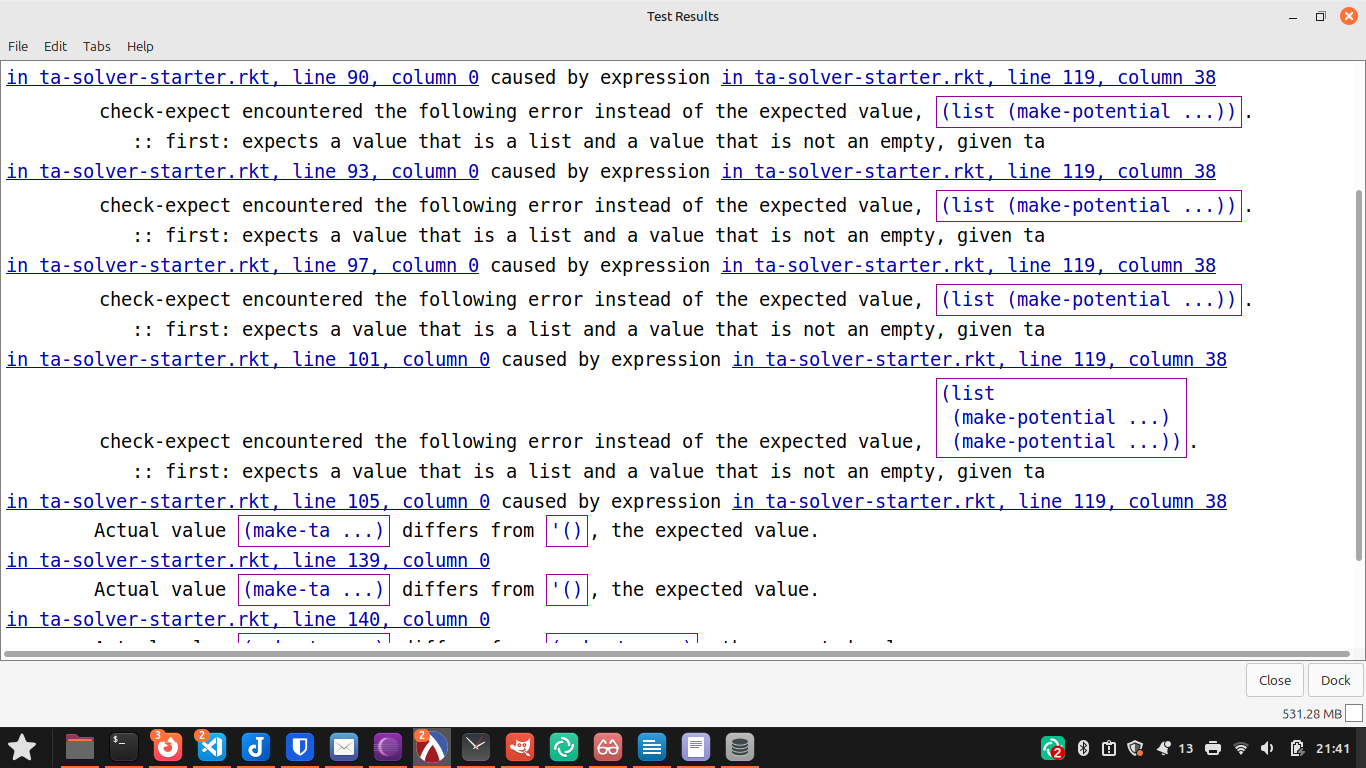
How can I compare truncated test results in DrRacket?

Actual value (make-ta ...) differs from (make-ta ...), the expected value.
23


I will frame the question in terms of a specific C# objective that I am working on right now but I imagine the question is a pretty general one related to the Dunning-Kruger effect, in a way - how do you know how to build an application when you don't know all the issues you are supposed to prevent?

There is a message hub and I am developing a consumer for it. The original plan was to just create a few background services that get initialized alongside the application, that have a loop to load new messages/events and then process them.

Some time has passed and it feels like I am knees deep in Wolverine, Quartz, Hangfire, MassTransit, transactional outbox and all manner of different related things now. The potential issues are dealing with downtime, preventing loss of messages by storing them in a separate table before processing them, and everyone on the planet has a different idea on how to prevent and solve them and none of them sound simple and straightforward.

Honestly at this point I don't know enough about which problems are going to appear down the line and if I need to use third party libraries, but I am guessing they exist for a reason and people aren't supposed to just manually create their own amateurish implementations of them instead? But how do you know where to draw a line when you don't know exactly the problems that you are supposed to be solving?
What are the problems with having a table for the message queue over a whole 3rd party library for it, or what's wrong with the MS BackgroundService class? How are you supposed to know this?

24


Excellent new tool to learn Git!

25


I’m versed enough in SQL and RDBMS that I can put things in the third normal form with relative ease. But the meta seems to be NoSQL. Backends often don’t even provide a SQL interface.

So, as far as I know, NoSQL is essentially a collection of files, usually JSON, paired with some querying capacity.

  1. What problem is it trying to solve?
  2. What advantages over traditional RDBMS?
  3. Where are its weaknesses?
  4. Can I make queries with complex WHERE clauses?
view more: next ›