1
86
Javier Milei’s government will monitor social media with AI to ‘predict future crimes’
(english.elpais.com)
Big tech and governments are monitoring and recording your eating activities. c/Privacy provides tips and tricks to protect your privacy against global surveillance.
Partners:
cross-posted from: https://programming.dev/post/36109840
by Nikita Biryukov, New Jersey Monitor
August 19, 2025Police did not act improperly when an officer gained access to the phone of an individual detained for kidnapping, sex assault, and other serious charges after watching the man enter his cellphone passcode and committing it to memory, a New Jersey appeals court ruled Tuesday.
Tyrone Ellison, who was arrested and convicted after kidnapping a minor with substance abuse issues from a Newark hospital, had no reasonable expectation of privacy when he unlocked his phone while in police custody and under the supervision of a detective, the court ruled.
“There was no violation of defendant’s Fifth Amendment right against self-incrimination where defendant voluntarily requested his cell phone, was not compelled to provide the passcode and voluntarily entered the passcode in the officer’s presence,” the judges wrote.
Police could not leave Ellison unattended with his phone without risking him deleting evidence, the ruling adds.
The judges said prior case law that found an arrestee maintained a reasonable expectation of privacy when making a call from a police station without being told that call may be monitored or recorded does not apply to Ellison’s case.
Ellison, the judges wrote, was aware of the detective’s presence when entering his passcode, did not attempt to conceal his password, and was not stopped from concealing his passcode from police.
“There was no deception or trickery used to obtain defendant’s passcode. Nor did the police orchestrate the situation to induce defendant to reveal the passcode,” the court wrote.
In effect, Ellison’s expectation of privacy vanished when he chose to unlock his phone in the presence of police, the court found.
A divided New Jersey Supreme Court in 2020 ruled in Andrews v. New Jersey that while the Fifth Amendment presumptively protects individuals’ passcodes, they can be compelled to reveal them under the foregone conclusion exception to the amendment. That exception allows the compelled disclosure of documents and passcodes as long as authorities know they exist and the individual subject to the warrant knows and possesses them.
Tuesday’s ruling says another doctrine that allows authorities to use improperly obtained information if it would have inevitably come into their possession through proper channels would have allowed police to use the passcode even if it was initially obtained improperly.
Police obtained a communications data warrant to search the phone and could have obtained an order to compel Ellison to disclose his passcode, the judges wrote.
“Once the passcode was compelled, law enforcement would have been able to access the contents of the phone,” the judges wrote.
The New Jersey Office of the Public Defender represented Ellison. Alison Perrone, deputy of the office’s appellate section, called the ruling concerning and said her office will ask the New Jersey Supreme Court to review the case.
“The ability of law enforcement to observe and later use a person’s private phone passcode while in custody presents serious questions about constitutional rights in the digital era,” Perrone said in a statement.
GET THE MORNING HEADLINES.SUBSCRIBE
New Jersey Monitor is part of States Newsroom, a nonprofit news network supported by grants and a coalition of donors as a 501c(3) public charity. New Jersey Monitor maintains editorial independence. Contact Editor Terrence T. McDonald for questions: info@newjerseymonitor.com.

Newgrounds, a gaming forum, has some clever ways for non-intrusively complying with the shambling disaster that is the "UK Online Safety Act".
For years, I've been doing something similar to this when generating internal reports on DNA Lounge demographics: e.g., if someone bought a ticket for an 18+ event 5 years ago, they must be at least 23 years old now.

Newgrounds: Here is our current plan for UK users:
If your account is more than ten years old, we will assume you are currently over 18. This is in line with one of the methods of effective age assurance, which involves paying a third party to match your email address against some sort of database of scraped data, which determines if your email has been in use for a long time. We have our own long-term data, so we'll use that instead.
If your account ever bought Supporter status with a credit card and we can confirm that with the payment processor, we will assume you are over 18 because you need to be 18 in the UK to have a credit card.
If your account ever bought Supporter status more than two years ago, we will assume you are over 18 because you need to be at least 16 to have a Paypal or debit card in the UK (assuming we are right about this).
If none of the above applies, you will have the opportunity to pay a small one-time fee via credit card as confirmation of your age.
We are not planning to offer things like ID checks or facial recognition because these require us to pay a third party to confirm each person.
cross-posted from: https://piefed.world/post/311743
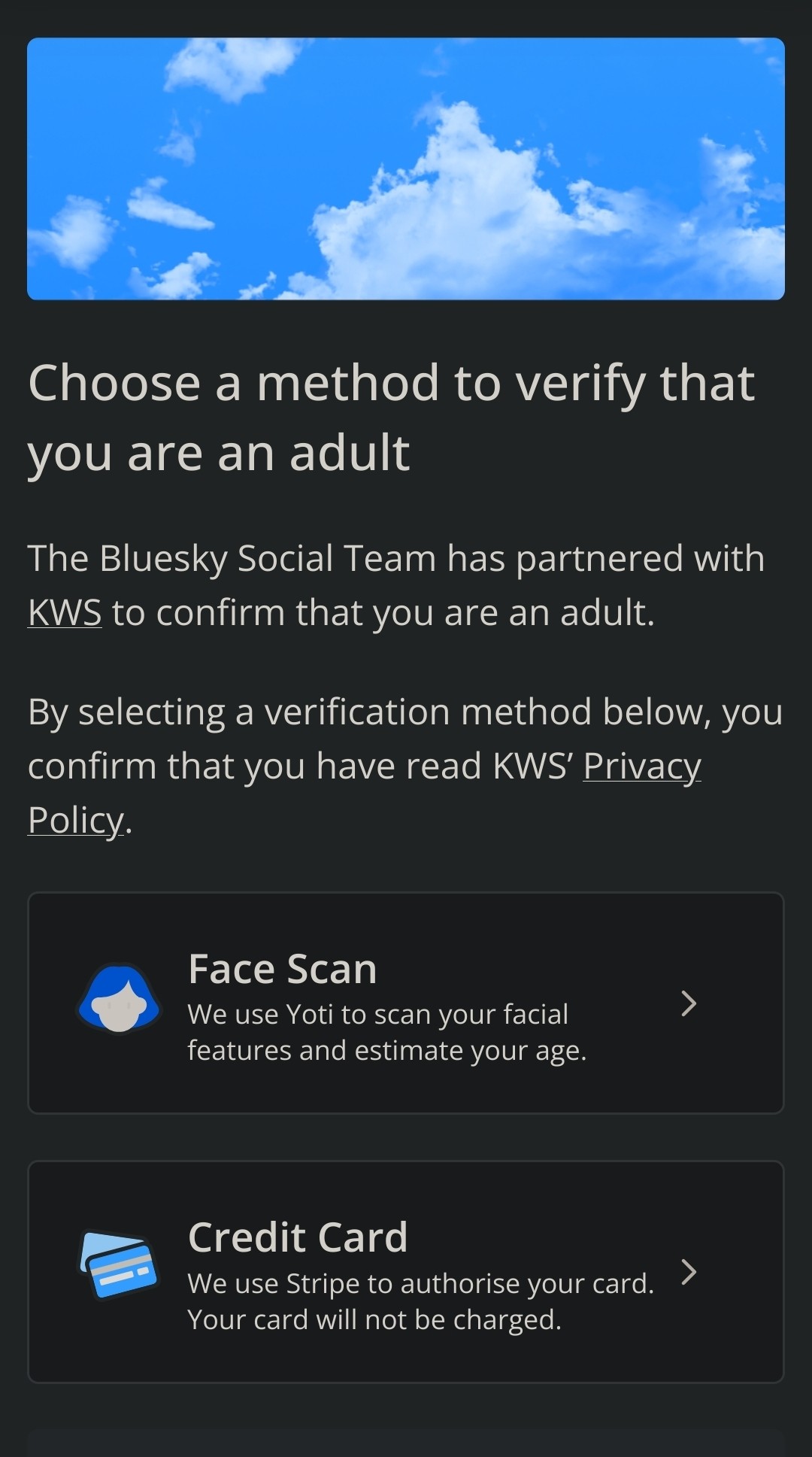
This is what is shown now when you have to verify