this post was submitted on 19 Dec 2025
299 points (99.0% liked)
History Memes
1221 readers
1502 users here now
A place to share history memes!
Rules:
-
No sexism, racism, homophobia, transphobia, assorted bigotry, etc.
-
No fascism (including tankies/red fash), atrocity denial or apologia, etc.
-
Tag NSFW pics as NSFW.
-
Follow all Piefed.social rules.
Banner courtesy of @setsneedtofeed@lemmy.world
OTHER COMMS IN THE HISTORYVERSE:
- !historymusic@quokk.au
- !historygallery@quokk.au
- !historymemes@piefed.social
- !historyruins@piefed.social
- !historyart@piefed.social
- !historyartifacts@piefed.social
- !historyphotos@piefed.social
founded 7 months ago
MODERATORS
you are viewing a single comment's thread
view the rest of the comments
view the rest of the comments
That would be curious considering that his account of democracy is not an account of 'mob rule', but of literal anarchy - ie that all people do as they wish to. If he didn't trust anyone with power, he should come off in support of his account of 'democracy', but instead he regards it as one of the worst states of a polity, below only tyranny.
Quis custodiet ipsos custodes?
And who stops them from changing the rules to benefit themselves, as a class?
"Oh, but as philosophers, they love justice (which remains ill-defined even after an extended aside trying to pin it down) and would never do anything wrong"
Not very compelling.
Inspected by who? The Auxiliaries, who are bound to obey the Guardians in all things (or else become the real rulers as a military caste a la the Mamluks)? Or their fellow Guardians?
People want power for its own sake - and once possessed of power, leverage that power to gain more of it. Don't think that abolishing, nominally, one form of power for a class does anything except redirect efforts towards other forms of power.
Plato blamed democracy for the death of Socrates. It was a sore spot for him. I think that having a ruling class that effectively made decisions democratically within their class was his compromise. I think that he would say that there are so many more people ruled by their stomachs (base desires) than by their hearts (honor and duty) or their heads (reason) that by giving everyone a vote democracy guarantees that the state is ruled by its stomach. His system places the responsibility of voting in the hands of those that have demonstrated that they are ruled by their heads and who have been trained to place the good of the state above all else. Restricting the vote means that the state will be ruled by its head and democratizing decisions among the ruling class defuses power to safeguards against corruption.
Who watches the watchmen is a universal critique that no system seems to have a good answer to. In Plato's system the answer is primarily the military class. They are responsible for upholding the laws and ensuring that the state is a just system. It's been years since I last read The Republic but if I remember correctly anyone had the right to inspect the philosophers for corruption. Any charges of corruption would ultimately be judged by the ruling class though so there is the problem of no clear way of controlling systemic corruption.
Plato's system was theoretical and untested by application. We also have the benefit of looking back on it with the accumulated knowledge and experience of 2,500 years. I don't argue that it's perfect or that there aren't valid criticisms. I interpreted your meme to say that Plato just wanted to put himself in charge. I don't think that particular criticism is valid.
I don't think there's any 'compromise' about it. He doesn't come off as having anything in the way of a 'modern' view of liberty and individuality, and seems to have little interest in portraying himself as such; only his reputation as a titan of philosophy makes people reluctant to ascribe the clearly oligarchic views he's expressing to him.
This isn't all that unusual for his time period. But that makes it all the more important to acknowledge.
Yes, he repeatedly expresses deep disdain for ordinary people and 'base' human desires. The man says "No problem with homosexuality except for the icky carnal stuff" and "Sex should be by government lottery for purposes of procreation"
Okay, so how is that voting system different than any other oligarchy of the ancient world?
Plato's proposed system, heavy on concept and light on details (which is fine for a philosophical work), differs primarily in the intentional construction of the institutions of the state and a unity of purpose in their design; and in the idea that an educated exclusively-ruling class would be in some way inclined to pursue justice.
Plato's Republic boils down to "If we educated our oligarchs and told them to be really strict with themselves (and especially the filthy poors), Justice Will Win In The End"
You would think all of ten minutes talking with other educated people would disabuse him of that notion, but I guess they didn't receive the right education.
A few hundred years later and half the world away, China's Confucian bureaucratic class would begin to take form, and boy, wouldn't you know? It has a lot of similarities with the proposed structure of Plato's Republic, including the emphasis on a self-selecting non-military ruling caste dedicated solely to governance and education, especially philosophical education.
Would you like to guess as to how just it was?
For a more modern example, you can look at any technocracy or Vanguardist regime of the 20th century and judge for yourself if a self-selecting caste of men educated in either practical matters (largely the former) or the humanities (largely the latter) with a clear intention of reconstructing society in their own image and with significant restrictions on the accumulation of personal property have made any exceptional progress towards a just society - or if they've done the exact opposite.
Aristotle and early Roman government both came up with a solution. Checks and balances.
There is no peace but deterrence. There is no deterrence without power.
But that means everyone must share in the task to some degree - everyone must be part of governance, including the farmers, including the artisans, including the soldiers. An unacceptable deviation from the notion of singular purpose espoused by Plato's Republic, wherein the people are not even to take up arms when the state is militarily outnumbered by its enemies (because it's not their job).
They literally are excluded from decision-making and are restricted to the enforcement of the dictates of the Guardians. He compares them to dogs at one point.
Yes.
No. That would not be their purpose, and everyone is to stay in their own narrow specialization in the idea of Plato's Republic. Having people who do not specialize in understanding justice and governance making decisions related to justice and governance would be the literal opposite of what Plato is arguing for in the dialogue.
Again, that would go against the entire ideal of Plato's Republic, wherein the third class of people are not to concern themselves with anything except following the dictates of the state, which is ruled by the Guardians who, alone, have the time and specialization to understand true justice.
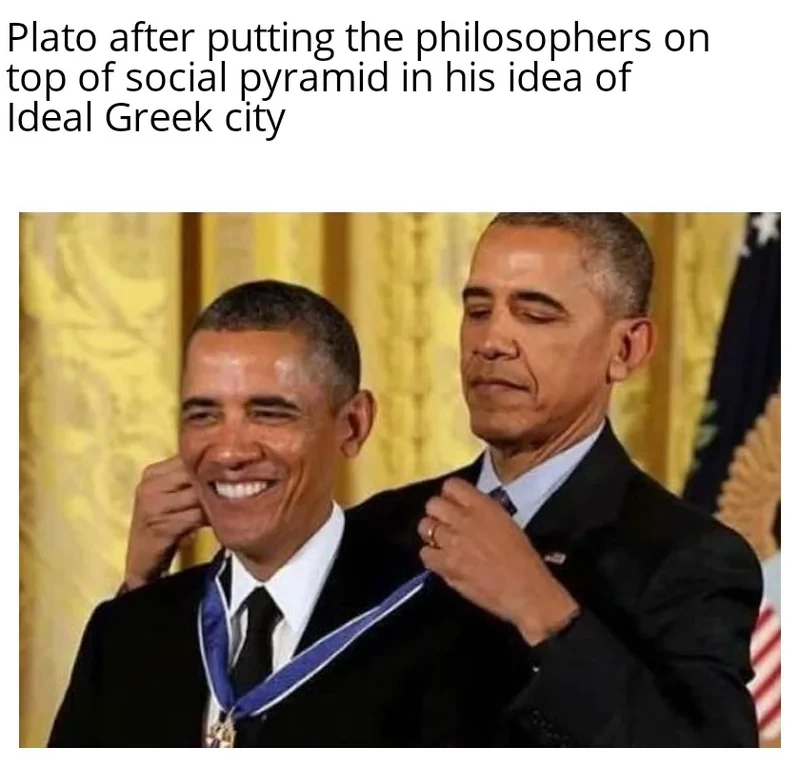
The Obama Awarding Obama meme isn't about power, it's about self-praise.
Plato says that if only philosophers like him ruled the world, there would be possible this utopia which is massively more just than any other extant system (despite reading like a dystopia to modern, liberal, non-aristocratic eyes).
Plato's Republic is important. Plato is an important figure in the history of Western philosophy. Plato made major contributions to the development of philosophy and modern thought, including by writing the Republic in the first place.
... but the core proposal of the Republic (whether read metaphysically or literally) remains utterly broken even at a glance, the 'dialogue' absurd in the lack of pushback received by Plato's mouthpiece, and the preconceptions involved (most relevant to the meme) masturbatory even if they were correct.
Individuality? Definitely not in the western way of thinking. Liberty? He did make men and women equal in the hypothetical society, while living in a highly patriarchal one. And the social mobility doesn't depend on who you were born to. Also there are no slaves.
The theoretical society is aristocratic in the literal meaning of the word - rule of the best. There are distinct classes, but every class is comprised of only the people who are best suited for that task.
I'd say it's overall quite unusual, utopic, and based on a long history of disappointment. Democracy was on its last legs and killed his teacher, an oligarchy he had an influence in was corrupt and murderously greedy, and tyranny got him enslaved for trying to teach an heir basic human decency.
The ruling class aren't oligarchs, and are in fact the filthy poors when compared to the working class. It's basically a society governed by monks with extremely strict rules and selection criteria.
I think that idea comes from an earlier form of Athenian democracy that involved a lottery to form an assembly. The idea was to prevent people who want to rule from ruling, and instead make it a chore that had to be done for the good of the community.
The working class are free to obtain all of the personal wealth they can, but they're disallowed from any involvement in ruling or enforcement. And considering your stance on oligarchy, you agree with him that the greedy shouldn't be involved in governing.
And if I remember correctly the founding myth warns that the society will fall apart if the greedy take control.
What did the myth warn about?
None of those had a system to completely remove all personal property from the government and enforcement. If those people are living better than the working class - you fucked up.
IMO that's the lesson of the metaphor, if your decisioning is influenced by personal gain or desires, it is not just. Only what is best for overall harmony is just.
"comprised".
It would be a waste, not to fix it.
Fixed, thanks.
... making men and women equal isn't liberty. Liberty and equality are not synonyms. An equal society is not necessarily a free one.
... the entire system is explicitly predicated on hereditary inheritance of position, with only occasional 'promotion' or 'demotion' to another caste - and abolishing marriage and private sexual relations to, again, explicitly and in a manner that is compared to breeding livestock for the best possible qualities, a system of eugenic state lottery breeding for the ruling caste.
... did you even fucking read the Republic?
There are no Greek slaves, foreign slaves are approved of and slavery is referenced as part of the society in several places.
Jesus fucking Christ.
It's also a mostly-closed hereditary caste of rulers who hold all power. So the theoretical society is aristocratic in all fucking meanings of the word.
... no, support for oligarchy is one of the most common stances of surviving ancient writers.
"It's not an oligarchy if we pinky promise to be responsible and that our decision to co-opt whomever we wish with no oversight is based on the best interests of the public (according to our judgement)"
Oh look, it's a Vanguard Party.
That was contemporary Athenian democracy.
The working class are explicitly not free to obtain all of the personal wealth they can; the issue of the Guardians ensuring no one in the third class becomes too rich is explicitly addressed in the work.
Jesus Christ.
Check the early days of most ML regimes.
... there is a long section in the book that addresses that justice is happiness, and that the desire to be happy is core to the desire to be just (for those who are truly wise and knowledgeable). That's the exact opposite of disdaining personal desires.
Are you talking about the transition from democracy to tyranny in the Republic, or something else? I don't know of any other accounts that could be considered in any way anarchistic.
If that's the case, it's not that everyone does whatever they want, but they think they can be whatever they want.
One day you're a labourer highschool dropout, the next a doctor proving vaccinees cause autism, the next you're a mathematician proving the earth is flat, and so on. It's a bit exaggerated, but it makes sense something like that could lead into tyranny. Remember Pisistratus and the other tyrants of Athens?
Keep the historical facts in mind.
During Plato's life Athens went through different systems, and ended up on a direct democracy that's paying free men to attend the assembly. The same free men who voted for Socrates to kill himself, and then a year later built a statue to honour him. Literally soldiers without a war, and the lowest of the free class, voting on things they know nothing about for a living.
He didn't shit on democracy for no reason, it was a dream on its last legs during his life, and it died shortly after him.
Did you not read the Republic
Ah, yes, the poors trying to make their own decision on what to do with their own lives leads to tyranny.
You may not have read the Republic, but you certainly seem inclined towards Plato's way of oligarchic thinking.
Yes, during Plato's life Athens lost a war and had a government installed by Sparta to rule over it, after which they overthrew it and restored their previous democracy.
"Literally soldiers"
... the Greek hoplite system was one of largely militia, not professionals.
"and the lowest of the free class"
Oh no
the filthy poors again
"voting on things they know nothing about for a living."
Good thing the Republic restricts voting on things they know nothing about for a living to only the oligarchic caste.
It 'died' because it was fucking conquered by the Macedonians.