this post was submitted on 02 Mar 2026
1550 points (99.1% liked)
Political Memes
11271 readers
1663 users here now
Welcome to politcal memes!
These are our rules:
1) Be civil
Jokes are okay, but don’t intentionally harass or disturb any member of our community. Sexism, racism and bigotry are not allowed. Good faith argumentation only. No posts discouraging people to vote or shaming people for voting.
2) No misinformation
Don’t post any intentional misinformation. When asked by mods, provide sources for any claims you make.
3) Posts should be memes
Random pictures do not qualify as memes. Relevance to politics is required.
4) No bots, spam or self-promotion
Follow instance rules, ask for your bot to be allowed on this community.
5) No AI generated content.
Content posted must not be created by AI with the intent to mimic the style of existing images
founded 2 years ago
MODERATORS
you are viewing a single comment's thread
view the rest of the comments
view the rest of the comments
You have to think about why it works that way.
A profit from a business is money that is taken out of the business. If the activities of the business generate more money than the business is spending, it doesn't have to become profit. It can also be re-invested in hiring more people, buying more equipment, training their workforce, expanding to new locations, even given as raises or bonuses to their employees. In theory, all of the things other than generating a profit are generally things that are good for the community. Employees can get hired, or trained, or raises. The business can expand allowing more people to buy from them, etc.
A profit is taxed because it's basically what a business does when it doesn't have any other useful ways of spending its money. In that case the excess money is just going to the business owners. The government is basically saying "ok, well if you aren't going to use that money for something that benefits everyone, and are just going to give it to the owners, we'll take our cut now. If the profits go directly to the business owners as income, they're then taxed again as income tax (again, in theory, in practice business owners don't want to pay that as income tax so they'll try to arrange to avoid it).
Income taxes are a different kind of taxation. They're basically a way for the government to own part of your labour. They go back to the time when peasants worked on the land. In exchange for the soldiers protecting them from bandits, the peasants shared some of their harvest. (I realize it was much more coercive than that, but the idealized theory is that taxes were to support the government which protects you or provides you services.)
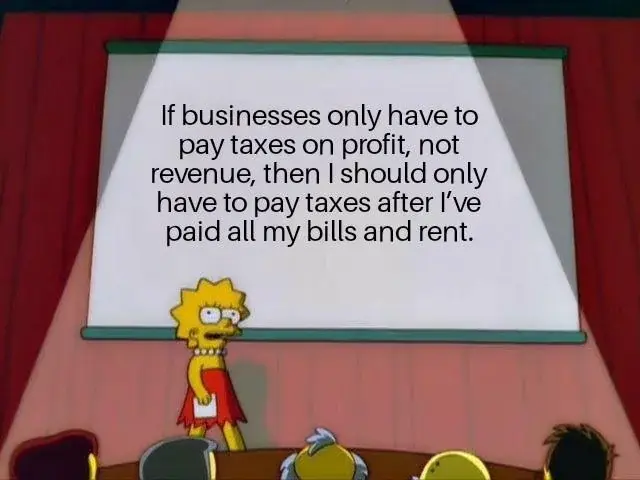
The obvious problem with "after I've paid all my bills and rent" is that "all my bills and rent" is something that someone could always adjust so they had to pay zero taxes. Even if you just limited it to "my housing expenses, food expenses, water bill, and electrical bill" someone might buy a huge house, or buy only the finest groceries, or install lavish fountains, or run up their electrical bills. So, instead you might want to say that someone only gets taxed after reasonable living expenses are deducted... and that's how things work.
Progressive taxation schemes typically mean that you pay 0 tax on your first X dollars earned per year. X is supposedly set to the minimum of what someone needs to get by. The way it's done on the US is that the lowest tax rate is set at 10%, but the standard deduction is set at $15,750, so the 10% only kicks in once you've passed that. $15,750 is absurdly low. It should really be at least double that, if not triple, but the idea is there. That's the "only after I've paid all my bills and rent" number, if you assume someone is paying the lowest rent possible and their bills are the absolute necessities. But, I don't think anybody could realistically live on their own for $15,750 per year.
So... yeah, Lisa. Things already work like that. It's just that the numbers are all fucked, there are too many loopholes and exceptions.
Businesses do the exact same thing to hide their profits, espicially since the owners can now borrow money against the value of their shares instead of relying on profits.
Here's my opinion, as someone who has zero education in economics. Feel free to voice your disagreement if you know better
If your personal expenses match your income but those expenses can't be written off, the resulting taxes result in a net loss for that month. This would be the same with a business if expenses could not be written off
And in my opinion, buying a house should not be written off as a personal expense, and neither should a business buying a warehouse be able to write it off either. If something can be sold, only the permanent loss should be considered an expense -- the remainder should be an asset
But bills and rent are generally permanent expenses. You don't get anything back after paying them, except the continuation of your services. I think these should be deductible. Similarly, if a business has to pay for a SaaS solution, I'm okay with that being a deductible
Is my thinking flawed?
I'd say it would be nothing but a boon to the economy. Yes we'd lose a TON of tax revenue from the lower and middle class, but it would be more than made up for by the richest, who's income is nearly entirely spending money, that they choose not to spend. (When not hidden in stocks or options or other assets).
The rich should pay more, but the rich could also hide their income by spending it -- they'd also have the benefit of consultants and lawyers who could sniff out every loophole.
If the rich spent their income the global economy would be in MUCH better shape.
There aren't as many rich people as you seem to think.
Yeah, it could possibly work if the "after bills" portion is super specific. Like rent/mortgage and utilities on primary residence Everything else is taxed. Would be hard to loophole that, but there's a reason I'm not a lawyer.
It would be pretty easy for loopholes there. What's a primary residence? Maybe your primary residence now contains a pub, or a co-working space, or a dance studio. Utilities are included? Well your electrical bill now supports a couple of for-profit electric car charging stations. That's why they went with the standard deduction in the US.
Dude. What the fuck are you on?
Walmart revenue was $681 billion Walmart taxes were $6.8 billion.
Reinvestment doesn't matter in this comparison. If it did, I could reinvest some money into something that would lower my taxable amount. That's what the meme is about.
There got to be better examples than that. Walmart manages about 4% margin, so 653 billion went toward procuring the stuff for sale. That figure suggests a tax rate of 25%, which is low at that magnitude but not as dramatically low as other companies pull off.
And lots of Walmarts "expenses" that they take out of their profit go into property rental and acquisition, I would venture to say it's one of if not the largest percentage of their expenses, much like my apartment is.
Dude. What the fuck are you on?
You can invest money into things that lower your taxable amount, for example charitable donations, investing in your pension and improving your home energy efficiency. That's exactly what tax credits and itemised tax deductions are.
https://www.irs.gov/credits-and-deductions-for-individuals