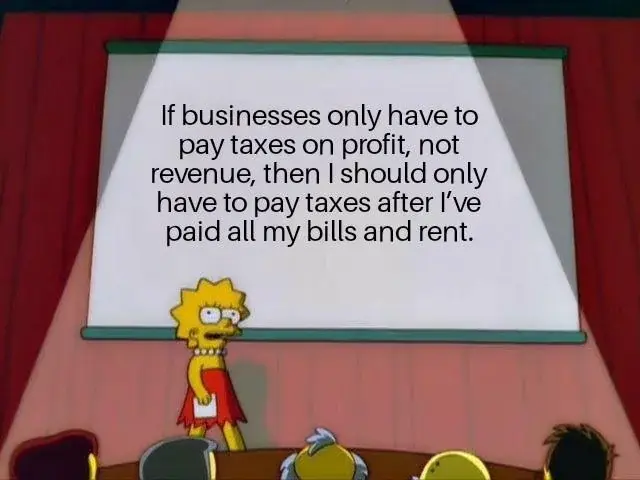
You have to think about why it works that way.
A profit from a business is money that is taken out of the business. If the activities of the business generate more money than the business is spending, it doesn't have to become profit. It can also be re-invested in hiring more people, buying more equipment, training their workforce, expanding to new locations, even given as raises or bonuses to their employees. In theory, all of the things other than generating a profit are generally things that are good for the community. Employees can get hired, or trained, or raises. The business can expand allowing more people to buy from them, etc.
A profit is taxed because it's basically what a business does when it doesn't have any other useful ways of spending its money. In that case the excess money is just going to the business owners. The government is basically saying "ok, well if you aren't going to use that money for something that benefits everyone, and are just going to give it to the owners, we'll take our cut now. If the profits go directly to the business owners as income, they're then taxed again as income tax (again, in theory, in practice business owners don't want to pay that as income tax so they'll try to arrange to avoid it).
Income taxes are a different kind of taxation. They're basically a way for the government to own part of your labour. They go back to the time when peasants worked on the land. In exchange for the soldiers protecting them from bandits, the peasants shared some of their harvest. (I realize it was much more coercive than that, but the idealized theory is that taxes were to support the government which protects you or provides you services.)
The obvious problem with "after I've paid all my bills and rent" is that "all my bills and rent" is something that someone could always adjust so they had to pay zero taxes. Even if you just limited it to "my housing expenses, food expenses, water bill, and electrical bill" someone might buy a huge house, or buy only the finest groceries, or install lavish fountains, or run up their electrical bills. So, instead you might want to say that someone only gets taxed after reasonable living expenses are deducted... and that's how things work.
Progressive taxation schemes typically mean that you pay 0 tax on your first X dollars earned per year. X is supposedly set to the minimum of what someone needs to get by. The way it's done on the US is that the lowest tax rate is set at 10%, but the standard deduction is set at $15,750, so the 10% only kicks in once you've passed that. $15,750 is absurdly low. It should really be at least double that, if not triple, but the idea is there. That's the "only after I've paid all my bills and rent" number, if you assume someone is paying the lowest rent possible and their bills are the absolute necessities. But, I don't think anybody could realistically live on their own for $15,750 per year.
So... yeah, Lisa. Things already work like that. It's just that the numbers are all fucked, there are too many loopholes and exceptions.