Imagine if an experienced pilot crashed on every 20th landing.
Humor, jokes, memes about TTRPGs
Imagine if an experienced pilot crashed on every 20th landing.
Part of the excellent case why you shouldn’t roll for the routine. Take “town downtime activities”.
If a character is a lifetime street urchin, they should be able to find a few “safe marks” versus rolling to snag some risky but lucrative pickpockets. A talented musician doesn’t flub every 20th note, but you can certainly reward bigger rolls with bigger tips.
I feel like this doesn't take two things into account.
First is what the group wants. While that work for a bunch, and does for my Tuesday game, it wouldn't for the games that I've run in the past and personally doesn't work for me either. A lot of people actually like rolling for stuff like that. It adds some element of flavor on how good or bad it can go. While you succeeding might be all but guaranteed, the numbers can impact a lot. That and some of us just like using the clicky math rocks we've spent a disgusting amount of money on.
The other thing is that it still ignores the core problem of a 5% chance of failure of something that you are proficient or an expert in. An expert having a 5% chance of not just failure but critical failure isn't something that I really jive with. Can you imagine if those margins were acceptable in our reality? Can you imagine if there was a 5% chance that during a lecture on something that they've been studying all their life, a medical doctor gives genuinely dangerous advice to his students? Sure. Accidents happen. That has happened in the past but if that happened 5% of the time with every expert on the planet... well things would look very different. The entire term expert would probably have a different definition as that perpetual 5% chance would really change your opinion on how much you trust someone when they have the same chance of catastrophic failure as Joe from the market.
Critical failure doesn't have to mean the worst outcome imaginable, though.
Rolling a 1 on a routine skill check that you've done a thousand times as an expert should reflect the circumstances.
Landing a familiar model plane at your home airport on a sunny day with no wind? Rolling a 1 means it's as bad as it can be under those circumstances. Let's say, a bird flies into the windshield and obscures your view. New problem to solve! New roleplaying opportunity! Doesn't mean the plane insta-crashes. You might just deal with the failure creatively and carry on like nothing happened. Scary moment, but fun to play out.
Now let's say you're the same experienced pilot, but you're landing an unfamiliar, stolen plane that your rogue hot wired, and you're trying to land on a beach littered with tourists and rocks.
Rolling a 1 for a critical failure is a much different scenario this time.
It's more that it's just more work for the DM in this case. Every time a skill check is called or considered, the DM has to reconsider if the character considers this a routine or trivial task. You can see this in the stats: if the character's modifier is 5 or less than the DC, it's trivial. But you also must consider even without a high mod vs DC, is this a task the character has performed hundreds of times before? I try not to come up with solutions, or utilize WOTC solutions that make a lot more work for the DM. Especially if there's already a rule or slight tweak that makes sense and prevents this work: in this case, no crits for skill checks.
I suppose if the DM is running the game through a rigid preformed structure then yeah, having things make stuff more unpredictable is gonna be hard on the DM, but if they are already choosing to fly by the seat of their pants and roll with the incoming suggestions from the dice, it's totally fine.
There are lots of different types of people that like to DM games. Something isn't automatically worse for all DMs.
Every 20th dish from Gordon Ramsay is just dogshit smeared on a plate.
Maybe that somewhat infamous expensive grilled cheese he showed people how to make over lockdown was him rolling a one.
That video is exactly why chefs should not be allowed to make normal folk food. They keep adding random bullshit and trying to make it theirs when it was perfect to begin with.
Except Jacque Pepin. That dude is always talking about how he grew up poor and uses all of the onion (yeah, even the hard part). He will show you a potato and leek soup that's to die for and costs no money.
No cream? Use milk! No milk? Use water! You will have the best tasting potato water around.
That's why I do crit fail confirms. That way an experienced pilot only crashes every 400th landing.
That's still far more than reality though.
D&D isn't meant to be an accurate simulator of reality. It's meant to be fun. If you find 1 in 400 auto failures to be unfun then don't use it.
Indeed.
Also you can take 10 if you're not stressed.
And that's why you as the DM can do passive skill checks (neé "taking a 10") for non-stressful situations. A routine landing is just 10 + ability mod (probably INT on a big plane with full FBW) + PB. It's only with 3 of the 4 engines down, the 4th on fire, the computers are fucked, you're trying to land the 747 on a dirt strip, and oh, there's a hurricane when you need to actually roll for it.
Though I'm also down with Esper's idea of every class having a limited reliable talent. So every character could pick one class skill at level 7 and one at level 14 in which they couldn't roll under a 10. The "expert" classes (rangers, rogues, bards, and artificers) would have additional picks at levels 3, 10, and 17 with full reliable talent being their capstone feature.
I like how Pathfinder 2E does it. A 20 brings your result one tier higher. A 1 brings your result one tier lower. With a high enough base expertise, you can still succeed when rolling a 1, just not as awesome as you normally are. And a 20 isn't a guarantee against really strong foes.
This. Plus, if you beat the DC by 10 or more, you get a Critical Success or if you fail by 10 or more you get a Critical Failure, regardless of the dice roll.
And for opposed skill checks only the player/NPC taking the action rolls a d20, and that's compared against the opposing skill DC (10 + Skill Bonus). This streamlines play and reduces random variability.
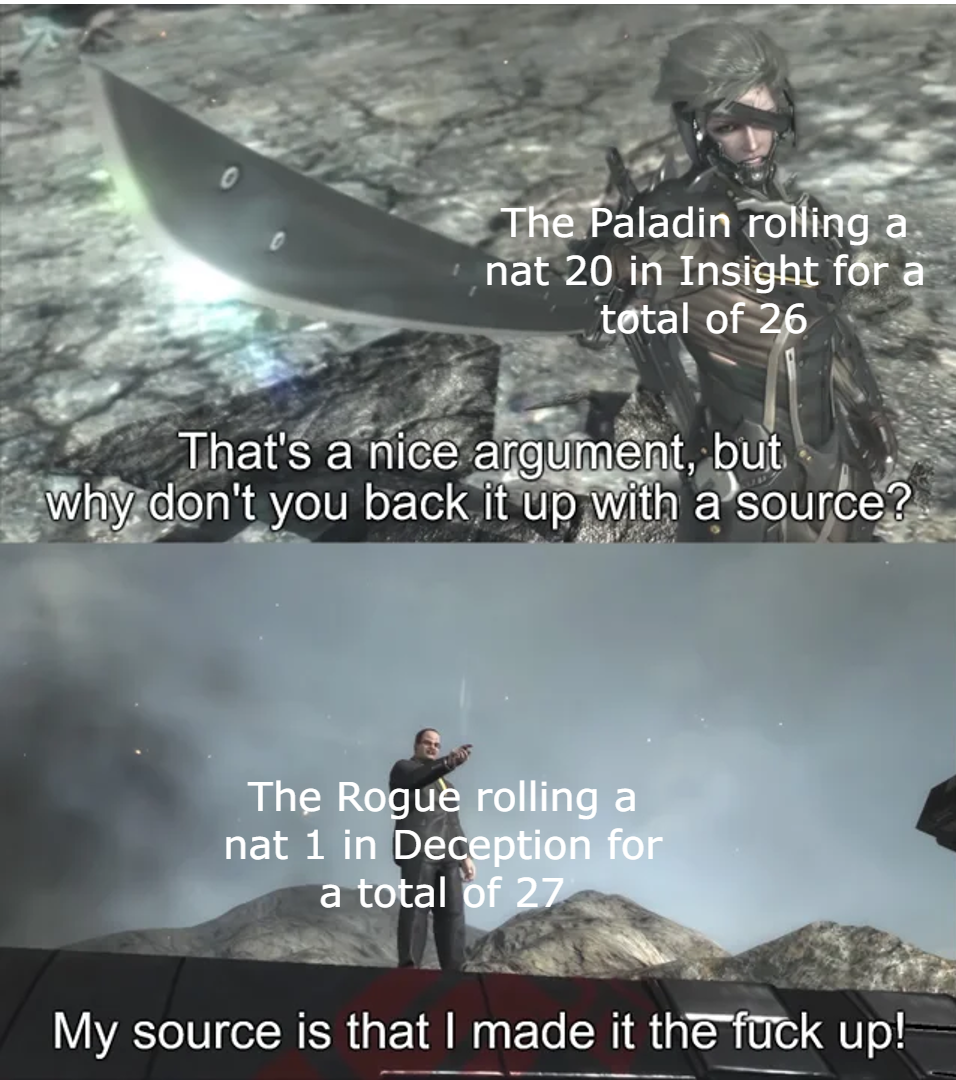
So in the example here, only the rogue would have rolled the natural 1 and added 26 for a 27. The paladin's Perception DC would be 16, so the Rogue beat it by 11 and it'd normally be a Critical Success. But since it was a natural 1, the Critical Success is reduced to a Success. They still succeeded at deception, but not quite as well as they could have.
I've had players have this exchange, and then the Paladin decided to ignore the rogue's critical miss, and just roll with it.
Paladin to the rest of the party "I forget what they said exactly, but it was a very convincing argument!"
Critical success and failure has never applied to skills. It was only ever in the rules for attack rolls and (in 5e) death saving throws. Critical success and failure in skill checks is probably an example of the Mandela Effect. Anyway, for the above reasons I don't use them as such. However, on nat 20s I might provide a "path for success" where one may not otherwise have been possible. But it's never a given. More of an opportunity for roleplay.
It's not the mandela effect, it's a common house rule that people express their opinions on.
Yeah, everyone is very aware it's not in the official rulebook, other than in the section of the official rulebook where it says not to treat it as an official rulebook and only something to fall back on if you can't think of something better.
And for anyone that for any small moment of time may not have temporarily been aware that skill crits isn't in the official rulebook, that problem is solved very quickly the second they meet any other player online.
It's not in the rules, but it makes sense. It also does have rules about taking an automatic 10 for low DC stuff, which you usually only do if even a roll of 1 would succeed so it gives a good trade off having nat 1s be a failure even in skill checks when the player opts to roll instead of taking a 10.
I like critical failure.
Skilled people can sometimes choke under pressure.
Under pressure, sure. But a perpetual 5% chance of colossal failure seems absolutely insane when it applies to restful situations as well.
In games, realism is often sacrificed in favor of drama.
Yeah. That's what the magic is for. But I refuse to believe that a wizard who can conjure and drop a meteor on a city has a 5% chance of not recognizing the light spell.
Edit: I forgot the word chance.
Can you think of a better mechanic to represent choking under pressure? Maybe “trivial” skill checks should roll with advantage?
Yes. Pathfinder 2e has a good one.
Rolling a nat 1 or 20 doesn't mean Critical success/failure. It means it moves the success status up or down one: Critical success, success, failure, critical failure. In addition, that game also specifies that a critical is also achieved by your result being +/- 10 of the result.
So if you're attempting a DC 35 check (arguing with a god, let's say) with a +2 mod, a nat 20 would get you a result of 22, a critical failure. But a nat 20 bumps it up one success, so you get a regular failure. Whereas if the DC was 25, a 22 is still a failure but your crit means it's a regular success.
This has middling applications in D&D 5e, though. PF2e's DCs and skill bonuses are not constrained by 5e's Bounded Accuracy. So they can vary a lot more. In D&D's case I had to pull pretty much the highest possible DC the game suggests so there's not a lot of use cases for this. But it's still a better system for including criticals on skill checks. And this is why 5e doesn't have them normally.
There is the option for removing trivial skill checks, as mentioned elsewhere in the comments of this post, but most players I've had want to roll for the small stuff. Just expecting you succeed gets really boring after a while. Not to mention a lot of us bought shitloads of these clicky math rocks and want to use 'em. So while that's an option it's not one that I'm a particular fan of. Advantage I'm also not a huge fan of as it then feels like it cheapens advantage itself. I use both advantage and disadvantage sparingly in my games and have outright banned Silvery Barbs at my table for that reason. When you get advantage or disadvantage from something I like it to feel like an "Oh fuck" moment. A friend helping you out in a time of need or an something catching you completely off guard. My idea would be confirming critical failures.
For combat I understand a simple natural 1 equals a failure. That is under pressure and yes you can choke in those moments or just be bested by an opponent. But for skill checks you're proficient or an expert in during a non-pressure environment or situation it makes no fucking sense. Cut that chance down by making them confirm it.
Natural 1 on a Proficient Skill = Re-roll the d20. If you roll 10 or below then you critically fail. 11 or above and your result is treated as a simple 1 instead of a critical failure.
Natural 1 on an Expertise Skill = Same as above but the failure bracket shifts down to be 1-5 for a critical failure and a 6-20 for a simple 1.
That's how I'd run it anyway. Maybe shift the failure/success brackets but the same basic set up.
For most skills, there low level human equivalents in the real world who will never "choke under pressure" once when doing the thing thousands of times throughout their life. When we're talking about one of the heroes of a tale that are also "the best of the best", I think it's ok from a literature, fantasy, or gameplay standpoint for them to have a 100% success rate despite the fact that a failure risk would be possible in the real world. This is doubly true (DM point of view) when failure would be uninteresting or mess with suspension of disbelief. If an ace pilot is trying to fly through a bad storm to land where the firefight is going to happen, he bloody well makes it. I'm ok with "success with complications" on a 1, but the complications should be fun as well. You land ok, but the wind that hit at the last minute caused some damage to a wing. You might need to find another way out" or even "unfortunately, you weren't able to fly evasively enough because of the buffetting winds, so they know you're here.
Nobody wants Skyrim syndrome, where a master thief gets caught pickpocketing someone (we Bethesda players do something called save-scumming to keep the immersion). I used to go to a pickpocket show at the local renfair and the performer never got caught. And he was not a "master thief".
In epic scaled games, I work around this with a "reroll at -20". So the rogue in this case would have had about a 25% chance to recover on a DC10 check.
I also always include an in-game explanation. In this case, I would have made it a huge flashy "boon of insight" from the Paladin's deity.
Then it's all the more fun if the rogue actually manages the re-roll. "Dude, I even tricked your god!"
I would also RP right into it. "A voice from on high intones 'I dunno, seems legit, to me.'"
Similarly if the rogue actually fails:
"A voice from on high intones 'Seriously, you need to stop falling for this crap. I'm going to send you an amulet of insight or something. What's your next stop?'"
I listened to one video which suggested rolling 3 d6 instead. Crits on 3 and 18. Turns that 5% into 0.46%.
...yes, but that also has the trade-off of moving your rolls from a flat distribution where every value between 1-20 have equal weight, to a bell curve that peaks at 10.5.
Many of your rolls are gonna end up right around that 10-11 mark as a result. Which can be fine! #alldicearebeautiful
But it's not gonna be a great drop in replacement for D&D. D&D's skill checks are built around beating numbers that you're not going to reach as easily with 3d6 vs a flat d20.
Basically, more dice = more predictability and fewer wild swings of fortune. That is a more accurate model of reality.... But arguably less fun in a game.
Imagine the difference in dramatic tension in a game where the boss has 50 HP. In one scenario, you deal a consistent 5.5 HP each round. In the other, you deal 1d10 damage each round.
In the long run, you'll deal the same amount of damage in either system. But the randomness of a 1d10 creates more dramatic tension and excitement! When you roll a 1, it's a crushing setback. A 10? Instant jubilation.
This is why my house rule is nat 20 or 1 gets a second roll to determine the degree of the crit. A 1 followed by another 1 is your true fall on your face odds.
Which, as said elsewhere, is still a 1-in-400 chance. A commercial pilot lands a plane thousands of times in his life. 1d20 with a 1d20 confirm would mean no pilot ever survived to retirement.
And one could argue a commercial pilot has a fairly average skill level, the equivalent of a level 0 character with a ~4 points of proficiency (D&D3 mindset, I know I'm old). Someone who is 5 or 6 times that should have no meaningful risk of crashing a plane (and the plane should have no meaningful risk of dangerously malfunctioning 0.25% of the time)
Critical skill failure is relative to the situation, you don't chop your arm off everytime you critically miss in combat. Although if it makes sense for the specific situation, chopping your arm off might be on the table sometimes for a critical miss in combat. Same sort of thing works for skills. It would only be the worst reasonable result that comes to mind. Not that all of a sudden the worst possible thing ever happens completely out of the blue.
Personally I think the right method is to only roll when there’s pressure. If you’re good at a skill and there’s no pressure, then it just succeeds.
I've been trying to include failure techniques from DungeonWorld's suddenly ogres in my game. It proposes a few neat ideas for consequences of failure that are broadly applicable to many RPG systems.
Eg, in the example above, maybe the Rogue (truthfully or not) blabs that their source was [ancient evil tome forbidden by the paladin's order]. Now the complication is not that the Paladin disbelieves the rogue's claim, but that they might question the rogue's true intentions.
Edit: Or in the example given about landing a plane. An experienced pilot won't crash 1/20 times, but what if Air Traffic Control did a bad job managing things today? It will take 1h for the plane to be assigned to a gate, but you need to catch the train to Borovia in 1h15.
An award winning surgeon rolls a 1 while giving a routine lecture? The presentation is so fucking boring that half the students fall asleep. Now the surgeon has to deal with the extra office hours of students who don't understand this part of the curriculum.
Yeah, I really like the "success with complications" category (Fate system does something like this, too) to keep things moving when a bad roll would otherwise make 1-in-a-million tragedy happen.
Doubly so if that bad roll would be a session- or campaign-ender.
Surely 1 when landing a plane indicates a go around
I like the idea of a critical role needing another roll to see just how critical it was. That way something crazy can always happen, but it doesn’t need to be a certain doom either.