psud

joined 2 years ago
MODERATOR OF
[–] psud@aussie.zone 3 points 22 hours ago

It's valuable to us like cars are valuable to highways, except our guts have a job without cars

Out of the analogy fibre is good for blocking uptake of what you eat and slowing down too fast digestion, which is great if what you're eating isn't good for you, but which you don't want if you only eat stuff that is entirely good

[–] psud@aussie.zone 3 points 1 day ago

Cigarette smoking has a hazard ratio of 7 (700%) for lung cancer, for comparison.

[–] psud@aussie.zone 2 points 1 day ago (2 children)

enough fibre

Funny, I can't find a number for the minimum fibre intake for optimum health, it's almost like fibre isn't a nutrient for humans

[–] psud@aussie.zone 2 points 1 day ago

Your environment bits

We all know the problems of industrial farming. It's unsustainable

Fortunately the solution works for both me and you: permaculture

It makes soil rather than consuming it. It makes marginal land suitable for crops

Permaculture requires animals on the land to fertilise it, and crop plants to turn the shit to soil.

Much worse than beef farms though are grain farms

[–] psud@aussie.zone 3 points 1 day ago

Comprehensive Review of Red Meat Consumption and the Risk of Cancer https://pmc.ncbi.nlm.nih.gov/articles/PMC10577092/ From the abstract: "The evidence is strong for the association between red meat and breast cancer and most gastric cancers.

This looks to me to be a review of food frequency questionnaire studies which are famous for being only good for hypothesis generation, and not great at that. Where their research has been tested by interventional experiments they generally don't survive, for example eggs and cholesterol.

Garbage in; garbage out

Are the rest of them the same? Bring interventional studies if you want to demonstrate causality, if your #1 reference is indicative all you've done is demonstrate you don't know or don't care about the explanatory power of different types of studies, and asking people what they ate in the last 5 years (tick the boxes in the categories on the form) are the least powerful, they don't even demonstrate correlation clearly since they are so low resolution, so prone to healthy food answer bias, and so reliant on human memory of what they ate up to half a decade ago

Anyway people have been doing carnivore or zero carb or zero fibre in modern times for 20 years, if meat was as dangerous as your poor quality studies say the would certainly be studies of the high cancer rate and heart attacks in the carnivore community

[–] psud@aussie.zone 1 points 2 days ago (1 children)

Is Dr Mason on carnivore?

[–] psud@aussie.zone 2 points 3 days ago

Interesting that he seems to make pemmican from ground meat. I haven't tried that though it should work pretty well

If I try that I might have to spread it on baking paper on the mesh that my dehydrator uses

[–] psud@aussie.zone 3 points 3 days ago* (last edited 3 days ago)

Science needs funding. Funding is always aligned to what the research is about; Coca cola is hardly going to sponsor a "meat is good" paper, though they do provide money to try to prosecute doctors for providing nutrition advice to sick patients

[–] psud@aussie.zone 3 points 3 days ago

Dr Mason is doctor enough to call out what is not scientifically proven. The only parts of this very short segment from a longer presentation that isn't demonstrated yet but science are:

  1. That people on low carb diets who avoid seed oils suffer less sunburn than those who eat seed oils; and
  2. A mechanism for seed oils to block the effect of vitamin D.

He clearly flagged those as anecdote and supposition so I'm not at all sure what your problem is.

The very short summary is "isn't it interesting that lots of people in this population claim to not get sunburnt, since this thing that other population eats and this population don't is known to stop parts of this system in the body, I wonder if it also blocks related thing"

There is nothing controversial there, it's a clearly stated hypothesis

[–] psud@aussie.zone 3 points 4 days ago

I only snack when I'm drying fatty meat, picking off pieces of fat from the half dried beef

[–] psud@aussie.zone 2 points 4 days ago (2 children)

The premise for his argument is "humans produce vitamin D as a Sunscreen"

Which...what?? No. Humans produce melanin as natural sunscreen, not vitamin D.

Yes melanin protects us from sunlight, but what's your source for vitamin D not being protective against sun damage?


Do seed oils block cholesterol to vitamin D? Vitamin D as sunscreen Sunburn resistance of people who don't eat seed oils

Summary by Google's LLMIn this video clip from Low Carb Down Under, Dr. Paul Mason presents a theory linking the consumption of industrial seed oils to a higher susceptibility to sunburn

Key Arguments and Claims:

  • Vitamin D as Natural Sunscreen: Dr. Mason states that the body naturally vitamin D as a protective shield against UV/UVB radiation damage to DNA, rather than strictly for bone health
  • The Cholesterol Connection: He references Ancel Keys' historical "Seven Countries Study", highlighting a data point that individuals with higher sun exposure had lower blood cholesterol levels. He explains this occurs because the body uses cholesterol to synthesize vitamin D
  • Interference by Plant Sterols: He argues that plant sterols (phytosterols) absorbed from dietary seed oils interfere with normal cholesterol chemistry, specifically disrupting the skin’s ability to synthesize vitamin D
  • Anecdotal Evidence: While acknowledging the evidence is largely anecdotal, he points out that a vast number of individuals on ketogenic internet forums report a noticeable resistance to sunburn after completely eliminating seed oils from their diet.
[–] psud@aussie.zone 3 points 5 days ago (1 children)

It's heavily salted so probably lasts ok

1
submitted 2 weeks ago* (last edited 2 weeks ago) by psud@aussie.zone to c/carnivore@discuss.online
 

My partner needed steak for a family dinner, so following my style she bought a whole porterhouse, and they ate about half of it

She eats low fat. Bulk meat comes untrimmed so has much more than supermarket or even butcher cuts

But it seems fair enough, easier for her and her mum to cut it off than for me to add fat


I just spent two weeks in tropical Cairns, Australia, a few of those days were out in the sun, snorkeling, fishing, bush walking. So I decided to test what I figured was a myth of meat making you proof against sunburn. I skipped sunscreen.

A light tan is supposed to be about SPF4 (Sun protection factor 4, stay in the sun 4x as long without burning, sunscreen is usually above SPF50) and my face, arms and legs had a little tan left over from summer. My back, chest, stomach, and shoulders were northern European white.

Two hours snorkeling was enough to get my shoulders burned enough to peel, my back got lightly burned. I guess I didn't point my stomach at the sun much. That's less burning than last time I spent a couple of hours in the sun with my shirt off, so I think there was some protection.

My friend I was traveling with told me that my face was bright red, I could see the red in my arms, but that all just turned to tan.

Last time I got burned enough to peel, it hurt. This time, it just itched as it peeled and felt very hot if I pointed that part of me at the sun for a couple of days.

While fishing I had my arms in the sun, with the un-tanned inside of my right arm getting hours of sunlight. That reddened, but didn't burn enough to peel. and now more of the inside of my right arm is tanned.

My thoughts:

  • You burn about as quickly
  • It hurts a lot less
  • You can get a bit more sun without it peeling
  • Once you get tanned you really don't get burned anymore
  • If you tan and you spend time outside you'll tan as soon as the sun gets above 50 degrees above the horizon. For me that's early Spring for minutes a day through to mid summer where it's hours a day.
  • You can get through a mid-summer day's UV with a deep tan.

To lots of people with episodes outside, or doing outside sport as the low sun of early spring turns into the high sun of summer, so solar UV dose slowly rises over months it would seem like immunity, getting tanned before burning enough to peel.

But if you go from nothing to hours under the summer sun meat won't be enough to protect whichever part of you is most pointed at the sun, but it will make the damage less severe and heal quicker, since unnecessary swelling will be suppressed.


Prusa have shared on their blog the upcoming version of their slicer which is intended to make colour printing easy using CMYKW for 5 colour printers and CMYW for their 4 colour systems

2
submitted 11 months ago* (last edited 11 months ago) by psud@aussie.zone to c/carnivore@discuss.online
 

Ingredients

  • Ruminant meat, I used beef
  • Rendered fat from the same, I used suet

Method

  1. Remove any fat from the meat. This can be done before or after drying. It's a nice snack when removed after drying
  2. Dehydrate the meat until it is so dry it can be broken into pieces Meat, so dry it snaps
  3. Grind, smash, or blend the dried meat to add small as practical Blended dried beef
  4. Weigh the dried meat
  5. Weigh out the same weight of rendered fat into a microwave or heat proof container Cold rendered suet
  6. Heat the fat until it is just melted, I use a microwave 1 minute at a time, or starting with 2 minutes if I'm doing more than 1 kg Melted rendered suet
  7. Put the dried meat in a suitably sized mixing bowl
  8. Add the melted fat to the meat, mix well with a wooden spoon Mixed blended dried meat and rendered suet
  9. Empty the mix into a suitable mold. I use a large casserole dish, once it has set reasonably firm, cut it into pieces. This has set completely, and two pieces are already eaten Completely set pemmican molded in a Corning Ware large casserole dish, cut into 8 pieces of which six remain
16
submitted 11 months ago* (last edited 11 months ago) by psud@aussie.zone to c/minecraft@lemmy.world
 

I updated my server from fabric 1.21.3 to vanilla 1.21.7 directly just recently and have noticed that my skeleton spawner farm is now killing unarmoured skeletons rather than leaving them on half a heart

  1. Is this a bug, or a bugfix?
  2. Is anyone else having this problem?
  3. Is this just a problem that happens when going from fabric to vanilla? The skeleton spawner was created by a mod which is no longer running.

I can't see anything relevant in the changes or bugfixes of the releases after 1.21.3

My workaround is to raise the landing floor by 1 block which has returned the farm to normal functionality


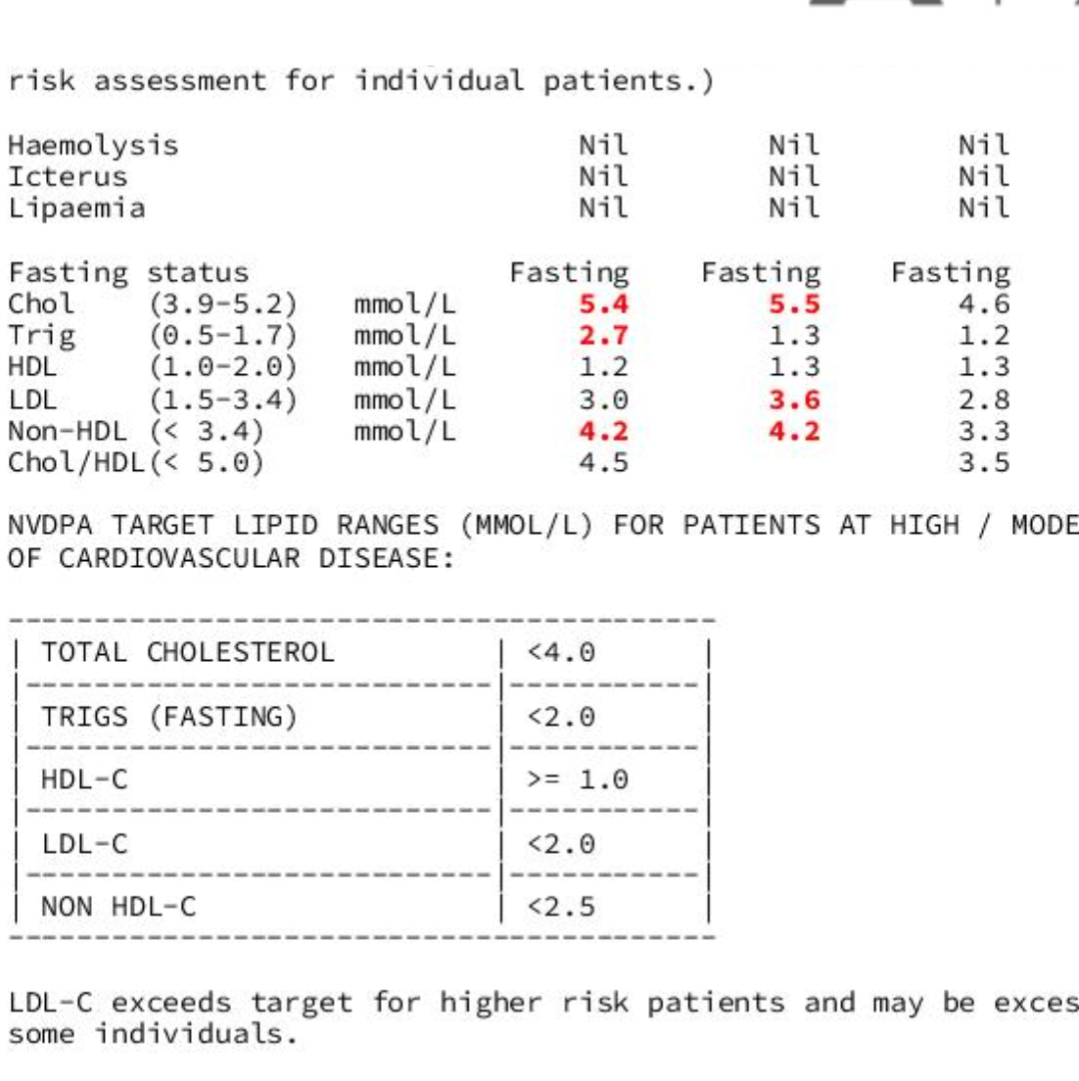
image of spreadsheet values showing high LDL from 3 to 3.6 to 2.8 and FFA/HDL reducing from 2.2 to 0.9


This Nick Norwitz video presents the biochemical link between inflammation and anxiety

It made me wonder - is this part of the reported cool that you hear about in carnivore circles. Is it just (or maybe mostly) that the lifestyle prevents the bulk of inflammation and thus the anxiety that inflammation would have caused

1
submitted 1 year ago* (last edited 1 year ago) by psud@aussie.zone to c/carnivore@lemm.ee
 

A bit of my past, back in about 2003 - before I had eliminated sugar from my diet - I went to an all day event, got dehydrated and had a gout attack.

I mistook it for a foot injury from jumping down some stairs

But it happened again and nothing I had done could be blamed, so I ended up on allopurinol

Time passed, allopurinol worked. Then about COVID lockdown time I fell off keto and went back to eating junk, then in December 2022, just before Christmas I read The Fat Of The Land and went carnivore, calling it zero carb

So everything I read said there's no gout without sugar, so I stopped using allopurinol

Then in April this year I got foot pain. Not quite the classic big toe ball of the foot swelling but the next three toes' joint

So I blamed gout despite having no sugar for years

I got prescribed an anti inflammatory and it quickly cleared the problem

Then it happened again and I noticed the pattern, it was particular shoes. I cut my toe nails shorter and now those shoes don't compress my toes and cause toe pain

So I'm pretty sure again that gout needs sugar

Reversal being:

  • I thought I had an injury but it was a gout attack when I ate junk
  • I thought I had a gout attack but it was an injury while I was eating just meat
0
submitted 1 year ago* (last edited 1 year ago) by psud@aussie.zone to c/carnivore@lemm.ee
 

Yesterday I ran out of pemmican, so I bought steak. Scotch fillet is usually one of the fattiest cuts, but what I got must have been the smallest, skinniest cattle.

I had maybe 50g of fat in the day and woke this morning feeling less than well

All symptoms vanished though when I had breakfast: 200g of tallow and about 600g of steak

Perhaps I'm too lean now to run well on my own fat (why can't you judge your own fatness?)

I highly recommend pemmican if you're as bad as me at making sure you have fatty enough meat

2
submitted 1 year ago* (last edited 1 year ago) by psud@aussie.zone to c/carnivore@lemm.ee
 

#Pemmican

Ingredients Beef, sliced thin for easy drying 1.2kg Tallow (made from suet) 1.2kg

Equipment

  • A method of making thin slices of meat - My butcher cut mine up
  • A dehydrator. I have had success with a cheap round one, and an expensive box one. The key is ability to hold a temperature. I prefer commercial driers over home made as they provide a reasonably sanitary environment. Higher temperature = faster drying, but higher temperature = less vitamin C
  • A method of making the meat into tiny pieces. I used a food processor. Feed it slowly, meat is harder than most of the stuff it cuts
  • A method of melting sufficient tallow. My dehydrator holds just over a kilo of meat, which means just over a kilo of tallow. I used a glass mixing bowl
  • A large enough mixing bowl to mix in - mine pictured below is an enormous steel salad bowl 34cm across
  • Something to mold the pemmican in, I use a large casserole dish lined with grease proof paper

Method

  1. Dry the meat. This can take a while. I'd love to know how hot I could take this without destroying too much vitamin C. I ran it at 30 degrees C

Thin slices of fresh silverside beef hanging in a biltong box dehydrator set to 25°C. The temperature was later increased to 30°

  1. Wait. I waited a week. Maybe 4 days would have been enough. The dryness you're looking for is where the meat cracks instead of bending

A hand demonstrating meat being so dry it cracks rather than bends

  1. Weigh your mixing bowl. This is a slow process and scales tend to turn off part way through.

  2. Blend the meat to powder. I used a food processor, with about a third of a slice being fed at time, emptying it into the mixing bowl after every 300 grams or so.
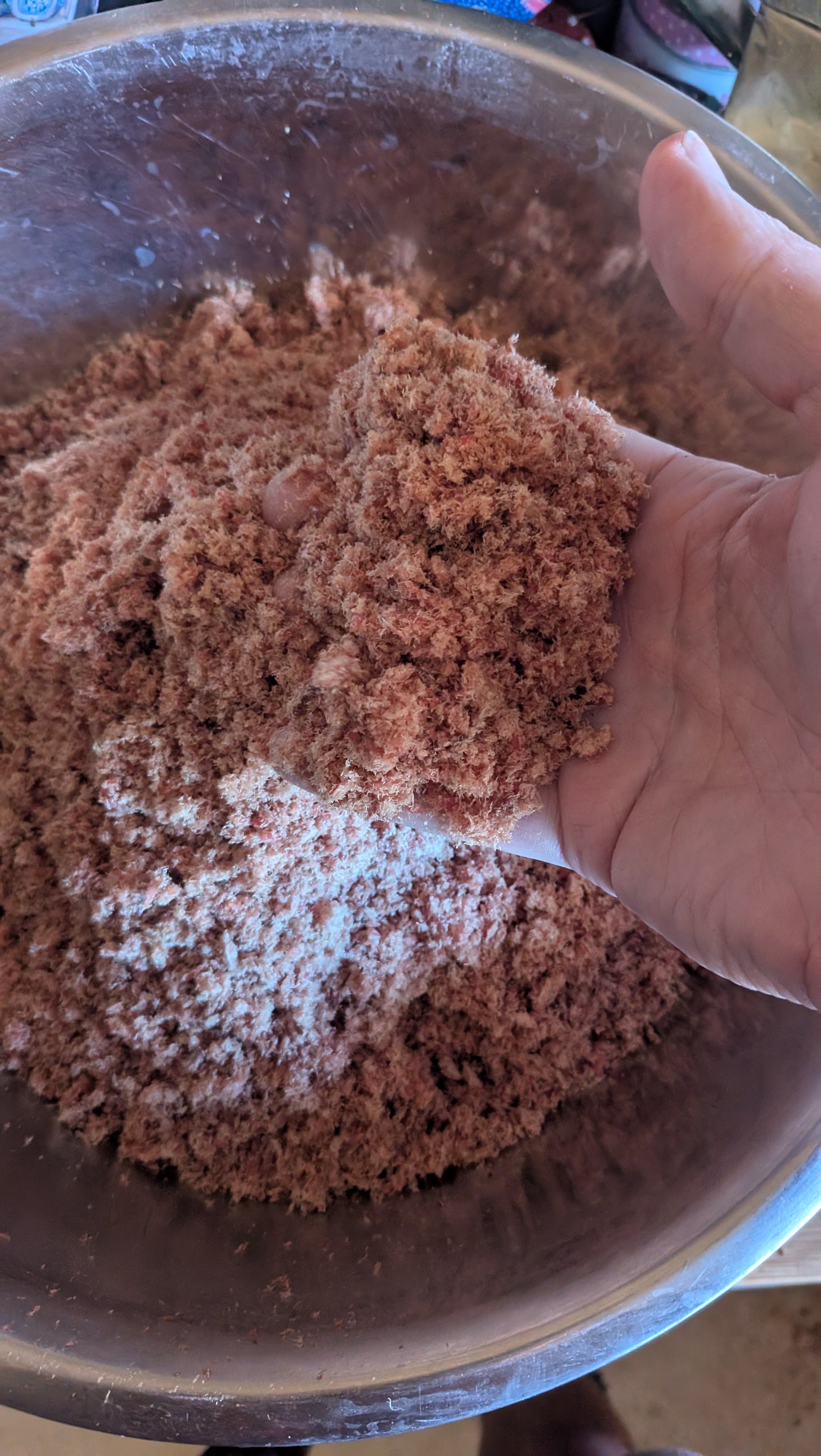
Dry meat blended fine. The little bit of fat in the meat makes it sticky

  1. Weigh your blended meat. Weigh out the same amount of tallow

Blocks of tallow in a glass bowl

  1. Melt the tallow at as low a temperature as you can. That's about 50°C. I used the microwave for this as I didn't want to dirty my double boiler. I ran it 1 minute at a time for about 3 minutes, stirring and measuring the temperature each time. Tallow melts at about 50°C

A glass bowl with melted tallow in it. A thermometer to the side reads 50°C

  1. Combine. This works just like making cake batter. Make a well in the mound of blended meat, pour in the tallow. Mix with hands or wooden spoon until all the meat is saturated.

  2. Mold it. I line a container with grease proof paper. I haven't tried a teflon lined container, though that could release the pemmican easily. Press the pemmican into the mold, I use a steel spatula to flatten the top.

Pemmican in the mold

  1. Let it cool. In the fridge or on the bench. Before it goes hard, but after it has set a bit, cut it into portions. I cut mine into 16 pieces averaging 140g each.

Package it in glass, paper, or foil. I used foil and packaged each two together

A rectangular prism of pemmican with added salt, unwrapped from its foil wrapping, in front of a wrapped piece

  1. Clean up. As the cook you get to eat the pemmican left in the mixing bowl

A spoon in a mixing bowl. The spoon scraped up pemmican that was left behind when the mold was filled


It's sad that it's so resisted

view more: next ›