this post was submitted on 30 Jul 2026
1584 points (98.4% liked)
Fuck AI
7790 readers
1661 users here now
"We did it, Patrick! We made a technological breakthrough!"
A place for all those who loathe AI to discuss things, post articles, and ridicule the AI hype. Proud supporter of working people. And proud booer of SXSW 2024.
AI, in this case, refers to LLMs, GPT technology, and anything listed as "AI" meant to increase market valuations.
founded 2 years ago
MODERATORS
you are viewing a single comment's thread
view the rest of the comments
view the rest of the comments
I'm not sure that's been extensively tested in courts. The document you referenced below appears to be as-yet not officially published, so I don't believe it actually qualifies as an official position yet, but the bigger issue is that it's untested in court.
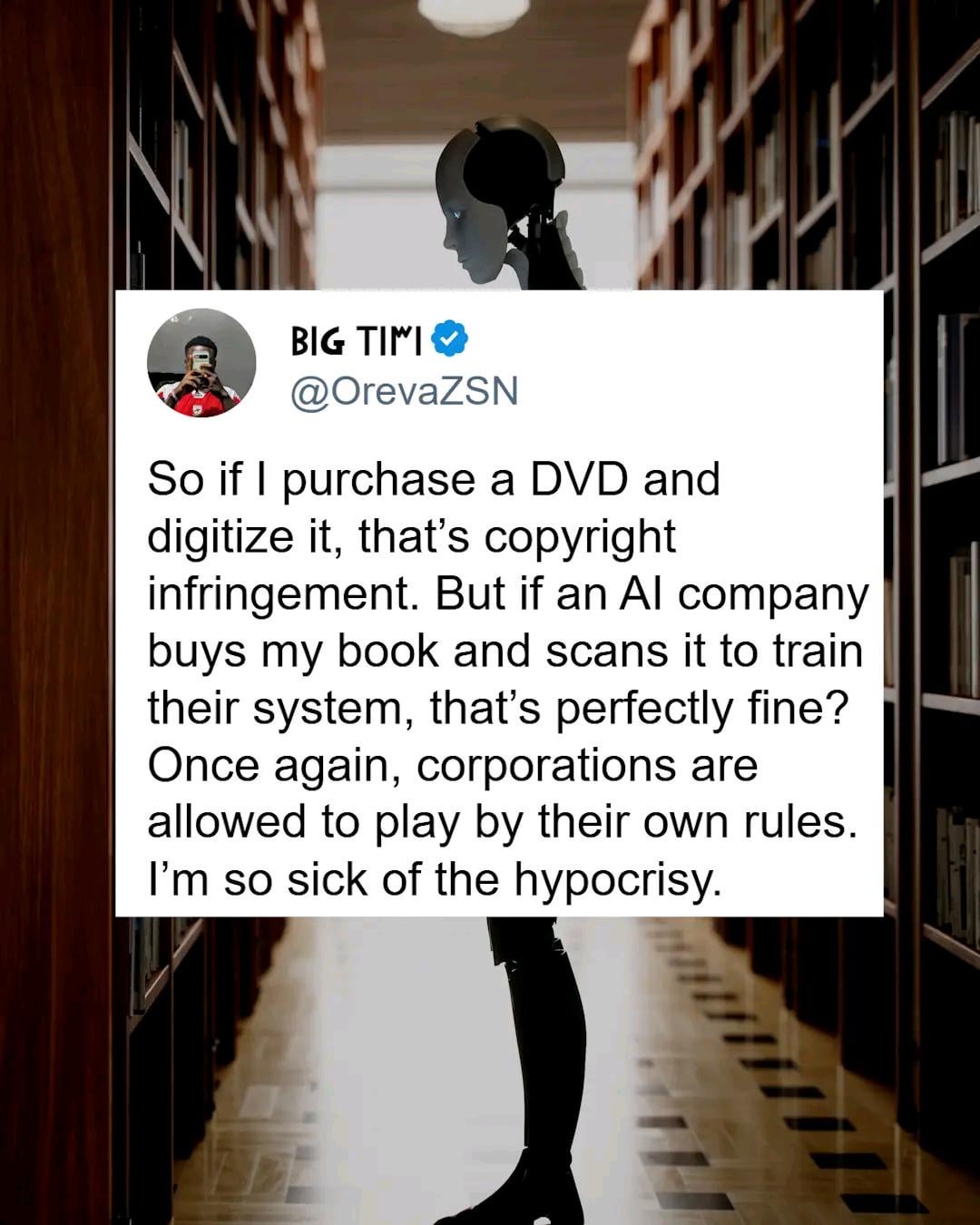
This thread is a response to an AI court case where the ruling was that training on copy written works is fair use.
https://www.reuters.com/sustainability/boards-policy-regulation/us-judge-approves-15-billion-anthropic-copyright-settlement-with-authors-2025-09-25/
Regardless, you do make good points and I think we agree that the end state is "they shouldn't be able to do that". I have concerns that using existing standards that take copying too literally results in some unintended ambiguity, and situations where AI training is incidentally blocked, but so is stuff like "opening a news article on a computer", which does the same things the copyright office report highlights as infringement.
I think we'd be in a much more agreeable place if we just legally state that a commercial AI tools training isn't fair use. That lets you have nuance like "search engine? It's a statistical model, but not generative: allowed. AI agent? Statistical model that's generating content as opposed to classification or ranking: not allowed".
Good luck getting any federal law changes through before 2028, at best. So, for at least a couple of years, we get to use the existing laws to address generative "AI"'s use of works still under copyright protection.
Any change in status before then we be policy changes by the U.S. Copyright Office, but they have already come down against training (mostly; the publications are long because there's a lot of nuance).
But, Kadrey v. Meta Platforms, Inc. (Judge Chhabria, June 25, 2025) states that “in most cases,” training LLMs on copyrighted works without permission is likely infringing and not fair use and "this ruling does not stand for the proposition that [...] use of copyrighted materials to train its language models is lawful."
The courts are divided, but the copyright office is not.
Parts 1 and 2 are officially published.