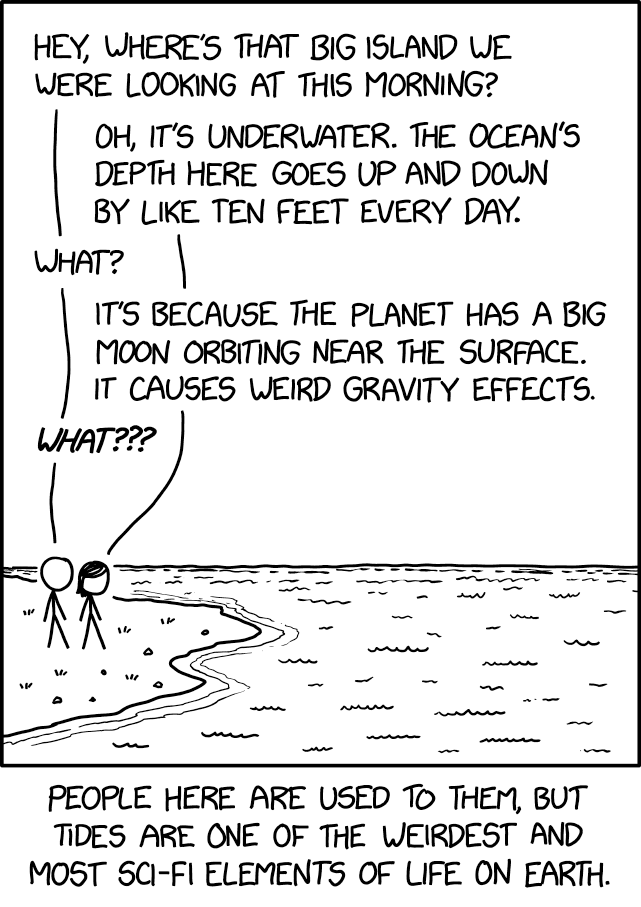
Alt text: They're up there with coral islands, lightning, and caterpillars turning into butterflies.
A place for majestic STEMLORD peacocking, as well as memes about the realities of working in a lab.

Rules
This is a science community. We use the Dawkins definition of meme.
Alt text: They're up there with coral islands, lightning, and caterpillars turning into butterflies.
Well it's different in several factors competing in different directions, and it's not clear to me what the overall aggregate direction is.
The fundamental force of gravity is going to drive a lot of disparate starting points to collapse into similar results.
But in the end, we're still talking about the probabilistic chances that certain lumpiness in the distribution of mass from supernovas or whatever forms the matter of solar systems, and how each solar system's spinning disk coalesces into planets with their own elemental composition and orbits and rotations and moons and internal rotation and energy that might make for magnetic fields, plate tectonics, etc.
If the probabilities of those may still have some independence from one another, then even if there are lots of stars like ours and maybe even lots of planets that are earth sized, and lots of planets with the oxygen to make water or carbon to make organic chemistry or the iron to make a magnetic field, we might still recognize that the correlations between these not-fully-independent variables still require stacking probabilities on probabilities at a factorial rate.
While the number of opportunities for those conditions to hit might go up at an exponential rate, if the probabilities are small enough and there are enough necessary factors for life stacking on each other, it's entirely possible that the exponential expansion of more solar systems than we could fathom is still too small to make for an appreciable probability of the conditions of life.
I don't know what the probabilities actually are. But I can see how the math of the combinatorics can totally dwarf the math of the vastness of the universe, such that the overall probability remains infinitesimal.
The aggregate direction is always towards highest entropy, which means lowest energy state, stability etc. Planets tend to self organise into harmonic orbits with simple whole number ratios, because that's the lowest energy state. But the result is that we have a nice, stable solar system where planets have relatively circular orbits with nice spacing. Despite the initial chaos of the formation, it's very likely that all solar systems collapse into this kind of high entropy, regular stability, and what little observations we can make of other systems have confirmed it.
The point is that it's not at all random, there are irresistible forces at play which narrow the space of what's possible into a very small box, cosmologically speaking. Matter organises itself into spheres, then into orbits etc. We don't see disc shaped planets for example because they're physically impossible to make using natural processes. And we don't see planetary collisions because they can only happen at the start, in the chaos of system formation. Then it all settles down into a stable, predictable, harmonically resonating system, as the laws of thermodynamics predict.
I'm not disagreeing with you on any of the physics of solar system formation, just disagreeing with your interpretation it means that habitable planets are high probability.
When clouds of dust and gas settle into spherical planets, what makes them rocky? What makes them have magnetic fields, atmospheres, water? What makes it so that the planet in the habitable zone hits those conditions.
The tendency of certain things to develop isn't a lockstep correlation of 1 between these factors.
We can believe that stars are common. And so are planets. But what combination of factors is required for life, and does that combination start leveraging the math of combinatorics in a way that even billions of planets in each of trillions of galaxies wouldn't be enough to make it likely that there are other planets that can give rise to life as we know it.
My point isn't actually about cosmological physics. It's a point I'm making about the math about probabilities being counterintuitive, in a way that "the vastness of the universe" doesn't actually mean that life is inevitable. It might still be, but it doesn't necessarily follow.
Well I didn't specifically say habitable planets are high probability. But it just so happens that they are. Firstly consider the Copernican Principle. If we live on a habitable planet then it's logical to make the assumption that habitable planets are common. There are strong counterpoints to this, but it's all very hypothetical anyway so it's better to just point to the empirical evidence: astronomers estimate that [one in five stars has an earth sized planet in the Goldilocks zone](One in Five Stars Has Earth-sized Planet in Habitable Zone – W. M. Keck Observatory https://share.google/J40L3PlVnAvee7C7B). In terms of the why, it's a much more difficult question to answer, but the stages of planetary formation that are proposed include processes whereby heavier elements coagulate together, earlier, and those that end up massive enough then attract lighter elements and become gas giants. Rocky planets formed close to the sun because it was hotter there and water/ice couldn't form and contaminate the denser elements, although it doesn't seem to happen that way in other artist systems.
Everywhere we look we see rocky planets and we see water. It's not unlikely that rocky planets therefore would have liquid water fairly often
That's what I take issue with. I don't think that follows.
If I have a random deck of cards, I can't assume that the deck order is common. Or, if I flip a coin 20 times I can't assume that the specific heads/tails order that results is commonly encountered, either. Just because it actually happened doesn't mean that the a priori probability of it happening was likely.
The Copernican Principle is assuming that all decks of cards or all flipped coins follow the same rules. I'm not disagreeing with that premise, but I'm showing that no matter how many decks or coins you use, the probability of any specific result may be infinitesimal even with as many decks as there are planets in the universe.
Showing me good reason to believe that earth sized planets have a 20% chance of showing up in habitable zones still doesn't answer the other questions I have about plate tectonics, elemental composition, magnetic fields, large moons, etc. Stacking dozens of variables with conditional probabilities can still produce numbers so small that even every star in the universe representing a "try" might not lead to a high probability result.
I think you need to let the deck of cards metaphor go! A deck of cards is specifically designed by intelligent minds to generate random outcomes, whereby natural processes follow predictable paths, and the outcomes are limited by natural laws. There is no intelligent mind altering the outcomes, or designing for or against randomness.
It's a fair assumption to say we are not privileged observers if the universe because there is zero evidence to the contrary.
There are answers to all of your questions about elemental makeup of planets, magnetosphere, moon and tectonic plate formation, but it's a lot of reading to get them.
The math I'm talking about still works with weighted probabilities or conditional probabilities. The underlying factorial math expands the number of possibilities way faster than the number of "tries" can increase the likelihood of at least one hit.
The point is: the fact that something has already happened is not proof that it is a high probability event. The deck of cards hypothetical is merely an example of that phenomenon. Applying different weights (e.g., ignoring the suits of cards) doesn't change that basic mathematical phenomenon, both only re-weights the probabilities to be bigger. But lining up a bunch of probabilities in a row still multiplies them in a way that results in a infinitesimal probability.
If there are only billions of earth-like planets in our galaxy, and only trillions of galaxies, that's still only 10^21 chances at life. Yes, that's an unfathomably large number for the human brain to process, but it's also nowhere near the numbers that can be generated through factorial expansion, so if the probability of life arising is something like 10^30 on any of those planets, the expected number of life bearing planets would be pretty much zero.
It's not probabilities that dictate these processes though, as stated above. It's natural laws. Certainties. Like the increase of entropy, or the conservation laws. So a planet isn't just 50% likely to form with rocky bias withín the frost line, it is certain to do so. I'm sorry but probability rarely tells even a small part of the story of natural processes.
The fact that something has happened nearly every time we see a chance of it happening very much does make it a high probability event, cf. Bayesian inference.
No, you're skipping a step. For any n number of chances, the likelihood of something with probability p happening at least once is 1 - (1 - p)^n . You may think that with high enough n that it doesn't matter what p is, because the exponential increase from n overwhelms the math to where the whole term basically converges onto 1, but my point is that there are combinatorics where the exponential increase in n is still dwarfed by the effect of the factorial increase in 1/p.
The probability of a rocky planet to form within a habitable zone is about 20% for any given star, according to your earlier link. How many will have a moon like ours? How many other life-sustaining characteristics will it have? If your argument is that the probability is 100% for every star, well, that's just wrong. If your argument is that it is inevitable in that the probability approaches 100% if you look at enough stars, then you're ignoring the entire point I've been making here, that you would have to show that the probability p is large enough that one would expect the overall probability to be found in at least some of the n stars viewed.
No, my deck of cards counterexample directly disproves this conjecture of yours. And you can't talk about Bayes theorem while simultaneously saying that this isn't a discussion about probability.
And you also can't talk about natural laws without probability, either, as quantum mechanics itself is probability distributions.
So I'll continue to point out that the vastness of space might mean that the n is in the order of 10^21, but I can simultaneously recognize that 10^21 is a mind bogglingly large number while still not being large enough.
I can, because you are forcing this discussion to be about probability
Literally none of the effects you have chosen to discuss are quantum effects.
Look I'm sorry, but I don't think the evidence points to p<10E-21 or anywhere near it. Why would the only solar system we're able to study be so unique? It's magical thinking. Apart from the moon and plate tectonics being nice, but not essential to complex life, which other factors are you proposing conspire to lower the probability of life to this practical impossibility?
I'm pointing out the fallacious reasoning behind your view that with enough chances, it is inevitable that every possible outcome occurs at least once. That does not necessarily follow, simply because it is possible to generate events of infinitesimal probability, simply because n! grows much faster than x^n. That's just plain math.
Turning to whether the rare earth hypothesis itself is correct or not, I don't actually have a strong view on this. I just know that you can't reason your way into disproving the rare earth hypothesis simply by saying "the earth is possible and therefore common, because everything that is possible is inevitably common."
I don't see how else this could be anything but probabilistic. Unless you're saying every star is the same size as the sun and every star has an earth-like planet orbiting it in he habitable zone, the probability of those things is obviously less than 100%. We can already observe counterexamples that proves those aren't 100%.
So if you want to argue that there's no way the probability is less than 1 in 10^21, fine. Then we're having the conversation about the actual probabilities. But my whole point, since my first comment in this thread, is that it is not enough to say "I think there are 10^21 planets so life is inevitable." That's not sufficient to support that conclusion.
Debate whether a large moon, plate tectonics, a magnetic field, an atmosphere, an ozone layer, a Jupiter-like neighbor, a G-type star, and what ratios of specific elements need to be present on a planet to qualify. I'll leave the actual estimates of those probabilities to others. But each of these factors has a non-100% chance of happening on any given planet, and it becomes a question of whether the probabilities stack in a way that overcomes the sheer number of stars and planets there are. And that's the thing I'm sure about, that you simply can't ignore the factorial expansion of those factors because you think that there are enough planets in the universe to make that irrelevant.
Can you point to what I have written that has led you to this misunderstanding? I'm not an idiot and I certainly do not believe this nonsense. Thanks.