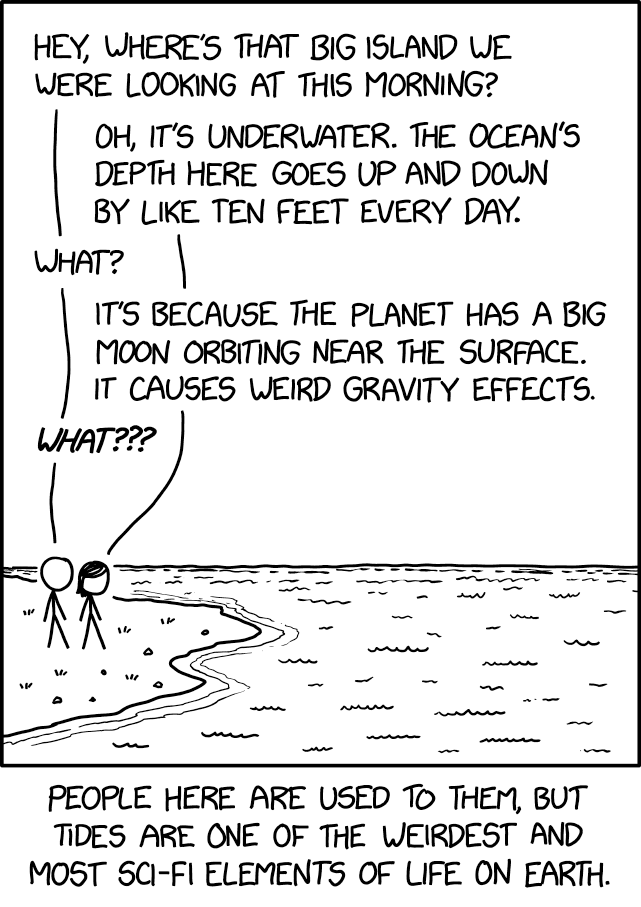
Alt text: They're up there with coral islands, lightning, and caterpillars turning into butterflies.
A place for majestic STEMLORD peacocking, as well as memes about the realities of working in a lab.
Rules
This is a science community. We use the Dawkins definition of meme.
Alt text: They're up there with coral islands, lightning, and caterpillars turning into butterflies.
This NASA page has some really cool simple visualizations of how tides work. They are kind of strange in ways you don't expect.
https://science.nasa.gov/moon/tides/
Now think about pouring a bucket of water out on a table. It’s easier to slide the water around on the table rather than lift it directly upwards. When the Moon’s gravity pulls at Earth, the water doesn’t float outward, it just gets pushed and squeezed around on the globe, directed by both gravitational pull and other forces, until it ultimately ends up bulging out on the side closest to the Moon and the side farthest away.

I don't know how to upload gifs to lemmy but check them out on the NASA page they are very satisfying and cool and explain the science wonderfully!
wow that's pretty cool!
By far the coolest and most unique aspect of the Earth-Lunar system is solar eclipses. The size and orbital distance is just right to allow for the spectacle we get today.
This is even more true when you consider that the Moon's average orbital radius is increasing by 3" (76mm) each year. In a million years, the Moon will be too far away to fully cover the Sun. A few million years ago it was close enough to fully cover the corona
Honestly, whenever I think about this, I get my tinfoil hat moment. Life being created by statistical probability and chance, well ok. Life being created and people with conscientiousness rising up at exactly the time this one planet has this perfect orbital distance - give me that tinfoil.
That's just our bias talking. There's certainly many other wonderful events we missed by a couple million years. We just think the moon size is special because of this coincidence.
Like the dinosaurs probably being around while the earth still had rings, right?
I didn't know that fact, but yeah
Earth's orbital distance has pretty much always been "perfect" though. It hasn't really changed much since it's formation 4-5 billion years ago.
Unless you mistyped and you're talking about the moon's orbital distance? In which case, it's actually kind of the opposite of what you're claiming. It's estimated that life first popped up pretty close to when the planet and moon finished forming, at which point the moon's orbital distance would have made it appear larger than the sun and probably fully obscure the sun + it's corona during an eclipse.
I did mean the distance between earth and moon, thanks for correcting!
I don’t recall what I was reading, but I once read about a lot of things lined up perfectly for evolution on Earth.
It’s bonkers that it all worked out that way so that I could be here, right now, reading your post and responding. It really boggles the mind and I don’t want to waste my time.
Welp, guess I’m gonna go look up random curse words in the dictionary. ಠᴗಠ
Look up Douglas Adams’ puddle analogy?
“If you imagine a puddle waking up one morning and thinking, 'This is an interesting world I find myself in — an interesting hole I find myself in — fits me rather neatly, doesn't it? In fact it fits me staggeringly well, must have been made to have me in it!"
This is rather as if you imagine a puddle waking up one morning and thinking, 'This is an interesting world I find myself in — an interesting hole I find myself in — fits me rather neatly, doesn't it? In fact it fits me staggeringly well, must have been made to have me in it!' -Douglas Adams
Lines up perfectly ... for life as we know it. See also: The Anthropic Principle
But in the vastness of space, it was practically guaranteed to happen somewhere. There are a set of criteria that allow for the evolution of life (as we know it) and it was going to happen somewhere, the fact that it happened here is no more awesome than it happening 3 galaxies over.
I know the feeling you are describing and the words to describe what i am trying to say are hard for me to grasp.
Its like in a film where the hero survives seemingly impossible odds and people watching say "no way, thats impossible" and can't enjoy the film because its too unbelievable. I say no! This is a story about the one almost impossible time all these things happened. Thats the point. Yes its hard to believe, but thats what makes it awesome.
So the earth being here and humanity and all other animals evolving here is just the time in the impossibly vast universe that the "stars aligned" and the fact that we are experiencing it is just expected.
Our planet is scifi as hell. We've got natural magnetic shielding to protect our UV-blocking ozone layer from solar winds. This planet is so damn cozy<3
This planet is so damn cozy<3
Oh! Oh! Let's wreck it by polluting the hell out of it :3
I think it’s more wild that not only are big moons rare, ours is literally the same size as the sun from our point of view.
It also makes almost exactly 13 laps for every lap the earth makes.
Which is why a 13 month calendar all having 28 days would have made more sense
Tidal currents are the least outlandish phenomenon. Most planets have moons and those that do all have tides. Most known ones don't have oceans and land.
That being said the tides tend to be stronger in e.g. the north sea as opposed to the Mediterranean.
Winter is kinda wild too. The fact that the planet is tilted just enough to make it cold part of the year, but not so cold that it kills everything, and many plants and animals have integrated this into their life cycles.
Makes you appreciate how much daily life depends on celestial geometry.
I get similar feelings about earth when I can see the moon during the daytime. Something about seeing it with clear craters against the blue sky makes it feel much more like we’re just floating in space with a cratered barren partner.
Ah btw, this is the gravitational form (geoid) of earth:

The meters is the height difference of orbit.