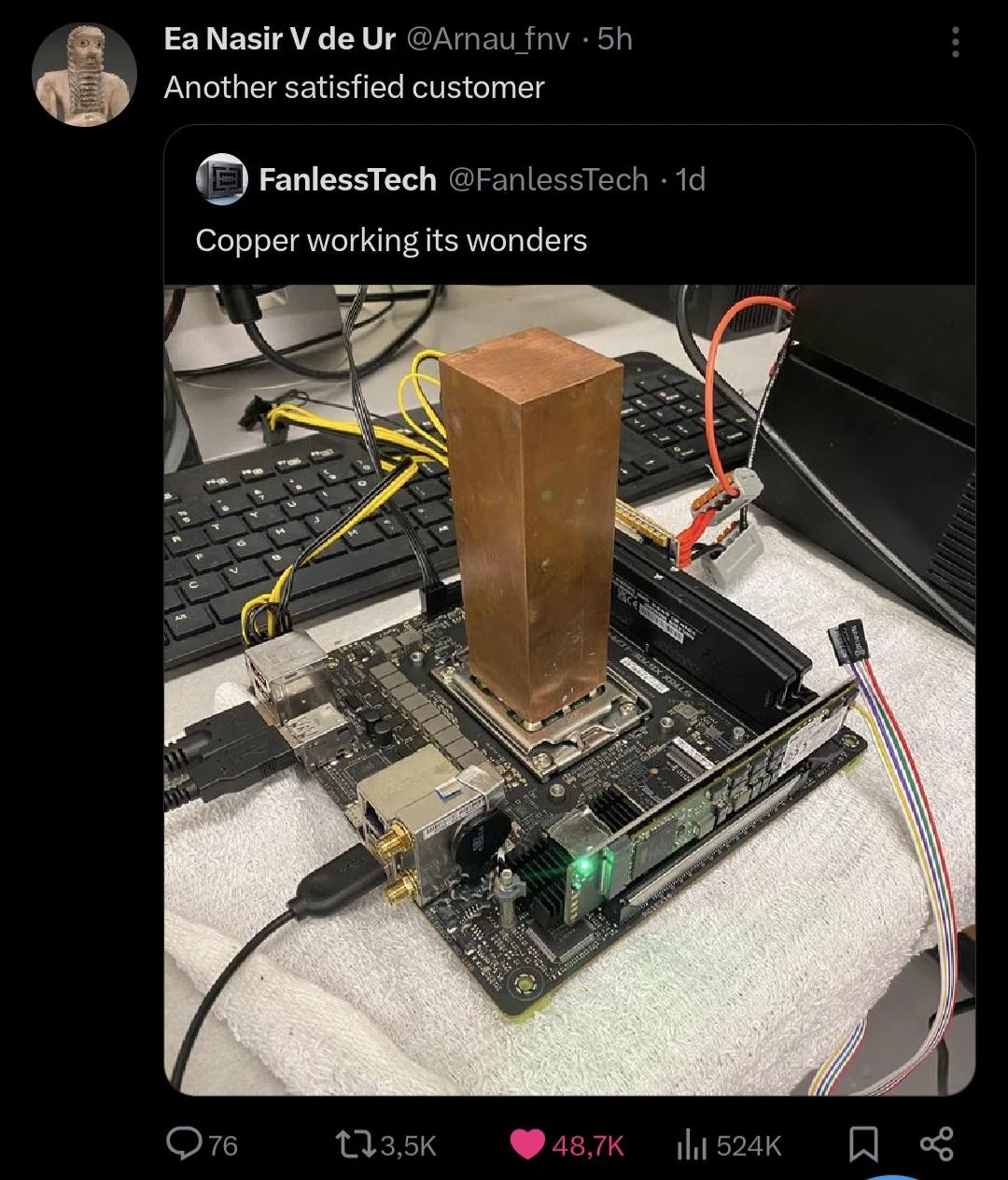
I hear this is what the inside of those flock cameras contain.
A place to share history memes!
Rules:
No sexism, racism, homophobia, transphobia, assorted bigotry, etc.
No fascism (including tankies/red fash), atrocity denial or apologia, etc.
Tag NSFW pics as NSFW.
Follow all Piefed.social rules.
History referenced must be 20+ years old.
Banner courtesy of @setsneedtofeed@lemmy.world
OTHER COMMS IN THE HISTORYVERSE:
I hear this is what the inside of those flock cameras contain.
And free meth.
Bro is flaunting their wealth. TWO whole sticks of RAM.
Copper is actually ~25-250X leas efficient at transferring heat than a heat pipe and convection is hundreds of times more efficient than radiation at transferring heat and the fins on a heat sink would have hundreds of times more surface area for dissipating heat all that is to say this might work but it would be orders of magnitude less efficient than a standard heat sink.
But without this ridiculous heatsink, we never would have gotten the most perfectly nerdy Lemmy post.
And to give it credit, I think this design wins for how much heat you can sink into the heatsink itself before you need somewhere else to put it!
It might? The only thing is that Heat pipes still transfer heat faster than copper and the air from the fan moves the heat faster than it travels through the copper, the only question is is that enough faster to make up for the speed it takes to transfer the heat from the fins into the air that is all technically radiative and thus slow but it's only hundreds of times slower and as I already said the heat sink would be orders of magnitude faster so I doubt it.
Oh I don't doubt that it would suck at it. It would just hold a lot of the heat within itself, eventually, lol.
Heat pipes are fucking magic and you can't convince me otherwise
PHASE CHANGE IS LIFE
I am in my 40s and almost every day it still pops back into my head how freaking amazing it was in high school chemistry watching water in the beaker above the bunsen burner stay the same temperature while all that damn energy went into the phase change.
I also have a pond in my back yard as a hobby. The ice has pretty much all melted now, after a lot built up during the very cold weather we had a while back. But holy hell, I started up the waterfall pump while there was still ice in places but water could flow. I had big slabs of ice that were in MOVING water and did not melt for DAYS because the water was almost the same temperature. It looked wrong, but the energy just wasn't there to do otherwise.
Looks nice. Why they don't sell PCs with cooling like that? What are the downsides?
I would guess that the low surface area would lead to problems. At first it would cool very well because of the huge thermal mass, but once it reaches thermal equilibrium the cooling would be quite weak.
I'd also think moving your PC will rip your CPU right off the motherboard
The trick is not to move the PC, but rather the copper block, which just happens to have a PC attached to it.
So, you're saying that putting blocks of copper on everything in a PC will automatically shed unnecessary parts, building a more efficient system?
So we need more copper?
Yes! The only way to increase the surface is to build a higher tower!
lead to problems
We're talking about copper, dumdum.
Do you have any idea how expensive a solid block of copper that big is?
If that block is roughly 4.5cm x 4.5cm x 25cm then the volume of it is about 500cm³ which translates to 4.5kg of copper. At 11€/kg that makes about 50 euros.
Cheaper than some noctua coolers.
Would you even notice, after buying the ram and storage?
Yes but you save on manufacturing.
I have a micro ATX case that itself is the cooler. Heatpipes transport the heat to the case walls and they have fins to increase surface area. It can handle up to 65 watt CPUs.
It's not produced anymore. But with all the talk of the Gabecube I've been itching to make a new build with it. Unfortunately I have neither the money or the energy.
Weight, cost, and it's probably not effective for the long haul. The mass of a copper ingot like that will work like a heatsink, but it has a very low surface area for the energy it can absorb. So it'll heat up to a point that is uncomfortable for the CPU, then fail to radiate that energy out to the air effectively.
As a test-bench temporary heatsink, this is actually kind of inspired. No fans, to fussy clips, just stack a copper brick on the CPU, run some benchmarks, and then turn it all off.
My guess is that will only work until it saturates with heat. Some liquid cooling setups are also like that, where the rad isn't capable of dissipating heat fast enough to prevent the whole thing from overheating, but it'll work fine for a while because the loop itself can absorb a bunch of heat before it stops being able to take any more. Then they probably blame the chip maker for running too hot even with liquid cooling when their liquid cooling setup is actually less effective than the stock cooler or their case has horrible airflow and would choke any size or number of rads. But their reservoir acts as a heat buffer, so it takes 30 mins to even realize that, but they've already concluded it works.
Incredibly unwieldy. Real quick estimate of volume puts that at around 1.75kg of copper, so it wouldn't be possible to mount in a vertical PC case orientation (ie the majority of consumer PC cases) without significant (expensive) modifications to both the mobo socket mount and the case, else its weight would snap the motherboard, or just slowly flex it until traces failed.
It may not even be able to be used vertically like that for very long or it will compress and damage the CPU / socket / mobo. Just as an example, the weight limit of the thermal solution (HSF/water chamber heatsink/etc) for socket LGA 1700 is 950g.
This is a lot easier than running a line out to the swimming pool.
Am I blind? What's that card in the PCIE slot?
Looks like a PCIE to NVMe. You can see a short M.2 slot on the board, but that drive is wayyyy too big for it