You say "give me xyz.com" it looks up what the IP address is for that domain so your computer can request it.
this post was submitted on 06 Jul 2026
31 points (91.9% liked)
Explain Like I'm Five
21651 readers
98 users here now
Simplifying Complexity, One Answer at a Time!
Rules
- Be respectful and inclusive.
- No harassment, hate speech, or trolling.
- Engage in constructive discussions.
- Share relevant content.
- Follow guidelines and moderators' instructions.
- Use appropriate language and tone.
- Report violations.
- Foster a continuous learning environment.
founded 3 years ago
MODERATORS
DNS is like a phone book for the internet.
Computers on the internet have IP addresses which are numbers like 104.26.9.209. Nobody really wants to remember dozens or even hundreds of those so we also give them names like lemmy.world which are a lot easier to remember. DNS is a service that you can ask "Hey, what's the IP address for lemmy.world?" and you get a reply like "You can reach lemmy.world under 104.26.9.209, 104.26.8.209 and 172.67.71.35. You may remember those for 256 seconds. After that, better ask me again in case they have moved."
In reality, it's a tiny bit more complex. For example, you can ask for different kinds of information, not just IP addresses and DNS servers talk to each other to efficiently distribute changes across the internet.
It also allows the numbers to change at any time, since it updates a lot faster than a phone book.
Yes. That's why DNS has a TTL (time to live) in seconds in every response which specifies how long you should remember it before you ask again. The 256 seconds in my example are the real TTL that I got when asking for lemmy.world.
A five year old has never heard of a phone book, let alone seen one. You've just expanded the problem without solving it.
That's why I didn't end it with the first sentence and instead dedicated a whole paragraph to what you do with it: you know a name and want to know the corresponding phone number / IP address.
tiny bit more complex
Understatement of the year !
DNS itself isn't that complex. We can ask for multiple things (A, AAAA, MX, NS, TXT, ...) and servers form a hierarchy so not everyone has to directly talk to the server that has authority over a domain. Maybe add DNSSEC if you feel fancy. That's about it.
The complexity comes from actually running these things at an enterprise or even global scale. Giving out different replies depending on who asks so everyone can contact a server that's geographically close to them. Load balancing between multiple nameservers. Aggressive caching. Failovers. Rights management. The reasons why DNS is the culprit for so many outages are a) the complexity we have layered on top of a relatively simple protocol and b) a lot of other stuff relies on DNS so problems spread super fast.
Oh yeah I'm well aware of DNS,. But I remember an article raising the alarm about the ever increasing complexity of the code behind it, and the progressive loss of knowledge due to it being a very old protocol.
I'm with you on the increasing complexity of code. That goes along with what I said about enterprise and global scale.
But loss of knowledge? Really? DNS is not some arcane knowledge limited to an inner circle who was there when it was invented. You can literally read RFC 1034 and RFC 1035 and know everything you need to build a basic working DNS server or client. The concepts are literally taught in every university course about networking because they are that important.
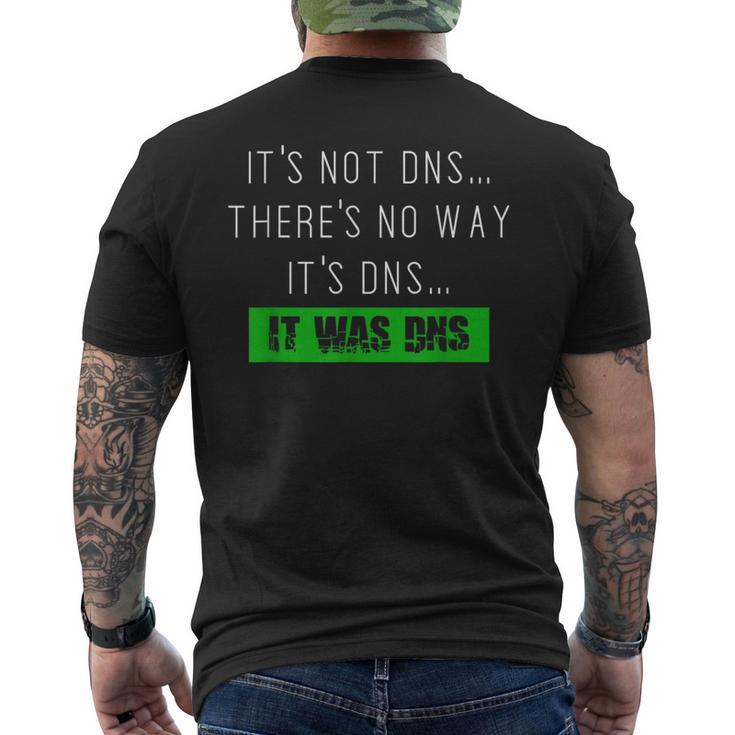
It's the reason every outage is always DNS.
It's not DNS I'm pretty sure.
Turns out, it was DNS
isitdns.com
It may also be worth adding, this is done because computers work in numbers, and do not inderstand what a "lemmy.world" is at all, but they understand "104.26.9.209" just fine.
That's not true though. Your computer understands "lemmy.world" just as much or as little as "104.26.9.209". If it couldn't handle a string of letters, it couldn't ask a nameserver for the corresponding IP address either.
Explaining why we need IP addresses would include the ISO/OSI layer model, fixed size DEST fields in IP packet headers, subnets, routing techniques, BGP and a lot more.
I could explain all that but it would take hours even when talking to someone who has a rough understanding of network technology and probably days when talking to a (virtual) 5-year-old. In the end it boils down to "Using numbers is more efficient" not to "Using names is impossible" and that must suffice for an ELI5.
104.26.9.209 is a bunch of 8 bit numbers. Lemmy.world is a bunch of translation from ascii to numbers to something meaningful. It directly understand 01101000000110100000100111010001 as on off electrical signals.
And your point is? Yes, everything on a PC is a list of numbers. That alone doesn't make an IP address (four 8-bit numbers / one 32-bit number) inherently more meaningful than the ASCII representation of a domain name (eleven 8-bit numbers in the case of "lemmy.world"). The mapping between a letter and its ASCII code is literally one of the most basic things a computer does.
The advantage comes from IP addresses having a fixed length, from IPv4 addresses being relatively short overall (IPv6 is 16 bytes which is about the same as many domains) and from prefixes being used for routing so you don't need a directory of every single IP address at every router (roughly analogous to country and area codes in phone numbers). None of that is relevant for understanding DNS and none of it means that computers don't "understand" text.
Edit to fully illustrate my point: IP addresses could just as well be strings like "de/hetzner/falkenstein12/rack42/server23". That would work. It would take up a lot of memory and be much slower than what we have but it would absolutely be possible to build a version of the internet that uses that instead of opaque numbers. And it would still need DNS on top because nobody wants to remember (or even know) where a website's server is physically located.
To be fair, I don't think most of us understand what a lemmy.world is...
phonebook for internet
Age bracket identified.
"what's a phone book?"
It's like the contacts app in your smartphone where you keep the phone numbers of people so you don't have to remember them. The main difference is that a phone book has lots and lots of people so you can look up numbers for people you have never met. We used to get updated versions as printed books every year or so. These days, they still exist as apps or websites.
My brother-in-law is 10 years older than me and he was trying to explain to his kids what dial-up internet was like and what it actually was. We covered the speed and the sound and he mentioned it was internet over a phone line. I had to remind him "they don't know what a 'phone line' is!"
DNS = Domain Name System
Computers talk in computer language. When they need to contact one another, they use an address to find each other, like we use addresses to find our homes or businesses on a map. Theirs is called an IP address, or Internet Protocol address. It's a series of numbers (and sometimes letters) that computers recognize as an address on the Internet.
But to humans, IP addresses are complex jumbles of numbers and letters. If you want to go to Google's website, you might type in one of their many IP addresses (e.g. 216.58.198.46, or 2a00:1450:400e:808::200e), but how are you ever going to remember all that nonsense? And for every single individual website?!
Instead, you can remember a simple little URL, or Uniform Resource Locator, that's quick and easy to recall: google.com.
DNS is a process that keeps track of all IP addresses and their associated hostnames (or URLs) and will translate between the two of them on the fly. For example, you tell your computer you want to go to amazon.com and DNS will tell the computer to track down 98.82.161.185.
TL;DR - DNS translates between human web addresses and computer web addresses, so us humans can communicate with our computers and receive information from across the Internet.
Bonus: Google secured a very simple IP address long ago, so even humans can remember how to find them: 8.8.8.8. I worked in an IT field for 20 years, managing a DNS server (along with dozens of other servers and thousands of personal computers). If the DNS server ever went down, we'd use that simple IP address to get to Google's website so we could search for answers while troubleshooting. To this day, it's the only public IP address I still remember.
To add to 8s, there's also Cloudflare at 1.1.1.1 and quad9 at 9.9.9.9
lol. back in the day I had to configure my dial up internet by hand Everytime. still remember the dns server
202.54.1.18
you have an address: city, street number... you could give to people the gps coordinates for it, latitude and longitude, but it's easier to use the address.
In the same way, computers on the internet have an ip address, such as 192.168.1.1, but it's easier to use a domain such as hello.com
DNS is the service translating between domains and ip addresses. Since it can store some information, it's also used to verify things for example for emails.
computers on the internet have an ip address, such as 192.168.1.1
Except computer on the internet specifically do not have an IP address such as that one.
Does not really matter for the explanation. Also you can still set up DNS for it.
It's like the Squid Game challenge where the team has to cross a bridge and they don't know which plate is safe and which will break. When a plate breaks, it turns out to be DNS.
that is amazing
A DNS server translates between addresses and hostnames. It makes it possible to tell a program to connect to example.com, and DNS translates it into 104.20.23.154
I don't think pointing to a Wikipedia article without further explanation is in the spirit of ELI5.
I know, should have just left it. but there is an amazing amount of information already out there
Yes, but that's not the point.
ELI5 means Explain Like I'm 5 [ys/o]. It's not meant to be an info-dump, it's meant to be a basic explainer for someone who is interested to know about a specific thing, but has no knowledge of the surrounding subject matter.
Would you point a 5 year old to a wikipedia article and tell them to read up about DNS's. No, you'd explain it to them in terms they understand.
ELI5 means Explain Like I’m 5 [ys/o]
Damn, now I'm seriously thinking about making an "Explain Like I'm 5 [Goblins in a Trench Coat]" community over on ttrpg.network.