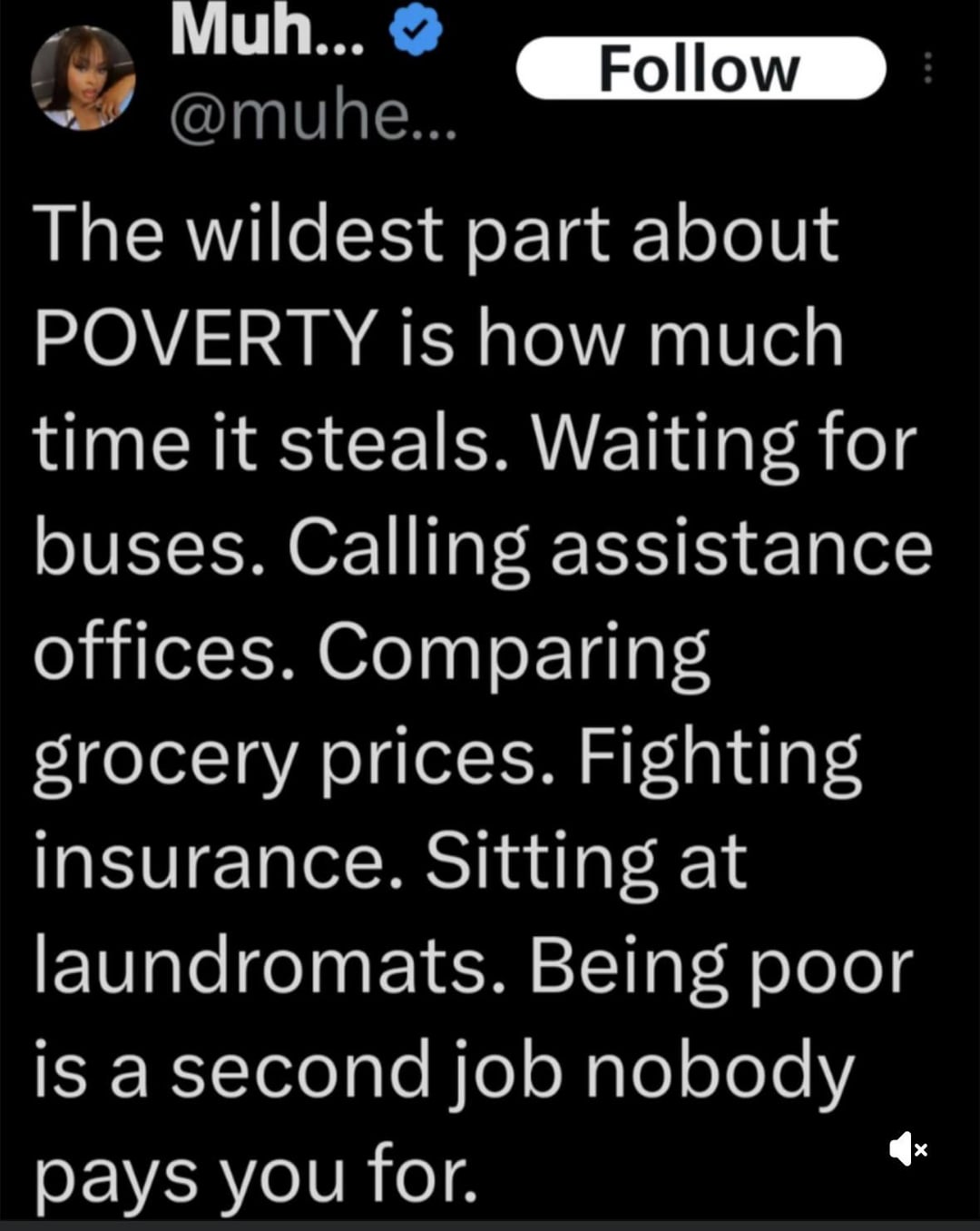
Literally why wealthy people pay exorbitant amounts of money to save time. It's one thing they can't buy back once it's spent.
A place to discuss positive changes that can make work more equitable, and to vent about current practices. We are NOT against work; we just want the fruits of our labor to be recognized better.
Our Philosophies:
Our Goals
Literally why wealthy people pay exorbitant amounts of money to save time. It's one thing they can't buy back once it's spent.
For the laundry stuff, this is a cheap solution for your day to day stuff: a washer spinner that you hang-dry your clothes. Doesn’t help much with heavy stuff like bed sheets, but it'll do for day-to-day stuff.
Not exactly the tweet, but dropping this again here because of the title.
The reason that the rich were so rich, Vimes reasoned, was because they managed to spend less money. Take boots, for example. ... A really good pair of leather boots cost fifty dollars. But an affordable pair of boots, which were sort of OK for a season or two and then leaked like hell when the cardboard gave out, cost about ten dollars. ... But the thing was that good boots lasted for years and years. A man who could afford fifty dollars had a pair of boots that'd still be keeping his feet dry in ten years' time, while a poor man who could only afford cheap boots would have spent a hundred dollars on boots in the same time and would still have wet feet.
This was the Captain Samuel Vimes 'Boots' theory of socio-economic unfairness.
Fun napkin math fact: If we divvied up the top... 5 wealthiest billionaires net worth... that'd get every living man, woman, and child on earth a cool $250 ish.
Sure - its not very much but it certainly does make you think. What if...
The idea of wealth redistribution is in stripping power from the very rich. If you are rich, you influence politics in a way that benefits you by not caring about others.
The problem with Bill Gates' poly vaccine in Africa is not in the fact that it didn't save children, in fact it did. The problem is that measles takes more children's lives in Africa by an order of magnitude and measles vaccination would've saved much more.
Now add to the picture the recent decisions: internet surveillance (age verification), ignoring the Paris agreement, data centers built everywhere. I guess a lot of people would oppose these, but their voices are not heard.
I mentioned this a moment ago as a different reply but your observations are all examples of a feedback loop perpetuating itself. Its certainly correctable. This isnt the first time it happened nor will it be the last. Its a product of some of the uglier parts of the human condition.
Absolute power corrupts - and those in power will not only seek to keep that power bit increase it. They consolidate it. Less people with power: less opposition. But this has diminishing returns... and has reset trap baked in. How? Numbers. Power moves people. As you concentrate power - you have less people to move and more people opposing that movement.
1 billionaire, 8 billion people. What do you do to maintain that power? Surveillance. Draconian rules. Control the narrative and paint yourself as necessary. The power dynamic is reaching a tipping point. Unrelated: I recall there seems to be an uptick in bunkers being built by the ultra wealthy. Puzzling.
Sound familiar? It should. History is littered with example after example.
The system breaks in the same way - every time. These aren't deitites - they aren't special. They are just another meat bag running on 80% lizard-brain firmware that is purely focused on ITS survival alone. In the end these twats engineer their own destruction. Now, while the all for one trait certainly is consistent in its consolidation of power: it still consistently maintains its loss record to the group. I'd like to think of that as an immune response to a foreign entity. In a weird way that sorta gives me hope.
Why not divide up ALL of their wealth?
And that's not at lot...for people in the US, like a month of groceries for 2 adults. Not touching other actual bills.
But in developing countries, $250 could rival a large percentage of their monthly wages.
250 USD is in my country about a daily wage of high-level specialist, I mean - top 5% of people who live from working.
63 USD is a minimal daily wage in my poor country.
Many workers get paid the equivalent of $120 a month or lower
Money and value are interesting topics. Many of the oddities surrounding expense vs need exist as a result of scales being unfairly influenced. Billionaires aren't the root of the problem - they are the symptom of the problem. If billionaires didnt exist: that would likely be because wages, costs, and services are more fairly balanced. Less disparity - less resources to leverage to create it... and likely a much higher cost to apply that leverage. We are simply in a feedback loop in a sick system. Cancer doesn't just go away with thoughts and prayers.
Waiting for busses isn't a poverty problem, it's a policy problem.
It's both.
In fact, poverty itself is a policy choice of forced deprivation.
Same with being disabled, growing up I thought disabled people just got helped by everyone in society with everything. Turns out most of the time it's "do what you were doing before except harder."
Waiting for buses and other public transport especially. In college I had no car and continued working a part time job that I previously borrowed my parents' car to commute to. My options were: spending an hour and a half to commute taking a bus with a reasonable schedule but I'd have to walk over a mile alongside a busy road to my job, or spend three hours to commute due to how two route schedules matched up to drop me off at the entrance to the shopping center.
Each of those options was one way, and this was before smart phones. I wasn't getting anything done in that time besides listening to music and maybe reading a book while on the bus itself.
And then I learned that on Saturdays, over half the time the bus just didn't fucking show up at the stop where I got on, and the support phone line would just fucking lie about it.
Plus, if I had a vehicle, the commute would have been only 20 minutes in bad traffic.
Will say, the regular distance power walking helped keep me in great shape though.
Ive run into this too. How many times Id just walk to work for the 1.5hours instead of taking the bus that took just as long, but would drop me off at work either 2hours early, or 15mins late. so Id just walk it.
It was glorious the day I finally got a bike.
I wonder how infrastructure would change if companies were required to reimburse valid claims of mileage or time spent (not the bus/train fare, but paying your wage for the time spent to get to work).
While the intent is good, as written it would probably have the unintended consequence of making it harder to get a job if you happen to live far away from the workplace, which I don't think is the way to go
I knew as I wrote it that it would be far more complex than just setting a single law down. But the fact that such cost of time and money just to get to work exists suggests the burden isn't balanced well. The case you mention of distance to a job is more a symptom of the problem of not being more localized for everything. Not just an American problem, but definitely something we deal with outside of a few major urban areas. A pay adjustment doesn't fix that, it just is a rough patch that wouldn't work for some.
In all honesty I think it's connected to the housing crisis bleeding into basically every other political issue, because of how damn massive of a problem it is
I don't know your distance for commuting. But I consider the bicycle the most superior form of commuting for distances below 10 miles(16km) (personally would even cycle more than double that).
It's even cheaper, keeps you healthy and often is even faster than a car, considering parking, traffic lights/jams etc.. I also enjoy doing that so another advantage.
Depends on geography
In a more mountine town ive lived in with a bike you can be very fast downslope
Upslope?
20 min for 2km and you will be sweaty as hell at the end
10 and sweaty as hell if you are fit
Yeah plus most jobs don't like you showing up dripping and smelling like a varsity locker room.
My locale even tried to build in employee showers to encourage bike commuting, but it hits 110⁰F outside and there's not a cloud in the sky, like LOL dudes you gotta be kidding.
I'd love to live in a place where the humble bicycle was viable beyond recreation.
I can recommend a cooling west for these cases. They are quite effective on the bicycle (moving air enhances the effect). I usually don't care much about a little bit of sweat, I just turn the ventilation on max then at my office. We even have a shower, but never used it... I think sweat is overrated and often an excuse to not cycle...
Being poor is super expensive. When you don't have enough money in your bank account they'll charge you a monthly fee. When you're too poor to have an account, you have to go to a check cashing place and pay to get paid. Too poor to have awesome credit? You have to pay higher interest fees and larger deposits.
This is what I point out whenever someone tries to tell me, "The only fair thing in life is everyone gets 24 hours in a day."
That doesn't mean shit when someone with a private jet can be on a different continent in hours.
Being poor is as close to being next to the wilderness that there is, other than homeless. None of the infrastructure we build is usable for them to be safe from the simplest threats of nature, like extreme temperatures, or bad food. Being that close is a struggle just to stay afloat.
