this post was submitted on 06 Mar 2026
1381 points (99.4% liked)
Climate
8407 readers
943 users here now
Discussion of climate, how it is changing, activism around that, the politics, and the energy systems change we need in order to stabilize things.
As a starting point, the burning of fossil fuels, and to a lesser extent deforestation and release of methane are responsible for the warming in recent decades:
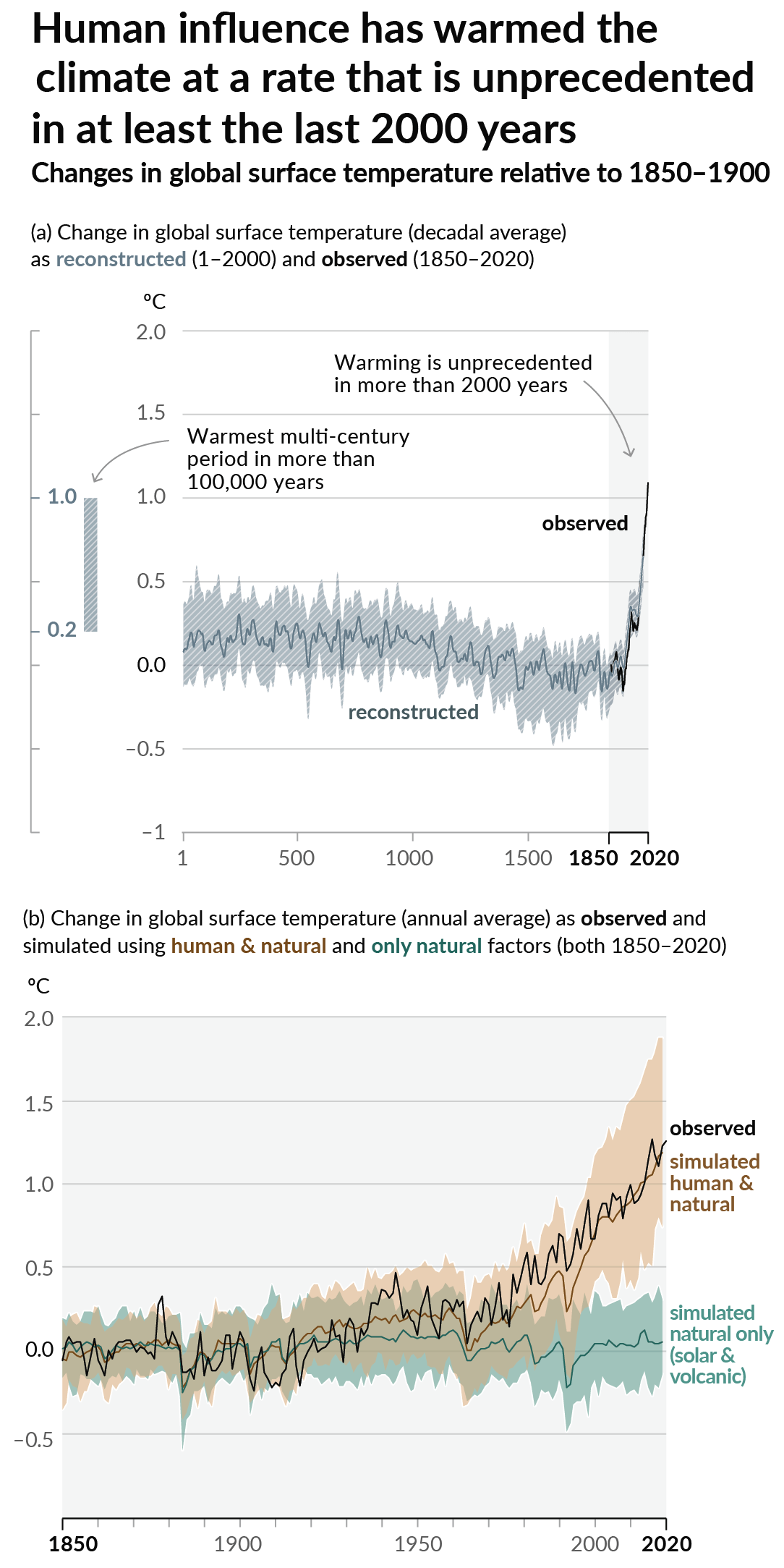
How much each change to the atmosphere has warmed the world:
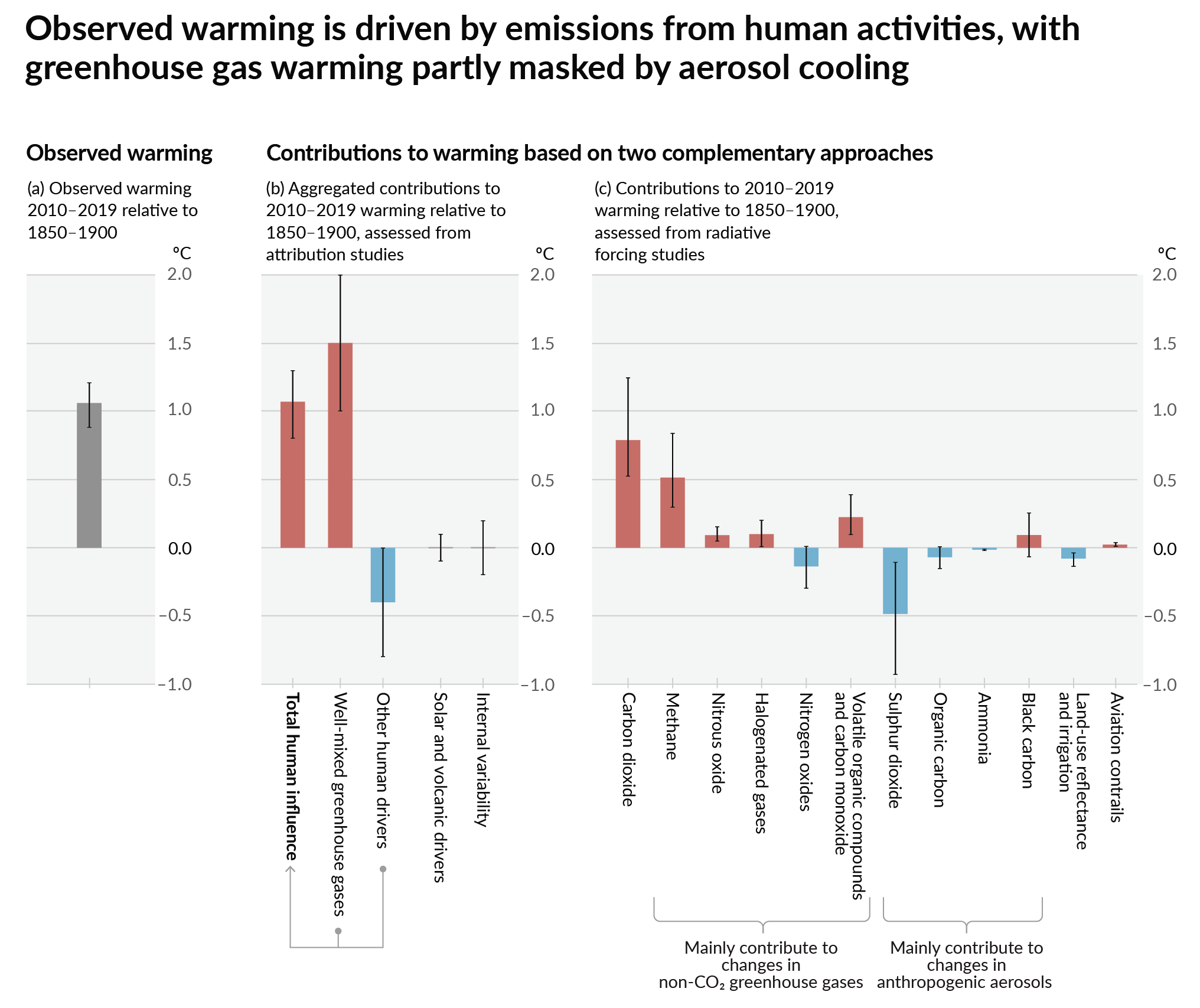
Recommended actions to cut greenhouse gas emissions in the near future:
Anti-science, inactivism, and unsupported conspiracy theories are not ok here.
founded 2 years ago
MODERATORS
you are viewing a single comment's thread
view the rest of the comments
view the rest of the comments
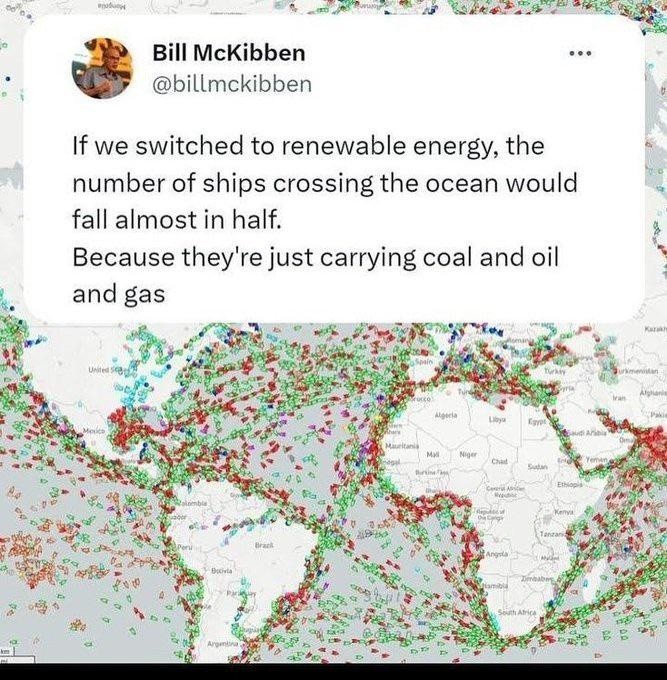
That really depends on what you will run all the remaining ships. Current battery technology isn't suitable for large container ships, sails work for smaller ships. There are ideas to use ammonia as fuel for large ships, and it won't be made were it is consumed, countries like Namibia are planning on becoming large suppliers of ammonia. If this comes true you'll get 40% of all ships just carrying ammonia around the world.
I think you missed the point. The idea is that almost half of shipping is getting around fossil fuels, so we can slash shipping emissions by reducing fossil fuel use.
Ok sorry I will be that guy.
At the outset, let me say renewables are the end goal and the best outcome.
That said there are a number of problems with this approach. This chart doesn't define what 40% it's talking about. Which is actually impossible because metrics in shipping are considered different for different types of ships and trade. I assume this map/post/thing about deadweight tons (DWT), which is the metric you judge liquid and sold bulk goods. For containers it's TEU (twenty foot equivalent units), for offshore vessels it is often but not always bollard pull, for cruise ships its passenger to crew ratio, etc.
Also the original poster may be referring to total tonnage by metric X (dwt, displacement, raw number of ships) or some other unknown metric)
But let's assume this is a good faith argument. In terms of bulk commodities, it is probably true that nearly half the fleet by deadweight is shipping coal, crude, refined products, LNG/LPG. But that is an effect of the size of ships one uses to transport such commodities - they are always very big ships even though there are far more many smaller ships in terms of raw numbers.
And in any case the problem is demand. If people want cheap shit from China and cheap oil from the Gulf, someone is going to ship it. Renewables are the way forward, but if you want to transport a lot of stuff or a lot of people that you cannot transport by rail, planes and ships are the answer. No other source has the energy density of petroleum to ship stuff.
Somewhat ironically, per ton-mile (i.e., how much stuff you can carry per mile), shipping is by FAR the most efficient way in terms of energy consumed. The pollution from ships is horrible, even changing certain weather patterns in the N Pacific, but as long as we have the demand, it will exist.
Mærsk is testing wind and electrical power on their fleet. Won't make the ships 100% self-sufficient, but will hopefully lower the impact of the vessels.
Flettner rotors can cause fuel reductions of 10-20% [source]. Definitely not nothing, but you still need some way to fuel the ship, those rotors don't turn on their own and are AFAIK not used as main propulsion.
I've heard of these things called "sails". Maybe they could look into those.
those are sails, they're just weird
They work. However they are a lot slower - by enough that no shipping company can compete using them. I'm not clear on if they scale to the size of modern ships either.
Pretty sure they don't, at least not as a total replacement. Reducing fuel usage is still a possibility maybe.
They 100% work - just as well as they did in 1700. The slow speed means nobody will use them exclusively. I'm not sure if they need extra labor as well (assuming modern controls) but that is another potential reason nobody would use them. They couD though.
Old sail ships could get stuck for days without wind.
They did not mean the ships become green energy ship, they meant the ships would no longet be sailing at all because we don't need to ship the coal etc.
Also, brrak the larger ships down into several sailing ships. Infinite small sailing ships would be more green than one large fuel burning ship.
And infinite small sailing ships could all simulatenously dock at our fractal infinitely long shorelines, all unloading their infinitely small cargo at the same instant, simultanously flooding the earth with infinite amounts of oil and zero amounts of oil that we wouldn't notice at all. :)
i mean, i don't deny that making ports bigger and able to handle more ships (with more infrastructure and people working the ports) would help alleviate some of the problems we're seeing, but it's the whole building more lanes on the freeway problem. build a bigger port and it'll fill up with just as bad traffic
Put mathematically, when we cut fossil fuel usage by 10%, it will result in 4% fewer cargo ships. When we reduce fossil fuel usage by 50%, it will result in a 20% reduction in cargo ships
40% of 60% of all current ships is still a lot less than 40% of 100% of all current ships.
Also there are sail assisted cargo vessels.
Needless to say, there is a lot of room for easy, quick, and achievable today improvement.
nuclear
Several countries already refuse to let nuclear ships into their ports. Also considering the state of some ships (look at Russia's shadow fleet for example) I'm not so sure it's a good idea to have them be powered by nuclear reactors.