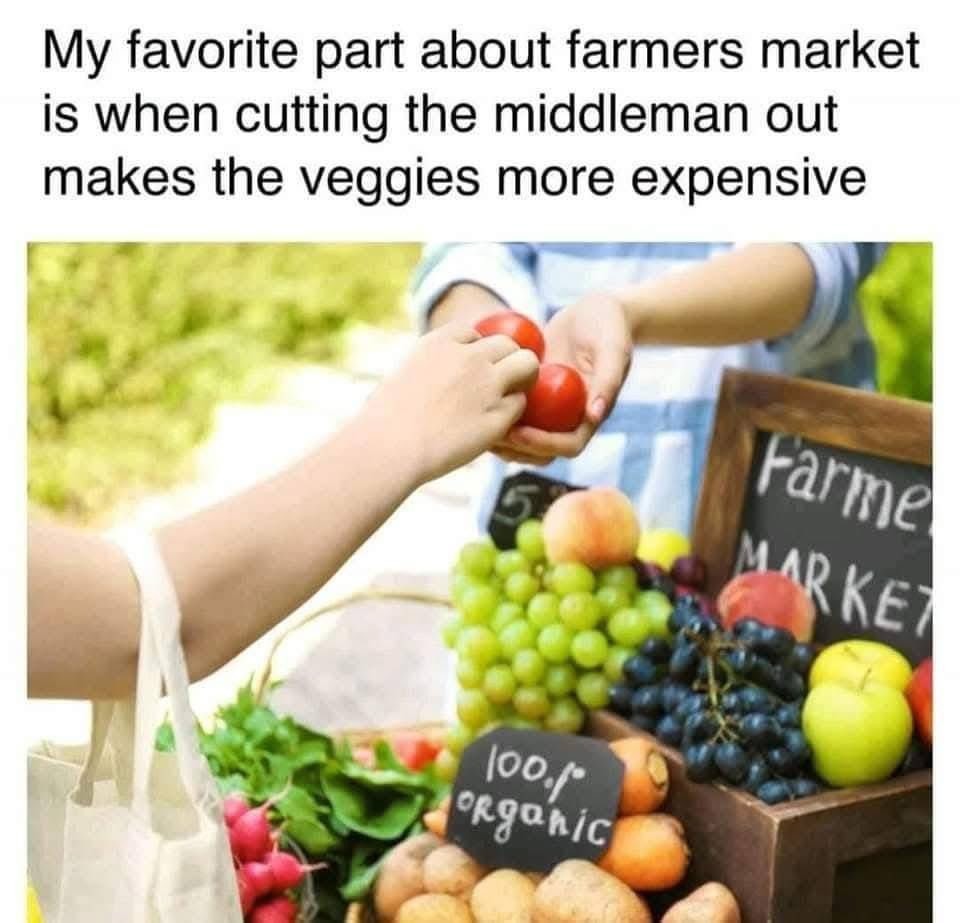
Nonsense my local farmers is 1/3 price of supermarket and last for 2 weeks in fridge ie is fresh.
1. Be civil
No trolling, bigotry or other insulting / annoying behaviour
2. No politics
This is non-politics community. For political memes please go to !politicalmemes@lemmy.world
3. No recent reposts
Check for reposts when posting a meme, you can only repost after 1 month
4. No bots
No bots without the express approval of the mods or the admins
5. No Spam/Ads/AI Slop
No advertisements or spam. This is an instance rule and the only way to live. We also consider AI slop to be spam in this community and is subject to removal.
A collection of some classic Lemmy memes for your enjoyment
Nonsense my local farmers is 1/3 price of supermarket and last for 2 weeks in fridge ie is fresh.
You know, some of them were just reselling grocery store stuff as their own.
I went to the co-op the other day, and they don't even stock mostly local any more.

i never even considered this. ugh.
It's wholesale vs retail. Not really a mystery.
It is indeed a mystery for those who never learned about economics.
It's because there they can sell them what they actually cost to produce instead of being forced to sell at a loss by the food industry.
That's not an incentive for people to shop there. Grocery store prices are already bad enough. No one wants to pay extra money for a more limited selection.
It is an incentive, just not price. People can choose to support a food system that provides a better living, less environmental damage, and other priorities. More people could choose that if they had more disposable income and I don't fault people for defaulting to price when making purchasing decisions.
I very seriously mean this: source?
Im assuming this is America, which has an overwhelming abundance of arable land and food. So is there any real data that backs up what you're saying? This is always the traditional excuse for farmers markets being overpriced relative to grocery stores, but they were not always from my pov. So: source? What should a tiny thing of strawberries cost?
Farmers aren't selling at a loss to companies in 99% of circumstances.
Every year, I buy a farm share. My farmer gets his money for the year up front; he doesn't have to borrow from the bank and he doesn't have to worry about losing the farm if it's a bad harvest. He gets to focus on growing stuff.
In exchange, every week during the growing season, I get 3/4's of a bushel of just-picked vegetables. Some are rare heirloom varieties you generally don't see; some are items you don't see much of at all; and everything is fresh and lasts much longer than store-bought would've.
That's an awesome suggestion. How does one do this? Are there a national registry?
Agressive takeover. You come to a farm with a suitcase full of cash and threaten the farmer's kids and wife. You force him to take the money and when you leave, make sure to point a finger at him and say "I'll be back next year to buy another share. I own you now!"
"Those are some nice vegetables you got there. Truly would be a shame if someone snuck onto your field every night and took a perfect cartoon bite out of every single one..."
It's generally called Community Supported Agriculture [CSA]; you should be able to Google "CSA near me" for results. You can also check localharvest.org , but sometimes their info is out of date or takes searching through. Like, a number of CSAs have drop-off points outside the farm that may be closer to you than the farm itself, or they may be willing to bring shares to a local farmers market that they're selling at, etc, and Local Harvest tells you where their main farm is :(
Each CSA makes their own rules. Some places will give you a pre-filled box; others will let you pack your own box and choose between options ("Take any combination of 2: eggplant, zucchini, squash"). Some offer different size shares, others offer shares for half-seasons, or for 10-12 weeks and you choose the weeks. Some offer work-shares: you volunteer at the farm for a few hours each week, and you get a box of vegetables in return.
Many will also let you do some pick-your-own each week: often these are either excess vegetables (extra PYO tomatoes and peppers are common); are more labor intensive (blackberries); are things that not everyone wants (okra); are specialty items grown in smaller quantities (ground cherries); or are items where personal choice really matters (flowers); etc.
Most farms include some fruits with their vegetables; I've had three local CSAs (one couple retired, another was a bad fit for me) and I've gotten raspberries, blueberries, blackberries, strawberries, cantaloupe, honeydew, pumpkins, watermelon, apples, figs, pawpaw, and Asian pears.
They may also partner with other local farms to offer other local goods: locally grown grains, honey, eggs, meats, mushrooms, etc. They may have an end-of-season gleaning. Many will have some kind of (paid) community meal during the season, and many also provide produce to local [food banks / shelters / community kitchens / etc].
I will say that it's a commitment, especially if you get the full season and full box share. The first month can be hard, as it's a lot of leafy green vegetables, and eating half a bushel of green leaves every week for a month is a challenge. Over time, I've developed a set of recipes that let me cook whatever's in season and preserve a bunch of stuff for the winter; and methods to deal with stuff that I get too much of too quickly.
So in June I make lettuce soup; it's decent enough (not great), but it's a fantastic way to use up lots of leafy green stuff when I get tired of salads and stir fries and frittatas, and I can freeze it. Bunches of onions here made into French onion soup and frozen; excess hot pepper gets made into pepper flakes or my own hot sauce; tomatoes become marinara or tomato paste and frozen, or salsa and canned.
I usually sit in front of the tv watching stuff for an hour or two while I slice and dice and chop; and then I spend a couple hours cooking. Half of whatever's cooked goes into the fridge for the week, the other half gets frozen for winter meals. Anything not used in a dish either gets put into a salad for the week, bagged up for snacks, or frozen to be used as ingredients for later meals.
My freezer currently contains: French onion soup; eggplant Parmesan; pizza; seven-layer casserole; vegetable pot pies; lasagna; stuffed tomatoes and stuffed peppers; zucchini boats; pumpkin pie filling and sweet potato pie filling (just the filling, the pies are too bulky); zucchini bread; butternut squash bread; butternut squash soup; marinara; pesto; garlic confit; blueberry pancakes; strawberry muffins; raspberry jam; quiche; burritos; etc. My goal during the season is to do something with all the food that comes in (my starving Irish ancestors would never forgive me for wasting food!), and my goal during the winter and spring is to eat through my freezer so that it's empty when the next season starts.
So you are one of touse evil investors buying food futures then!111!?
evil cackling intensifies
I'd rather pay higher prices to my local farmer that gives me quality food than a faceless corporation that gives me shitty products that travelled 10,000 kilometers and paid every single worker along that route as little as possible.
I swear this is propaganda. I have 3 farmers' markets within biking distance of me (that I've visited regularly, there are another 2 on inconvenient days for me), in a capital city. All are cheaper than the grocery store. Yet when I tell people I do my weekly shop at the farmer's markets, they always say something to this effect. The popular opinion simply does not match the reality. There are some stalls which are more expensive, but they are usually targeting a much higher quality, and are normally prepared products (pasta, sauces, etc.) rather than raw produce.
It highly varies.
100% agree.
You mention Boston, so I will share my experience with New England. There are "farmers markets" advertised everywhere, but 90% its just a free way for people to setup stands for candles, honey and overpriced crafts. The few people who bring produce to the market often realize that there is no real demand so they can sell 500% marked up veggies to upper class wives that don't actually do any manual shopping and know what prices should be. Not to mention the difference between quality.
It depends entirely on where you live. My last place, it was a super over priced yuppie gathering spot with subpar produce. Here, exact opposite.
The popular opinion simply does not match the reality.
or maybe your personal experience is not the reality for everyone, how about that?
Maybe your experience with personal experience is not the reality for everyone, how about that?
crosses arms
The farmer's markets around me are absolute extortion rackets. That being said, I buy my vegetables from a local farm coop that is a very good deal.
There are "farmer's markets" and then there are farmer's markets. Riding your cargo bike to the once-a-week market in the urban hipster neighborhood's park to pay $5 for a tomato is not the same thing as driving out to the actual state-run farmer's market and spending $5 for a bushel.
Compare:
Buy your garbage veggies from Mal-Wart then and don't support your local CSA or local economy and don't complain when all you have left is a Mal-Wart job in a Mal-Wart economy town
my local farmers use immigrant workers on starvation wages to harvest their crops. is that what you mean by supporting the local economy?
Big box supermarkets routinely pressure producers into accepting extremely low prices so that they can sell them for cheap in their stores. It's either you accept the price or they don't sell your produce at all. Farmer's markets let producers sell their stuff at a price that allows them to live from their work
Funfact about germany:
the gov gives money to supermarkets when they buy organic products as an incentive to stock up on less conventional products.
not to the people producing it. to the supermarket.
against which we then have to compete
You make it sound like there are not also multiple subsidies programs directly for organic farmers.
In fact, the German government operates a dedicated website offering information for farmers who want to do exactly that:
https://www.bundesprogramm.de/foerderung
Additionally, federal options exist:
The middlemen exploiting the farmers and putting them in debt. Farmers exploiting immigrant labor to try to make ends meet.
It's not really hard to work out if your head isn't up your butt.
cause farmers markets are fake.
Its nothing but assholes buying shit wholesale from the same distributors that your supermarket gets their shit from (at much higher prices due to not having the super markets favor of volume), then pretending to be some salt of the earth farmer man/woman trying to get you to buy fruit and veg they "hand grew and loved".
nothing but assholes buying shit wholesale
They're not all fake. Some are. Look for local farms, know your growing seasons. The wholesalers give them so little for their crop it still makes sense for them to sell to you if you'll buy it.
Even a real farm will wholesale you strawberries out of season if you'll buy them, they just want to augment their income.
My local place labels where stuff comes from and when it's corn or pepper season, it's WAY cheaper than the local market.
This depends on your farmer's market entirely.
Plenty of the non-fruit/veg stands are also small shops trying to go somewhere with more foot traffic.
Post needs accessibility.
This comment section: people who've never cracked open an economics textbook or seriously thought about this.
Intermediaries can bring down distribution costs. It's pretty easy to see how.
Consider N farmers & M markets: that results in NM trips to distribute all their goods to every market. Add a single intermediary: this reduces to N + M trips to distribute goods. This reduces overhead costs. The farmer can sell in bulk to the intermediary. The intermediary can ship in bulk goods of all farmers to the markets. Less fuel & time is wasted transporting everything.
Partners can specialize in their respective tasks. Farmers don't need to rent booths, put their goods on display, wait there all day, or handle all the customers at each market.
If you're selling to the stores, you generally pack your produce and truck it to a central depot where they manage the shipping to the stores. If you're selling it at a market, you have to pack your truck, rent the booth, unpack the truck for display, sit there all day(or hire someone to sit there all day), then pack everything up and drive home. It's way more work and time to do a market.
I guess I just live somewhere with real farms? There are 3 weekly farmers markets near me. All of them are something like 1/2 to 2/3 of the cost, and at least triple the quality of the grocery store.