1098
google's AI moderation deleted artist's entire google account for uploading his own old manga to gdrive
(lm.kluge.cafe)
https://xcancel.com/AyakaMods/status/2057438125203296642#m
this needs to stop man
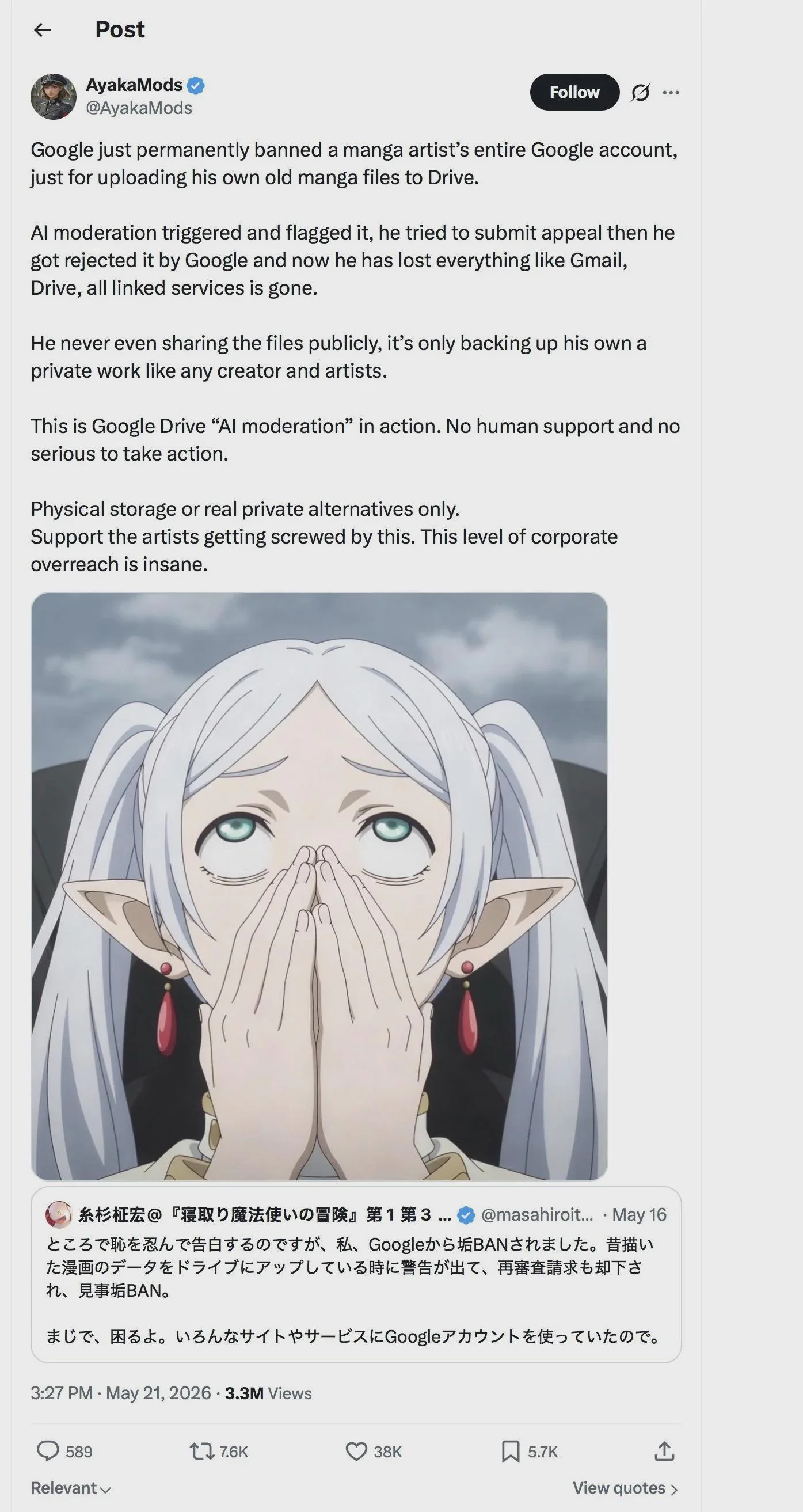
Forgive my bluntness.
...But I feel like "artist tech debt" is now a problem.
I first started complaining about it in the photography space. Basically, no one understands colorspace, HDR formats, HEIFs/JXL, how modern sensors/encoders actually work... everyone is "stuck" in a circa-2000s "crush RAW stills to JPEG, export video to mp4" workflow, like they're in a time loop. They're not even using the crazy dynamic range of modern sensors and displays, and have no clue.
But the more I look around, the more I see it elsewhere. A manga artist choosing Google Drive as their host is a great example.
I dunno what to do about it, though.
A lot of older artists are stuck in their ways. A lot of younger artists cannot afford the subscriptions they perceive they need for those workflows you mentioned.
It often doesn't work anyway!
Take HDR photography, as an example:
https://gregbenzphotography.com/hdr-display-photo-software/
The list of supported software is short, and doesn't mention caveats (like Lightroom's/Affinity's HDR editing looking wonky if you don't understand "paper white" and such). Popular "switch away from Photoshop" apps like DXO don't even support HDR, or AVIF or anything.
Some cutting edge cameras support HEIFs instead of JPEGs, but only sometimes, and not well; they'll pretty much only render right on an iPhone or Mac.
The video side is pretty greusome, too. VLog LUTs, for example are mostly to Rec709, and no workspace uses HLG by default.
I'm going a bit far here. My point is: ask many photographers about the RAW -> image conversion process, and they'll have an intuitive grasp. Ask them about SDR vs HDR, and 98% think you're talking about "HDR" multi-exposure stacking like it's 2009. 1.9% will tell you HDR is "TV nonsense."
One can navigate this software stuff if they understand the basics of HDR vs SDR, but the most basic understanding isn't even there.
This is true in a lot of spaces that have a specialized skill set. Lots of people doing things by rote without actually understanding the underlying fundamentals of what they're doing, or just cargo culting nonsense that happens to kind of work but with a lot of wasted effort or a poor quality result.
It comes up in both IT and software development more or less constantly.
That's the fault of the YouTube Effect. In color grading or video editing, for example, we have people learning from youtube tutorials on what buttons to push, but nothing about the actual science and theory behind why to push those particular buttons. You'll watch a ten minute video on "How to get the bleach-bypass look for your video" with absolutely no explanation of what the Bleach-bypass look is or when it would appropriate to use it (for example).
Most new creatives in any field have learned primarily from YouTube content creators that have themselves learned from other YouTube content creators. They're just re-recording the same tutorial that they learned it from, down and down the line. Maybe at some point down the line, there was originally somebody who went to an accredited film-school/photography school or what have you that actually understood the why of it, but for the most part it's amateurs teaching amateurs what buttons to push.
It's even more frustrating that "old" stuff (like debayering, white point and such) is often understood on a technical level, but it stops at anything new.
I guess this happens in software, too.
Tbf a lot of modern screens can’t display HDR properly, even those that advertise that they can, so when people do see an “HDR image” they don’t get it.
The HLG standard, gain maps, and honest display specifications should take care of that. But alas…
Mmh, they didn't say Google Drive was their host, but rather that they wanted to make an additional backup of their work.
Man I hate HDR, just makes my screen brighter without asking me